
2010 AMC 12A 详解
向下滚动即可查看来自 LIVE by Po-Shen Loh 的精心整理的解答,打印PDF 解答,查看答案,或参加完整限时模拟考试。
所有题目均经美国数学协会(MAA)官方合法授权使用。
1.
2.
一艘渡船从上午 点开始,每小时载游客去一座岛,最后一班在下午 点出发。某天船长注意到上午 点那班有 名游客,并且之后每一班的游客数都比前一班少 人。那天这艘渡船一共载了多少名游客到岛上?
A ferry boat shuttles tourists to an island every hour starting at am until its last trip, which starts at pm. One day the boat captain notes that on the am trip there were tourists on the ferry boat, and that on each successive trip, the number of tourists was fewer than on the previous trip. How many tourists did the ferry take to the island that day?
3.
如图所示,长方形 与正方形 有 的面积重叠。正方形 与长方形 有 的面积重叠。求 ?
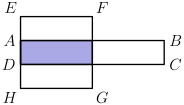
Rectangle pictured below, shares of its area with square Square shares of its area with rectangle What is
小提示:
设正方形边长为 ;阴影重叠部分的宽为 ,高为 。
Let be the side length of the square; the shaded overlap has width and height
大提示:
长方形面积的一半等于重叠面积,得 ;正方形面积的五分之一给出 。
Half the rectangle’s area equals the overlap, giving one fifth of the square’s area gives
解答:
设正方形 的边长为 。重叠部分宽为 ,高为 ,所以面积为 。
因为重叠部分占长方形面积的 ,所以 ,从而 。又因为它占正方形面积的 ,所以 ,从而 。
因此
所以 E 是正确答案。
Let be the side length of square The shaded overlap has width and height so its area is
Because the overlap is of the rectangle, so Because it is of the square, so
Therefore
Thus, E is the correct answer.
4.
若 ,下列哪一个一定为正?
If then which of the following must be positive?
小提示:
用一个负数,如 ,检验每个选项。
Test each choice with a negative value such as
大提示:
将 改写为 ;用负数作除数会使符号反转。
Rewrite as dividing into a negative number flips the sign
解答:
选项 D 为 。当 时,,所以 。
取 可知其他选项不一定为正:,,,且 。
因此 D 是正确答案。
Choice (D) is When so
Testing shows the other choices need not be positive: and
Thus, D is the correct answer.
5.
在一场 箭的射箭比赛进行到一半时,Chelsea 领先 分。每箭射中靶心得 分,其他可能得分为 、、 和 分。Chelsea 每箭至少得 分。如果 Chelsea 接下来 箭都射中靶心,她就能保证获胜。 的最小值是多少?
Halfway through a -shot archery tournament, Chelsea leads by points. For each shot a bullseye scores points, with other possible scores being and points. Chelsea always scores at least points on each shot. If Chelsea’s next shots are bullseyes she will be guaranteed victory. What is the minimum value for
小提示:
Chelsea 的对手在剩下的 箭中每箭最多得 分。
Chelsea’s opponent can score at most points on each of the remaining shots
大提示:
若有 箭靶心,其他 箭至少 分,则需要 。
With bullseyes and at least points on the other shots, require
解答:
对手在最后 箭中最多可得 分。Chelsea 已领先 分,所以她还需要超过 分。
设 Chelsea 有 箭靶心,得 分,其余 箭至少得 分。要保证获胜,需要 化简得 ,即 。
因此至少需要 箭靶心。
所以正确答案是 C。
The opponent can score at most on the last shots. Since Chelsea leads by she must score more than points on her remaining shots to guarantee victory.
Her bullseyes give points, and her other shots give at least points, so This simplifies to i.e.
Therefore Chelsea needs at least bullseyes.
Thus, C is the correct answer.
6.
回文数,例如 ,是一个数字反过来读仍相同的数。数 和 分别是三位数和四位数回文数。 的各位数字之和是多少?
A palindrome, such as is a number that remains the same when its digits are reversed. The numbers and are three-digit and four-digit palindromes, respectively. What is the sum of the digits of
小提示:
将四位回文数限制在 到 之间。
Bound the four-digit palindrome between and
大提示:
找出该区间内唯一的回文数,再减去 。
Find the only palindrome in that interval, then subtract
解答:
因为 至多为 ,所以 至多为 。
同时 至少为 。
这个范围内唯一的回文数是 ,所以 等于这个数。
于是 ,它的各位数字之和为 。
所以正确答案是 E。
Note that is at most This means that has a maximum of
Similarly, we have that the minimum value of is
The only palindrome in this range is so this is what equals.
Thus whose digit sum is
Thus, E is the correct answer.
7.
Logan 正在制作他的城镇的比例模型。该城市的水塔高 米,顶部是一个可容纳 升水的球体。Logan 的迷你水塔可容纳 升水。他应该把水塔做成多少米高?
Logan is constructing a scaled model of his town. The city’s water tower stands meters high, and the top portion is a sphere that holds liters of water. Logan’s miniature water tower holds liters. How tall, in meters, should Logan make his tower?
小提示:
体积比例是长度比例的立方。
Volume scale is the cube of length scale
大提示:
比较 升和 升,再取立方根。
Compare liters to liters, then take a cube root
解答:
模型与原物的体积比为 。长度按体积比的立方根缩放,所以模型与原物的高度比为 。因此模型的高度应为 米。
所以正确答案是 C。
The model-to-original volume ratio is Lengths scale by the cube root, so the model-to-original height ratio is Therefore the model should be meters tall.
Thus, C is the correct answer.
8.
三角形 满足 。点 和 分别在 和 上,且 。设 为线段 和 的交点,并且 是等边三角形。求 ?
Triangle has Let and be on and respectively, such that Let be the intersection of segments and and suppose that is equilateral. What is
小提示:
设 。
Let
大提示:
用 求 ,再追角求 。
Use to find then angle-chase
解答:
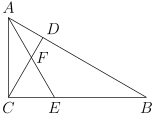
设 。因为 是等边三角形,所以 。射线 与 方向相反,因此 。
在 中, 。因为 位于 上,这个角就是 。所以 。
设 ,则 。由余弦定理,因此三边之比为 ,且 为斜边,所以 。
所以正确答案是 C。
Let Because is equilateral, Rays and are opposite, so
In we get Since lies on this is Hence
Put so The Law of Cosines gives Thus the side lengths are in the ratio with the hypotenuse, so
Thus, C is the correct answer.
9.
一个实心立方体边长为 英寸。在每个面的中心切出一个 英寸乘 英寸的正方形孔。每个切口的边都与立方体的边平行,并且每个孔都贯穿整个立方体。剩余立体的体积是多少立方英寸?
A solid cube has side length inches. A -inch by -inch square hole is cut into the center of each face. The edges of each cut are parallel to the edges of the cube, and each hole goes all the way through the cube. What is the volume, in cubic inches, of the remaining solid?
小提示:
对三个长方体孔使用容斥。
Use inclusion-exclusion for the three rectangular holes
大提示:
三个 的孔在中心的 立方体中重叠。
The three holes overlap in the central cube
解答:
三个被切出的长方体都在立方体中心相交。
交集是边长为 的立方体。因此切除区域的体积为
中心区域被全部 个孔包含,因此要减去重复计入的两次。
剩余体积为
所以正确答案是 A。
Note that all the cut out solids intersect in the middle of the cube.
This region of intersection is a cube with side length Then the volume of the cutout region is
We have to subtract out the center region twice since it is included in all regions.
The remaining volume is then
Thus, A is the correct answer.
10.
一个等差数列的前四项为 、、 和 。这个数列的第 项是多少?
The first four terms of an arithmetic sequence are and What is the th term of this sequence?
小提示:
公差等于 。
The common difference equals
大提示:
同时 ,且 ;解出 和 。
Also and solve for and
解答:
相邻两项之差都是公差 ,且 。
由前两项可得 ,由第二、三项可得 。解得 ,,。
因此第 项为
所以正确答案是 A。
Consecutive terms differ by a common difference From the last two terms,
From the first two terms, and from the second and third, Solving this system gives and
The th term is
Thus, A is the correct answer.
11.
12.
在一片神奇的沼泽中,有两种会说话的两栖动物:蟾蜍总是说真话,青蛙总是说假话。Brian、Chris、LeRoy 和 Mike 四只两栖动物一起住在这片沼泽中,并作出以下陈述。
Brian:“Mike 和我是不同物种。”
Chris:“LeRoy 是青蛙。”
LeRoy:“Chris 是青蛙。”
Mike:“我们四个中至少有两个是蟾蜍。”
这四只两栖动物中有多少只是青蛙?
In a magical swamp there are two species of talking amphibians: toads, whose statements are always true, and frogs, whose statements are always false. Four amphibians, Brian, Chris, LeRoy, and Mike live together in this swamp, and they make the following statements.
Brian: “Mike and I are different species.”
Chris: “LeRoy is a frog.”
LeRoy: “Chris is a frog.”
Mike: “Of the four of us, at least two are toads.”
How many of these four amphibians are frogs?
小提示:
Chris 和 LeRoy 不可能是同一物种。
Chris and LeRoy cannot have the same species
大提示:
如果 Brian 是蟾蜍,Mike 的陈述会产生矛盾。
If Brian were a toad, Mike’s statement would create a contradiction
解答:
Chris 和 LeRoy 必定属于不同物种:如果 Chris 是蟾蜍,他的话说明 LeRoy 是青蛙;如果 Chris 是青蛙,他这句假话说明 LeRoy 是蟾蜍。因此他们两个中恰好有一只是蟾蜍。
如果 Brian 是蟾蜍,他说的是真话,于是 Mike 是青蛙。如果 Brian 是青蛙,他这句假话意味着他和 Mike 是同一物种,此时 Mike 仍然是青蛙。所以 Mike 一定是青蛙。
因此 Mike 的陈述是假话,也就是说蟾蜍不足两只。而 Chris 和 LeRoy 中已经恰好有一只蟾蜍,所以 Brian 只能是青蛙。于是四只中有一只蟾蜍和 只青蛙。
所以正确答案是 D。
Chris and LeRoy are of opposite species: if Chris is a toad, his statement makes LeRoy a frog; if Chris is a frog, his false statement makes LeRoy a toad. Thus exactly one of them is a toad.
If Brian is a toad, his true statement makes Mike a frog. If Brian is a frog, his false statement says that he and Mike are the same species, again making Mike a frog. Therefore Mike is always a frog.
Mike’s statement is therefore false, so there are fewer than two toads. Chris and LeRoy already supply exactly one toad, forcing Brian to be a frog. Hence there is one toad and frogs.
Thus, D is the correct answer.
13.
对多少个整数 ,图像 与 不相交?
For how many integer values of do the graphs of and not intersect?
小提示:
当 时, 是半径为 的圆,而 是双曲线。
For is a circle of radius and is a hyperbola
大提示:
双曲线上离原点最近的点到原点距离为 ;把它与半径 比较。
The hyperbola’s points closest to the origin are at distance compare with the radius
解答:
当 时, 的图像是单点 ,而 是两条坐标轴,它们在原点相交。
当 时,圆的半径为 ,双曲线 离原点最近的两个顶点到原点距离为 。两图像相交当且仅当 ,即 。
所以只有 时两图像不相交,也就是 和 ,共有 个值。
因此 C 是正确答案。
For the graph of is the single point and is the two axes, which meet at the origin, so the graphs intersect.
For the circle has radius and the hyperbola has its two vertices nearest the origin at distance The graphs meet exactly when that is
So they fail to intersect only when namely and giving values.
Thus, C is the correct answer.
14.
非退化三角形 的边长都是整数, 是角平分线,,。周长的最小可能值是多少?
Nondegenerate has integer side lengths, is an angle bisector, and What is the smallest possible value of the perimeter?
小提示:
使用角平分线定理。
Use the Angle Bisector Theorem
大提示:
,并且 。
and
解答:
由角平分线定理,
为使 和 都是整数, 必须是 的倍数。
若为了最小化周长取 、,三角形会退化。
因此 必须取 ,此时 。又 ,周长为
所以正确答案是 B。
Using the Angle Bisector Theorem, we have that
For and to be integers, we must have that is a multiple of
To minimize the perimeter, we can set and This, however, makes the triangle degenerate.
must then be and Since the perimeter is
Thus, B is the correct answer.
15.
一枚硬币被改造后,正面朝上的概率小于 ,抛这枚硬币四次,正面和反面次数相等的概率为 。这枚硬币正面朝上的概率是多少?
A coin is altered so that the probability that it lands on heads is less than and when the coin is flipped four times, the probability of an equal number of heads and tails is What is the probability that the coin lands on heads?
小提示:
两次正面、两次反面的概率为 。
The chance of two heads and two tails is
大提示:
这会化为 ;解二次方程并取 的根。
This reduces to solve the quadratic and take the root with
解答:
设正面朝上的概率为 。抛掷四次恰好出现两次正面和两次反面的概率为
因此 ,所以 。
这给出 ,故 。由于 ,取 。
因此 D 是正确答案。
Let be the probability of heads. The chance of two heads and two tails in four flips is
Thus so
This gives so Since we take
Thus, D is the correct answer.
16.
Bernardo 随机选出 个不同的数,这些数来自集合 并按降序排列形成一个 位数。Silvia 也随机选出 个不同的数,这些数来自集合 并按降序排列形成一个 位数。Bernardo 的数大于 Silvia 的数的概率是多少?
Bernardo randomly picks distinct numbers from the set and arranges them in descending order to form a -digit number. Silvia randomly picks distinct numbers from the set and also arranges them in descending order to form a -digit number. What is the probability that Bernardo’s number is larger than Silvia’s number?
小提示:
按 Bernardo 是否选到 分情况。
Separate cases according to whether Bernardo picks
大提示:
若没有 ,两人的数对称,除了选到相同集合的情况。
Without a the two numbers are symmetric except when the chosen sets match
解答:
分两种情况:Bernardo 选到 ,或者没有选到。
情况 : Bernardo 选到 。
固定一个数后,另外两个数有 种选法。
总选法为 ,所以此情况的概率是
注意,如果 Bernardo 选到 ,他一定比 Silvia 的数大。
因此本情况中 Bernardo 一定获胜。
情况 : Bernardo 没有选到 。
这种情况发生的概率为 。此时两人从同一组数字中选择,获胜机会对称。
我们还需要求出两人选到相同数字的概率。Silvia 与 Bernardo 选到同一组数字的概率为 于是此时 Bernardo 的数更大的概率为
因此 Bernardo 得到较大数的总概率为
所以正确答案是 B。
There are two cases: Bernardo picks a or he doesn’t.
Case Bernardo picks a
Since a number is fixed, there are ways to choose the other two numbers.
There are a total of ways to pick all three numbers. The probability is then
Note that if Bernardo picks a he automatically has a greater number than Silvia.
This means that Bernardo always wins in this case.
Case Bernardo doesn’t pick a
There is a chance of this happening. Since both people are choosing from the same numbers, they have an equal chance of winning.
We still need to find the probability that the numbers are the same. There is a chance that Silvia chooses the same numbers as Bernardo. The probability that Bernardo gets a higher number is then
The total probability of Bernardo getting a higher number is then
Thus, B is the correct answer.
17.
等角六边形 的边长满足 和 的面积是六边形面积的 。 的所有可能值之和是多少?
Equiangular hexagon has side lengths and The area of is of the area of the hexagon. What is the sum of all possible values of
小提示:
将六边形分成 和三个角上的三角形。
Split the hexagon into and three corner triangles
大提示:
用 和 表示两个面积。
Express both areas using and
解答:
注意 是等边三角形。在 中用余弦定理,得 。
因此 的面积为
三个角上的三角形 、 和 各自面积为 。
所以六边形面积为 。
条件 给出 所以 。
由韦达定理, 的所有可能值之和为 。
因此 E 是正确答案。
Note that is equilateral. Using the Law of Cosines in we get
The area of is then
The three corner triangles and each have area
Thus the hexagon has area
The condition gives so
By Vieta’s formulas, the sum of the possible values of is
Thus, E is the correct answer.
18.
一条 步路径要从 走到 ,每一步都使 坐标或 坐标增加 。有多少条这样的路径在每一步都位于正方形 、 的外部或边界上?
A -step path is to go from to with each step increasing either the -coordinate or the -coordinate by How many such paths stay outside or on the boundary of the square at each step?
小提示:
每一步都使 增加 ,所以路径与直线 恰好相交于一个格点。
Each step increases by so the path meets the line at exactly one lattice point
大提示:
为避开正方形内部,该点只能是 ,或 ;分别计数。
To avoid the square’s interior, that point is or count paths through each
解答:
每一步都使 增加 ,而坐标和从 变到 ,所以每条路径恰好经过一个满足 的格点。
为了不进入开正方形内部,该点 必须满足 ,所以它是 之一。
由对称性,只考虑三点 ,然后将结果加倍。从 到 的路径数为 ,继续到 的路径数也是 。
因此总数为
所以正确答案是 D。
Every step increases by which runs from to so each path passes through exactly one lattice point with
To stay out of the open square, that point must have so it is one of
By symmetry consider the three points and double. The number of paths from to is and the number continuing on to is also
Therefore the total is
Thus, D is the correct answer.
19.
一排有 个盒子,每个盒子里有一颗红弹珠;对 ,第 个盒子还含有 颗白弹珠。Isabella 从第一个盒子开始,依次从每个盒子中随机抽取一颗弹珠。她第一次抽到红弹珠时停止。令 为 Isabella 正好抽取 颗弹珠后停止的概率。使 的最小 是多少?
Each of boxes in a line contains a single red marble, and for the box in the th position also contains white marbles. Isabella begins at the first box and successively draws a single marble at random from each box, in order. She stops when she first draws a red marble. Let be the probability that Isabella stops after drawing exactly marbles. What is the smallest value of for which
小提示:
前 次必须抽到白弹珠,第 次抽到红弹珠。
The first draws must be white, then the th draw red
大提示:
抽到白弹珠的各个概率相乘后会逐项相消:。
The white probabilities telescope:
解答:
第 个盒子中有 颗弹珠,所以 Isabella 从中抽到白弹珠的概率为 。
抽到红弹珠的概率为 。要在抽到第 颗弹珠后停止,前 颗必须都是白色。
其概率为
所有分子都与相邻分母相消,所以这个表达式化为 。
需要寻找最小的 ,使得
因为 ,但 ,所以最小的 是 。
所以正确答案是 A。
Since there are marbles in the th box, there is a chance Isabella draws a white marble from it.
The probability of drawing a red marble is then To stop after drawing the th marble, the first marbles must have been white.
This happens with a probability of
Note that all the numerators cancel with the adjacent denominator, which means that this expression reduces to
We have to find the smallest such that
Since but the smallest such is
Thus, A is the correct answer.
20.
等差数列 和 的各项都是整数,且 。若对某个 有 ,则 的最大可能值是多少?
Arithmetic sequences and have integer terms with and for some What is the largest possible value of
小提示:
写成 、,所以 同时整除 和 。
Write and so divides both and
大提示:
检查 的每对因数,且令 ;然后 必须整除 。
Check each factor pair of with then must divide
解答:
因为 、,其中 为整数,所以 同时整除 和 ,从而整除 。
满足 的 因数对为 、、、、、 和 。
除了 外,每对的 和 都互质,迫使 。对于 ,,所以 可以等于 ,得到 。
数列 和 可以达到这个值,因此最大值为 。
所以正确答案是 C。
Since and for integers the value divides both and hence divides
The factor pairs of with are and
For every pair except the numbers and are relatively prime, forcing For so can equal giving
The sequences and realize this, so the largest value is
Thus, C is the correct answer.
21.
函数图像 除了在三个 值处与直线 相交外,其余都在该直线上方。这三个值中最大的是多少?
The graph of lies above the line except at three values of where the graph and the line intersect. What is the largest of those values?
小提示:
图像减去直线得到一个非负多项式,并有三个二重根,所以它等于 。
The graph minus the line is nonnegative with three double roots, so it equals
大提示:
比较 的系数来确定三次多项式,再分解它。
Match the coefficients of to determine the cubic, then factor it
解答:
设 为该图像减去直线所得的函数。它非负,并在三个点处为零,每个零点都是二重根,所以
比较系数可得 ,接着 ,再由 。
因此三次式为 ,根为 和 。最大值为 。
所以正确答案是 A。
Let be the graph minus the line. It is nonnegative and vanishes at three points, each a double root, so
Matching coefficients gives then then
Thus the cubic is with roots and The largest is
Thus, A is the correct answer.
22.
下式的最小值是多少:
What is the minimum value of
小提示:
是分段线性函数,拐点在 ;最小值出现在斜率由负变正的位置。
is piecewise linear with corners at the minimum is where its slope turns from negative to positive
大提示:
在 上,斜率为 ;找出它为零的位置。
On the slope is find where it vanishes
解答:
函数 是分段线性的,断点在 。在区间 上,它的斜率为 其中 。
当 时斜率为零,即 ,所以最小值出现在右端点 。
在那里, 的项贡献 , 的项贡献 ,所以
所以正确答案是 A。
The function is piecewise linear with breakpoints at On the interval its slope is where
This slope is zero when i.e. so the minimum occurs at the right endpoint
There, terms with contribute and terms with contribute so
Thus, A is the correct answer.
23.
的最后两个非零数字组成的数等于 。求 ?
The number obtained from the last two nonzero digits of is equal to What is
小提示:
去掉产生末尾零的因数,然后模 计算。
Remove the factors making trailing zeroes, then work modulo
大提示:
用模 和模 的同余确定最后两位。
Use congruences modulo and modulo to pin down the last two digits
解答:
末尾零的个数为 。令 。
去掉 后仍剩下超过两个因数 ,所以 。
设 为 中不能被 整除的那些因数之积, 为能被 整除的那些因数之积。每一块 都满足 ,一共有 块,所以 。
从 中去掉 个因数 后,剩余因数可分组为
因此 。因为 ,而 模 的逆元为 ,所以 。
同时满足 和 的数为 ,所以最后两个非零数字组成 。
所以正确答案是 A。
The number of trailing zeroes in is Let
There are still more than two factors of left after removing so
Let be the product of factors of not divisible by and let be the product of the factors divisible by Each block is and there are blocks, so
After removing the factors of from the remaining factors can be grouped as
Therefore Since and the inverse of modulo is we get
The number congruent to and is so the last two nonzero digits form
Thus, A is the correct answer.
24.
令 则 的定义域与区间 的交集是 个互不相交的开区间的并。求 ?
Let The intersection of the domain of with the interval is a union of disjoint open intervals. What is
小提示:
定义域满足 ; 关于 对称。
The domain is where is symmetric about
大提示:
统计 内形如 的零点,并注意在 和 处符号不会改变。
Count the zeros in and note the sign fails to flip at and
解答:
令 ;则 的定义域为 的地方。由于 ,且 为偶数,所以 ,只需研究 后再加倍。
在 中, 的零点是满足 、、、 的分数。对 数量分别为 ,合计 个。
这 个零点把 分成 个小区间,在每个小区间上 的符号恒定。靠近 时每个因子为正,所以 。每经过一个零点符号通常改变,但在 和 处有偶数个因子同时为零,符号不改变。
跟踪符号可知,这 个小区间中正好有 个满足 。由对称性,在 中还有 个,所以 。
因此,正确答案是 B。
Let the domain of is where Since and is even, so it suffices to study and double.
In the zeros of are the fractions with and For there are of them, totaling
These zeros split into subintervals on which has constant sign. Near every factor is positive, so there, and the sign flips at each zero except and where an even number of factors vanish.
Tracking the signs, exactly of the subintervals have By symmetry there are more in so
Thus, B is the correct answer.
25.
如果一个四边形可以通过旋转和平移得到另一个四边形,则认为这两个四边形相同。边长为整数且周长等于 的不同凸圆内接四边形有多少个?
Two quadrilaterals are considered the same if one can be obtained from the other by a rotation and a translation. How many different convex cyclic quadrilaterals are there with integer sides and perimeter equal to
小提示:
给定一组按圆周顺序排列的边长后,凸圆内接四边形唯一;每条边至多为 。
A convex cyclic quadrilateral with given side lengths in a given cyclic order is unique; each side is at most
大提示:
先数和为 的有序四元组,再用 Burnside 引理按循环旋转取商。
Count ordered quadruples summing to then quotient by cyclic rotation using Burnside’s lemma
解答:
一个凸圆内接四边形由其按圆周顺序排列的边长唯一确定,且存在的条件是最大边长小于其他三边之和。周长为 时,每条边至多为 。
先数正整数有序四元组 ,满足 且每项至多为 。若没有上界限制,有 个;去掉某一项至少为 的情况,需减去 ,剩下 个。
四边形的旋转对应于 的循环置换。由 Burnside 引理,不同四边形的数量为 其中 表示旋转 个位置后不变的四元组数。
旋转一步或三步只固定 ,所以 。旋转两步固定形如 且 、 的四元组,所以 。
因此数量为
所以正确答案是 C。
A convex cyclic quadrilateral is determined up to rotation and translation by its cyclic sequence of side lengths, and it exists exactly when the largest side is less than the sum of the others. With perimeter this means each side is at most
First count ordered quadruples of positive integers with and each entry at most Without the upper bound there are removing those with some entry at least subtracts leaving
Rotations of the quadrilateral correspond to cyclic permutations of By Burnside’s lemma the number of distinct quadrilaterals is where counts quadruples fixed by rotating positions.
A one- or three-step rotation fixes only so A two-step rotation fixes with and giving
Hence the count is
Thus, C is the correct answer.