
2018 AMC 10A 详解
向下滚动即可查看来自 LIVE by Po-Shen Loh 的精心整理的解答,打印PDF 解答,查看答案,或参加完整限时模拟考试。
所有题目均经美国数学协会(MAA)官方合法授权使用。
1.
2.
Liliane 的汽水比 Jacqueline 多 ,Alice 的汽水比 Jacqueline 多 。Liliane 和 Alice 的汽水量有什么关系?
Liliane has more soda than Jacqueline, and Alice has more soda than Jacqueline. What is the relationship between the amounts of soda that Liliane and Alice have?
Liliane 的汽水比 Alice 多 。
Liliane has more soda than Alice.
Liliane 的汽水比 Alice 多 。
Liliane has more soda than Alice.
Liliane 的汽水比 Alice 多 。
Liliane has more soda than Alice.
Liliane 的汽水比 Alice 多 。
Liliane has more soda than Alice.
Liliane 的汽水比 Alice 多 。
Liliane has more soda than Alice.
小提示:
以 Jacqueline 的汽水量为基准设未知数。
Use Jacqueline’s amount as the base variable
大提示:
直接比较 Liliane 与 Alice 的汽水量。
Compare Liliane’s amount directly to Alice’s amount
解答:
设 Jacqueline 有 加仑汽水,则 Alice 有 加仑,Liliane 有 加仑。
两人的汽水量之比为 ,所以 Liliane 的汽水比 Alice 多 。
因此正确答案是 A。
Let be the number of gallons of soda that Jacqueline has. Then Alice has gallons, and Liliane has gallons.
Therefore, the relationship can be found by dividing the amount of soda that each has to yield which means Liliane has more soda than Alice.
Thus, A is the correct answer.
3.
一单位血液经过 秒后过期。Yasin 在一月 日中午捐献了一单位血液。这单位血液会在哪一天过期?
A unit of blood expires after seconds. Yasin donates a unit of blood at noon on January On what day does his unit of blood expire?
一月 日
January
一月 日
January
一月 日
January
二月 日
February
二月 日
February
小提示:
把 秒换算成天数。
Convert seconds into days
大提示:
一天有 秒。
Use seconds per day
解答:
把 依次除以 、 和 ,即可求出血液经过多少天后过期。
第一次约去 和 ,第二次约去 和 ,最后一次约去 ,并把 化为 。
剩下 和 ,乘积为 。一月有 天,所以到二月 日时还剩 天。
从二月 日再过 天,血液将在二月 日过期。
因此正确答案是 E。
We can divide by and to get the number of days that it takes for a unit of blood to expire.
The first division cancels a and The second division cancels and The final division cancels and turns the into a
This leaves and a which multiply to There are days in January, so by February the blood only has days left.
days from February would make the blood expire on February
Thus, E is the correct answer.
4.
一天有 节课。若任意两门数学课都不能安排在相邻课时,那么一名学生安排 门数学课,包括代数、几何和数论,共有多少种排法?
(其余 节课所上的课程无需考虑。)
How many ways can a student schedule mathematics courses — algebra, geometry, and number theory — in a -period day if no two mathematics courses can be taken in consecutive periods?
(What courses the student takes during the other periods is of no concern here.)
小提示:
先选出三个互不相邻的课时。
First choose the three nonconsecutive periods
大提示:
选定课时后,再排列三门不同的课程。
After the periods are chosen, arrange the three named courses
解答:
这 门数学课可以占据以下课时:
因此,选择数学课所在课时共有 种方法。
每种课时安排中,三门课有 种顺序,所以总共有 种课程表。
因此正确答案是 E。
The classes can occupy the following periods:
This means that there are ways to choose which periods the mathematics courses occur.
For each configuration, there are ways to determine the order of the courses, for a total of schedules.
Thus, E is the correct answer.
5.
Alice、Bob 和 Charlie 徒步时想知道最近的城镇有多远。Alice 说:“我们离城镇至少 英里。”Bob 回答:“我们离城镇至多 英里。”Charlie 接着说:“其实最近的城镇至多在 英里外。”结果三人的话都不正确。设到最近城镇的距离为 英里。下列哪个区间是 的所有可能取值?
Alice, Bob, and Charlie were on a hike and were wondering how far away the nearest town was. When Alice said, “We are at least miles away,” Bob replied, “We are at most miles away.” Charlie then remarked, “Actually the nearest town is at most miles away.” It turned out that none of the three statements was true. Let be the distance in miles to the nearest town. Which of the following intervals is the set of all possible values of
小提示:
分别否定三个人的陈述。
Negate each person’s statement
大提示:
将所得三个关于 的不等式取交集。
Intersect the three resulting inequalities for
解答:
Alice 的话不正确,说明 。Bob 的话不正确,说明 。Charlie 的话不正确,说明 。
合并这些条件可得 且 ,因此 位于区间 。
因此正确答案是 D。
Alice’s statement tells us that Bob’s statement tells us that Charlie’s statement tells us that
Combining all of these tells us that and which means is in the interval
Thus, D is the correct answer.
6.
Sangho 把一个视频上传到某网站,观看者可以投喜欢票或不喜欢票。每个视频的初始分数为 ,每收到一张喜欢票,分数增加 ;每收到一张不喜欢票,分数减少 。
某一时刻,Sangho 看到视频的分数为 ,而且所有投票中有 是喜欢票。当时这个视频一共收到了多少票?
Sangho uploaded a video to a website where viewers can vote that they like or dislike a video. Each video begins with a score of and the score increases by for each like vote and decreases by for each dislike vote.
At one point Sangho saw that his video had a score of and that of the votes cast on his video were like votes. How many votes had been cast on Sangho’s video at that point?
小提示:
设总票数为 。
Let be the total number of votes
大提示:
分数等于喜欢票数减去不喜欢票数。
The score is likes minus dislikes
解答:
喜欢票占 ,所以不喜欢票占 。因此视频分数等于总票数的 。
已知分数为 ,所以总票数为 。
因此正确答案是 B。
If of votes were like votes, then of votes are dislike votes. Then Sangho’s score is the total number of votes.
We know that Sangho’s score is so the total number of votes is
Thus, B is the correct answer.
7.
有多少个整数 (不一定是正数)使下式为整数?
For how many (not necessarily positive) integer values of is the following value an integer?
小提示:
把 写成 。
Write as
大提示:
和 的指数都必须是非负数。
The exponents of and must both be nonnegative
解答:
原式可改写为
要使它成为整数,两个指数都必须非负,即
所以 共有 个取值。
因此正确答案是 E。
We can rewrite the expression as
For this to be an integer, both exponents must be nonnegative. This means that
This gives us values for
Thus, E is the correct answer.
8.
Joe 有 枚硬币,分别是 分、 分和 分硬币。他的 分硬币比 分硬币多 枚,所有硬币总值为 分。Joe 的 分硬币比 分硬币多多少枚?
Joe has a collection of coins, consisting of -cent coins, -cent coins, and -cent coins. He has more -cent coins than -cent coins, and the total value of his collection is cents. How many more -cent coins does Joe have than -cent coins?
小提示:
设 分硬币的枚数为 。
Let the number of -cent coins be
大提示:
同时利用硬币总数和总价值列方程。
Use both the total number of coins and total value equations
解答:
设 Joe 有 枚 分硬币,则他有 枚 分硬币。
因此,他有 枚 分硬币。
这些硬币的总价值为
由总价值可得
所以 Joe 有 枚 分硬币;他的 分硬币比 分硬币多 枚。
因此正确答案是 C。
Let be the number of -cent coins that Joe has. Then the number of -cent coins he has is
Therefore, Joe has -cent coins.
The total value of all these coins is
We know that
This means that Joe has -cent coins. Therefore, he has more -cent coins than -cent coins.
Thus, C is the correct answer.
9.
下图中的所有三角形都与等腰三角形 相似,其中 。 个最小三角形的面积均为 ,而 的面积为 。梯形 的面积是多少?
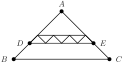
All of the triangles in the diagram below are similar to isosceles triangle in which Each of the smallest triangles has area and has area What is the area of trapezoid
小提示:
相似三角形的面积比等于对应边长比的平方。
Area scales as the square of side length for similar triangles
大提示:
先求上方三角形的面积,再从 中减去。
Find the area of the top triangle and subtract from
解答:
由相似三角形可知,小三角形的边长是大三角形对应边长的 倍。
因此, 的边长是大三角形对应边长的 倍。
两者的面积比为
所以 的面积为 ,梯形的面积为 。
因此正确答案是 E。
We know that the side length of the smaller triangles is times the length of the larger triangle from similar triangles.
Then the side length of is times the length of the side length of the larger triangle.
This makes the ratio of the areas
Therefore, the area of is The area of the trapezoid is then
Thus, E is the correct answer.
10.
设实数 满足求下式的值:
Suppose that real number satisfies What is the value of
小提示:
把两个根式组成的差与和看作一对共轭式。
Treat the two radicals as conjugate-like quantities
大提示:
将已知的差乘以所求的和。
Multiply the given difference by the desired sum
解答:
题中给出的差与所求的和互为共轭式,将两式相乘即可消去根号。
乘积为
所以两式的乘积是 ,所求的和为 。
因此正确答案是 A。
Note that the left hand side of the equation and the desired expression are conjugates. Multiplying them would remove the square roots.
Multiplying them yields
This means that the product of the values of the expressions is equal to The desired value is therefore
Thus, A is the correct answer.
11.
掷出 个公平的标准 面骰子,朝上点数之和为 的概率可写成 其中 是正整数。求 。
When fair standard -sided dice are thrown, the probability that the sum of the numbers on the top faces is can be written as where is a positive integer. What is
小提示:
列出七次掷骰所得点数之和为 的无序形式。
List the unordered ways seven positive die rolls can sum to
大提示:
分别计算每种形式的排列数。
Count the orderings for each listed pattern
解答:
用隔板法求 :这等价于把 个球放入 个盒子,并要求每个盒子至少有一个球。
这类问题的公式为 其中 是球数, 是盒子数。
七个正点数之和为 时,任何一个骰子的点数都不会超过 ,所以每个面最大为 这一上限不会带来额外限制。因此所求答案为
因此正确答案是 E。
We can use stars and bars to find It is the same as finding the number of ways to put balls into boxes, where each box has at least one ball.
The formula for such a scenario is where is the number of balls and is the number of boxes.
No die can exceed in a sum of from seven positive rolls, so the upper bound of creates no additional restriction. The desired answer is therefore
Thus, E is the correct answer.
12.
有多少个实数有序对 满足下列方程组?
How many ordered pairs of real numbers satisfy the following system of equations?
小提示:
把绝对值方程拆成四种线性情形。
Replace the absolute-value equation by four linear cases
大提示:
不同情形可能得到同一个解,因此要数互不相同的有序对。
Distinct solutions can repeat across cases, so count unique ordered pairs
解答:
第二个方程等价于 或 ,因此只需检查四种线性关系 和 。
分别与 联立,得到 、、再次得到 ,以及 。
其中有三个互不相同的有序对,而且都满足原绝对值方程。因此正确答案是 C。
The second equation says or , so it is enough to check the four linear possibilities and .
Combining these with gives , , again, and .
These are three distinct ordered pairs, and each satisfies the original absolute-value equation. Thus, C is the correct answer.
13.
如图所示,一张三角形纸片的三边长分别为 、 和 英寸。将纸片折叠,使点 落到点 上。折痕长多少英寸?

A paper triangle with sides of lengths and inches, as shown, is folded so that point falls on point What is the length in inches of the crease?
小提示:
折痕是 的垂直平分线。
The crease is the perpendicular bisector of
大提示:
利用它与原来的 -- 三角形之间的相似关系。
Use similarity with the original -- triangle
解答:

折痕是 的垂直平分线。设折痕为 。
由 相似判定,。因此 代入各边长得 所以 。
因此正确答案是 D。
The crease is the perpendicular bisector of Let be the crease.
By similarity, Therefore, Plugging in the side lengths gives so
Thus, D is the correct answer.
14.
求不超过下式的最大整数:
What is the greatest integer less than or equal to
小提示:
先将这个式子与 比较。
Compare the expression to first
大提示:
再证明它仍然大于 。
Then prove it is still greater than
解答:
令 ,。原式为 ,所以小于 。
要证明其最大整数为 ,还要证明原式大于 。这等价于 ,也就是 。
因为 ,所以 。于是原式大于 且小于 。因此正确答案是 A。
Let and . The expression is , so it is less than .
To show the floor is , we also need the expression to be greater than . This is equivalent to , or .
Because we have Hence the expression is greater than and less than Thus, A is the correct answer.
15.
两个半径为 的圆彼此外切,并且都内切于一个半径为 的圆,切点分别为 和 ,如图所示。距离 可写成 ,其中 与 是互质的正整数。求 。
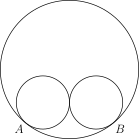
Two circles of radius are externally tangent to each other and are internally tangent to a circle of radius at points and as shown in the diagram. The distance can be written in the form where and are relatively prime positive integers. What is
小提示:
连接三个圆的圆心。
Join the three circle centers
大提示:
包含切点的三角形与圆心三角形相似。
The triangle through tangent points is similar to the triangle through centers
解答:
设大圆的圆心为 ,两个小圆的圆心分别为 。则 ,且 。
切点处的半径共线,因此 与 共线, 与 共线,于是 。所以 。
因此 ,从而 。所以正确答案是 D。
Let be the center of the large circle and let be the centers of the two smaller circles. Then and .
The radii to tangent points make collinear with and collinear with , so . Thus .
Hence , so . Thus, D is the correct answer.
16.
直角三角形 的两条直角边长分别为 和 。从顶点 向斜边 上一点作线段,把 和 也计算在内,共有多少条这样的线段长度是整数?
Right triangle has leg lengths and Including and how many line segments with integer length can be drawn from vertex to a point on hypotenuse
小提示:
求从 到斜边的高。
Find the altitude from to the hypotenuse
大提示:
高两侧会对称地出现整数长度的线段。
Integer-length segments occur in symmetric pairs around the altitude
解答:
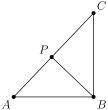
设 是从 向 所作高的垂足。由勾股定理得 。用两种方式计算面积,得到 所以 ,它介于 和 之间。
当端点从 移到 时,它到 的距离从 连续减小到 。因此长度分别为 的线段各有一条。当端点从 移到 时,这个距离从 连续增大到 ,所以长度分别为 的线段各有一条。这样共有 条不同的线段。
所以正确答案是 D。
Let be the foot of the altitude from to The Pythagorean Theorem gives Computing the area in two ways gives so which lies between and
As the endpoint moves from to its distance from decreases continuously from to Thus there is one segment of each integer length As the endpoint moves from to the distance increases continuously from to giving one segment of each integer length These are distinct segments.
Thus, D is the correct answer.
17.
设 是从 中选出的 个整数所组成的集合,并满足:若 和 都属于 ,且 ,则 不是 的倍数。 中元素的最小可能值是多少?
Let be a set of integers taken from with the property that if and are elements of with then is not a multiple of What is the least possible value of an element in
小提示:
把整数分成若干组,使每组至多能选一个数。
Group numbers so at most one from each group can be chosen
大提示:
尝试从整除链中强制选出六个数。
Try forcing six choices from the divisor chains
解答:
分情况讨论 中的最小元素:
最小元素不可能是 ,因为这样集合中不能再放入任何其他数。
最小元素也不可能是 ,因为这时必须选入除 以外的所有奇数,而其中 和 会违反条件。
若最小元素是 ,可以选 和 ,再从 与 中选一个,并从 与 中选一个。
无论怎样选,最多只能得到 个元素,所以最小元素不能是 。
从 开始时,可以选入 和 ,再从 与 中选一个,便得到一个含 个元素的集合。
因此正确答案是 C。
We proceed by casing on possible values for
cannot be the smallest element since that would mean that no other number can be in the set.
cannot be the smallest element since we would have to include every odd number except This would make and violate the rule.
Let be the smallest element. Then we can include and We can finally include either or and or
Either way, the maximum number of elements that we can include is so cannot be the smallest element.
Starting with we can include and Finally, we can add either or creating a -element set.
Thus, C is the correct answer.
18.
有多少个非负整数可以写成其中对 ,都有 ?
How many nonnegative integers can be written in the form where for
小提示:
把这个表达式看成平衡三进制表示。
Think of the expression as balanced ternary
大提示:
正数与负数会关于 对称配对。
Positive and negative values pair off symmetrically around
解答:
每一组系数得到的和必为正数、负数或零。
由于对称性,正数与负数的数量相等:把所有 换成 ,同时把所有 换成 即可一一配对。
只有当所有系数都为 时,和才等于 。
系数的组合共有 种。因为 的每个幂都大于它前面各个幂之和,所以不同的系数组合给出不同的值。更具体地说,在两组系数最高的不同位上,差的绝对值至少为 ,而所有更低的位加起来最多只能抵消 。
因此,不同的非负整数共有 个。
因此正确答案是 D。
Note that every number formed by this sum is either positive, negative, or zero.
The number of positive numbers equals the number of negative numbers due to symmetry (flip the s to s and s to s).
The only way for the sum to be is if all the coefficients are
The total number of numbers is Because each power of is larger than the sum of all previous powers of three, each combination of coefficients yields a different value. More explicitly, at the highest place where two combinations differ, the difference has magnitude at least while all lower places together can cancel at most
Therefore, there are distinct nonnegative integers.
Thus, D is the correct answer.
19.
从集合 中随机选择一个数 ,并从集合 中随机选择一个数 。 的个位数字为 的概率是多少?
A number is randomly selected from the set and a number is randomly selected from What is the probability that has a units digit of
小提示:
只需考虑个位数字的循环。
Only units-digit cycles matter
大提示:
分别统计个位为 的底数对应的成功次数。
Average the success counts for bases ending in
解答:
只需考虑 的个位数字。在 个连续的可能指数中,每个模 的余数出现 次,并且有 个偶数指数。个位为 的底数对全部 个指数都成功;个位为 或 的底数在能被 整除的那 个指数上成功;个位为 的底数从不成功;个位为 的底数在 个偶数指数上成功。
因此,在 个等可能数对中,有 个符合条件,概率为 。
所以正确答案是 E。
Only the units digit of matters. Among the consecutive possible exponents, each residue modulo occurs times, and exponents are even. A base ending in succeeds for all exponents; bases ending in or succeed for the exponents divisible by a base ending in never succeeds; and a base ending in succeeds for the even exponents.
Thus of the equally likely pairs work, and the probability is
Thus, E is the correct answer.
20.
一个扫描码由一个 方格构成,其中一些小方格涂黑,其余小方格涂白。在这个由 个小方格组成的网格中,两种颜色都必须至少出现一次。
如果把整个正方形绕中心逆时针旋转 的任意整数倍,或关于连接两个对角顶点的直线、连接两条对边中点的直线反射后,扫描码的外观都不改变,就称它是对称的。
一共有多少种可能的对称扫描码?
A scanning code consists of a grid of squares, with some of its squares colored black and the rest colored white. There must be at least one square of each color in this grid of squares.
A scanning code is called symmetric if its look does not change when the entire square is rotated by a multiple of counterclockwise around its center, nor when it is reflected across a line joining opposite corners or a line joining midpoints of opposite sides.
What is the total number of possible symmetric scanning codes?
小提示:
按照正方形的对称性把小方格分成若干轨道。
Classify grid squares by symmetry orbits
大提示:
每个轨道选择一种颜色,再排除两种纯色涂法。
Choose one color per orbit, excluding the two constant colorings
解答:
把行和列从 编号到 ,中心为 。旋转和反射可以改变坐标的符号,也可以交换两个坐标,所以 所在的轨道由 从小到大排序后得到的数对决定。这样的数对是满足 的 ,共有 个。
每个轨道选定一个小方格的颜色后,该轨道内其余方格的颜色都由对称性确定。
因此,在考虑两种颜色都必须出现的条件之前,共有 种对称涂法。
全黑和全白两种涂法不合要求,所以有效的对称扫描码共有 种。因此正确答案是 B。
Number rows and columns from through with the center at Rotations and reflections can change signs and exchange coordinates, so the orbit of is determined by the ordered pair obtained by sorting These pairs are with of which there are
Once one square in each orbit is colored, symmetry forces the colors of all other squares in that orbit.
There are therefore symmetric colorings before the condition about using both colors. The all-black and all-white colorings are not allowed.
The total number of valid symmetric scanning codes is . Thus, B is the correct answer.
21.
在实 平面内,曲线 与 恰好相交于 个点时,下列哪一项描述了 的取值范围?
Which of the following describes the set of values of for which the curves and in the real -plane intersect at exactly points?
小提示:
把抛物线方程代入圆的方程。
Substitute the parabola equation into the circle equation
大提示:
只有当 为正数时,才会出现非零根。
The nonzero roots appear only when is positive
解答:
把 代入 ,得到 ,所以 。
因子 总会给出一个交点 。另一个因子恰好在 时给出两个额外的实交点。
因此,恰有三个交点的条件是 。所以正确答案是 E。
Substitute into . This gives , so .
The factor always gives the single point . The other factor gives two additional real points exactly when .
There are exactly three intersection points when . Thus, E is the correct answer.
22.
设 、、 和 是正整数,并满足 以及 下列哪一个数一定是 的因数?
Let and be positive integers such that and Which of the following must be a divisor of
小提示:
追踪各个最大公因数中必然含有的 和 的幂。
Track the forced powers of and in the gcds
大提示:
的剩余因子必须在 与 之间。
The remaining factor of must lie between and
解答:
由 和 可知, 能被 整除,但不能被 整除。
由 和 可知, 能被 整除,但不能被 整除。因此 ,其中 不含因子 或 。
由 得 。这个范围内不含因子 或 的整数 只有 ,所以 一定是 的因数。因此正确答案是 D。
From and , the number is divisible by but not by .
From and , the number is divisible by but not by . Therefore , where has no factor or .
Since the integer satisfies The only value in this range with no factor or is so must divide Thus, D is the correct answer.
23.
农夫 Pythagoras 有一块直角三角形田地,两条直角边分别长 和 个单位。他在两条直角边相交的角落留出一个未种植的小正方形 ,使它从空中看起来像直角符号。田地的其余部分都已种植。 到斜边的最短距离为 个单位。田地中已种植部分占几分之几?
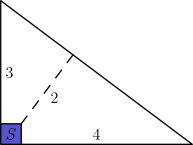
Farmer Pythagoras has a field in the shape of a right triangle. The right triangle’s legs have lengths and units. In the corner where those sides meet at a right angle, he leaves a small unplanted square so that from the air it looks like the right angle symbol. The rest of the field is planted. The shortest distance from to the hypotenuse is units. What fraction of the field is planted?
小提示:
设未种植正方形的边长为 。
Let be the side length of the unplanted square
大提示:
把大三角形分成正方形、两个直角三角形和一个高为 的三角形。
Decompose the triangle into the square, two right triangles, and a triangle of height
解答:
设 的边长为 ,可将田地分成下图所示的几个部分。
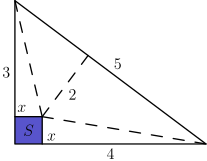
田地的面积可用两种方式表示:
化简得
所求比例为
因此正确答案是 D。
Let be the side length of Then we can split the field up into the following shapes.
We can express the area of the field in two ways:
Simplifying yields
The desired fraction is
Thus, D is the correct answer.
24.
三角形 中,,,面积为 。设 是 的中点, 是 的中点。 的角平分线分别与 和 交于 和 。四边形 的面积是多少?
Triangle with and has area Let be the midpoint of and let be the midpoint of The angle bisector of intersects and at and respectively. What is the area of quadrilateral
小提示:
用角平分线定理确定 的位置。
Use the angle bisector theorem to locate
大提示:
中位线 使梯形的高等于原三角形高的一半。
The midsegment makes a similar half-height trapezoid
解答:
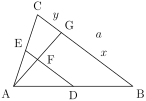
设 ,并设过 的高为 。
由角平分线定理,,所以 。因为 是中位线,。在 中再次应用该定理,得 ,所以 。
梯形的高为 ,且 。它的平均底长为 。因此面积为 所以正确答案是 D。
Let and be the length of the altitude through
By the Angle Bisector Theorem, so Because is a midsegment, Applying the same theorem in gives so
The trapezoid’s height is and Its average base length is Therefore, its area is Thus, D is the correct answer.
25.
对于正整数 和非零数字 、、,令 表示每一位数字都等于 的 位整数;令 表示每一位数字都等于 的 位整数;令 表示每一位数字都等于 的 位(而不是 位)整数。若至少有两个 的取值使下式成立,那么 的最大可能值是多少?
For a positive integer and nonzero digits and let be the -digit integer each of whose digits is equal to ; let be the -digit integer each of whose digits is equal to ; and let be the -digit (not -digit) integer each of whose digits is equal to What is the greatest possible value of for which there are at least two values of such that
小提示:
把各个重复数字组成的整数写成等比数列之和。
Write the repeated-digit numbers as geometric sums
大提示:
存在两个不同的 值,会迫使关于 的线性方程恒成立。
Having two different values forces the linear equation in to be identically true
解答:
各位数字相同的数可写成
把这些表达式代入 ,再除以 ,得到
整理可得 若它对两个不同的 值都成立,两式相减可知 。原方程又迫使 。
因此 ,且 。因为 都是非零数字,候选三元组为 、 和 。最后一个三元组无效,因为 不是一位数字。最大的有效和为 。所以正确答案是 D。
The repeated-digit numbers can be written as
Substituting these expressions into and dividing by gives
Rearranging yields If this holds for two different values of subtracting the two equations shows that The displayed equation then also forces
Hence and Because are nonzero digits, the candidates are and The last triple is invalid because is not a digit. The greatest valid sum is Thus, D is the correct answer.