
2016 AMC 10B 详解
向下滚动即可查看来自 LIVE by Po-Shen Loh 的精心整理的解答,打印PDF 解答,查看答案,或参加完整限时模拟考试。
所有题目均经美国数学协会(MAA)官方合法授权使用。
1.
2.
3.
令 。求下式的值:
Let What is the value of
小提示:
当 时,。
For ,
大提示:
从最里面的绝对值开始向外计算。
Evaluate the absolute values from the inside outward
解答:
由 可知 ,所以 最内层的绝对值为 。因此整个表达式为
所以正确答案是 D。
Since we have Thus so the innermost absolute value is Therefore the full expression is
Thus, the correct answer is D .
4.
Zoey 一本一本地读了 本书。第一本书花了她 天,第二本花了 天,第三本花了 天,依此类推,每一本都比前一本多花 天。Zoey 在星期一读完第一本书,在星期三读完第二本书。她会在星期几读完第 本书?
Zoey read books, one at a time. The first book took her day to read, the second book took her days to read, the third book took her days to read, and so on, with each book taking her more day to read than the previous book. Zoey finished the first book on a Monday, and the second on a Wednesday. On what day of the week did she finish her th book?
星期日
Sunday
星期一
Monday
星期三
Wednesday
星期五
Friday
星期六
Saturday
小提示:
总阅读天数是 。
The total reading time is
大提示:
把第 本读完的日期与第 本读完的日期模 比较。
Compare the finish day of book with the finish day of book modulo
解答:
读完 本书共需要 天。因此第十五本读完是在第一本读完后的 天。因为这是 的倍数,所以第 本是在与第 本相同的星期几读完的,也就是星期一。
所以正确答案是 B。
The number of days it takes to read books is Therefore, it is days after the first book is read. This is a multiple of so the th book was finished on the same day as the st book. Therefore, it was finished on a Monday.
Thus, the correct answer is B .
5.
Amanda 的 个表亲的平均年龄是 ,年龄中位数是 。她最小和最大的两个表亲的年龄之和是多少?
The mean age of Amanda’s cousins is and their median age is What is the sum of the ages of Amanda’s youngest and oldest cousins?
小提示:
四个人的年龄总和是 。
The total age is
大提示:
中间两个年龄的和是 。
The two middle ages sum to
解答:
四个年龄的总和是 。由于中位数是 ,中间两个年龄的平均数是 ,所以它们的和是 。
因此最小年龄与最大年龄的和为 。
所以正确答案是 D。
The total of the four cousin ages is . Since the median is , the two middle ages have average , so their sum is .
Therefore the youngest and oldest ages sum to .
Thus, the correct answer is D.
6.
Laura 把两个三位正整数相加。这两个数中的六个数字互不相同。她得到的和是一个三位数 。 的各位数字之和最小可能是多少?
Laura added two three-digit positive integers. All six digits in these numbers are different. Laura’s sum is a three-digit number What is the smallest possible value for the sum of the digits of
小提示:
说明数字和小于 不可能。
Show a digit sum below is impossible
大提示:
可以达到数字和 。
reaches digit sum
解答:
为使两个加数的和尽量小,百位取两个最小的非零数字 和 ,剩下的四个数位取余下最小的四个数字 。把较小的数字放在十位上可知,任何可能的和都至少是 。另一方面,数字和小于 的三位数最大也只有 。因此 的数字和至少为 。
例子 使用六个互不相同的数字,且数字和为 。因此最小可能值是 。
所以正确答案是 B。
To minimize the sum of the addends, use the two smallest nonzero hundreds digits, and , and then the four smallest remaining digits, . Placing the smaller digits in the tens places shows that every possible sum is at least . On the other hand, any three-digit number with digit sum less than is at most . Therefore the digit sum of is at least .
The example uses six distinct digits and has digit sum . Thus the smallest possible digit sum is .
Thus, the correct answer is B.
7.
两个锐角的度数之比为 ,且其中一个角的余角是另一个角的余角的两倍。这两个角的度数之和是多少?
The ratio of the measures of two acute angles is and the complement of one of these two angles is twice as large as the complement of the other. What is the sum of the degree measures of the two angles?
小提示:
设较小的锐角为 。
Let the smaller acute angle be
大提示:
较大的角有较小的余角。
The larger angle has the smaller complement
解答:
设较小角为 。则较大角为 ,两角和为 。
它们的余角分别是 与 。由于 大于 ,所以
因此两角和为
所以正确答案是 C。
Let the smaller angle be Then, the larger angle is Note that their sum is
Their complements are then and Since is larger than we know
Therefore, the sum is
Thus, the correct answer is C .
8.
的十位数字是多少?
What is the tens digit of
小提示:
为了得到十位数字,计算这个数模 。
Work modulo to get the tens digit
大提示:
分别使用模 和模 的同余。
Use congruences modulo and
解答:
为了求十位数字,先求该数模 的余数。先求 ,可用中国剩余定理分别考虑 和 。
有 因为它是 的倍数。
另一方面,底数除以四的余数为负一,所以
由中国剩余定理可知,这个数同余于 。
因此 这说明十位数字是 。
所以正确答案是 A。
To find the tens digit, we first need to find the number modulo First, we can find We can do this with the Chinese Remainder Theorem by first getting the number and then
The number since it is a multiple of
Then, observe that
By the Chinese remainder theorem, we can get that our number is congruent to
Therefore, This means the tens digit is
Thus, the correct answer is A .
9.
的三个顶点都在抛物线 上,其中 在原点,且 平行于 轴。若三角形面积为 ,则 的长度是多少?
All three vertices of lie on the parabola defined by with at the origin and parallel to the -axis. The area of the triangle is What is the length of
小提示:
使用对称点 与 。
Use symmetric points and
大提示:
三角形的面积是 。
The triangle area is
解答:
设三个顶点为
因为 平行于 轴,所以 ,记为 。又两点都在抛物线上,,即 。因此 或 。后一种会让两点重合,面积为 。所以令 ,同时 。
于是点为 以 为底时,底长为 ,高为 ,面积为 。因此 ,所以 。
所以正确答案是 C。
Let the points be
Then, since is parallel with the -axis, we know which we will let be Then, so This implies that either or The second option cannot happen since that would set two points as the same, which would create an area of As such, let Then also.
Then, the points are With a base of the length is and the height is This would make the area Therefore, so
Thus, the correct answer is C .
10.
一块均匀密度的薄木板是边长为 英寸的等边三角形,重 盎司。另一块同种木材、同样厚度的等边三角形木板边长为 英寸。下面哪个数最接近第二块木板的重量(盎司)?
A thin piece of wood of uniform density in the shape of an equilateral triangle with side length inches weighs ounces. A second piece of the same type of wood, with the same thickness, also in the shape of an equilateral triangle, has side length inches. Which of the following is closest to the weight, in ounces, of the second piece?
小提示:
厚度和密度固定时,重量按面积比例缩放。
Weights scale like areas because thickness and density are fixed
大提示:
边长的缩放因子是 。
The side-length scale factor is
解答:
面积按 倍增加,因为边长按 倍增加。厚度不变,所以体积也按同样倍数增加。又因为木材密度相同,重量也按 倍增加,于是新重量为 约为 。
所以正确答案是 D。
The surface area is increased by a factor of since the side lengths are increased by a factor of Also since the thickness is constant, the volume is scaled up by that much. Then, the wood having the same density makes the weight increase by a factor of as well, so the new weight is This is approximately
Thus, the correct answer is D .
11.
Carl 决定给他的长方形花园围篱笆。他买了 根柱子,四个角各放一根,其余柱子沿花园边均匀放置,相邻柱子之间恰好相隔 码。较长边(包括两端角上的柱子)上的柱子数是较短边的两倍。Carl 的花园面积是多少平方码?
Carl decided to fence in his rectangular garden. He bought fence posts, placed one on each of the four corners, and spaced out the rest evenly along the edges of the garden, leaving exactly yards between neighboring posts. The longer side of his garden, including the corners, has twice as many posts as the shorter side, including the corners. What is the area, in square yards, of Carl’s garden?
小提示:
设短边和长边上包括角柱在内的柱子数分别为 和 。
Let and be posts on the short and long sides, including corners
大提示:
使用 和 。
Use and
解答:
设长边上有 根柱子,短边上有 根柱子,均包括两个角。总柱子数为 其中 是为了避免四个角被重复计算。
又长边柱子数是短边的两倍,所以 。代入得 ,因此 ,。
短边有 个间隔,长边有 个间隔,每个间隔 码,所以边长分别为 和 ,面积为 。
所以正确答案是 B。
Let be the number of posts on a long side, including corners, and let be the number of posts on a short side, including corners. The total number of posts is where the avoids double-counting the corners.
Since a long side has twice as many posts as a short side, . Thus , so and .
There are equal gaps on a short side and equal gaps on a long side. With yards between neighboring posts, the side lengths are and , so the area is .
Thus, the correct answer is B.
12.
从集合 中随机选出两个不同的数并相乘。乘积为偶数的概率是多少?
Two different numbers are selected at random from and multiplied together. What is the probability that the product is even?
小提示:
反过来数乘积为奇数的数对。
Count the odd-product pairs instead
大提示:
总共有 对,其中奇数对有 对。
There are odd pairs out of pairs
解答:
乘积为奇数当且仅当两个数都是奇数。有 种奇数对,总共有 种数对。因此乘积为奇数的概率为 ,乘积为偶数的概率为 。
所以正确答案是 D。
The product is odd if and only if both numbers are odd. There are ways to do this out of a possible ways. This makes the probability of it being odd equal to This means the probability it is even is
Thus, the correct answer is D .
13.
某年 Megapolis 医院的多胞胎统计如下:双胞胎、三胞胎、四胞胎一共占 个出生婴儿。三胞胎组数是四胞胎组数的四倍,双胞胎组数是三胞胎组数的三倍。这 个婴儿中,有多少个属于四胞胎?
At Megapolis Hospital one year, multiple-birth statistics were as follows: Sets of twins, triplets, and quadruplets accounted for of the babies born. There were four times as many sets of triplets as sets of quadruplets, and there were three times as many sets of twins as sets of triplets. How many of these babies were in sets of quadruplets?
小提示:
设双胞胎、三胞胎、四胞胎的组数分别为 。
Let be the numbers of twin, triplet, and quadruplet sets
大提示:
使用 和 。
Use and
解答:
设双胞胎、三胞胎、四胞胎的组数分别为 。婴儿总数给出 条件给出 ,且 。
代入得 ,所以 。四胞胎中的婴儿数为 。
所以正确答案是 D。
Let be the numbers of sets of twins, triplets, and quadruplets. Then The statement gives and .
Substituting gives , so . The number of babies in sets of quadruplets is .
Thus, the correct answer is D.
14.
有多少个边平行于坐标轴、顶点坐标都是整数的正方形完全位于由直线 、直线 和直线 围成的区域内?
How many squares whose sides are parallel to the axes and whose vertices have coordinates that are integers lie entirely within the region bounded by the line the line and the line
小提示:
对每一种边长,数可能的左上顶点格点。
For each square size, count possible top-left lattice points
大提示:
只有边长 的正方形能放入。
Only side lengths can fit
解答:
正方形必须在 上方、 左方、且在 下方。因为 略大于 ,在 处可用的整数高度分别是 ,边长大于 的正方形不能完全放入。
按左上顶点和边长计数。边长为 时有 个;边长为 时有 个;边长为 时有 个。
总数为 。
所以正确答案是 D。
A square must lie above , to the left of , and below . Since is a little more than , the lattice heights available at are , and side lengths larger than cannot fit.
Count by side length using the top-left lattice point. For side length , there are choices. For side length , there are choices. For side length , there are choices.
The total is .
Thus, the correct answer is D.
15.
把数字 、、、、、、、、 填入一个 方格阵列,每格一个数,使得任意两个连续数字所在方格都共边。四个角上的数字之和为 。中心格中的数字是多少?
All the numbers are written in a array of squares, one number in each square, in such a way that if two numbers are consecutive then they occupy squares that share an edge. The numbers in the four corners add up to What is the number in the center?
小提示:
相邻的连续数字奇偶性相反。
Adjacent consecutive numbers have opposite parity
大提示:
中心和四个角必须具有相同的奇偶性。
The center and four corners must all have the same parity
解答:
把方阵像棋盘一样染色,使中心和四个角是一种颜色,四个边格是另一种颜色。相邻整数占据相邻格,所以路径 的颜色交替。因此五个奇数全在一个颜色类中,四个偶数全在另一个颜色类中。
由中心和四个角组成的颜色类有五个格子,所以其中放的是五个奇数。因此四角与中心之和为
由于四个角的和为 ,中心的数为 。
所以正确答案是 C。
Color the array like a checkerboard, with the center and four corners one color and the four edge squares the other color. Consecutive numbers occupy adjacent squares, so the path alternates colors. Therefore all five odd numbers occupy one color class and all four even numbers occupy the other.
The color class consisting of the center and four corners has five squares, so it contains the five odd numbers. Hence the sum of the corners and center is
Since the corners have a sum of the center has a value of
Thus, the correct answer is C .
16.
一个无穷等比级数的和是正数 ,且该级数的第二项是 。 的最小可能值是多少?
The sum of an infinite geometric series is a positive number and the second term in the series is What is the smallest possible value of
小提示:
设首项为 ,公比为 。
Write the first term as and common ratio as
大提示:
条件 使得 。
The condition makes
解答:
设首项为 ,公比为 。由第二项为一可得 因此要使级数和最小,就要找使下式最大的 : 这个最大值在 时取到。
所以 。
所以正确答案是 E。
Let the first value of the series be and let the ratio be Thus, This means we have to find that maximizes This maximization will happen with
Therefore,
Thus, the correct answer is E .
17.
把数字 、、、、、 分配到一个立方体的六个面上,每个面一个数。对立方体的每个顶点,计算包含该顶点的三个面上的三个数的乘积。所有八个顶点的这些乘积之和最大可能是多少?
All the numbers are assigned to the six faces of a cube, one number to each face. For each of the eight vertices of the cube, a product of three numbers is computed, where the three numbers are the numbers assigned to the three faces that include that vertex. What is the greatest possible value of the sum of these eight products?
小提示:
把立方体的相对面配成三对。
Pair opposite faces of the cube
大提示:
最大化 。
Maximize
解答:
把三对相对面上的数记为 、、。每个顶点的乘积从每一对中各取一个数,所以八个顶点乘积之和为
六个面上数字之和为 ,所以三对相对面之和的总和为 。它们的乘积在尽量相等时最大,即 ,最大为 。
这个最大值可以通过把 与 、 与 、 与 配成相对面来达到。因此最大可能和为 。
所以正确答案是 D。
Pair opposite faces as , , and . Each vertex product uses one number from each pair, so the sum of all eight vertex products is
The six face labels sum to , so the three opposite-pair sums have total . Their product is maximized when the sums are as equal as possible, namely , giving at most .
This maximum is attainable by pairing with , with , and with . Hence the greatest possible sum is .
Thus, the correct answer is D.
18.
可以用多少种方式写成两个或更多个连续正整数的递增序列之和?
In how many ways can be written as the sum of an increasing sequence of two or more consecutive positive integers?
小提示:
若长度为 ,则 。
If the length is , then
大提示:
检查能使 为正整数的因子长度。
Check factor lengths that give positive integer
解答:
设这个数列的长度为 ,首项为 。于是 即
因此 必须是 的因子,而且 要是正整数。逐一检查可能的因子长度,得到 只有这些长度才能让 保持为正整数。
因此共有 种表示。
所以正确答案是 E。
Suppose the sequence has length and first term . Then or
Thus must be a divisor of , with a positive integer. Checking the possible divisor lengths gives These are the only lengths that keep positive and integral.
Therefore there are representations.
Thus, the correct answer is E.
19.
长方形 中,,。点 在 上且 ,点 在 上且 ,点 在 上且 。线段 与 分别在 与 处和 相交。求 。
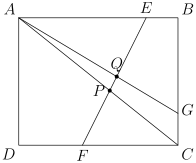
Rectangle has and Point lies on so that point lies on so that and point lies on so that Segments and intersect at and respectively. What is the value of
小提示:
先求 和 在 上的交点位置。
First find where and cut
大提示:
用相似三角形表示 与 。
Use similar triangles to express and
解答:
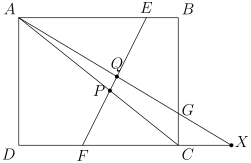
我们有 和 。因为 ,所以三角形 与 相似。于是 从而 。
延长 ,与直线 交于 。因为 ,由相似得 于是 。因此 。又因为 ,三角形 与 相似,所以 从而 。
因此
所以正确答案是 D。
We have and Since the triangles and are similar. Therefore so
Extend to meet line at Because similarity gives and hence . Thus Since triangles and are similar, so Consequently
It follows that
Thus, the correct answer is D .
20.
平面上的一次位似变换,也就是具有正比例因子的大小变换,把以 为圆心、半径为 的圆变成以 为圆心、半径为 的圆。在这个变换下,原点 移动了多远?
A dilation of the plane—that is, a size transformation with a positive scale factor—sends the circle of radius centered at to the circle of radius centered at What distance does the origin move under this transformation?
小提示:
位似比例因子是 。
The dilation scale factor is
大提示:
位似中心在两个圆心所在的直线上。
The center of dilation lies on the line through the two circle centers
解答:
半径从 变为 ,所以位似比例因子为 。位似中心 在 与 所在的直线上。
从 到 的向量为 。若 是位似中心,则由比例因子可得 于是 ,所以 。
以 为中心作比例因子为 的位似时,一个点移动的距离是它到 距离的一半。由于 ,原点移动的距离为 。
所以正确答案是 C。
The dilation scale factor is , since the radius changes from to . The center of dilation lies on the line through and .
The vector from to is . If is the dilation center, then the scale factor gives Thus , so
Under a scale factor dilation about , a point moves by half its distance from . Since , the origin moves .
Thus, the correct answer is C.
21.
方程 的图形围成区域的面积是多少?
What is the area of the region enclosed by the graph of the equation
小提示:
先在第一象限求面积,再乘以 。
Work in one quadrant and multiply by
大提示:
第一象限的区域是一个三角形加一个半圆。
The first-quadrant region is a triangle plus a semicircle
解答:
这个方程在四个象限中都是对称的。在第一象限里它化为 即
在第一象限中,围成的区域是直线 下方的三角形,面积为 ,再加上一个半径为 的半圆,面积为 。
乘以 ,总面积为
所以正确答案是 B。
The equation is symmetric in all four quadrants. In the first quadrant it becomes or
In the first quadrant, the enclosed region is the triangle under , with area , plus a semicircle of radius , with area .
Multiplying by , the total area is
Thus, the correct answer is B.
22.
一组队伍进行循环赛,每支队伍与其他每支队伍恰好比赛一次。每支队伍都赢了 场、输了 场,没有平局。有多少个三队集合 满足 击败 , 击败 ,且 击败 ?
A set of teams held a round-robin tournament in which every team played every other team exactly once. Every team won games and lost games; there were no ties. How many sets of three teams were there in which beat beat and beat
小提示:
先数所有三队集合,再减去没有循环胜负的集合。
Count all triples of teams, then subtract transitive triples
大提示:
每支队伍作为最强队,会出现在 个传递型三队集合中。
Each team is the top team in transitive triples
解答:
队伍总数为 。因此三队集合总数为 。
没有循环胜负的三队集合中,有一支队伍击败另外两支。选择这支队伍有 种方法,再从它击败的十支队伍中选两支,有 种方法。因此非循环集合有 个,循环集合数为 。
所以正确答案是 A。
The total number of teams is The total number of sets is therefore
Now, we must subtract the total number of sets such that there is no cycle. This only happens if one team beats the other two teams. There are choices for the team that beat the other two and ways to choose the teams they beat. Thus, the total of non-cycles is This means the total number of cycles is
Thus, the correct answer is A .
23.
在正六边形 中,点 、、、 分别选在边 、、、 上,使直线 、、、 互相平行且间距相等。六边形 的面积与六边形 的面积之比是多少?
In regular hexagon points and are chosen on sides and respectively, so lines and are parallel and equally spaced. What is the ratio of the area of hexagon to the area of hexagon
小提示:
延长 和 ,直到它们相交。
Extend and until they meet
大提示:
比较以延长交点为公共顶点的三个相似三角形的面积。
Compare the areas of three similar triangles with vertex at the extension point
解答:
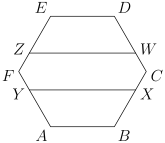
延长 和 ,直到它们相交于点 。
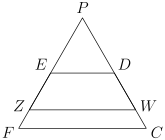
设 为 与 之间的距离。因为题中的四条直线彼此等距,且 恰好位于 与 的正中间,所以 到 的距离是 。设从 到 的高为 。等边三角形 与 的边长之比为 ,所以它们的高满足 从而 。因此 与 的边长之比为
取 ,由相似可得 和 。于是 所求的六边形由两块全等的 拼成,而正六边形由两块全等的 拼成。因此所求的比值是 。
所以正确答案是 C。
Extend and until they meet at
Let be the distance between and Because the four given lines are equally spaced and lies halfway between and the distance from to is Let the altitude from to be The equilateral triangles and have side lengths in the ratio so their altitudes satisfy giving Therefore the side-length ratio of to is
Taking similarity gives and Hence The desired hexagon consists of two congruent copies of while the regular hexagon consists of two congruent copies of Thus the requested ratio is
Thus, the correct answer is C .
24.
有多少个四位整数 ,其中 ,满足:三个两位数 构成一个递增等差数列?
其中一个例子是 ,此时 、、、。
How many four-digit positive integers with have the property that the three two-digit integers form an increasing arithmetic sequence?
One such number is where and
小提示:
等差数列条件是 。
The arithmetic-sequence condition is
大提示:
数字方程会分成两种进位情形。
The digit equation has two possible carry cases
解答:
由 ,可得 。等差数列条件为 整理得 右边是 的倍数。因为 ,四个符号都是数字,且 ,所以右边介于 和 之间。因此它只能是 或 。
情况 :
下面逐一考察 的可能值。
:。由第一个方程有 ,但这无法满足第二个方程。
:。由第一个方程有 ,由第二个方程有 ,所以只有 这一种情况。
:。由第一个方程有 ,由第二个方程有 ,所以 。给出三种情况。
:。由第一个方程有 ,由第二个方程有 ,所以 。给出四种情况。本情况的解为 共 个。
情况 : 这表示四个数字构成等差数列。
若公差为 ,则 ,给出 个解。
若公差为 ,则 ,给出 个解。若公差至少为 ,就会迫使 。因此本情况给出 个解。
总解数为 。
所以正确答案是 D。
From , we have The arithmetic-sequence condition is which rearranges to The right side is a multiple of Because and all four symbols are digits with it lies between and . Hence it is either or
Case
We can look at the possible values of
Thus, from the first equation, but can’t work for the second equation.
Thus, from the first equation, and from the second equation. This makes one case for
Thus, from the first equation, and from the second equation. This makes three cases for
Thus, from the first equation, and from the second equation. This makes four cases for Altogether this case gives for solutions.
Case which means the digits are an arithmetic sequence.
If the difference is then makes solutions.
If the difference is then makes solutions. A difference of at least would force This case therefore gives solutions.
In total, the number of solutions is
Thus, the correct answer is D .
25.
令 其中 表示小于或等于 的最大整数。当 时, 会取到多少个不同的值?
Let where denotes the greatest integer less than or equal to How many distinct values does assume for
小提示:
只有 的小数部分会影响函数值。
Only the fractional part of matters
大提示:
数出 时不同的断点 。
Count distinct breakpoints for
解答:
写 ,其中 。则 所以 只取决于小数部分 。
的值只会在 跨过某个分数 时改变,其中 ,。在 内这些不同分数的个数是
加上第一个断点之前的初始取值, 共有 个不同的值。
所以正确答案是 A。
Write , where . Then so depends only on the fractional part .
The value of changes only when crosses a fraction , where and . The number of distinct such fractions in is
Including the initial value before the first breakpoint, assumes distinct values.
Thus, the correct answer is A.