
2004 AMC 10B 详解
向下滚动即可查看来自 LIVE by Po-Shen Loh 的精心整理的解答,打印PDF 解答,查看答案,或参加完整限时模拟考试。
所有题目均经美国数学协会(MAA)官方合法授权使用。
1.
Misty Moon Amphitheater 的每一排有 个座位。第 排到第 排预留给一个青年俱乐部。这个俱乐部一共预留了多少个座位?
Each row of the Misty Moon Amphitheater has seats. Rows through are reserved for a youth club. How many seats are reserved for this club?
2.
有多少个两位正整数至少有一个数字是 ?
How many two-digit positive integers have at least one as a digit?
小提示:
分别数十位是 的数和个位是 的数。
Count the numbers with in the tens place and those with in the units place separately
大提示:
数 同时属于两类。
The number belongs to both groups
解答:
到 给出 个十位为 的两位数。
数列 给出 个个位为 的两位数。
因为 被重复计算一次,所以总数为 。
所以正确答案是 B。
The numbers through give with a in the tens place.
The numbers give with a in the units place.
Since is counted twice, the total is
Thus, the correct answer is B.
3.
上周每次篮球训练中,Jenny 罚中球数都是前一次训练的两倍。她第五次训练罚中 个球。她第一次训练罚中了多少个球?
At each basketball practice last week, Jenny made twice as many free throws as she made at the previous practice. At her fifth practice she made free throws. How many free throws did she make at the first practice?
小提示:
每次训练数目都是前一次的两倍,所以倒推时每次除以二。
Each practice count is twice the previous one, so work backward by halving
大提示:
从 开始反复减半,直到第一次训练。
Halve repeatedly to reach the first practice
解答:
从第五次训练倒推,罚中数依次为 和 ,对应第五、第四、第三、第二、第一次训练。
所以正确答案是 A。
Working backward from the fifth practice, the counts are and at the fourth, third, second, and first practices.
Thus, the correct answer is A.
4.
掷一个标准六面骰子,令 为可见的五个面上的数字之积。一定能整除 的最大数是多少?
A standard six-sided die is rolled, and is the product of the five numbers that are visible. What is the largest number that is certain to divide
小提示:
六个面数字的乘积是 ,恰好有一个面被遮住。
The product of all six faces is ; exactly one face is hidden
大提示:
对每个质因数,找出不论遮住哪个面都一定剩下多少个。
For each prime, find how many copies must remain no matter which face is hidden
解答:
因为 ,所以可见乘积只会用到质数 、 和 。
遮住 时剩下的因数 最少,为 。遮住 或 时剩下的因数 最少,为一个;遮住 时则没有因数 。
因此 一定能被 整除,但不一定能被更大的数整除。
所以正确答案是 B。
Since the visible product uses only the primes and
Hiding leaves the fewest ’s, namely Hiding or leaves the fewest ’s, namely one. Hiding leaves no factor of
Therefore is always divisible by but not necessarily by any larger number.
Thus, the correct answer is B.
5.
在表达式 中,、、 和 的值为 、、 和 ,但顺序不一定如此。结果的最大可能值是多少?
In the expression the values of and are and although not necessarily in that order. What is the maximum possible value of the result?
小提示:
要使结果最大,让被减去的值 。
To maximize the result, make the subtracted value
大提示:
剩下 、、 时,比较合理分配下的 。
With remaining, compare for the sensible assignments
解答:
取 可以去掉减法,所以只需用 、、 最大化 。
取 、、,得到 。另一种大幂 更小,而让 会迫使幂更小,所以最大值为 。
所以正确答案是 D。
Setting removes the subtraction, so we maximize using
Taking gives The alternative is smaller, and any assignment with forces a smaller power. The maximum is
Thus, the correct answer is D.
6.
下列哪个数是完全平方数?
Which of the following numbers is a perfect square?
小提示:
当 时,将 写成 。
For write as
大提示:
这个乘积是完全平方数,当且仅当 是完全平方数。
The product is a perfect square exactly when is
解答:
当 时, 等于 。前面的平方因子不影响判断,因此只需检查 是否为完全平方数。
五个选项的剩余因子分别为 、、、 和 。只有 是完全平方数。
因此 是完全平方数。
所以正确答案是 C。
For equals which is a perfect square precisely when is a perfect square.
For the five choices this leftover factor is and Only is a perfect square.
Therefore is the perfect square.
Thus, the correct answer is C.
7.
Isabella 从美国去加拿大旅行,带了 美元。在边境她把钱全部兑换,汇率为每 美元兑换 加元。花掉 加元后,她还剩 加元。 的各位数字之和是多少?
On a trip from the United States to Canada, Isabella took U.S. dollars. At the border she exchanged them all, receiving Canadian dollars for every U.S. dollars. After spending Canadian dollars, she had Canadian dollars left. What is the sum of the digits of
8.
Minneapolis-St. Paul International Airport 位于 St. Paul 市中心西南 英里处,也位于 Minneapolis 市中心东南 英里处。下列哪个数最接近 St. Paul 市中心与 Minneapolis 市中心之间的英里数?
Minneapolis-St. Paul International Airport is miles southwest of downtown St. Paul and miles southeast of downtown Minneapolis. Which of the following is closest to the number of miles between downtown St. Paul and downtown Minneapolis?
小提示:
西南方向和东南方向互相垂直。
Southwest and southeast are perpendicular directions
大提示:
距离为 ,再估计最接近的整数。
The distance is ; estimate the nearest whole number
解答:
两个给定方向互相垂直,因此机场位于一个直角三角形的直角顶点,两条直角边为 和 。
两个市中心之间的距离为 ,最接近 。
所以正确答案是 A。
The two given directions are perpendicular, so the airport sits at the right angle of a right triangle with legs and
The distance between the downtowns is which is closest to
Thus, the correct answer is A.
9.
一个正方形边长为 ,一个圆以该正方形的一个顶点为圆心、半径为 。正方形和圆所围区域的并集面积是多少?
A square has sides of length and a circle centered at one of its vertices has radius What is the area of the union of the regions enclosed by the square and the circle?
小提示:
将正方形面积和圆面积相加,再减去重叠部分。
Add the areas of the square and the circle, then subtract the overlap
大提示:
重叠部分是圆中位于正方形内部的四分之一圆。
The overlap is the quarter of the circle that lies inside the square
解答:
正方形面积为 ,圆面积为 。
因为圆心在正方形顶点,正好有四分之一圆位于正方形内部,面积为 。
并集面积为 。
所以正确答案是 B。
The square has area and the circle has area
Since the circle is centered at a vertex of the square, exactly one quarter of the circle, area lies inside the square.
The union has area
Thus, the correct answer is B.
10.
一位杂货商摆放罐头,最上面一排有一个罐头,每往下一排比上一排多两个罐头。如果这个展示架共有 个罐头,它有多少排?
A grocer makes a display of cans in which the top row has one can and each lower row has two more cans than the row above it. If the display contains cans, how many rows does it contain?
小提示:
各排罐头数为 。
The rows contain cans
大提示:
前 个奇数的和等于 。
The sum of the first odd numbers equals
解答:
各排罐头数为 ,前 个奇数的和为 。
令 ,得 。
所以正确答案是 D。
The rows hold cans, and the sum of the first odd numbers is
Setting gives
Thus, the correct answer is D.
11.
两个八面骰子的面都标有 到 。掷骰子时,每个面朝上的概率相同。两个朝上数字的乘积大于它们的和的概率是多少?
Two eight-sided dice each have faces numbered through When the dice are rolled, each face has an equal probability of appearing on the top. What is the probability that the product of the two top numbers is greater than their sum?
小提示:
条件 可改写为 。
The condition rearranges to
大提示:
反过来数满足 的有序对。
Count the ordered pairs where instead
解答:
共有 个有序结果。条件 等价于 。
不满足条件的情况只有 、,或 。这些情况共有 个。
因此概率为 。
所以正确答案是 C。
There are ordered pairs. The inequality is equivalent to
This fails only when or which account for pairs.
The probability is
Thus, the correct answer is C.
12.
圆环是两个同心圆之间的区域。图中同心圆半径分别为 和 ,其中 。令 为大圆半径, 在 点与小圆相切, 是经过 的大圆半径。设 、、。这个圆环的面积是多少?
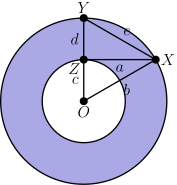
An annulus is the region between two concentric circles. The concentric circles in the figure have radii and with Let be a radius of the larger circle, let be tangent to the smaller circle at and let be the radius of the larger circle that contains Let and What is the area of the annulus?
小提示:
环形区域面积为 。
The annulus area is
大提示:
因为 在 点相切,三角形 是直角三角形,所以 。
Since is tangent at triangle is right-angled, giving
解答:
圆环面积是两个圆面积之差,即 。
因为 在 点与小圆相切,所以它垂直于半径 。在直角三角形 中,、、,所以 。
因此圆环面积为 。
所以正确答案是 A。
The annulus is the difference of the two circular areas,
Because is tangent to the small circle at it is perpendicular to the radius In right triangle with and we get
Therefore the area of the annulus is
Thus, the correct answer is A.
13.
美国硬币厚度如下:一分硬币为 毫米,五分硬币为 毫米,十分硬币为 毫米,二十五分硬币为 毫米。如果一叠这样的硬币高度正好为 毫米,那么这叠硬币有多少枚?
In the United States, coins have the following thicknesses: penny, mm; nickel, mm; dime, mm; quarter, mm. If a stack of these coins is exactly mm high, how many coins are in the stack?
小提示:
每种硬币厚度的百分位都是 ,所以考虑总高度小数末两位。
Every coin thickness ends in a in the hundredths place, so consider the height’s last two decimal digits
大提示:
要让总高度是整数毫米,硬币枚数必须是 的倍数。
For the height to be a whole number of mm, the number of coins must be a multiple of
解答:
把每个厚度都用百分之一毫米表示。四种可能的厚度为 、、、,它们都同余于 。若一摞有 枚硬币且高度为整数毫米,则以百分之一毫米表示的总厚度能被 整除,所以 能被 整除。因此 必须是 的倍数。
枚硬币的高度至多为 毫米, 枚硬币的高度至少为 毫米,所以只有 枚硬币可能恰好高 毫米。
事实上, 枚二十五美分硬币的高度为 毫米。
所以正确答案是 B。
Measure every thickness in hundredths of a millimeter. The four possible thicknesses are all congruent to If the stack has coins and an integer height, its total in hundredths is divisible by so is divisible by Therefore must be a multiple of
A stack of coins is at most mm, and a stack of coins is at least mm, so only coins can total mm.
Indeed, quarters give mm.
Thus, the correct answer is B.
14.
一个袋子最初只含红色和蓝色弹珠,且蓝色比红色多。向袋中加入红色弹珠,直到蓝色弹珠只占袋中弹珠的 。然后加入黄色弹珠,直到蓝色弹珠只占袋中弹珠的 。最后,将袋中蓝色弹珠的数量加倍。现在袋中弹珠有几分之几是蓝色?
A bag initially contains red marbles and blue marbles only, with more blue than red. Red marbles are added to the bag until only of the marbles in the bag are blue. Then yellow marbles are added to the bag until only of the marbles in the bag are blue. Finally, the number of blue marbles in the bag is doubled. What fraction of the marbles now in the bag are blue?
小提示:
设蓝色弹珠数为 ,追踪每一步的总数。
Let be the number of blue marbles and track the total at each stage
大提示:
在最后加倍之前,有 个蓝色弹珠,总数为 。
Just before doubling there are blue out of total
解答:
设蓝色弹珠数为 。加入红色弹珠后,总数为 ;加入黄色弹珠后,总数为 ,蓝色仍为 。
将蓝色弹珠数量加倍后,有 个蓝色弹珠,总数变为 ,所以蓝色所占比例为 。
所以正确答案是 C。
Let there be blue marbles. After adding red marbles the total is after adding yellow marbles the total is still with blue.
Doubling the blue marbles gives blue out of total, which is
Thus, the correct answer is C.
15.
Patty 有 枚硬币,由五分硬币和十分硬币组成。如果她的五分硬币都变成十分硬币,而十分硬币都变成五分硬币,她会多 美分。她现在的硬币总值是多少?
Patty has coins consisting of nickels and dimes. If her nickels were dimes and her dimes were nickels, she would have cents more. How much are her coins worth?
小提示:
交换后总值增加,说明她的五分硬币比十分硬币多。
Swapping raises the value, so she has more nickels than dimes
大提示:
每枚五分硬币与十分硬币的交换会改变 美分。
Each nickel-for-dime swap changes the total by cents
解答:
交换后价值增加,所以 Patty 的五分硬币比十分硬币多。每枚硬币交换后价值变化 美分,所以五分硬币比十分硬币多 枚。
两种硬币的数量满足 和 ,解得她有 枚五分硬币和 枚十分硬币。
她的硬币总值为 美分,即 。
所以正确答案是 A。
Swapping increases the value, so Patty has more nickels than dimes. Each swapped coin changes the total by cents, so she has more nickels than dimes.
With and she has nickels and dimes.
Her coins are worth cents, or
Thus, the correct answer is A.
16.
三个半径为 的圆两两外切,并且都与一个较大的圆内切。大圆的半径是多少?
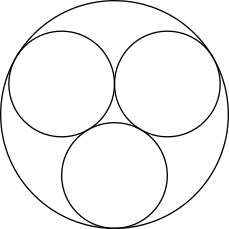
Three circles of radius are externally tangent to each other and internally tangent to a larger circle. What is the radius of the large circle?
小提示:
三个小圆的圆心形成边长为 的等边三角形。
The three small centers form an equilateral triangle of side
大提示:
大圆半径等于 加上该等边三角形中心到顶点的距离。
The large radius is plus the distance from that triangle’s center to a vertex
解答:
三个单位圆的圆心形成边长为 的等边三角形;它的中心就是大圆的圆心。
对于边长为 的等边三角形,中心到顶点的距离为 。
再加上单位圆半径,大圆半径为 。
所以正确答案是 D。
The centers of the three unit circles form an equilateral triangle with side Its center is the center of the large circle.
For an equilateral triangle of side length the distance from its center to a vertex is
Adding the unit radius, the large radius is
Thus, the correct answer is D.
17.
Jack 年龄的两个数字与 Bill 年龄的两个数字相同,但顺序相反。五年后 Jack 的年龄将是 Bill 那时年龄的两倍。他们现在年龄相差多少?
The two digits in Jack’s age are the same as the digits in Bill’s age, but in reverse order. In five years Jack will be twice as old as Bill will be then. What is the difference in their current ages?
小提示:
将 Jack 的年龄写成 ,Bill 的年龄写成 。
Write Jack’s age as and Bill’s as
大提示:
条件 可化简为 。
The condition reduces to
解答:
设 Jack 的年龄为 ,Bill 的年龄为 。条件给出 ,即 。
由于 和 是数字,唯一解为 、。
所以 Jack 为 岁,Bill 为 岁,差为 。
所以正确答案是 B。
Let Jack’s age be and Bill’s be In five years which simplifies to
Since and are digits, the only solution is
So Jack is and Bill is a difference of
Thus, the correct answer is B.
18.
在直角三角形 中,、、。点 、 和 分别在 、 和 上,且 、、。 的面积与 的面积之比是多少?
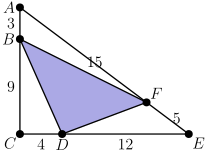
In right triangle we have and Points and are located on and respectively, so that and What is the ratio of the area of to that of
小提示:
的面积是 。
The area of is
大提示:
减去三个角上的三角形;每个角上三角形的底和高都是大三角形相应底和高的已知比例。
Subtract the three corner triangles; each has a base and height that are known fractions of the big triangle’s
解答:
的面积是 。
三个角上的三角形 、 和 的一组底和高,分别是 中对应底和高的 和 。所以每个小三角形的面积都是 面积的 。
因此
所以正确答案是 E。
The area of is
Each corner triangle and has a base and an altitude that are and of a corresponding base and altitude of So each has area of
Hence
Thus, the correct answer is E.
19.
在数列 、、、 中,第三项之后每一项等于前面两项的和减去紧前一项。例如第四项为 。这个数列的第 项是多少?
In the sequence each term after the third is found by subtracting the previous term from the sum of the two terms that precede that term. For example, the fourth term is What is the th term in this sequence?
小提示:
写出若干项:、、、、、、
Write out several terms:
大提示:
偶数位置的项每次减少 。
The even-position terms decrease by each time
解答:
递推式 给出 。数列开头为 、、、、、、。
因此偶数位置项形成等差数列 ,公差为 。第 项是这个等差数列的第 项,即 。
所以正确答案是 C。
The recurrence gives The sequence begins
So the even-position terms form the arithmetic sequence with common difference The th term is its nd term,
Thus, the correct answer is C.
20.
在 中,点 和 分别在 和 上。若 与 交于 ,且 、,求 。
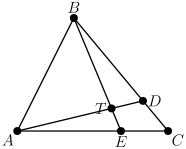
In points and lie on and respectively. If and intersect at so that and what is
21.
设 、、 和 、、 是两个等差数列。集合 是这两个数列各自前 项的并集。 中有多少个不同的数?
Let and be two arithmetic progressions. The set is the union of the first terms of each sequence. How many distinct numbers are in
小提示:
第一个数列公差为 ,最后一项为 。
The first sequence has common difference and last term
大提示:
公共项从 开始,间隔为 ;数出不超过 的公共项。
Common terms start at and are spaced by count the terms not exceeding
解答:
第一个数列为 ,最大项为 。第二个数列为 ,其最后一项更大,所以公共项上界由 限制。
公共项形如 ,因为第一个公共项为 ,且 。由 得 ,共有 个公共项。
因此不同数的个数为 。
所以正确答案是 A。
The first sequence is with largest term and the second is with a much larger last term, so the binding limit is
A common value has the form (the first shared term is spaced by ). Requiring gives that is common numbers.
The number of distinct values is
Thus, the correct answer is A.
22.
一个边长为 、 和 的三角形有内切圆和外接圆。这两个圆的圆心之间的距离是多少?
A triangle with sides of and has both an inscribed and a circumscribed circle. What is the distance between the centers of those circles?
小提示:
将直角三角形放在坐标系中,顶点取 、、。
Place the right triangle with vertices and
大提示:
直角三角形的外心是斜边中点;内切圆半径为 。
The circumcenter is the midpoint of the hypotenuse; a right triangle’s inradius is
解答:
因为 ,这是直角三角形。将顶点放在 、、,则外心为斜边中点 。
内切圆半径满足 ,所以 ,内心为 。
两圆心之间的距离为
所以正确答案是 D。
Since the triangle is right. Place it at The circumcenter is the midpoint of the hypotenuse,
The inradius satisfies so and the incenter is
The distance is
Thus, the correct answer is D.
23.
一个立方体的每个面独立地以概率 涂成红色或蓝色。这个涂色立方体可以放在水平面上,使四个竖直面颜色全相同的概率是多少?
Each face of a cube is painted either red or blue, each with probability The color of each face is determined independently. What is the probability that the painted cube can be placed on a horizontal surface so that the four vertical faces are all the same color?
小提示:
固定立方体方向,共有 种等可能涂色。
Fixing the cube’s orientation, there are equally likely colorings
大提示:
可行涂色包括:六面同色、恰好五面同色,或四面同色且剩下两面为相对面并为另一种颜色。
The working colorings are: all one color, exactly five one color, or four of one color with the opposite pair the other
解答:
固定立方体方向,共有 种涂色。
可行情况包括:六面同色,有 种;恰好五面同色,有 种;以及四个面同色而剩下的一对相对面为另一种颜色,有 组相对面、 种颜色,共 种。
总共有 种,所以概率为 。
所以正确答案是 B。
Fixing the orientation, there are colorings.
A coloring works if all six faces match ( ways), exactly five match ( ways), or four faces share a color with the remaining pair being opposite faces of the other color ( opposite pairs, colors, giving ways).
The total is so the probability is
Thus, the correct answer is B.
24.
在 中,、、。点 在三角形的外接圆上,使得 平分 。求 。
In we have and Point is on the circumscribed circle of the triangle so that bisects What is the value of
小提示:
设 交 于 ;圆周角定理给出 。
Let meet at inscribed angles give
大提示:
三角形 与三角形 相似,所以 ;再由角平分线定理求 。
Triangles and are similar, so find from the Angle Bisector Theorem
解答:
设 交 于 。因为 与 截同弧,所以它们相等;又有 ,因此 。
因此 。
由角平分线定理,,所以 。
因此
所以正确答案是 B。
Let meet at Since and subtend the same arc, they are equal, and so
Hence
By the Angle Bisector Theorem, so
Therefore
Thus, the correct answer is B.
25.
一个半径为 的圆在点 和 处分别与两个半径为 的圆内切,其中 是小圆的一条直径。求图中阴影区域面积,该区域位于小圆外部且在两个大圆内部。
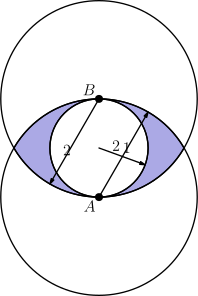
A circle of radius is internally tangent to two circles of radius at points and where is a diameter of the smaller circle. What is the area of the region, shaded in the figure, that is outside the smaller circle and inside each of the two larger circles?
小提示:
由对称性,阴影区域可以分成四个全等部分;先求其中四分之一。
By symmetry the shaded region splits into four congruent pieces; compute one quarter
大提示:
一个四分之一部分等于大圆的 扇形减去一个直角三角形,再减去小圆的四分之一。
One quarter is a sector of a large circle minus a right triangle minus a quarter of the small circle
解答:
设两个大圆圆心为 和 ,小圆圆心为 ,两个大圆的一个交点为 。
则 是直角三角形,且 、,所以 、,其面积为 。
阴影区域的四分之一等于半径为 的大圆中一个 扇形面积 ,减去 的面积 ,再减去小圆四分之一的面积 ,得到 。
乘以 ,阴影总面积为 。
所以正确答案是 B。
Let the large circles have centers and let be the center of the small circle, and let be a point where the two large circles meet.
Then is right with and so and its area is
One quarter of the shaded region equals the sector of the radius- circle (area ) minus (area ) minus a quarter of the small circle (area ), giving
Multiplying by the shaded area is
Thus, the correct answer is B.