
2022 AIME II 详解
向下滚动即可查看来自 LIVE by Po-Shen Loh 的精心整理的解答,打印PDF 解答,查看答案,或参加完整限时模拟考试。
所有题目均经美国数学协会(MAA)官方合法授权使用。
1.
一场音乐会中,成年人占观众人数的 。后来一辆载有 人的公共汽车到达,此时成年人占音乐会现场人数的 。求公共汽车到达后,现场成年人可能的最少人数。
Adults made up of the crowd of people at a concert. After a bus carrying more people arrived, adults made up of the people at the concert. Find the minimum number of adults who could have been at the concert after the bus arrived.
小提示:
设原来总人数为 ,则成年人数 是整数
Let the original crowd be people, so that the adult count is a whole number
大提示:
新总人数 必须能被 整除,因此 必须是 的倍数
The new total must be divisible by which forces to be a multiple of
解答:
设原来有 名观众,其中 人是成年人。公共汽车到达后共有 人,成年人数为 。要使其为整数, 必须整除 ,所以 整除 ,因为 ,所以 是 的倍数。
成年人数 随 增大而增大,因此最小值在 时取得:新总人数为 ,成年人数为 。这是可以实现的,例如公共汽车上有 名成年人和 名非成年人,所以答案是 。
Let the original crowd have people, of whom are adults. After the bus arrives there are people, and the number of adults is For this to be an integer, must divide so divides and since this means is a multiple of
The adult count increases with so the minimum occurs at the new total is and the number of adults is This is achievable, for example if the bus carries adults and non-adults, so the answer is
2.
Azar、Carl、Jon 和 Sergey 是单打网球锦标赛剩下的四名选手。他们被随机分配半决赛对手,半决赛的胜者再进行决赛以决出冠军。当 Azar 对 Carl 时,Azar 以 的概率获胜。当 Azar 或 Carl 对 Jon 或 Sergey 中的任意一人时,Azar 或 Carl 以 的概率获胜。假设不同比赛的结果相互独立。Carl 赢得锦标赛的概率为 ,其中 和 是互质的正整数。求 。
Azar, Carl, Jon, and Sergey are the four players left in a singles tennis tournament. They are randomly assigned opponents in the semifinal matches, and the winners of those matches play each other in the final match to determine the winner of the tournament. When Azar plays Carl, Azar will win the match with probability When either Azar or Carl plays either Jon or Sergey, Azar or Carl will win the match with probability Assume that outcomes of different matches are independent. The probability that Carl will win the tournament is where and are relatively prime positive integers. Find
小提示:
四人的配对共有三种等可能方式,其中 Carl 的半决赛对手恰有一种是 Azar
There are three equally likely pairings, and Carl’s semifinal opponent is Azar in exactly one of them
大提示:
若 Carl 的半决赛对手是 Jon 或 Sergey,则他的决赛对手以 的概率是 Azar,以 的概率是 Jon 或 Sergey
If Carl’s semifinal opponent is Jon or Sergey, his opponent in the final is Azar with probability and Jon or Sergey with probability
解答:
四名选手的三种配对方式等可能,所以 Carl 在半决赛对 Azar 的概率为 。在这种情况下,Carl 以 的概率战胜 Azar,再以 的概率战胜 Jon 和 Sergey 中的胜者,所以 Carl 赢得锦标赛的概率为 。
否则(概率为 ),Carl 对 Jon 或 Sergey,并以 的概率获胜。他在决赛中的对手以 的概率是 Azar(此时 Carl 以 的概率获胜),以 的概率是 Jon 或 Sergey(此时 Carl 以 的概率获胜)。所以在这种情况下,Carl 赢得锦标赛的概率为
总概率为 ,所以 。
The three ways to pair the four players are equally likely, so Carl plays Azar in the semifinal with probability In that case Carl beats Azar with probability and then beats the Jon–Sergey winner with probability so Carl wins the tournament with probability
Otherwise (probability ) Carl plays Jon or Sergey and wins with probability His opponent in the final is Azar with probability (Carl then wins with probability ) and is Jon or Sergey with probability (Carl then wins with probability ). So in this case Carl wins the tournament with probability
The total probability is so
3.
一个正四棱锥的体积为 ,底面边长为 。这个棱锥的五个顶点都在一个半径为 的球面上,其中 和 是互质的正整数。求 。
A right square pyramid with volume has a base with side length The five vertices of the pyramid all lie on a sphere with radius where and are relatively prime positive integers. Find
小提示:
体积决定高度:,由此求出高度。
The volume determines the height:
大提示:
球心在棱锥的轴线上;令它到顶点的距离等于它到底面顶点的距离,而底面顶点到轴线的距离为
The sphere’s center lies on the pyramid’s axis; set its distance to the apex equal to its distance to a base vertex, which sits from the axis
解答:
底面积为 ,所以 给出高度 。由对称性,球心在棱锥的轴线上,设其在底面上方的高度为 。每个底面顶点到轴线的距离为 ,所以球心到底面顶点的距离为 ,而它到顶点的距离为 。
令 ,得到 ,所以 。半径为 ,因此 。
The base has area so gives height By symmetry the sphere’s center lies on the pyramid’s axis, say at height above the base. Each base vertex is at distance from the axis, so the center’s distance to a base vertex is while its distance to the apex is
Setting gives so The radius is and
4.
存在一个正实数 ,它既不等于 也不等于 ,并且满足 数值 可写成 ,其中 和 是互质的正整数。求 。
There is a positive real number not equal to either or such that The value can be written as where and are relatively prime positive integers. Find
小提示:
把两边都换成同一个底:,再比较分子分母的差。
Change both sides to a common base:
大提示:
若 ,则两个分数也都等于 。应用这一点并化简所得商。
If then both fractions also equal Apply this and simplify the resulting quotient.
解答:
设公共值为 。用自然对数表示, 当两个分数相等时,它们也等于分子之差与分母之差的商:
为了验证这样的 确实存在,而不仅仅依赖题目给出的存在性,注意 。令 便有 。另外 所以 也成立。这个正实数 不等于题目排除的两个值(它们都不满足上面的线性方程),因此两个对数的底都有效。由于 ,得到 。
Let be the common value. In natural logarithms, When two fractions are equal, each also equals the quotient of the differences of numerators and denominators:
To check existence rather than merely use the promised note that Setting makes Also so as well. This positive is neither excluded value (neither one satisfies the displayed linear equation), so both logarithm bases are valid. Since we get
5.
在一个圆上标出二十个不同的点,并按顺时针顺序标号为 到 。若两点标号之差为质数,就在这两点之间画一条线段。求以原来的 个点为顶点形成的三角形个数。
Twenty distinct points are marked on a circle and labeled through in clockwise order. A line segment is drawn between every pair of points whose labels differ by a prime number. Find the number of triangles formed whose vertices are among the original points.
小提示:
对标号 ,三个差都必须是质数,并且 是另外两个差的和
For labels all three differences must be prime, and is the sum of the other two
大提示:
两个奇质数之和为偶数,所以其中一个差必须是 :差为 ,其中 和 都是质数
Two odd primes sum to an even number, so one difference must be the differences are with and both prime
解答:
一个三角形的顶点为 ,其中 、 和 都是质数。因为 是两个质数之和且本身也是质数,而两个奇质数之和为偶数,所以两个较小的差中必有一个等于 。因此两个较小的差按某种顺序为 ,其中 和 都是质数;满足 的孪生质数对为 、、 和 。
对每一对,居中的顶点可以离最小顶点距离 ,也可以离最小顶点距离 ,总跨度为 ,所以有 个三角形。四对分别给出 、、 和 。
总数为 。
A triangle has vertices where and are all prime. Since is a prime that is a sum of two primes, and the sum of two odd primes is even, one of the two smaller differences must equal So the differences are in some order with and both prime: the twin prime pairs with are and
For each pair, the middle vertex can be at distance or at distance from the smallest, and the total span is so there are triangles. This gives and for the four pairs.
The total is
6.
设 为实数,满足 且 。在所有这样的 元数组中, 能达到的最大值为 ,其中 和 是互质的正整数。求 。
Let be real numbers such that and Among all such -tuples of numbers, the greatest value that can achieve is where and are relatively prime positive integers. Find
小提示:
两个条件迫使正项之和为 ,负项之和为
The two conditions force the positive terms to sum to and the negative terms to sum to
大提示:
若 小于 ,仅前 项之和就会小于 ;用同样方式由最后 项约束
If were below the first terms alone would sum below bound the same way using the last terms
解答:
因为各项之和为 ,而绝对值之和为 ,正项之和为 ,负项之和为 。若 ,则 都小于 ,它们的和会小于 ,矛盾;因此 。类似地,若 ,则 这 项都大于 ,总和超过 ;因此 。
所以 。取 、 以及 ,即可取到这个值。
因为 ,答案为 。
Since the terms sum to while their absolute values sum to the positive terms sum to and the negative terms sum to If then are all less than and would sum below a contradiction; hence Similarly, if then are terms each exceeding summing above hence
Therefore and this is achieved by taking and
Since the answer is
7.
一个半径为 的圆与一个半径为 的圆外切。求这两个圆的三条公切线围成的三角形区域的面积。
A circle with radius is externally tangent to a circle with radius Find the area of the triangular region bounded by the three common tangent lines of these two circles.
小提示:
两条外公切线交于中心连线上的一点 ,它到两个圆心的距离之比为
The two external tangents meet at a point on the line through the centers, whose distances to the centers are in ratio
大提示:
第三条边是在切点处的公切线,垂直于中心连线。对 处的半角使用 。
The third side is the common tangent at the point of tangency, perpendicular to the center line. Use for the half-angle at
解答:
两个圆心 (半径 )和 (半径 )相距 。两条外公切线交于 线上小圆外侧的一点 ,并满足 。结合 ,得到 且 。每条外公切线与中心连线成角 ,其中 ,所以 。
第三条公切线是在两圆切点 处的切线,它在距 为 的位置垂直于 。三条切线围成的三角形以 为顶点,底边在这条直线上,高为 ,半底长为 。
面积为 。
The centers (radius ) and (radius ) are apart. The two external tangents meet at a point on line beyond the small circle, with Combined with this gives and Each external tangent makes angle with the center line, where so
The third common tangent is the tangent at the point of tangency which is perpendicular to at distance from The triangle bounded by the three tangents has apex and base on this line, with height and half-base
Its area is
8.
求满足 的正整数的个数,使得当 、 和 的值给定时,该正整数能在所有正整数中被唯一确定。这里 表示不超过实数 的最大整数。
Find the number of positive integers whose value can be uniquely determined among all positive integers when the values of and are given, where denotes the greatest integer less than or equal to the real number
小提示:
共享同一个向下取整三元组的整数形成一段连续整数,因此 恰好在这段长度为 时被确定
The integers sharing a given triple of floor values form a block of consecutive integers, so is determined exactly when its block has size
大提示:
这段长度为 当且仅当 和 中每一个都能被 中的至少一个整除。按模 的一个周期计数这些 。
The block has size exactly when each of and is divisible by at least one of Count such in one period of
解答:
共享给定三元组 的正整数集合是三个区间的交集,因此是一段连续整数。所以 被唯一确定,当且仅当 和 都不给出同一个三元组:在 处必须有某个向下取整值下降,这意味着 或 整除 ;在 处必须有某个向下取整值跳升,这意味着 或 整除 。
因为 和 不可能同为偶数, 的除数配对为 、、 和 。模 计算: 整除 且 整除 给出 ; 整除 且 整除 给出 ; 整除 且 整除 给出 ;而 整除 且 整除 给出 。并集是模 的 个剩余类 。
在 中,每个剩余类出现 次,所以个数为 。(注意 不满足: 不能被 中任何一个整除,所以 与 共享同一个三元组。)
The set of positive integers sharing a given triple is an intersection of three intervals, hence a block of consecutive integers. So is uniquely determined exactly when neither nor gives the same triple: some floor must drop at meaning or divides and some floor must jump at meaning or divides
Since and cannot both be even, the divisor pairs for are and Working modulo dividing and dividing gives dividing and dividing gives dividing and dividing gives and dividing and dividing gives The union is the residues modulo
Each residue occurs times among so the count is (Note fails: is divisible by none of so share ’s triple.)
9.
设 和 是两条不同的平行线。对正整数 和 ,不同的点 、、、、 位于 上,不同的点 、、、、 位于 上。此外,若对所有 、、、、 和 、、、、 都画出线段 ,则在 与 严格之间没有任何一点落在两条以上的线段上。当 且 时,求这个图形把平面分成的有界区域个数。图中显示当 且 时有 个区域。
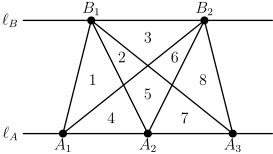
Let and be two distinct parallel lines. For positive integers and distinct points lie on and distinct points lie on Additionally, when segments are drawn for all and no point strictly between and lies on more than two of the segments. Find the number of bounded regions into which this figure divides the plane when and The figure shows that there are regions when and
小提示:
每选两个 点和两个 点,恰好产生一个内部交点,所以交点数为
Each choice of two ’s and two ’s produces exactly one interior crossing, so there are crossing points
大提示:
使用欧拉公式 :每个交点分割两条线段,所以这些线段贡献 条边
Use Euler’s formula each crossing splits two segments, so the segments contribute edges
解答:
两条线段 和 严格在两条直线之间相交,当且仅当两个 点的先后顺序与对应两个 点的先后顺序相反;任取两个 点和两个 点时,恰有一种配对会发生这种情况。由一般位置假设,这些交点互不相同,所以交点数为 。
将两条直线截成足够长的线段并应用欧拉公式。顶点包括 个标记点、 个交点和 个截断端点,所以 。直线 被分成 条边, 被分成 条边;每个交点分割两条所画线段,所以所画线段贡献 条边,得到 。于是 其中一个面是无界的,所以有 个有界区域。对 、,这给出 ,与图形一致。
对 和 : 。
Two segments and cross strictly between the lines exactly when one of the ’s comes first and the other’s comes first, which happens for exactly one pairing of any two ’s with any two ’s. By the general-position hypothesis these crossings are distinct, so there are of them.
Clip the two lines to long segments and apply Euler’s formula. The vertices are the marked points, the crossings, and the clipped line ends, so Line is divided into edges and into each crossing splits two segments, so the drawn segments contribute edges, giving Then of which one face is unbounded, so there are bounded regions. For this gives matching the figure.
For and
10.
求下式 除以 的余数。
Find the remainder when is divided by
11.
设 是一个凸四边形,满足 、、,且锐角 与 的角平分线相交于 的中点。求 面积的平方。
Let be a convex quadrilateral with and such that the bisectors of acute angles and intersect at the midpoint of Find the square of the area of
小提示:
将 关于从 出发的角平分线反射,并将 关于从 出发的角平分线反射:两个像都落在 上
Reflect over the bisector from and over the bisector from both reflections land on
大提示:
因为 ,所以中点 到两个反射像的距离相等,而这两个像在 上,分别距 为 、距 为
Since the midpoint is equidistant from the two reflections, which lie on at distances from and from
解答:
取 、,且 在坐标轴上方,并设 为 的中点。将 关于角平分线 反射,会把射线 变到射线 ,所以 映到 ,将 关于角平分线 反射,得到 。因为 在两条镜像线之上,,所以 到 与 等距,从而 ,其中 。
记 、,于是 且 。则 ,,而中点条件在 坐标上给出 。代入 和 ,清除分母后得到 ,所以 。(此时 坐标条件也自动满足: 。)
现在 、、、,所以 ,。对 使用鞋带公式,面积为 ,其平方为 。
Place and with above the axis, and let be the midpoint of Reflecting over the bisector line carries ray to ray so maps to and reflecting over the bisector gives Since lies on both mirror lines, so is equidistant from and and hence for some
Write and so and Then and and the midpoint condition on the -coordinates reads Substituting and and clearing denominators gives so (The -coordinate condition is then satisfied automatically: )
Now so and The shoelace formula on gives area whose square is
12.
设 、、 和 为实数,满足 且 ,并且 求 的最小可能值。
Let and be real numbers with and such that Find the least possible value of
小提示:
两个方程是经过同一点的椭圆:第一个的焦点为 ,第二个的焦点为 和
Both equations are ellipses through a common point: the first has foci the second has foci and
大提示:
是公共点到四个焦点的距离之和;将焦点配对,使三角不等式给出的线段实际相交
is the sum of the four focal distances of the common point; pair the foci so the triangle inequality gives segments that actually intersect
解答:
第一个椭圆有 ,所以焦点为 和 ,到两焦点的距离和为 。第二个椭圆以 为中心,长轴竖直,且 ,所以焦点为 和 ,到两焦点的距离和为 。若 在两个椭圆上,则 所以 。
等号要求 同时位于线段 和 上。这两条线段确实相交于 :此时 、,所以 ,;且 、,所以 ,。
因此 的最小可能值为 。
The first ellipse has hence foci and with distance sum The second is centered at with vertical major axis and hence foci and with distance sum If lies on both, then so
Equality requires to lie on both segments and These segments do intersect, at then so and so
Hence the least possible value of is
13.
存在一个整系数多项式 ,满足 对每个 都成立。求 中 的系数。
There is a polynomial with integer coefficients such that holds for every Find the coefficient of in
小提示:
写成 ,其中 ;由于 ,分子只贡献常数项
Write for since the numerator contributes only its constant term
大提示:
通过分别模 来固定 关于 的余数,从而计数 的解
Count solutions of by reducing modulo to pin down modulo
解答:
对 , 且每个因子 都可展开为等比级数。由于 ,因子 只贡献常数项 ,所以 的系数等于非负整数解 的个数。
模 化简给出 ,所以 为偶数;模 化简给出 ,所以 整除 ;模 化简给出 ,所以 ;模 化简给出 ,所以 。令 、、、,原方程变为 所以
由隔板法共有 个解,因此该系数为 。
For and each factor expands as a geometric series. Since the factor contributes only its constant term so the coefficient of is the number of nonnegative integer solutions of
Reducing modulo gives so is even; modulo gives so divides modulo gives so modulo gives so Writing turns the equation into so
By stars and bars there are solutions, so the coefficient is
14.
对满足 的正整数 、、,考虑面值为 、、 分的邮票集合,其中每种面值至少有一张。如果存在这样的集合,其子集合能组成从一分到 分的每一个整数分值,则令 为这种集合中邮票张数的最小值。求所有使得对某些 和 有 的 中,最小三个值的和。
For positive integers and with consider collections of postage stamps in denominations and cents that contain at least one stamp of each denomination. If there exists such a collection that contains sub-collections worth every whole number of cents up to cents, let be the minimum number of stamps in such a collection. Find the sum of the three least values of such that for some choice of and
小提示:
能组成 分迫使 。一个集合可行,当且仅当一分邮票能达到 ,一分和 分邮票合起来能达到 ,且总价值至少为 。
Making cent forces A collection works exactly when the ones reach the ones and ’s together reach and the total value is at least
大提示:
固定 时,邮票张数在 时最大,此时等于 ;对 ,它从不会达到
For fixed the stamp count is largest at where it equals for this never reaches
解答:
要组成 分,必须有 。设集合中有 张一分邮票、 张 分邮票、 张 分邮票。数值 只能用一分邮票组成,所以 ;数值 必须由一分和 分邮票组成,所以 ;总价值 必须至少为 。反过来,这三个条件也足够:若 ,一分和 分邮票能组成从一到 的所有值,而 分邮票会将其延伸到总价值为止。所以最优选择为先取 ,再取最小的 使 ,最后取最小的 达到 。
固定 时,任何 所需的邮票都不会多于 时的数量。事实上,对任意 ,取 张一分邮票和 张 分邮票。这 张较低面值的邮票总价值为 因为两边之差为 。再加入 张 分邮票,就得到一个至多有 张邮票的可行集合。当 时取到等号:必须有的 张一分邮票和一张 分邮票总价值为 ,而面值至多为 的邮票若少于 张,总价值就无法达到 。
对 ,端点界 给出 ,所以这个最大值至多为 ,没有 会给出 。对 ,任意 张邮票的总价值至多为 ,所以不可能组成从一分到 分的每个值。
对 ,取 ,便有 张一分邮票、一张 分邮票(达到 ),以及 张十一分邮票:。对 和 ,取 ,便有 张一分邮票、一张 分邮票(达到 ),以及 张 分邮票,两种情况下都是 。所以最小的三个 值为 ,和为 。
To form cent we need Suppose the collection has ones, stamps of and of The value must be made from ones alone, so the value must be made from ones and ’s, so and the total must be at least Conversely these three conditions suffice: with the ones and ’s make every value up to and then ’s extend this to every value up to the total. So the optimum takes then the least with then the least reaching
For fixed no can require more stamps than Indeed, for any take ones and stamps of These lower-denomination stamps have total value because the difference is Adding stamps of therefore gives a working collection of at most stamps. Equality is attained when the mandatory ones and one stamp have value and stamps of value at most cannot reach with fewer than stamps in total.
For the endpoint bounds give so this maximum is at most and no gives For any stamps have total value at most so they cannot cover every value through
For taking gives ones, one (reaching ), and elevens: For and taking gives ones, one (reaching ), and stamps of for in both cases. So the three least values of are with sum
15.
两个外切圆 和 的圆心分别为 和 ,第三个圆 经过 和 ,并与 交于 和 ,与 交于 和 ,如图所示。已知 、、,且 是一个凸六边形。求这个六边形的面积。
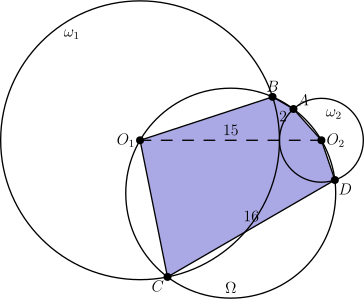
Two externally tangent circles and have centers and respectively. A third circle passing through and intersects at and and at and as shown. Suppose that and is a convex hexagon. Find the area of this hexagon.
小提示:
六个顶点都在 上,且 、 是 的弦,其中
All six vertices lie on and and are chords of with
大提示:
将每条弦写成 ,再用和差化积把 和 的方程相加相减,并使用两个等于 的事实
Write each chord as then add and subtract the and equations with sum-to-product, using both facts worth
解答:
六边形的六个顶点都在 上: 和 由题设在其上,而 是与 的交点。设 的半径为 ,并设边 、、、、、 所截的弧分别为 (两个 是因为弦 都等于 的半径;同理 ),所以 。每条弦都等于 :、,而弦 对应的弧为 ,给出 ,其中 。外切又给出一个值为 的等式:。
因为 ,所以 。和差化积给出 因此 。类似地, 给出 。结合 ,得到 ,所以 。另外 ,且 ,所以 ,从而 。
连接 的圆心和六个顶点,可将六边形分成六个三角形,所以面积为 。现在 ,而 ,因为 ,所以 。面积为 。
All six hexagon vertices lie on and by hypothesis, and as intersection points with Let be the radius of and let the arcs cut off by the sides be (the two ’s because chords the radius of and likewise ), so Each chord equals and the chord subtends giving where External tangency gives a second equation worth
Since we have Sum-to-product then gives so and similarly gives Combining with yields so Also with so and
Joining the center of to the six vertices splits the hexagon into six triangles, so its area is Now while since so The area is