
2005 AIME II 详解
向下滚动即可查看来自 LIVE by Po-Shen Loh 的精心整理的解答,打印PDF 解答,查看答案,或参加完整限时模拟考试。
所有题目均经美国数学协会(MAA)官方合法授权使用。
1.
一个游戏使用一副由 张不同卡片组成的牌,其中 是整数且 。从中抽取 张牌的组合数,是抽取 张牌的组合数的 倍。求 。
A game uses a deck of different cards, where is an integer and The number of possible sets of cards that can be drawn from the deck is times the number of possible sets of cards that can be drawn. Find
2.
一家旅馆为三位客人各打包了一份早餐。每份早餐本应包含三种小面包:坚果、奶酪和水果口味各一个。准备早餐的人把这九个小面包分别包好;包好后,这些小面包彼此无法区分。然后她随机在每位客人的袋子里放入三个小面包。已知每位客人都拿到每种口味各一个小面包的概率为 ,其中 和 是互质正整数,求 。
A hotel packed a breakfast for each of three guests. Each breakfast should have consisted of three types of rolls, one each of nut, cheese, and fruit rolls. The preparer wrapped each of the nine rolls, and, once they were wrapped, the rolls were indistinguishable from one another. She then randomly put three rolls in a bag for each of the guests. Given that the probability that each guest got one roll of each type is where and are relatively prime positive integers, find
小提示:
逐个抽取第一位客人袋中的三个小面包,求其中正好包含每种口味各一个的概率。
Find the chance the first guest’s bag has one roll of each type by drawing its three rolls one at a time
大提示:
在第一个袋子合格的条件下,第二个袋子从余下的六个小面包中抽取,其中每种口味各有两个;第三个袋子的内容随后自动确定。
Given the first bag is good, the second bag draws from six rolls, two of each type; the third bag is then forced
解答:
逐个装第一位客人的袋子。第一个小面包可以是任意口味;第二个必须避开与第一个同口味的剩余 个小面包,成功概率为 ;第三个必须是剩余 个中缺少口味的 个之一。因此第一个袋子含有每种口味各一个的概率为 。
在此条件下,剩下六个小面包,每种口味各两个,同样的论证给出第二个袋子的概率为 。此时第三个袋子自动是每种口味各一个。所求概率为 ,所以 。
Fill the first guest’s bag one roll at a time. The first roll can be anything; the second must avoid the remaining rolls of the first roll’s type, succeeding with probability and the third must be one of the rolls of the missing type among the remaining So the first bag has one roll of each type with probability
Given that, six rolls remain, two of each type, and the same argument gives for the second bag. The third bag is then automatically one of each type. The probability is so
3.
一个无穷等比级数的和为 。将原级数的每一项平方后得到一个新级数,其和是原级数和的 倍。原级数的公比为 ,其中 和 是互质正整数。求 。
An infinite geometric series has sum A new series, obtained by squaring each term of the original series, has sum times the sum of the original series. The common ratio of the original series is where and are relatively prime positive integers. Find
小提示:
平方后的级数仍是等比级数,首项为 ,公比为 。
The squared series is also geometric, with first term and ratio
大提示:
分解 ,得到 ,再与 比较。
Factor to get then compare with
解答:
设原级数首项为 ,公比为 ,则 。平方后的级数是首项 、公比 的等比级数,所以 因此 。
两个方程相除,得 ,所以 ,进而 ,。由于 且 ,该分数已最简,故 。
Let the original series have first term and ratio so The squared series is geometric with first term and ratio so which gives
Dividing the two equations, so giving and Since and the fraction is in lowest terms, and
4.
求至少整除 、、 中一个数的正整数个数。
Find the number of positive integers that are divisors of at least one of
小提示:
先由质因数分解数出每个数的因数个数,再修正重复计数。
Count the divisors of each number from its prime factorization, then fix the overcounting
大提示:
两个数的公共因数恰好是它们最大公因数的因数,例如 。
The common divisors of two of the numbers are exactly the divisors of their gcd, e.g.
解答:
由分解式 、 以及 ,它们的因数个数分别为 、 和 。
两个数的公共因数恰好是它们最大公因数的因数: 有 个因数, 有 个, 有 个。只有 同时整除三个数。
由容斥原理,所求个数为 。
From the factorizations and the divisor counts are and
The divisors common to two of the numbers are exactly the divisors of their gcd: has divisors, has and has Only divides all three numbers.
By inclusion-exclusion, the count is
5.
求整数有序对 的个数,使得 ,,且 。
Determine the number of ordered pairs of integers such that and
小提示:
令 ;因为 ,方程变为 。
Set since the equation becomes
大提示:
两种情形是 和 ;分别数出有多少 能使 。
The two cases are and count how many keep in each
解答:
令 。因为 ,方程变为 ,即 ,所以 或 。这意味着 或 。
对 ,需要 (因为 且 ),得到 个有序对。对 ,需要 (因为 且 ),得到 个有序对。
总共有 个有序对。
Let Since the equation becomes i.e. so or That means or
For we need (since and ), giving pairs. For we need (since and ), giving pairs.
In total there are ordered pairs.
6.
一叠 张卡片从上到下连续编号为 到 。取走上面的 张卡片,保持顺序,形成牌堆 。剩下的卡片形成牌堆 。现在把卡片重新叠成一叠,方法是分别从牌堆 和牌堆 的顶部交替取牌。在这个过程中,编号为 的卡片是新牌堆的底牌,编号为 的卡片放在它上面,如此继续,直到牌堆 和 都用完。如果重新叠牌后,每个牌堆中至少有一张卡片仍占据它在原来整叠牌中的位置,则称这叠牌为神奇牌堆。例如,八张卡片形成一叠神奇牌,因为编号为 和编号为 的卡片保留了原来的位置。求在编号为 的卡片保留原位置的神奇牌堆中,卡片的张数。
The cards in a stack of cards are numbered consecutively from through from top to bottom. The top cards are removed, kept in order, and form pile The remaining cards form pile The cards are now restacked into a single stack by taking cards alternately from the tops of pile and pile respectively. In this process, card number is the bottom card of the new stack, card number is on top of this card, and so on, until piles and are exhausted. If, after the restacking process, at least one card from each pile occupies the same position that it occupied in the original stack, the stack is called magical. For example, eight cards form a magical stack because cards number and number retain their original positions. Find the number of cards in the magical stack in which card number retains its original position.
小提示:
重新叠牌后,牌堆 的卡片以相反顺序占据从顶部数的奇数位置,牌堆 的卡片占据偶数位置。
After restacking, pile ’s cards fill the odd positions from the top in reverse order, and pile ’s fill the even positions
大提示:
卡片 必须来自牌堆 ,而牌堆 中原位置为 的卡片会落到位置 。
Card must come from pile and a pile- card at position lands at position
解答:
从底部往上读,新牌堆为 。因此牌堆 的卡片以相反顺序占据从顶部数的偶数位置,牌堆 的卡片以相反顺序占据奇数位置:原位置 (牌堆 )的卡片移到位置 ,而原位置 (牌堆 )的卡片移到位置 。
由于 是奇数,编号为 的卡片若要保持原位置,只能来自牌堆 ,因而 ,解得 。确实,,且这叠牌是神奇的,因为牌堆 中编号为 的卡片也保持不动:。这叠牌共有 张。
The new stack, read from the bottom up, is So pile ’s cards occupy the even positions from the top in reverse order, and pile ’s cards occupy the odd positions in reverse order: a card at original position (pile ) moves to position while a card at position (pile ) moves to position
Since is odd, card can keep its position only if it comes from pile so which gives Indeed and the stack is magical because card from pile also stays fixed: The stack has cards.
7.
设 求 。
Let Find
小提示:
令 ,并将分子和分母同乘以 。
Let and multiply the numerator and denominator by
大提示:
反复使用平方差公式会把分母化简为 。
Repeated difference of squares collapses the denominator to
解答:
令 。分子和分母同乘以 ,反复使用平方差公式后,分母中的各项会逐次相消:
因此 ,且 。
Let Multiplying the numerator and denominator by telescopes the denominator by repeated difference of squares:
Hence and
8.
圆 和 外切,并且它们都内切于圆 。 和 的半径分别为 和 ,且三个圆的圆心共线。 的一条弦同时也是 和 的一条公外切线。已知这条弦的长度为 ,其中 、 和 是正整数, 与 互质,且 不被任何质数的平方整除,求 。
Circles and are externally tangent, and they are both internally tangent to circle The radii of and are and respectively, and the centers of the three circles are all collinear. A chord of is also a common external tangent of and Given that the length of the chord is where and are positive integers, and are relatively prime, and is not divisible by the square of any prime, find
小提示:
相切条件迫使 的半径为 ,且其圆心位于连接另外两个圆心的线段上,距 的圆心为 。
Tangency forces to have radius with its center on the segment joining the other two centers, from ’s center
大提示:
共线圆心到切线的距离线性变化:中间圆心的距离为 。然后使用半弦构成的直角三角形。
Distances from the collinear centers to the tangent line vary linearly: the middle one is Then use the half-chord right triangle.
解答:
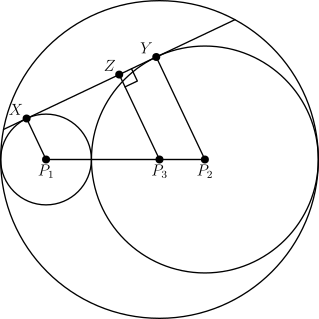
设 、、 为三个圆的圆心, 为 的半径。外切给出 ,内切给出 和 。由于圆心共线,,所以 ,且 位于 上,满足 和 。
向弦作垂线 ,,,于是 ,,且 是弦的中点。沿着直线 移动时,到切线的距离线性变化,而 位于从 到 的 处,所以
半弦长为 ,所以弦长为 。由于 无平方因子且 ,答案为 。
Let be the centers of the circles and the radius of External tangency gives and internal tangency gives and Since the centers are collinear, so and lies on with and
Drop perpendiculars to the chord, so and is the midpoint of the chord. The distance from a point moving along line to the tangent line changes linearly, and is of the way from to so
The half-chord is so the chord has length Since is squarefree and the answer is
9.
有多少个正整数 不超过 ,使得 对所有实数 都成立?
For how many positive integers less than or equal to is true for all real
小提示:
写成 且 。
Write and
大提示:
由棣莫弗定理,方程化为 ,因此 必须比 的某个倍数大 。
By de Moivre the equation reduces to so must be more than a multiple of
解答:
因为 且 ,由棣莫弗定理(应用于角 )可得
所以该等式对所有实数 成立,当且仅当 ,也就是 。数值 给出不超过 的 个正整数。
Since and de Moivre’s theorem (applied to angle ) gives
So the equation holds for all real exactly when that is, when The values give exactly positive integers up to
10.
已知 是一个正八面体, 是以 各面的中心为顶点的立方体,且 的体积与 的体积之比为 ,其中 和 是互质正整数,求 。
Given that is a regular octahedron, that is the cube whose vertices are the centers of the faces of and that the ratio of the volume of to that of is where and are relatively prime positive integers, find
小提示:
将八面体的顶点放在 、、,并把它看成两个四棱锥。
Place the octahedron’s vertices at and view it as two square pyramids
大提示:
每个面的重心是其三个顶点的平均值,所以立方体顶点为 。
Each face centroid is the average of its three vertices, so the cube’s vertices are
解答:
将八面体的顶点放在 、、。它由两个四棱锥沿着顶点为 和 的正方形拼合而成;该正方形面积为 ,每个四棱锥的高为 ,所以
每个面的重心是该面三个顶点的平均值,例如 ,因此立方体顶点为 。它的边长为 ,体积为 。
比值为 ,所以 。
Place the octahedron’s vertices at It is two square pyramids glued along the square with vertices and which has area and each pyramid has height so
Each face centroid is the average of that face’s three vertices, e.g. so the cube has vertices Its edge is and its volume is
The ratio is so
11.
设 是正整数,且 、、、 是一列实数,满足 、、,并且对 、、、 都有 求 。
Let be a positive integer, and let be a sequence of real numbers such that and for Find
小提示:
将递推式乘以 ,可看出乘积 每一步减少 。
Multiply the recurrence by to see that the products drop by at each step
大提示:
,且 恰好在乘积 达到 时发生。
and exactly when the product reaches
解答:
将递推式乘以 ,得 ,所以乘积 构成公差为 的等差数列。由于 ,得
因此当 时 ,所以 之前没有任何一项为零(递推式也不会除以零),而 且 。因此 ,所以 。
Multiplying the recurrence by gives so the products form an arithmetic sequence with common difference Since we get
Thus for so no term before can vanish (and the recurrence never divides by zero), while with Hence and
12.
正方形 的中心为 ,。点 和 在 上,且 , 在 与 之间,,并且 。已知 ,其中 、、 是正整数,且 不被任何质数的平方整除,求 。
Square has center and are on with and between and and Given that where and are positive integers and is not divisible by the square of any prime, find
小提示:
令 为 的中点;则 ,且射线 将 角分成 。
Let be the midpoint of then and ray splits the angle into
大提示:
由 和 ,得 ;然后解一个二次方程。
From and get then solve a quadratic
解答:
令 为 的中点,则 且 。设 、,它们位于射线 的两侧,则 ,,且 。由 ,得 。
正切加法公式给出 所以 。因此 和 是 的根,即 。
由于 且 ,条件 意味着 ,因此 。于是 ,且 。
Let be the midpoint of so and With and on either side of ray we have and From we get
The tangent addition formula gives so Hence and are the roots of namely
Since and the condition means so Then and
13.
设 是一个整系数多项式,满足 且 。已知方程 有两个不同的整数解 和 ,求乘积 。
Let be a polynomial with integer coefficients that satisfies and Given that the equation has two distinct integer solutions and find the product
小提示:
考虑 ,它在 和 处都等于 。
Consider which equals at both and
大提示:
若 ,则 整除 ;这两个因子都是整数且相差 。
If then divides those two factors are integers differing by
解答:
令 ,则 。由于 有整数系数并在 和 处为零, 其中 是某个整系数多项式。
若某个整数 满足 ,则 ,所以 整除 。因子 和 是相差 的整数,其乘积整除 ,所以它们为 或 ,得到 和 。这两个值确实能同时成为解,例如取 。
因此 。
Let so Since has integer coefficients and vanishes at and for some polynomial with integer coefficients.
If for an integer then so divides The factors and are integers differing by whose product divides so they are or giving and Both occur, for example, for
Hence
14.
在三角形 中,、、。点 在 上,且 。点 在 上,使得 。已知 ,其中 和 是互质正整数,求 。
In triangle and Point is on with Point is on such that Given that where and are relatively prime positive integers, find
小提示:
比较 与 :用 计算以 为顶点的三角形面积,并把每个比值写成面积之比。
Compare and by writing each as a ratio of triangle areas at vertex
大提示:
相等的角会配对:两个比值相乘得到 。
The equal angles pair up: multiplying the two ratios gives
解答:
线段 将对边分成的比满足 同理,。
因为 ,也有 (二者都是这个公共角加上 ),所以两个比值相乘时所有正弦都约去:。代入 、、 和 ,得
因而 。由于 是质数,且不整除 ,该分数已最简,所以 。
A cevian splits the opposite side in the ratio and similarly
Since we also have (each is that common angle plus ), so multiplying the two ratios cancels all the sines: With and this gives
Hence Since is prime and does not divide the fraction is in lowest terms, and
15.
设 和 分别表示圆 与 。在使直线 经过某个内切于 且外切于 的圆的圆心的所有正数 中,令 为最小值。已知 ,其中 和 是互质正整数,求 。
Let and denote the circles and respectively. Let be the smallest positive value of for which the line contains the center of a circle that is internally tangent to and externally tangent to Given that where and are relatively prime positive integers, find
小提示:
配方:两个圆的圆心为 和 ,半径为 和 。将两个相切距离条件相加。
Complete the square: the circles have centers and with radii and Add the two tangency distance conditions.
大提示:
圆心的轨迹是焦点为 的椭圆;代入 ,并要求判别式非负。
The centers trace an ellipse with foci substitute and require the discriminant to be nonnegative
解答:
配方得 和 ,圆心分别为 与 ,半径分别为 和 。若一个圆的圆心为 、半径为 ,且它内切于 、外切于 ,则 且 ,所以 。
因此 位于焦点为 和 、长轴为 的椭圆上:半长轴为 ,中心到焦点的距离为 ,所以半短轴平方为 ,得到 即 。代入 ,得到 。
直线 含有这样的圆心,当且仅当这个二次方程有实根,即 ,化简为 ,所以 。最小的正 满足 ,因而 。
Completing the square gives and with centers and and radii and If a circle with center and radius is internally tangent to and externally tangent to then and so
Thus lies on the ellipse with foci and and major axis the semimajor axis is the center-to-focus distance is so the semiminor axis squared is giving i.e. Substituting yields
The line contains such a center exactly when this quadratic has a real root, i.e. which simplifies to so The smallest positive such has and