
2001 AIME II 详解
向下滚动即可查看来自 LIVE by Po-Shen Loh 的精心整理的解答,打印PDF 解答,查看答案,或参加完整限时模拟考试。
所有题目均经美国数学协会(MAA)官方合法授权使用。
1.
设 是满足以下性质的最大正整数:从左到右看, 的每一对相邻数字都组成一个完全平方数。求 最左边的三位数字。
Let be the largest positive integer with the following property: reading from left to right, each pair of consecutive digits of forms a perfect square. What are the leftmost three digits of
小提示:
每一对相邻数字必须是两位完全平方数 、、、、、 之一。
Each adjacent digit pair must be one of the two-digit perfect squares
大提示:
每个数字至多只有一个可能的下一个数字,所以追踪各条链并取最长的一条。
Every digit has at most one possible next digit, so trace the chains and take the longest one
解答:
每一对相邻数字必须是两位完全平方数 、、、、、 之一。因此,若某个数字有后继,它就唯一确定这个后继:、、、、、,而 和 会结束这个数。
从每个可能的起始数字追踪,最长的数字串为 、 和 。五位链 长于其他所有链,所以 ,其最左边三位数字为 。
Each pair of consecutive digits must be one of the two-digit squares So each digit determines its successor uniquely if one exists: while and end the number.
Following these chains from each possible starting digit, the longest strings are and The five-digit chain beats everything else, so whose leftmost three digits are
2.
某高中的 名学生每人都学习西班牙语或法语,也有一些人两种语言都学。学习西班牙语的人数占全校总人数的百分之 到百分之 之间,学习法语的人数占百分之 到百分之 之间。设 为可能同时学习两种语言的最少学生数, 为可能同时学习两种语言的最多学生数。求 。
Each of the students at a high school studies either Spanish or French, and some study both. The number who study Spanish is between percent and percent of the school population, and the number who study French is between percent and percent. Let be the smallest number of students who could study both languages, and let be the largest number of students who could study both languages. Find
小提示:
若 人学西班牙语、 人学法语,则两种都学的人数是 。
If study Spanish and study French, then students study both
大提示:
百分比范围给出 和 ;将 推到两个极端。
The percentage bounds give and push to its two extremes
解答:
设学习西班牙语和法语的人数分别为 和 。因为每个学生至少学习一种语言,同时学习两种语言的人数为 。由范围 得 ,由 得 。
重叠人数在 最小时最小,所以 ;在 最大时最大,所以 。这两个极端都可以达到,因此 。
Let and be the numbers of students studying Spanish and French. Since every student studies at least one language, the number studying both is The bounds force and force
The overlap is smallest when is smallest, giving and largest when is largest, giving Both extremes are achievable, so
3.
前四项为 、、 和 。对 ,有 求 的值。
The first four terms are and For Find the value of
小提示:
将 的递推式代入 的公式,可得 。
Substitute the recurrence for into the formula for to get
大提示:
该数列以 为周期,所以把每个下标模 化简,并用已知值算出 。
The sequence repeats with period so reduce each subscript mod and compute from the given values
解答:
当 时,将 的递推式代入:因此 ,所以数列周期为 。
、 和 除以 的余数分别为 、 和 ,所以 、,且 。
所求和为 。
For substitute the recurrence for Hence so the sequence has period
Since and leave remainders and upon division by we get and
The sum is
4.
设 。方程为 和 的直线分别含有点 和 ,且 是 的中点。长度 等于 ,其中 和 是互质正整数。求 。
Let The lines whose equations are and contain points and respectively, such that is the midpoint of The length equals where and are relatively prime positive integers. Find
小提示:
写成 、,这样两个直线条件会自动满足。
Write and so that both line conditions hold automatically
大提示:
中点条件给出 和 ;解出 和 ,再用距离公式。
The midpoint condition gives and solve for and then use the distance formula
解答:
两条直线上的点可写成 和 。因为 是 的中点, 且
第二个方程给出 ;代入第一个方程,得 ,所以 ,且 。于是 ,。
因而 ,所以 。
Points on the two lines can be written and Since is the midpoint of and
The second equation gives substituting into the first, so and Thus and
Then so
5.
一组正数若有三个不同元素可以作为某个面积为正的三角形的边长,则称它具有三角形性质。考虑由连续正整数组成的集合 ,并且它的每个十元素子集都具有三角形性质。求 的最大可能值。
A set of positive numbers has the triangle property if it has three distinct elements that are the lengths of the sides of a triangle whose area is positive. Consider sets of consecutive positive integers, all of whose ten-element subsets have the triangle property. What is the largest possible value of
小提示:
在没有三角形的集合中,每个元素至少必须是前两个元素之和。
In a set with no triangle, each element must be at least the sum of the two preceding elements
大提示:
从 开始的最小十元素无三角形集合按斐波那契式增长:。它的最大元素决定 应停在哪里。
The smallest triangle-free ten-element set starting from grows like Fibonacci: Its largest element tells you where must stop.
解答:
设某个十元素集合 没有三角形。那么任意三个元素都不满足严格三角不等式;特别地,对每个 ,都有 。从 和 出发,依次迫使 、、、、、、,且 。
因此若 , 的任何十元素子集都无法避开三角形,因为它的最大元素至少要达到 。反过来,取每一步都等号成立, 是 中一个没有三角形的子集。
所以最大可能值为 。
Suppose a ten-element set has no triangle. Then every three elements fail the strict triangle inequality; in particular for each Starting from and this forces and
So if no ten-element subset of can avoid triangles, since its largest element would have to be at least Conversely, taking equality throughout, the subset of has no triangle.
Therefore the largest possible value is
6.
正方形 内接于一个圆。正方形 的顶点 和 在 上,顶点 和 在圆上。正方形 的面积与正方形 的面积之比可表示为 ,其中 和 是互质正整数且 。求 。
Square is inscribed in a circle. Square has vertices and on and vertices and on the circle. The ratio of the area of square to the area of square can be expressed as where and are relatively prime positive integers and Find
小提示:
将圆心放在原点;若 的边长为 ,则圆为 。
Put the circle’s center at the origin; if has side the circle is
大提示:
若 的边长为 ,则 在圆上,得到 。
If has side then lies on the circle, giving
解答:
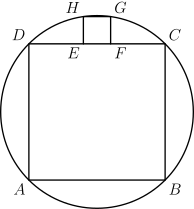
将圆心放在原点,设 的边长为 ,于是圆为 ,边 位于直线 上。小正方形立在 上,并在 外侧:若它的边长为 ,由对称性 ,且该点必须在圆上。
代入得 ,展开为 ,即 。因为 ,得 。
面积比为 ,所以 ,,且 。
Center the circle at the origin and let have side so the circle is and side lies on the line The small square sits on outside if its side is then by symmetry which must lie on the circle.
Substituting, which expands to or Since we get
The ratio of areas is so and
7.
设 是直角三角形,且 ,,。令 为其内切圆。作 ,其中 在 上、 在 上,使得 垂直于 并与 相切。作 ,其中 在 上、 在 上,使得 垂直于 并与 相切。令 为 的内切圆, 为 的内切圆。 和 的圆心距离可写为 。求 。
Let be a right triangle with and Let be the inscribed circle. Construct with on and on such that is perpendicular to and tangent to Construct with on and on such that is perpendicular to and tangent to Let be the inscribed circle of and the inscribed circle of The distance between the centers of and can be written as What is
小提示:
将 放在原点。大内切圆半径为 ,所以 和 是直线 与 。
Put at the origin. The big incircle has radius so and are the lines and
大提示:
三角形 和 分别与原三角形相似,比例为 和 ;用坐标确定两个小内切圆圆心。
Triangles and are similar to the original with ratios and locate each small incircle’s center in coordinates
解答:
直角在 ,所以令 、、。直角三角形的内切圆半径等于两条直角边之和减去斜边后的一半:,所以 的圆心为 。在 靠近 的一侧,垂直于 的切线为 ;在靠近 的一侧,垂直于 的切线为 。
三角形 与三角形 相似,比例为 ,所以其内切圆半径为 ,内切圆 的圆心为 。三角形 与三角形 相似,比例为 ,所以其内切圆半径为 , 的圆心为 。
两圆心距离的平方为 ,所以 。
The right angle is at so place The inradius of a right triangle is half the difference between the sum of the legs and the hypotenuse: so has center The tangent line to perpendicular to (on the side toward ) is and the tangent perpendicular to (toward ) is
Triangle is similar to triangle with ratio so its inradius is and its incircle is centered at Triangle is similar to triangle with ratio so its inradius is and is centered at
The squared distance is so
8.
某函数 满足:对所有正实数 ,都有 ;并且当 时,。求满足 的最小 。
A certain function has the properties that for all positive real values of and that for Find the smallest for which
小提示:
用 计算 ,因为 落在 中。
Use to compute since lies in
大提示:
在 上,图像是一个峰值为 的帐篷形;找第一个峰值达到 的区间。
On the graph is a tent peaking at height so look in the first interval whose peak reaches
解答:
连续使用 六次得 ,且 在 中,所以
对 有 ,这是一个最大值为 的帐篷形函数。要取得 ,需要 ,所以 。最小的解会在 中,此时 。
令 ,得 ,所以 或 。最小的 是 。
Applying six times gives and lies in so
For we have a tent whose maximum value is To achieve we need so and the smallest solutions lie in where
Setting gives so or The smallest is
9.
一个 乘 的单位正方形网格中,每个单位正方形要被涂成蓝色或红色。对每个小方格,两种颜色被使用的概率相等。得到一个不含 乘 红色正方形的网格的概率为 ,其中 和 是互质正整数。求 。
Each unit square of a -by- unit-square grid is to be colored either blue or red. For each square, either color is equally likely to be used. The probability of obtaining a grid that does not have a -by- red square is where and are relatively prime positive integers. Find
小提示:
对四个可能的 乘 全红方块位置,用容斥法计算补事件。
Count the complement by inclusion-exclusion on the four possible positions of a -by- red square
大提示:
两个相交的 乘 方块覆盖 或 个格子,任意三个覆盖 个格子,四个全部覆盖 个格子;每个被强制为红色的格子贡献因子 。
Two overlapping -by- blocks cover or cells, any three cover and all four cover each forced cell contributes a factor
解答:
对四个可能位置使用容斥法,计算网格中含有一个全红 乘 方块的概率。一个方块强制 个格子为红色;两个方块若共边,则强制 个格子为红色,共有 对;另外两对对角位置各强制 个格子为红色。任意三个方块强制 个格子,四个方块强制全部 个格子。
每种强制红色格子的配置概率为 ,所以至少有一个全红方块的概率是
所求概率为 ,且 与 互质,因此 。
Compute the probability that the grid does contain an all-red -by- block by inclusion-exclusion over the four possible positions. One block forces cells; two blocks sharing an edge force cells ( such pairs), while the two diagonal pairs force any three blocks force cells, and all four force all
Each configuration of forced red cells has probability so the probability of at least one red block is
The desired probability is and is coprime to so
10.
有多少个 的正整数倍可以表示为 的形式,其中 和 是整数且 ?
How many positive integer multiples of can be expressed in the form where and are integers and
小提示:
分解 ,并注意 与 互质。
Factor and note that is coprime to
大提示:
能被 整除当且仅当 是 的倍数,所以只需数出满足 且 为 的倍数的有序对。
is divisible by exactly when is a multiple of so count pairs with a multiple of
解答:
分解得 。由于 与 互质,我们需要 能被 整除。 模 、模 、模 的乘法阶分别为 、、,所以 当且仅当 是 的倍数。不同的 给出不同的值,因此只需计数这些有序对。
若 ,其中 ,则 可取 ,共有 种。总数为
Factor Since is coprime to we need to be divisible by The multiplicative order of is modulo modulo and modulo so exactly when is a multiple of Distinct pairs give distinct values, so we just count the pairs.
For with the index can be giving choices. The total is
11.
Truncator 俱乐部与另外六支队同在一个足球联赛中,并与每支队比赛一次。在它的 场比赛中,Truncator 俱乐部获胜、失利、打平的概率各为 。Truncator 俱乐部赛季结束时胜场数多于负场数的概率为 ,其中 和 是互质正整数。求 。
Club Truncator is in a soccer league with six other teams, each of which it plays once. In any of its matches, the probabilities that Club Truncator will win, lose, or tie are each The probability that Club Truncator will finish the season with more wins than losses is where and are relatively prime positive integers. Find
小提示:
由对称性,胜场数多于负场数和负场数多于胜场数的概率相等。
By symmetry, more wins than losses and more losses than wins are equally likely
大提示:
求胜场数等于负场数的概率:对每个 ,数出恰有 场胜、 场负、 场平的结果数。
Find the probability of equally many wins and losses: count outcomes with wins, losses, and ties for each
解答:
交换胜负是保持概率不变的对称操作,所以胜场多于负场的概率 等于负场多于胜场的概率。因此 ,其中 是胜场数和负场数相等的概率。
若有 场胜、 场负、 场平,则这些结果可排列成 种。当 时,这些数量分别为 、、、,总计 。所有 个结果序列等可能,所以 。
因此 ,所以 。
Swapping wins and losses is a probability-preserving symmetry, so the probability of more wins than losses equals the probability of more losses than wins, giving where is the probability of equally many wins and losses.
An outcome with wins, losses, and ties can be arranged in ways: for totaling Each of the outcome sequences is equally likely, so
Therefore and
12.
对一个三角形,它的中点三角形由连接三边中点得到。递归定义一列多面体 如下: 是体积为 的正四面体。为了得到 ,将 的每个面上的中点三角形替换为一个向外突出的正四面体,该中点三角形作为这个正四面体的一个面。 的体积为 ,其中 和 是互质正整数。求 。
Given a triangle, its midpoint triangle is obtained by joining the midpoints of its sides. A sequence of polyhedra is defined recursively as follows: is a regular tetrahedron whose volume is To obtain replace the midpoint triangle of every face of by an outward-pointing regular tetrahedron that has the midpoint triangle as a face. The volume of is where and are relatively prime positive integers. Find
小提示:
的每个面会被替换成 个半边长的面,所以 有 个面。
Each face of is replaced by half-size faces, so has faces
大提示:
第 步添加的每个四面体体积为 ,所以添加的总体积为 。
The tetrahedra added at step each have volume so the total volume added is
解答:
在某个面上的中点三角形处贴上一个四面体,会把原来的面替换成 个边长为一半的等边三角形: 个角上的三角形,加上新四面体暴露出的 个面。因此 的所有面全等,边长为原来的 倍,且 有 个面。
从 到 时,每个面上粘上一个正四面体;每个新四面体都与 相似,比例为 ,因而体积为 。增加的体积为
因此 的体积为 ,所以 。
Attaching a tetrahedron over the midpoint triangle of a face replaces that face by equilateral triangles of half the side length: the corner triangles plus exposed faces of the new tetrahedron. So all faces of are congruent, with side times the original, and has faces.
Passing from to glues one regular tetrahedron onto each face; each is similar to with ratio hence has volume The volume added is
Therefore the volume of is and
13.
在四边形 中, 且 ,并且 、、。长度 可写成 的形式,其中 和 是互质正整数。求 。
In quadrilateral and and The length may be written in the form where and are relatively prime positive integers. Find
小提示:
延长 和 交于 ; 与 处的相等角会迫使 。
Extend and to meet at the equal angles at and force
大提示:
角 和 分别是题中相等角的补角,所以三角形 与 相似。
Angles and are supplements of the given equal angles, so triangles and are similar
解答:
将 越过 延长,将 越过 延长,交于 。因为 ,三角形 是等腰三角形,且 。另外,,,所以 。
三角形 与 共用角 ,并且 ,所以它们相似,得到 因为 ,中间的比例为 ,所以 ,且 。于是 。
最后 ,已经是最简形式,所以 。
Extend beyond and beyond to meet at Since triangle is isosceles with Also and so
Triangles and share angle and have so they are similar, giving Since the middle ratio reads so and Then
Finally which is in lowest terms, so
14.
有 个复数同时满足 和 。这些数形如 ,其中 ,且角以度为单位。求 的值。
There are complex numbers that satisfy both and These numbers have the form where and angles are measured in degrees. Find the value of
小提示:
将方程改写为 ,并取绝对值:。
Rewrite the equation as and take absolute values:
大提示:
到 和 的距离都为 ,所以 ;再推出 ,从而推出 模 。
is at distance from both and so deduce and hence mod
解答:
记 。原方程为 。取绝对值并使用 ,得 ,所以 到 和 的距离都为 :它等于 。
若 ,则 ,所以 ,并且 因此 ,即 。反过来,每个这样的 都满足条件,因为此时 ,且 。类似地, 的情形恰好给出 。
因此 个角按从小到大排列为 ,并且 。
Write The equation says Taking absolute values and using gives so is at distance from both and it is
If then so and which means i.e. Conversely every such works, since then and The case similarly gives exactly
So the angles in increasing order are and
15.
设 、 和 是一个立方体的三个相邻正方形面,且 , 是该立方体的第八个顶点。令 、、 分别在 、、 上,满足 。在立方体中钻出一个隧道后,得到立体 。隧道的侧壁是平行于 的平面,并且分别包含边 、 和 。 的表面积(包括隧道壁)为 ,其中 、、 是正整数,且 不被任何素数的平方整除。求 。
Let and be three adjacent square faces of a cube, for which and let be the eighth vertex of the cube. Let and be points on and respectively, so that A solid is obtained by drilling a tunnel through the cube. The sides of the tunnel are planes parallel to and containing the edges and The surface area of including the walls of the tunnel, is where and are positive integers and is not divisible by the square of any prime. Find
小提示:
取 、;每个隧道壁都是过三角形 一条边且方向为 的平面。
Take and each tunnel wall is a plane through one edge of triangle in the direction
大提示:
隧道从六个立方体面各切去面积 ,且三面隧道壁每面都是一个 的长方形加一个小三角形。
The tunnel cuts area from each of the six cube faces, and each of the three walls is a rectangle plus a small triangle
解答:
令 、,于是 、、,且 的方向为 。从 沿这个方向的直线在 处离开立方体;类似地, 和 分别对应 和 。经过 和 的隧道壁所在平面为 ,它也包含 和 ,并在 -轴上交于 ;另外两面隧道壁对称地在 -轴和 -轴上分别交于 和 。
现在求总表面积。靠近 的三个立方体面各少掉一个直角边为 的直角三角形(如 ),剩余面积为 。靠近 的三个面各少掉面积为 的四边形;在平面 上,这个四边形的顶点为 、、、。每面隧道壁都是像 这样的五边形:长方形 中,、,面积为 ;等腰三角形 的底边 ,高为 ,再增加 ,所以每面隧道壁面积为 。
总表面积为 ,所以 。
Place and so that and has direction The line through in that direction leaves the cube at similarly and lead to and The tunnel wall through and is the plane which also contains and and crosses the -axis at the other two walls behave symmetrically, crossing the - and -axes at and
Now add up the surface. Each of the three cube faces at loses a right triangle with legs (such as ), leaving area Each of the three faces at loses a quadrilateral of area on the face its vertices are Each tunnel wall is a pentagon like the rectangle with and has area and the isosceles triangle with base and height adds for per wall.
The total surface area is so