
2024 AMC 12A Problems
Scroll down and press Start to try the exam! Or, go to the printable PDF, answer key, or professional solutions curated by LIVE by Po-Shen Loh.
All problems are used with official legal permission of the Mathematical Association of America (MAA).
Or jump straight to a single problem with its solution: 1 · 2 · 3 · 4 · 5 · 6 · 7 · 8 · 9 · 10 · 11 · 12 · 13 · 14 · 15 · 16 · 17 · 18 · 19 · 20 · 21 · 22 · 23 · 24 · 25
Want to learn professionally through interactive video classes?
Timed
1:15:00
1.
What is the value of
Answer: A
Small Hint:
Big Hint:
Solution:
Directly, and Their difference is Thus, the correct answer is A.
2.
A model used to estimate the time it will take to hike to the top of a mountain on a trail is of the form where and are constants, is the time in minutes, is the length of the trail in miles, and is the altitude gain in feet. The model estimates that it will take minutes to hike to the top if a trail is miles long and ascends feet, as well as if a trail is miles long and ascends feet.
How many minutes does the model estimate it will take to hike to the top if the trail is miles long and ascends feet?
Answer: B
Small Hint:
Set the two estimates equal:
Big Hint:
This gives so
Solution:
From we get so Then giving and For Thus, the correct answer is B.
3.
The number is written as the sum of not necessarily distinct two-digit numbers. What is the least number of two-digit numbers needed to write this sum?
Answer: B
Small Hint:
The largest two-digit number is so many numbers are needed
Big Hint:
which falls short; can numbers reach exactly
Solution:
Each number is at most so numbers sum to at most Since at least numbers are required. With we can use twenty s and one : Thus, the correct answer is B.
4.
What is the least value of such that is a multiple of
Answer: D
Small Hint:
Factor
Big Hint:
must contain the prime so
Solution:
Factoring, The factorial contains the prime only when At the product already includes and plenty of factors of so is a multiple of Thus, the correct answer is D.
5.
A data set containing numbers, some of which are has mean When all the s are removed, the data set has mean How many s were in the original data set?
Answer: D
Small Hint:
The numbers sum to
Big Hint:
If there are sixes, the remaining numbers sum to
Solution:
The full set sums to Removing sixes leaves numbers summing to with mean so Then giving Thus, the correct answer is D.
6.
The product of three integers is What is the least possible positive sum of the three integers?
Answer: B
Small Hint:
Integers may be negative; the product stays positive with two negative factors
Big Hint:
Writing the numbers as with minimize while keeping it positive
Solution:
To obtain a small positive sum, use two negative integers and one positive integer where Up to order, the positive factor triples of are A positive value of is smallest when the largest factor is chosen as The positive values from the list are the last two triples give negative values. Thus the least positive sum is (Three positive integers have sum at least and three negative integers cannot have positive product.) Thus, the correct answer is B.
7.
In and Points lie on hypotenuse so that
What is the length of the vector sum
Answer: D
Small Hint:
The points are symmetric about the midpoint of so the vectors pair up
Big Hint:
The sum equals the median to the hypotenuse of a right triangle is half the hypotenuse
Solution:
The points are symmetric about the midpoint of so pairing with its mirror gives Hence the whole sum is In a right triangle the median to the hypotenuse has length half the hypotenuse; here so The length of the sum is Thus, the correct answer is D.
8.
How many angles with satisfy
Answer: A
Small Hint:
which must equal
Big Hint:
A product of two numbers each at most equals only when both equal
Solution:
The equation means with both factors positive (for the logs to be defined). Since and their product is only if and simultaneously. But forces where No angle works. Thus, the correct answer is A.
9.
Let be the greatest integer such that both and are perfect squares. What is the units digit of
Answer: E
Small Hint:
Let and subtract to get
Big Hint:
with both factors even; to maximize make as small as possible
Solution:
Write and so i.e. Both factors have the same parity, hence both even. To maximize (and thus ), minimize take so Then whose units digit is Thus, the correct answer is E.
10.
Let be the radian measure of the smallest angle in a right triangle. Let be the radian measure of the smallest angle in a right triangle. In terms of what is
Answer: C
Small Hint:
apply the double-angle formula for
Big Hint:
is the reciprocal of
Solution:
The smallest angle of the triangle has Then The smallest angle of the triangle has Hence Thus, the correct answer is C.
11.
There are exactly positive integers with such that the base- integer is divisible by (where is in base ten). What is the sum of the digits of
Answer: D
Small Hint:
so you need to be divisible by
Big Hint:
Reduce and count in each valid residue class of
Solution:
Here so is divisible by exactly when is divisible by Checking residues precisely for
Counting in residue gives ( values), residue gives ( values), and residue gives ( values). So and its digit sum is
Thus, the correct answer is D.
12.
The first three terms of a geometric sequence are the integers and where What is the sum of the digits of the least possible value of
Answer: E
Small Hint:
The middle term gives so
Big Hint:
To minimize take the largest divisor of
Solution:
Since the terms are geometric, so Because minimizing means finding the smallest divisor of greater than There is no divisor strictly between and if its exponent of is or then after dividing by or respectively, a number of the form would have to lie in or the allowed powers give none. Since is a divisor, it is the least possible Its paired divisor is and the digit sum of is Thus, the correct answer is E.
13.
The graph of has an axis of symmetry. What is the reflection of the point over this axis?
Small Hint:
The axis of symmetry is the vertical line where the function attains its minimum
Big Hint:
Set the derivative to find then reflect across it
Solution:
The curve is symmetric about the vertical line through its minimum. Setting the derivative gives so Reflecting across keeps the -coordinate and sends to The image is Thus, the correct answer is D.
14.
The numbers, in order, of each row and the numbers, in order, of each column of a array of integers form an arithmetic progression of length The numbers in positions and are and respectively. What number is in position
Answer: C
Small Hint:
If every row and every column is arithmetic, the entry has the form
Big Hint:
Substitute the four known entries into that form and solve for
Solution:
A grid whose rows and columns are all arithmetic has entries of the bilinear form The four givens yield
Solving gives Then
Thus, the correct answer is C.
15.
The roots of are , , and . What is the value of
Answer: D
Small Hint:
so the product relates to and where
Big Hint:
and are complex conjugates; multiply them to get a real number
Solution:
Since grouping over all roots gives Compute and Their product is Thus, the correct answer is D.
16.
A set of tokens — red, white, blue, and black — is to be distributed at random to game players, tokens per player. The probability that some player gets all the red tokens, another gets all the white tokens, and the remaining player gets the blue token can be written as where and are relatively prime positive integers. What is
Answer: C
Small Hint:
Assign the three roles (all reds, all whites, the lone blue) to the players in ways
Big Hint:
The black tokens must then split as among the players; divide by
Solution:
Treat all tokens as distinct; the total number of ways to deal to each player is For the favorable event, choose which player gets the reds, whites, and blue in ways. The red player needs more token, the white player more, and the blue player more, all black; the black tokens split as in ways. So the probability is Then Thus, the correct answer is C.
17.
Integers and satisfy and What is
Answer: D
Small Hint:
Subtract equations in pairs, e.g. factors as
Big Hint:
is prime, so has few options; test them for integer solutions
Solution:
Subtracting the second equation from the first gives Hence The corresponding values of are Substituting into eliminates the first two cases because they would require or The case gives and which satisfies all three equations. The case gives which fails Thus the unique integer solution is and Thus, the correct answer is D.
18.
On top of a rectangular card with sides of length and an identical card is placed so that two of their diagonals line up, as shown ( in this case).
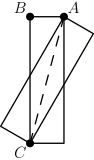
Continue the process, adding a third card to the second, and so on, lining up successive diagonals after rotating clockwise. In total, how many cards must be used until a vertex of a new card lands exactly on the vertex labeled in the figure?
No new vertex will land on
Answer: A
Small Hint:
The diagonal makes angle with the long side, since
Big Hint:
The two diagonals meet at track the unused diagonal as five new cards are added
Solution:
A diagonal makes an angle with a long side, where Thus the acute angle between the two diagonals of a card is
Each new card shares one diagonal with the previous card, and its other diagonal is the next line obtained by turning clockwise. All these equal diagonals have the same midpoint and are diameters of one common circle. The line through the original card’s other diagonal, which contains is counterclockwise from As an unoriented line, this is the same as clockwise from Five additions advance the unused diagonal by so the sixth card is the first new card with a vertex at
Thus, the correct answer is A.
19.
Cyclic quadrilateral has lengths and with What is the length of the shorter diagonal of
Answer: D
Small Hint:
In
Big Hint:
Find using then apply Ptolemy:
Solution:
In the law of cosines gives so
Since is cyclic, In with and the law of cosines gives so By Ptolemy, hence This is shorter than
Thus, the correct answer is D.
20.
Points and are chosen uniformly and independently at random on sides and respectively, of equilateral triangle Which of the following intervals contains the probability that the area of is less than half the area of
Answer: D
Small Hint:
Let and be uniform on the area ratio is
Big Hint:
Compute and subtract from
Solution:
With and uniform on the area ratio The complementary event requires and with probability Therefore which lies in Thus, the correct answer is D.
21.
Suppose that and the sequence satisfies the recurrence relation for all What is the greatest integer less than or equal to
Answer: B
Small Hint:
Compute a few terms and conjecture the closed form
Big Hint:
Then and lies strictly between and
Solution:
The recurrence rearranges to Computing early terms suggests This follows by induction: substituting into the recurrence gives Then so where and Hence the sum is between and and its floor is Thus, the correct answer is B.
22.
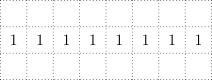
The figure below shows a dotted grid cells wide and cells tall consisting of squares. Carl places -inch toothpicks along some of the sides of the squares to create a closed loop that does not intersect itself. The numbers in the cells indicate the number of sides of that square that are to be covered by toothpicks, and any number of toothpicks are allowed if no number is written. In how many ways can Carl place the toothpicks?
Answer: C
Small Hint:
Each middle-row cell must touch exactly one toothpick; after the two turnaround columns are fixed, each interior cell’s toothpick is independently above or below it
Big Hint:
A loop crossing the middle uses all the first the last or the middle columns; its interior columns independently bend above or below
Solution:
Each middle-row cell must touch exactly one toothpick. First consider loops that pass from one side of the middle strip to the other. The loop can span all columns, the first the last or the middle a narrower span would leave an outer middle cell untouched.
Once the two ends are fixed, each interior middle cell independently has its one toothpick on its top or bottom side, and the rest of the non-self-intersecting loop is forced. The four cases therefore contribute and loops. There are also exactly two loops that do not cross the middle strip: the horizontal rectangle running entirely along the top or entirely along the bottom. Hence the total is
Thus, the correct answer is C.
23.
What is the value of
Answer: B
Small Hint:
Let the sum factors as
Big Hint:
and
Solution:
With the expression is
Since we have so Likewise Their product is
Thus, the correct answer is B.
24.
A disphenoid is a tetrahedron whose triangular faces are congruent to one another. What is the least total surface area of a disphenoid whose faces are scalene triangles with integer side lengths?
Answer: D
Small Hint:
A disphenoid can be built from a triangle exactly when that triangle is acute; its surface is faces
Big Hint:
Seek the smallest-area acute scalene integer triangle; is right, so try
Solution:
A disphenoid exists (as the tetrahedron formed by the face-plane midpoints of a box) exactly when the common face triangle is acute, and its total surface area is times one face’s area. Write the integer side lengths as If then and (with equality only for ), so the triangle is not acute. Thus
The triangle is acute because It also has the least possible area. The largest angle of any acute triangle is at least so a candidate with has area at least which is greater than the area of
By Heron’s formula with that area is The total surface area is
Thus, the correct answer is D.
25.
A graph is symmetric about a line if the graph remains unchanged after reflection in that line. For how many quadruples of integers where and and are not both is the graph of symmetric about the line
Small Hint:
Reflecting over gives its inverse, so symmetry means is its own inverse
Big Hint:
A map is an involution exactly when (and it is nondegenerate); also count the identity
Solution:
Reflecting the graph of over produces the graph of its inverse, so the graph is symmetric about exactly when equals its own inverse. For this happens in two ways: when with (a genuine involution, including the slope lines when ), or when is the identity ().
For set the determinant must be nonzero, so we need together with When both and must be nonzero, giving choices. For each nonzero start with choices of If or exactly pairs satisfy if exactly pairs do. Thus the genuine involutions number The identity case adds more (), for a total of
Thus, the correct answer is B.