
2019 AMC 12B Problem 15
Attempt Problem 15 of the 2019 AMC 12B below, then check your answer against the professionally curated solution from LIVE by Po-Shen Loh. You can also try the full timed exam, view all 2019 AMC 12B solutions, or check the answer key.
All problems are used with official legal permission of the Mathematical Association of America (MAA).
15.
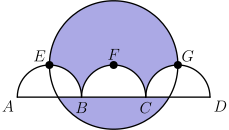
As shown in the figure, line segment is trisected by points and so that Three semicircles of radius and have their diameters on and are tangent to line at and respectively. A circle of radius has its center on The area of the region inside the circle but outside the three semicircles, shaded in the figure, can be expressed in the form
where and are positive integers and and are relatively prime. What is
Answer: E
Small hint:
Break the shaded area into circular sectors and simple leftover pieces
Big hint:
Compute the central sector cut out by the radius- circle
Solution:
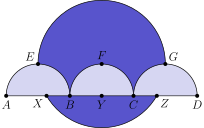
Line passes through the center of the radius- circle, so the shaded upper semicircle has area .
The chord lies on , one unit from . Thus The shaded circular segment below has area
The portion between and consists of four congruent pieces of the following form.

Each piece is a unit square with a quarter of a unit circle removed, so the four pieces have total area
The total shaded area is therefore Hence , , , and , giving .
Thus, the answer is E .
Problem 15 in other years
- 1950 AMC 12
- 1951 AMC 12
- 1952 AMC 12
- 1953 AMC 12
- 1954 AMC 12
- 1955 AMC 12
- 1956 AMC 12
- 1957 AMC 12
- 1958 AMC 12
- 1959 AMC 12
- 1960 AMC 12
- 1961 AMC 12
- 1962 AMC 12
- 1963 AMC 12
- 1964 AMC 12
- 1965 AMC 12
- 1966 AMC 12
- 1967 AMC 12
- 1968 AMC 12
- 1969 AMC 12
- 1970 AMC 12
- 1971 AMC 12
- 1972 AMC 12
- 1973 AMC 12
- 1974 AMC 12
- 1975 AMC 12
- 1976 AMC 12
- 1977 AMC 12
- 1978 AMC 12
- 1979 AMC 12
- 1980 AMC 12
- 1981 AMC 12
- 1982 AMC 12
- 1983 AMC 12
- 1984 AMC 12
- 1985 AMC 12
- 1986 AMC 12
- 1987 AMC 12
- 1988 AMC 12
- 1989 AMC 12
- 1990 AMC 12
- 1991 AMC 12
- 1992 AMC 12
- 1993 AMC 12
- 1994 AMC 12
- 1995 AMC 12
- 1996 AMC 12
- 1997 AMC 12
- 1998 AMC 12
- 1999 AMC 12
- 2000 AMC 12
- 2001 AMC 12
- 2002 AMC 12A
- 2002 AMC 12B
- 2003 AMC 12A
- 2003 AMC 12B
- 2004 AMC 12A
- 2004 AMC 12B
- 2005 AMC 12A
- 2005 AMC 12B
- 2006 AMC 12A
- 2006 AMC 12B
- 2007 AMC 12A
- 2007 AMC 12B
- 2008 AMC 12A
- 2008 AMC 12B
- 2009 AMC 12A
- 2009 AMC 12B
- 2010 AMC 12A
- 2010 AMC 12B
- 2011 AMC 12A
- 2011 AMC 12B
- 2012 AMC 12A
- 2012 AMC 12B
- 2013 AMC 12A
- 2013 AMC 12B
- 2014 AMC 12A
- 2014 AMC 12B
- 2015 AMC 12A
- 2015 AMC 12B
- 2016 AMC 12A
- 2016 AMC 12B
- 2017 AMC 12A
- 2017 AMC 12B
- 2018 AMC 12A
- 2018 AMC 12B
- 2019 AMC 12A
- 2020 AMC 12A
- 2020 AMC 12B
- 2021 AMC 12A Spring
- 2021 AMC 12B Spring
- 2021 AMC 12A Fall
- 2021 AMC 12B Fall
- 2022 AMC 12A
- 2022 AMC 12B
- 2023 AMC 12A
- 2023 AMC 12B
- 2024 AMC 12A
- 2024 AMC 12B
- 2025 AMC 12A
- 2025 AMC 12B
- 2026 AMC 12A
- 2026 AMC 12B