
2019 AMC 12B Solutions
Scroll down to view professionally curated solutions from LIVE by Po-Shen Loh, print PDF solutions, view answer key, or take the full timed exam.
All problems are used with official legal permission of the Mathematical Association of America (MAA).
1.
Alicia had two containers. The first was full of water and the second was empty. She poured all the water from the first container into the second container, at which point the second container was full of water. What is the ratio of the volume of the first container to the volume of the second container?
Small Hint:
The amount of water is unchanged when it is poured
Big Hint:
Solution:
The volume of water is the same before and after, so
Then
Thus, D is the correct answer.
2.
Consider the statement, “If is not prime, then is prime.” Which of the following values of is a counterexample to this statement?
Small Hint:
A counterexample makes the hypothesis true but the conclusion false
Big Hint:
Look for that is not prime while is also not prime
Solution:
A counterexample needs not prime (so the hypothesis holds) and not prime (so the conclusion fails).
Among the choices, is not prime and is not prime. The primes and fail the hypothesis, and are prime.
Thus, E is the correct answer.
3.
Which one of the following rigid transformations (isometries) maps the line segment onto the line segment so that the image of is and the image of is
reflection in the -axis
counterclockwise rotation around the origin by
translation by units to the right and units down
reflection in the -axis
clockwise rotation about the origin by
Small Hint:
Track the coordinate change: and
Big Hint:
Both points follow the rule
Solution:
Each point maps by indeed and
The map is a rotation about the origin.
Thus, E is the correct answer.
4.
A positive integer satisfies the equation What is the sum of the digits of
5.
Each piece of candy in a store costs a whole number of cents. Casper has exactly enough money to buy either pieces of red candy, pieces of green candy, pieces of blue candy, or pieces of purple candy. A piece of purple candy costs cents. What is the smallest possible value of
Small Hint:
Casper’s total money must be divisible by each candy count
Big Hint:
The total is a multiple of
Solution:
Let be Casper’s money in cents. Since he can exactly buy or whole-cent pieces, is a multiple of
Purple candy costs cents, so The smallest is giving
Thus, B is the correct answer.
6.
In a given plane, points and are units apart. How many points are there in the plane such that the perimeter of is units and the area of is square units?
infinitely many
Small Hint:
With fixed, the perimeter condition puts on an ellipse with foci and
Big Hint:
Area with base needs height compare that to the ellipse’s greatest height
Solution:
The perimeter condition gives so lies on an ellipse with foci and major axis Thus and so the semi-minor axis is
For area with base the height from must be But the greatest possible height on the ellipse is so no such exists.
Thus, A is the correct answer.
7.
What is the sum of all real numbers for which the median of the numbers and is equal to the mean of those five numbers?
Small Hint:
The mean is
Big Hint:
Split into cases by whether the median is or itself
Solution:
The mean is
If the median is so gives which is consistent.
If the median is so gives not in range. If the median is so gives not in range.
The only solution is so the sum is
Thus, A is the correct answer.
8.
Let What is the value of the sum
Small Hint:
Big Hint:
Pair with and compare their signs
Solution:
Since we have
In the sum, the term with index has sign while the term with index equals it in value but has sign the opposite.
Every term cancels with its partner, so the total is
Thus, A is the correct answer.
9.
For how many integral values of can a triangle of positive area be formed having side lengths and
Small Hint:
Let so
Big Hint:
Apply the triangle inequality to sides
Solution:
Let Then and the sides are
The triangle inequalities give (so ) and (so ); the third inequality is automatic.
Thus i.e. The integers number
Thus, B is the correct answer.
10.
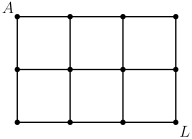
The figure below is a map showing cities and roads connecting certain pairs of cities. Paula wishes to travel along exactly of those roads, starting at city and ending at city without traveling along any portion of a road more than once. (Paula is allowed to visit a city more than once.) How many different routes can Paula take?
Small Hint:
Using of the roads leaves exactly roads unused
Big Hint:
A trail exists only if just and have odd degree; this forces which roads to drop
Solution:
Name the four cities in the top row those in the middle row and those in the bottom row A route using roads is an open Euler trail, so in the used graph exactly and have odd degree.
In the full map, the vertices whose degree parity must change are Because only roads are removed, those roads must pair these vertices. Among them, is adjacent only to forcing to be removed; then is forced. Similarly is adjacent only to forcing and then
The remaining graph is a chain Each of the two -cycles can be traversed in either direction, and everything else is forced. Hence there are routes.
Thus, E is the correct answer.
11.
How many unordered pairs of edges of a given cube determine a plane?
Small Hint:
Two edges determine a plane unless they are skew
Big Hint:
Count the pairs that are parallel and the pairs that share a vertex
Solution:
Two edges determine a plane exactly when they are coplanar, that is, parallel or intersecting.
The edges split into directions of parallel edges, giving parallel pairs. Edges sharing a vertex give intersecting pairs.
The total is
Thus, D is the correct answer.
12.
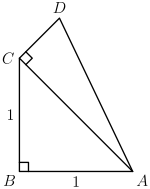
Right triangle with right angle at is constructed outwards on the hypotenuse of isosceles right triangle with leg length as shown, so that the two triangles have equal perimeters. What is
Small Hint:
has legs and hypotenuse set and use equal perimeters
Big Hint:
Since use
Solution:
Triangle has perimeter and In let so and equal perimeters give
Then so giving and
Since writing gives so With we get
Thus, D is the correct answer.
13.
A red ball and a green ball are randomly and independently tossed into bins numbered with the positive integers so that for each ball, the probability that it is tossed into bin is for What is the probability that the red ball is tossed into a higher-numbered bin than the green ball?
Small Hint:
By symmetry, red-higher and green-higher are equally likely
Big Hint:
Find the probability of a tie,
Solution:
The probability the balls land in the same bin is
By symmetry, the red ball being higher and the green ball being higher are equally likely, so each has probability
Thus, C is the correct answer.
14.
Let be the set of all positive integer divisors of How many numbers are the product of two distinct elements of
Small Hint:
Divisors are with products are with
Big Hint:
All products arise; discard those obtainable only as a divisor times itself
Solution:
Since every divisor is with A product of two divisors is with and every such pair is attainable, giving values.
We need two distinct divisors. A value is forced to be a divisor times itself only when both and have a unique split, which happens exactly when Those corner values () cannot use two distinct divisors.
The count is
Thus, C is the correct answer.
15.
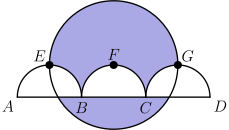
As shown in the figure, line segment is trisected by points and so that Three semicircles of radius and have their diameters on and are tangent to line at and respectively. A circle of radius has its center on The area of the region inside the circle but outside the three semicircles, shaded in the figure, can be expressed in the form
where and are positive integers and and are relatively prime. What is
Small Hint:
Place the circle of radius then passes through and and the middle semicircle lies entirely inside it
Big Hint:
Subtract from the circle’s area the parts of the three semicircles that fall inside it
Solution:
Put so the semicircles are centered at and their tops are The circle has center and radius so it passes through and and has area
The middle semicircle lies entirely inside the circle, removing area For the left semicircle, the overlap starts at and includes its right-hand quarter-circle, except for the region below the large circle. The large circle meets the -axis at The excluded area is Therefore the overlap has area By symmetry, the right semicircle contributes the same overlap.
The shaded area is Hence so
Thus, E is the correct answer.
16.
There are lily pads in a row numbered to in that order. There are predators on lily pads and and a morsel of food on lily pad Fiona the frog starts on pad and from any given lily pad, has a chance to hop to the next pad, and an equal chance to jump pads. What is the probability that Fiona reaches pad without landing on either pad or pad
Small Hint:
Each step is or each with probability
Big Hint:
Track the probability of reaching each pad, treating pads and as dead ends
Solution:
Let be the probability of landing on pad without first landing on pad or Each pad sends probability to the next pad and two pads ahead, and pads and pass nothing on.
Then and (skipping ) then (skipping )
Finally
Thus, A is the correct answer.
17.
How many nonzero complex numbers have the property that and when represented by points in the complex plane, are the three distinct vertices of an equilateral triangle?
infinitely many
Small Hint:
Equilateral means
Big Hint:
forces then require
Solution:
The three points form an equilateral triangle iff From we get
Then so we need Writing so
This gives four values of all yielding distinct vertices.
Thus, D is the correct answer.
18.
Square pyramid has base which measures cm on a side, and altitude perpendicular to the base, which measures cm. Point lies on one third of the way from to point lies on one third of the way from to and point lies on two thirds of the way from to What is the area, in square centimeters, of
Small Hint:
Set with above
Big Hint:
Find then compute
Solution:
Place Then
So and giving
The area is
Thus, C is the correct answer.
19.
Raashan, Sylvia, and Ted play the following game. Each starts with A bell rings every seconds, at which time each of the players who currently have money simultaneously chooses one of the other two players independently and at random and gives to that player. What is the probability that after the bell has rung times, each player will have (For example, Raashan and Ted may each decide to give to Sylvia, and Sylvia may decide to give her dollar to Ted, at which point Raashan will have Sylvia will have and Ted will have and that is the end of the first round of play. In the second round Raashan has no money to give, but Sylvia and Ted might choose each other to give their to, and the holdings will be the same at the end of the second round.)
Small Hint:
The only states are and permutations of
Big Hint:
Show that from either kind of state the next state is with probability
Solution:
From each of the three players gives to one of two others, so there are equally likely outcomes; only the cyclic gift patterns return to a probability of
From a state the broke player gives nothing, and checking the equally likely choices of the other two shows exactly one yields again probability
So after any ring the probability of is including after rings.
Thus, B is the correct answer.
20.
Points and lie on circle in the plane. Suppose that the tangent lines to at and intersect at a point on the -axis. What is the area of
Small Hint:
Equal tangent lengths put the intersection point equidistant from and
Big Hint:
Find that point on the -axis, then use and to locate the center
Solution:
Let be the intersection. Equal tangent lengths give so yielding and
The center satisfies and With and these give and so
Then so the area is
Thus, C is the correct answer.
21.
How many quadratic polynomials with real coefficients are there such that the set of roots equals the set of coefficients? (For clarification: If the polynomial is and the roots are and then the requirement is that )
infinitely many
Small Hint:
Since has at most two values, at least two coefficients are equal
Big Hint:
By Vieta, and work through each equal-coefficient case
Solution:
If all three coefficients had one value the polynomial would be whose roots do not equal Thus the coefficient and root sets both have two distinct values, so exactly two coefficients coincide. By Vieta’s formulas, and
First suppose and The roots are so Vieta gives and Hence producing and
If and the same product equation gives while the sum equation leaves only This gives
Finally, if and the product equation gives so The sum equation becomes This strictly increasing cubic has one real root producing exactly one more polynomial, Therefore there are polynomials.
Thus, B is the correct answer.
22.
Define a sequence recursively by and
for all nonnegative integers Let be the least positive integer such that
In which of the following intervals does lie?
Small Hint:
Let then
Big Hint:
Since decreases toward the ratio stays between and
Solution:
Let A short computation gives
Starting from the terms stay positive and decrease. Because decreases from toward each ratio lies strictly between and
Hence is squeezed between and Solving puts between about and which lies in
Thus, C is the correct answer.
23.
How many sequences of s and s of length are there that begin with a end with a contain no two consecutive s, and contain no three consecutive s?
Small Hint:
Between consecutive s there is a block of one or two s
Big Hint:
With zeros there are blocks of size or whose sizes sum to
Solution:
No two s are adjacent, so the s are separated by blocks of s, each of size or (never ). If there are zeros, there are such blocks summing to ones.
The number of size- blocks is which must satisfy i.e.
Summing over gives
Thus, C is the correct answer.
24.
Let Let denote all points in the complex plane of the form where and What is the area of
Small Hint:
is the Minkowski sum of three segments along
Big Hint:
A zonogon’s area equals over the generating vectors
Solution:
As range over the set is the Minkowski sum of the three unit segments along
This is a zonogon whose area is the sum of the cross-product magnitudes over pairs. Each pair gives
Therefore the area is
Thus, C is the correct answer.
25.
Let be a convex quadrilateral with and Suppose that the centroids of and form the vertices of an equilateral triangle. What is the maximum possible value of the area of
Small Hint:
The differences of the three centroids are
Big Hint:
So is equilateral with side write the area using and maximize
Solution:
The centroids are Their pairwise differences are so an equilateral centroid triangle forces that is, is equilateral with side
Splitting along where By the Law of Cosines so
The expression has maximum so the greatest area is Equality occurs at constructing with that angle and placing equilateral on the opposite side of produces a convex quadrilateral, so the maximum is attainable.
Thus, C is the correct answer.