
1956 AMC 12 Problems
Scroll down and press Start to try the exam! Or, go to the printable PDF, answer key, or professional solutions curated by LIVE by Po-Shen Loh.
All problems are used with official legal permission of the Mathematical Association of America (MAA).
Or jump straight to a single problem with its solution: 1 · 2 · 3 · 4 · 5 · 6 · 7 · 8 · 9 · 10 · 11 · 12 · 13 · 14 · 15 · 16 · 17 · 18 · 19 · 20 · 21 · 22 · 23 · 24 · 25 · 26 · 27 · 28 · 29 · 30 · 31 · 32 · 33 · 34 · 35 · 36 · 37 · 38 · 39 · 40 · 41 · 42 · 43 · 44 · 45 · 46 · 47 · 48 · 49 · 50
Want to learn professionally through interactive video classes?
Timed
1:15:00
1.
The value of when is:
Answer: A
Small Hint:
Evaluate the exponent before doing the multiplication
Big Hint:
At the second term is
Solution:
Substituting and evaluating the exponent first, gives
Thus, the correct answer is A.
2.
Mr. Jones sold two pipes at each. Based on the cost his profit on one was and his loss on the other was On the sale of the pipes, he:
broke even
lost ¢
gained ¢
lost ¢
gained ¢
Answer: D
Small Hint:
Recover each cost by dividing the sale price by or
Big Hint:
Compare the combined cost with the combined selling price of
Solution:
The pipe sold at a profit cost while the pipe sold at a loss cost Their combined cost was but they sold for so Mr. Jones lost cents.
Thus, the correct answer is D.
3.
The distance light travels in one year is approximately miles. The distance light travels in years is:
miles
miles
miles
miles
miles
Answer: D
Small Hint:
Multiplying by moves the decimal point two places to the right
Big Hint:
Rewrite the given distance as
Solution:
The given distance is miles. Multiplying by gives miles.
Thus, the correct answer is D.
4.
A man has to invest. He invests at and at In order to have a yearly income of he must invest the remainder at:
Answer: E
Small Hint:
First find both the uninvested principal and the income still needed
Big Hint:
The first two investments earn and per year
Solution:
The amount left to invest is The first two investments earn dollars, so the remaining investment must earn dollars. Its required rate is
Thus, the correct answer is E.
5.
A nickel is placed on a table. The number of nickels which can be placed around it, each tangent to it and to two others is:
Answer: C
Small Hint:
Join the center of the middle nickel to the centers of two neighboring nickels
Big Hint:
Those three mutually tangent equal circles make an equilateral triangle of centers
Solution:
The centers of the middle nickel and any two neighboring nickels are pairwise two radii apart, so they form an equilateral triangle. Therefore consecutive outer centers subtend at the center of the middle nickel. Exactly nickels fit around it.
Thus, the correct answer is C.
6.
In a group of cows and chickens, the number of legs was more than twice the number of heads. The number of cows was:
Answer: B
Small Hint:
Twice the number of heads already accounts for two legs per animal
Big Hint:
Each cow contributes two additional legs beyond that baseline
Solution:
Counting two legs for every head accounts for both legs of each chicken and two of each cow’s four legs. Thus every cow contributes exactly two of the extra legs. Hence the number of cows is
Thus, the correct answer is B.
7.
The roots of the equation will be reciprocal if:
Answer: C
Small Hint:
If the roots are and reciprocal roots satisfy
Big Hint:
Use Vieta’s formula
Solution:
By Vieta’s formulas, the product of the two roots is Reciprocal roots have product so which requires
Thus, the correct answer is C.
8.
If then, when
Answer: B
Small Hint:
Substitute into the exponent on
Big Hint:
Write as
Solution:
When the right side is Therefore so and
Thus, the correct answer is B.
9.
Simplify the result is:
Answer: D
Small Hint:
Replace each th root by an exponent of
Big Hint:
Each bracket has exponent
Solution:
For each of the two factors, the nested roots and outer fourth power multiply the exponent of by Thus each factor is and their product is
Therefore, the correct answer is D.
10.
A circle of radius inches has its center at the vertex of an equilateral triangle and passes through the other two vertices. The side extended through intersects the circle at The number of degrees of angle is:
Answer: B
Small Hint:
The radii and form a central angle
Big Hint:
Angle is an inscribed angle intercepting the minor arc
Solution:
Since is equilateral, the central angle is The inscribed angle intercepts the same minor arc so its measure is half the central angle:
Thus, the correct answer is B.
11.
The expression equals:
Answer: A
Small Hint:
Combine the two fractional terms over
Big Hint:
The product of the conjugate denominators is
Solution:
Combining the fractional terms, Adding the initial gives
Thus, the correct answer is A.
12.
If is divided by the quotient is:
Answer: E
Small Hint:
Rewrite as
Big Hint:
Factor
Solution:
Where the quotient is defined,
Thus, the correct answer is E.
13.
Given two positive integers and with The percent that is less than is:
Answer: C
Small Hint:
The amount by which is smaller is
Big Hint:
Because the comparison is to use as the denominator
Solution:
The difference is Measured as a fraction of the reference value this is Multiplying by converts the fraction to a percent:
Thus, the correct answer is C.
14.
The points and are on a circle The tangent line at and the secant intersect at lying between and If and then equals:
Answer: B
Small Hint:
Use
Big Hint:
If then
Solution:
Let Since lies between and we have The tangent-secant theorem gives Thus or A length is positive, so
Therefore, the correct answer is B.
15.
The root(s) of is (are):
and
only
and
only
Answer: A
Small Hint:
The original equation requires
Big Hint:
Multiply through by and collect terms
Solution:
For multiplying by gives Hence so Both and satisfy the domain restriction.
Thus, the correct answer is A.
16.
The sum of three numbers is The ratio of the first to the second is and the ratio of the second to the third is The second number is:
Answer: C
Small Hint:
Choose a common scaling so the three numbers have ratio
Big Hint:
Those ratio parts add to
Solution:
The first-to-second ratio and second-to-third ratio combine to give the three-number ratio The total parts equal so each part is The second number is
Thus, the correct answer is C.
17.
The fraction was obtained by adding the two fractions and The values of and must be, respectively:
Answer: D
Small Hint:
Factor
Big Hint:
After combining the two fractions, match coefficients in
Solution:
Combining the proposed partial fractions gives Matching its numerator with yields Solving gives and
Thus, the correct answer is D.
18.
If then equals:
Answer: E
Small Hint:
Write as
Big Hint:
The quantity is positive
Solution:
We have Since is positive, Taking the reciprocal gives
Thus, the correct answer is E.
19.
Two candles of the same height are lighted at the same time. The first is consumed in hours and the second in hours. Assuming that each candle burns at a constant rate, in how many hours after being lighted was the first candle twice the height of the second?
hr.
hr.
hr.
hr.
hr.
Answer: D
Small Hint:
Scale the common initial height to
Big Hint:
After hours the remaining fractions are and
Solution:
Let each initial height be After hours the remaining heights are and The required condition is Multiplying by gives so and
Thus, the correct answer is D.
20.
If and then the value of to the nearest tenth is:
Answer: C
Small Hint:
Take common logarithms of both sides
Big Hint:
Use
Solution:
Taking common logarithms gives Since To the nearest tenth, this is
Thus, the correct answer is C.
21.
If each of two intersecting lines intersects a hyperbola and neither line is tangent to the hyperbola, then the possible number of points of intersection with the hyperbola is:
or
or
or
or
Answer: E
Small Hint:
A non-tangent line that intersects a hyperbola can meet it in either one or two points
Big Hint:
The two lines may share one hyperbola point, since the lines themselves intersect
Solution:
A line can meet a hyperbola in either one finite point, when its direction is parallel to an asymptote, or two finite points. By choosing the two lines so that their finite intersection sets on the hyperbola are disjoint, they can therefore contribute or distinct intersections. If their own intersection lies on the hyperbola, one point is shared instead.
Thus, or are possible, and the correct answer is E.
22.
Jones covered a distance of miles on his first trip. On a later trip he traveled miles while going three times as fast. His new time compared with the old time was:
three times as much
twice as much
the same
half as much
a third as much
Answer: B
Small Hint:
Write each travel time as distance divided by speed
Big Hint:
If the old speed is compare with
Solution:
If the first speed was the old time was The later time was Thus the new time was twice the old time.
The correct answer is B.
23.
About the equation with and real constants, we are told that the discriminant is zero. The roots are necessarily:
equal and integral
equal and rational
equal and real
equal and irrational
equal and imaginary
Answer: C
Small Hint:
A zero discriminant makes the two quadratic-formula values coincide
Big Hint:
The repeated root is
Solution:
A quadratic with real coefficients and discriminant zero has the repeated root Since is a nonzero real number, this root is real. It need not always be rational or always be irrational.
Thus, the roots are necessarily equal and real, so the correct answer is C.
24.
In the figure angle and Then angle equals:
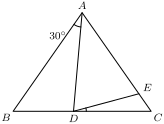
Answer: D
Small Hint:
Let and express the base angle at using isosceles triangle
Big Hint:
Use to express then split the straight angle at
Solution:
Let Since and Triangle gives so Since
Thus, the correct answer is D.
25.
The sum of all numbers of the form where takes on integral values from to is:
Answer: C
Small Hint:
Separate into two sums
Big Hint:
Use
Solution:
We compute
Thus, the correct answer is C.
26.
Which one of the following combinations of given parts does not determine the indicated triangle?
base angle and vertex angle; isosceles triangle
vertex angle and the base; isosceles triangle
the radius of the circumscribed circle; equilateral triangle
one arm and the radius of the inscribed circle; right triangle
two angles and a side opposite one of them; scalene triangle
Answer: A
Small Hint:
Ask whether each set of information fixes scale as well as shape
Big Hint:
Two angles determine only a similarity class unless some length is also supplied
Solution:
In an isosceles triangle, a base angle and the vertex angle determine all three angles, but no side length is specified. Therefore triangles of every scale have the same given data, so the triangle is not determined. Each other choice includes enough length information, directly or through a radius, to fix the scale as well as the shape.
Thus, the correct answer is A.
27.
If an angle of a triangle remains unchanged but each of its two including sides is doubled, then the area is multiplied by:
more than
Answer: C
Small Hint:
Use the area formula for two sides and their included angle
Big Hint:
Doubling both side factors multiplies their product by
Solution:
If the included sides are and and their unchanged angle is the original area is After both sides are doubled, the area is
Thus, the correct answer is C.
28.
Mr. J left his entire estate to his wife, his daughter, his son, and the cook. His daughter and son got half the estate, sharing in the ratio of to His wife got twice as much as the son. If the cook received a bequest of then the entire estate was:
Answer: D
Small Hint:
Let the daughter’s and son’s shares be and
Big Hint:
Their is half the estate, while the other half is the wife’s plus
Solution:
Let the daughter receive and the son Together they receive which is half the estate. The wife receives so the other half gives Thus and the whole estate is dollars.
Therefore, the correct answer is D.
29.
The points of intersection of and are joined in succession. The resulting figure is:
a straight line
an equilateral triangle
a parallelogram
a rectangle
a square
Answer: D
Small Hint:
Use to find the possible sums
Big Hint:
The four intersection points are permutations and negatives of
Solution:
At an intersection, so Together with this gives the four points In their cyclic order around the circle, adjacent side vectors are perpendicular, so the quadrilateral is a rectangle. Its adjacent side lengths are unequal, so it is not a square.
Thus, the correct answer is D.
30.
If the altitude of an equilateral triangle is then the area is:
Answer: B
Small Hint:
For side length an equilateral triangle has altitude
Big Hint:
Once is known, use area
Solution:
Let the side length be From we get Hence the area is
Thus, the correct answer is B.
31.
In our number system the base is ten. If the base were changed to four you would count as follows: The twentieth number would be:
Answer: E
Small Hint:
The twentieth positive number represents the ordinary value
Big Hint:
Divide successively by or express it using the place values and
Solution:
The twentieth positive integer has ordinary value Since its base-four representation is
Thus, the correct answer is E.
32.
George and Henry started a race from opposite ends of the pool. After a minute and a half, they passed each other in the center of the pool. If they lost no time in turning and maintained their respective speeds, how many minutes after starting did they pass each other the second time?
Answer: B
Small Hint:
Meeting at the center means the two swimmers have equal speeds
Big Hint:
They reach the opposite ends at minutes, turn, and need another half-pool each
Solution:
Because they started simultaneously from opposite ends and first met at the center, their speeds are equal. Each reaches the opposite end after minutes. They turn immediately, and each then needs another minutes to return to the center, where they meet again. The second meeting occurs after minutes.
Thus, the correct answer is B.
33.
The number is equal to:
a rational fraction
a finite decimal
an infinite repeating decimal
an infinite non-repeating decimal
Answer: E
Small Hint:
Recall what kind of decimal expansion every rational number has
Big Hint:
The number is irrational, so its decimal neither terminates nor repeats
Solution:
The number is irrational. A rational number has a decimal expansion that either terminates or eventually repeats, whereas an irrational number has an infinite non-repeating decimal expansion. The finite decimal is only an approximation.
Thus, the correct answer is E.
34.
If is any whole number, is always divisible by:
any multiple of
and
Answer: A
Small Hint:
Factor the expression as
Big Hint:
Among three consecutive integers there is a multiple of and the factors supply at least two powers of
Solution:
We have Among and one is divisible by If is even, is divisible by if is odd, both and are even, so their product is divisible by Thus the expression is always divisible by It is not always divisible by since gives
Therefore, the correct answer is A.
35.
A rhombus is formed by two radii and two chords of a circle whose radius is feet. The area of the rhombus in square feet is:
Answer: B
Small Hint:
Every side of the rhombus has length so each chord equals the radius
Big Hint:
A chord equal to the radius subtends a central angle; use
Solution:
All four sides of the rhombus equal the circle’s radius, A chord of length equal to the radius forms an equilateral triangle with the two radii to its endpoints, so the included central angle is Therefore the rhombus has area
Thus, the correct answer is B.
36.
If the sum is a perfect square and if is less than then the possible values for are:
only
and
only
and
and
Answer: E
Small Hint:
Rewrite as
Big Hint:
Generate successive positive solutions by multiplying by stopping when
Solution:
The condition is or The positive solutions of this Pell equation are generated from the fundamental solution Their first pairs are Thus the values with are
Therefore, the correct answer is E.
37.
On a map whose scale is miles to an inch and a half, a certain estate is represented by a rhombus having a angle. The diagonal opposite is in. The area of the estate in square miles is:
Answer: E
Small Hint:
In a rhombus, the shorter diagonal equals the side length
Big Hint:
The scale is miles per inch, so convert the -inch side before finding area
Solution:
The diagonal opposite the angle divides the rhombus into two equilateral triangles, so its length equals the rhombus side. The map scale is miles per inch, hence the actual side length is miles. Therefore the rhombus area is
Thus, the correct answer is E.
38.
In a right triangle with sides and and hypotenuse the altitude drawn on the hypotenuse is Then:
Answer: D
Small Hint:
Compute the triangle’s area using either the legs or the hypotenuse and its altitude
Big Hint:
From substitute and divide by
Solution:
Equating two area formulas gives so Squaring and using yields Dividing by gives
Thus, the correct answer is D.
39.
The hypotenuse and one arm of a right triangle are consecutive integers. The square of the second arm is:
none of these
Answer: C
Small Hint:
If the second arm is then
Big Hint:
Factor the difference of squares and use
Solution:
By the Pythagorean theorem, Since and are consecutive and we have Hence
Thus, the correct answer is C.
40.
If and then equals:
Answer: A
Small Hint:
Use the first equation to replace in the second
Big Hint:
Factor after writing
Solution:
From the first equation, Therefore Solving gives
Thus, the correct answer is A.
41.
The equation where is satisfied by:
no value of
all values of
only
all integral values of only
all rational values of only
Answer: C
Small Hint:
Substitute on both sides before expanding
Big Hint:
The and constant terms cancel
Solution:
Substituting gives Cancelling the common quadratic and constant terms leaves so This value satisfies both equations.
Thus, the correct answer is C.
42.
The equation has:
no root
one real root
one real root and one imaginary root
two imaginary roots
two real roots
Answer: A
Small Hint:
For real square roots the domain requires
Big Hint:
On that domain, compare directly with
Solution:
For a real solution, Then so Consequently and it cannot equal zero. The original equation is a real radical expression, so nonreal roots are outside its domain.
The correct answer is A.
43.
The number of scalene triangles having all sides of integral lengths, and perimeter less than is:
Answer: C
Small Hint:
Order the distinct integer sides as and use
Big Hint:
List possibilities by the largest side; the perimeter bound leaves only small values of
Solution:
Write the distinct integer sides in increasing order. Checking the small possibilities under the triangle inequality and perimeter bound gives For the smallest new scalene candidate satisfying is whose perimeter is already and larger choices cannot qualify. Thus there are triangles.
The correct answer is C.
44.
If means that and are numbers such that is less than and is less than zero, then:
but
but
Answer: B
Small Hint:
Both numbers are negative, but has the larger absolute value
Big Hint:
Multiply once by and once by reversing each inequality
Solution:
Since multiplying by the negative number reverses the inequality and gives Multiplying the same inequality by the negative number gives Therefore
Thus, the correct answer is B.
45.
A wheel with a rubber tire has an outside diameter of in. When the radius has been decreased a quarter of an inch, the number of revolutions in one mile will:
be increased about
be increased about
be increased about
be increased
remain the same
Answer: A
Small Hint:
For a fixed distance, the revolution count is inversely proportional to the wheel’s radius
Big Hint:
Compare the original radius with the new radius
Solution:
The original radius is inches and the new radius is inches. For a fixed distance, the number of revolutions varies inversely with radius, so the relative increase is This is about
Thus, the correct answer is A.
46.
For the equation to be true where is positive, can have:
any positive value less than
any value less than
the value zero only
any non-negative value
any value
Answer: A
Small Hint:
Cross-multiply and solve for in terms of
Big Hint:
The equation reduces to also solve this relation for
Solution:
Cross-multiplication gives so and Every positive gives Conversely, for any so such an exists.
Thus, may be any positive value less than and the correct answer is A.
47.
An engineer said he could finish a highway section in days with his present supply of a certain type of machine. However, with more of these machines the job could be done in days. If the machines all work at the same rate, how many days would it take to do the job with one machine?
Answer: D
Small Hint:
Let be the present number of machines and measure work in machine-days
Big Hint:
Equate with
Solution:
If there are presently machines, the job requires machine-days. With three more machines it requires machine-days, so giving The job therefore requires machine-days, so one machine would take days.
Thus, the correct answer is D.
48.
If is a positive integer, then can be a positive integer, if and only if is:
at least
equal to or
no more than
equal to
equal to or
Answer: B
Small Hint:
Let positivity forces to be a positive odd integer
Big Hint:
Rewrite the quotient as so must be a positive divisor of
Solution:
Set A positive quotient requires and is odd. Since Thus must be a positive divisor of The possibilities and give and respectively, and each works. No other positive integer works.
Therefore the mathematically correct set is shown in the adjusted choice B.
49.
Triangle is formed by three tangents to circle and then angle equals:
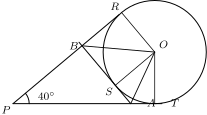
Answer: E
Small Hint:
The circle is tangent to one side of triangle and the extensions of the other two, so is the excenter opposite
Big Hint:
The external angle bisectors at and form an angle of
Solution:
The circle lies opposite across side so is the excenter opposite Thus and bisect the exterior angles at and If the interior angles at and are and then triangle has angles and at and Hence
Thus, the correct answer is E.
50.
In triangle On square is constructed away from the triangle. If is the number of degrees in angle then
depends upon triangle
is independent of the triangle
may equal angle
can never equal angle
is greater than but less than
Answer: B
Small Hint:
Scale to and place
Big Hint:
Because the square is outside the triangle, take and compare vectors and
Solution:
Scale the equal sides to and place Since square is constructed away from the triangle, Put and Then Their dot product is while the absolute value of their two-dimensional cross product is also Therefore so independent of and hence independent of the triangle’s shape.
Thus, the correct answer is B.