
2023 AMC 10A Problems
Scroll down and press Start to try the exam! Or, go to the printable PDF, answer key, or professional solutions curated by LIVE by Po-Shen Loh.
All problems are used with official legal permission of the Mathematical Association of America (MAA).
Or jump straight to a single problem with its solution: 1 · 2 · 3 · 4 · 5 · 6 · 7 · 8 · 9 · 10 · 11 · 12 · 13 · 14 · 15 · 16 · 17 · 18 · 19 · 20 · 21 · 22 · 23 · 24 · 25
Want to learn professionally through interactive video classes?
Timed
1:15:00
1.
Cities and are miles apart. Alicia lives in and Beth lives in Alicia bikes towards at miles per hour. Leaving at the same time, Beth bikes toward at miles per hour. How many miles from City will they be when they meet?
Answer: E
Small Hint:
They ride toward each other, so their speeds add; find the time until they meet
Big Hint:
The meeting time is hours; multiply Alice’s speed by that time
Solution:
They ride toward each other, so their speeds add. That closes the -mile gap at mph, and they meet after hours. Alice starts at so by then she’s gone miles. Thus, E is the correct answer.
2.
The weight of of a large pizza together with cups of orange slices is the same as the weight of of a large pizza together with cup of orange slices. A cup of orange slices weighs of a pound. What is the weight, in pounds, of a large pizza?
Answer: A
Small Hint:
Let be the pizza’s weight and convert cups of orange slices to pounds using pound per cup
Big Hint:
Set and solve for
Solution:
Let be the pizza’s weight. A cup of orange slices is pound, so the two sides balance as that is Collect the pizza terms: So Therefore, the answer is A.
3.
How many positive perfect squares less than are divisible by
Answer: A
Small Hint:
A perfect square divisible by must be divisible by
Big Hint:
Write the square as and count the valid
Solution:
If a perfect square is divisible by it’s divisible by so it looks like We need i.e. That allows which is squares. Thus, A is the correct answer.
4.
A quadrilateral has all integer side lengths, a perimeter of and one side of length What is the greatest possible length of one side of this quadrilateral?
Answer: D
Small Hint:
In any quadrilateral, each side is less than the sum of the other three
Big Hint:
If the longest side is the other three sum to so
Solution:
In any quadrilateral each side is shorter than the sum of the other three. Call the longest side The rest sum to so which gives and hence Can we hit The sides work, since So the greatest length is Therefore, the answer is D.
5.
How many digits are in the base-ten representation of
Answer: E
Small Hint:
Factor each base into primes: and
Big Hint:
Combine into which is followed by zeros
Solution:
Factor everything into primes. That’s followed by zeros, so it has digits. Thus, E is the correct answer.
6.
An integer is assigned to each vertex of a cube. The value of an edge is defined to be the sum of the values of the two vertices it touches, and the value of a face is defined to be the sum of the values of the four edges surrounding it. The value of the cube is defined as the sum of the values of its six faces. Suppose the sum of the integers assigned to the vertices is What is the value of the cube?
Answer: D
Small Hint:
Each edge belongs to faces, so the total face value is times the total edge value
Big Hint:
Each vertex belongs to edges, so the total edge value is times the vertex total
Solution:
Count by incidences. Each edge lies on faces, so the six face values together are times the total of all edge values. Each vertex lies on edges, so the total edge value is times the vertex sum. Chaining these, the cube’s value is Therefore, the answer is D.
7.
Janet rolls a standard -sided die times and keeps a running total of the numbers she rolls. What is the probability that at some point her running total will equal
Answer: B
Small Hint:
The running total reaches only through the first few rolls; list the disjoint ways to hit exactly
Big Hint:
The cases are first roll rolls rolls rolls add their probabilities
Solution:
The total can only reach exactly through the opening rolls, and these ways are disjoint: alone (probability ), then and (each ), and (probability ). Add them up: Thus, B is the correct answer.
8.
Barb the baker creates a new temperature system for baking bread, Breadus, which is linearly based on Fahrenheit. Bread rises at which is on the Breadus scale. Bread bakes at which is on the Breadus scale. Bread is done when its internal temperature is What is this temperature on the Breadus scale?
Answer: D
Small Hint:
The Breadus reading is linear in Fahrenheit through and
Big Hint:
The slope is apply it to the degrees above the point
Solution:
The Breadus reading is linear in Fahrenheit through and so Plug in Therefore, the answer is D.
9.
A digital display shows the current date as an -digit integer consisting of a -digit year, followed by a -digit month, followed by a -digit date within the month. For example, Arbor Day this year is displayed as For how many dates in will each digit appear an even number of times in the -digit display for that date?
Small Hint:
The year contributes two s (even), one and one
Big Hint:
The four month-and-day digits must supply one more and one more with the remaining two digits equal to each other
Solution:
The year already gives two s (even), one , and one . So to make every digit occur an even number of times, the four digits of and must supply one more , one more , and two equal digits, while keeping the number of s even. Checking the legal dates gives and exactly dates. Thus, E is the correct answer.
10.
Maureen is keeping track of the mean of her quiz scores this semester. If Maureen scores an on the next quiz, her mean will increase by If she scores an on each of the next three quizzes, her mean will increase by What is the mean of her quiz scores currently?
Answer: D
Small Hint:
Let the current mean be over tests, so the current total is
Big Hint:
Adding one gives mean and adding three s gives mean form two equations
Solution:
Let be the current mean over quizzes. One more makes the mean which tidies up to Three more s make it i.e. Solve the pair and Therefore, the answer is D.
11.
A square of area is inscribed in a square of area creating four congruent triangles, as shown below. What is the ratio of the shorter leg to the longer leg in the shaded right triangle?

Answer: C
Small Hint:
Each corner triangle has legs with (a side of the big square) and (a side of the small square)
Big Hint:
gives then and are the roots of
Solution:
Each corner right triangle has legs and A side of the outer square gives and a side of the inscribed square gives Subtract to find the product: so Then and are the roots of namely The ratio of the smaller leg to the larger is Thus, C is the correct answer.
12.
How many three-digit positive integers satisfy the following properties?
• The number is divisible by
• The number formed by reversing the digits of is divisible by
Answer: B
Small Hint:
The reversed number ends in the first digit of and for divisibility by that digit must be or
Big Hint:
Since is three digits it starts with count the multiples of from to
Solution:
When we reverse its last digit is the first digit of For the reversal to be divisible by that digit is or A three-digit number can’t start with so starts with meaning (and the reversal ends in always fine). Now just count multiples of here: from to that’s numbers. Therefore, the answer is B.
13.
Abdul and Chiang are standing feet apart in a field. Bharat is standing in the same field as far from Abdul as possible so that the angle formed by his lines of sight to Abdul and Chiang measures What is the square of the distance (in feet) between Abdul and Bharat?
Answer: C
Small Hint:
Points that see segment at a fixed lie on a circular arc through and
Big Hint:
The farthest such point from Abdul is a diameter endpoint; find the circle’s diameter with the law of sines
Solution:
Let be Abdul, be Chiang with and be Bharat with Every point seeing at lies on one circular arc, so all valid sit on a circle where chord subtends The law of sines gives its diameter, Now is a chord, and a chord is longest when it’s a diameter. So and Thus, C is the correct answer.
14.
A number is chosen at random from among the first positive integers, and a positive integer divisor of that number is then chosen at random. What is the probability that the chosen divisor is divisible by
Answer: B
Small Hint:
Only multiples of up to can have a divisor divisible by
Big Hint:
For with exactly half of ’s divisors are multiples of since is not a multiple of
Solution:
A number can only have a divisor divisible by when is divisible by so Write with Here is not a multiple of so and the divisors that are multiples of are exactly the numbers That makes the chance for each such Averaging over all starting numbers, the probability is Therefore, the answer is B.
15.
An even number of circles are nested, starting with a radius of and increasing by each time, all sharing a common point. The region between every other circle is shaded, starting with the region inside the circle of radius but outside the circle of radius An example showing circles is displayed below. What is the least number of circles needed to make the total shaded area at least

Answer: E
Small Hint:
The shaded region between the circles of radius and has area
Big Hint:
With circles the shaded area is solve
Solution:
A circle of radius has area So the shaded ring between radius and has area With circles the shaded total is We want At it’s at it’s So which means circles. Thus, E is the correct answer.
16.
In a table tennis tournament every participant played every other participant exactly once. Although there were twice as many right-handed players as left-handed players, the number of games won by left-handed players was more than the number of games won by right-handed players. (There were no ties and no ambidextrous players.) What is the total number of games played?
Answer: B
Small Hint:
With left-handed and right-handed players, the number of games is
Big Hint:
Every game has one winner, and left wins to right wins is so the total is a multiple of
Solution:
Say there are left-handers and right-handers, so players and games. Every game has one winner, and left wins are times right wins, so the wins split and the total must be a multiple of . Left-handers can win at most all games involving at least one left-hander, namely . Hence which gives . For and , the total is not divisible by . For , there are games. This is attainable if the left-handers win all cross-group games and all games among themselves, while the right-handers win their internal games. The win totals are and , so the answer is . Therefore, the answer is B.
17.
Let be a rectangle with and Points and lie on and respectively so that all sides of and have integer lengths. What is the perimeter of
Answer: A
Small Hint:
Each of the three triangles is right-angled at a corner, so and must be perfect squares
Big Hint:
Use the triples -- and -- then comes out an integer too
Solution:
Set , , , , with on and on . The three right triangles give , , and . For , the equation gives only and , with and . Similarly, setting , the equation with gives or . Testing these four combinations in the formula for , only , works. Thus , , and . The perimeter of is . Thus, A is the correct answer.
18.
A rhombic dodecahedron is a solid with congruent rhombus faces. At every vertex, or edges meet, depending on the vertex. How many vertices have exactly edges meeting?
Answer: D
Small Hint:
The solid has faces and edges; use Euler’s formula to get the number of vertices
Big Hint:
If vertices have degree and the rest degree the sum of all degrees is
Solution:
Each rhombus has edges, and every edge is shared by faces, so With Euler’s formula gives Suppose vertices have edges and the other have The degrees sum to twice the edge count: so Therefore, the answer is D.
19.
The line segment formed by and is rotated to the line segment formed by and about the point What is
Answer: E
Small Hint:
The rotation center is equidistant from each point and its image, so it lies on the perpendicular bisectors of and
Big Hint:
Intersect the perpendicular bisector of (a vertical line) with that of
Solution:
A rotation keeps its center equidistant from each point and its image. So is equidistant from and and from and which puts it at the intersection of two perpendicular bisectors. The bisector of from to is The bisector of from to is Then so and Thus, E is the correct answer.
20.
Each square in a grid of squares is colored red, white, blue, or green so that every square contains one square of each color. One such coloring is shown on the right below. How many different colorings are possible?

Answer: D
Small Hint:
Label the cells row by row as the top-left four are a permutation of all four colors
Big Hint:
Then and are each the two remaining colors in some order, and is forced but works only when
Solution:
Label the cells row by row as The top-left block is a permutation of the four colors, so ways. The block is also all four colors, and are fixed, so is the remaining two in some order: ways. Same story for the two colors apart from another ways. That leaves forced to whatever color is missing from and that only works when Of the order combinations, exactly one has so survive. The total is Therefore, the answer is D.
21.
There is a unique polynomial of least degree with leading coefficient satisfying all of the following:
is a root of is a root of is a root of and is a root of
All the roots of except one are integers. If the one non-integer root can be written as where and are relatively prime positive integers, what is
Answer: D
Small Hint:
Translate each condition into a value:
Big Hint:
The integer roots force use to find
Solution:
Translate each condition into a value: and So are roots. Could a cubic do it? A monic cubic with those roots has so no. The least-degree monic polynomial is degree Now so and That’s the lone non-integer root, so Thus, D is the correct answer.
22.
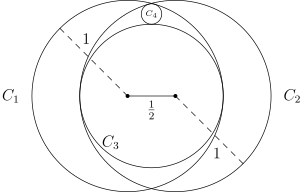
Circle and each have radius and the distance between their centers is Circle is the largest circle internally tangent to both and Circle is internally tangent to both and and externally tangent to What is the radius of
Answer: D
Small Hint:
Put the centers of at is centered at the origin with radius from
Big Hint:
Let be centered at with radius internal tangency to and external tangency to give two equations
Solution:
Put the centers of at By symmetry the largest circle inside both sits at the origin with radius where so Let be centered at with radius Internal tangency to gives and external tangency to gives Substitute the second into the first: This collapses to so Therefore, the answer is D.
23.
Positive integer divisors and of are called complementary if Given that has a pair of complementary divisors that differ by and a pair of complementary divisors that differ by find the sum of the digits of
Answer: C
Small Hint:
Complementary divisors with product differing by are and so
Big Hint:
Then is also a perfect square; combine the two to get a difference of squares equal to
Solution:
Complementary divisors differing by are and with product , so and . A pair differing by gives . Set . Then , so . The positive factor pair gives , hence the inadmissible value . The pair gives , , hence . Check it: , and the digit sum is . Thus, C is the correct answer.
24.
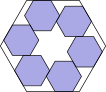
Six regular hexagonal blocks of side length unit are arranged inside a regular hexagonal frame. Each block lies along an inside edge of the frame and is aligned with two other blocks, as shown in the figure below. The distance from any corner of the frame to the nearest vertex of a block is unit. What is the area of the region inside the frame not occupied by the blocks?
Answer: C
Small Hint:
The uncovered region is the frame’s area minus the six unit hexagons; a regular hexagon of side has area
Big Hint:
Extend the block edges to the frame: one frame side splits into lengths and then subtract the six block areas
Solution:
Let Extend the slanted edges of the blocks that meet a fixed side of the frame. Because all the relevant angles are the extensions form an equilateral triangle of side at one end and an equilateral triangle of side at the other. Thus that frame side is partitioned into lengths and so its length is A regular hexagon of side has area Therefore the uncovered area is the area of the side- frame minus the areas of the six unit blocks: Therefore, the answer is C.
25.
If and are vertices of a polyhedron, define the distance to be the minimum number of edges of the polyhedron one must traverse in order to connect and For example, if is an edge of the polyhedron, then but if and are edges and is not an edge, then Let and be randomly chosen distinct vertices of a regular icosahedron (a regular polyhedron made up of equilateral triangles). What is the probability that
Answer: A
Small Hint:
From any vertex of an icosahedron, vertices are at distance at distance and (the opposite vertex) at distance
Big Hint:
Fix by symmetry so it equals
Solution:
Fix Of the other vertices, sit at distance at distance and (the opposite vertex) at distance Pick ordered distinct from these that’s pairs. The ones with number so By the symmetry between and the and cases split the rest evenly, so Thus, A is the correct answer.