
2014 AMC 10A Problem 16
Attempt Problem 16 of the 2014 AMC 10A below, then check your answer against the professionally curated solution from LIVE by Po-Shen Loh. You can also try the full timed exam, view all 2014 AMC 10A solutions, or check the answer key.
All problems are used with official legal permission of the Mathematical Association of America (MAA).
16.
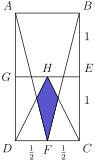
In rectangle and points and are midpoints of and respectively. Point is the midpoint of What is the area of the shaded region?
Answer: E
Small Hint:
Use similar triangles created by the crossing lines
Big Hint:
The shaded kite area is twice one small triangle area
Solution:
We can find the area of the shaded region by finding the area of and subtracting out the two unshaded triangles.
Extend so that it hits Let the intersection of and be
We have that Since , corresponding sides give .
This means that which means that the altitude of is the height of the rectangle.
The area of is then
The area of both unshaded triangles is then The area of is
The area of the shaded region is then
Thus, E is the correct answer.
Problem 16 in Other Years
2000 AMC 10 · 2001 AMC 10 · 2002 AMC 10A · 2002 AMC 10B · 2003 AMC 10A · 2003 AMC 10B · 2004 AMC 10A · 2004 AMC 10B · 2005 AMC 10A · 2005 AMC 10B · 2006 AMC 10A · 2006 AMC 10B · 2007 AMC 10A · 2007 AMC 10B · 2008 AMC 10A · 2008 AMC 10B · 2009 AMC 10A · 2009 AMC 10B · 2010 AMC 10A · 2010 AMC 10B · 2011 AMC 10A · 2011 AMC 10B · 2012 AMC 10A · 2012 AMC 10B · 2013 AMC 10A · 2013 AMC 10B · 2014 AMC 10B · 2015 AMC 10A · 2015 AMC 10B · 2016 AMC 10A · 2016 AMC 10B · 2017 AMC 10A · 2017 AMC 10B · 2018 AMC 10A · 2018 AMC 10B · 2019 AMC 10A · 2019 AMC 10B · 2020 AMC 10A · 2020 AMC 10B · 2021 AMC 10A Spring · 2021 AMC 10B Spring · 2021 AMC 10A Fall · 2021 AMC 10B Fall · 2022 AMC 10A · 2022 AMC 10B · 2023 AMC 10A · 2023 AMC 10B · 2024 AMC 10A · 2024 AMC 10B · 2025 AMC 10A · 2025 AMC 10B