
2014 AMC 10A Problems
Scroll down and press Start to try the exam! Or, go to the printable PDF, answer key, or professional solutions curated by LIVE by Po-Shen Loh.
All problems are used with official legal permission of the Mathematical Association of America (MAA).
Or jump straight to a single problem with its solution: 1 · 2 · 3 · 4 · 5 · 6 · 7 · 8 · 9 · 10 · 11 · 12 · 13 · 14 · 15 · 16 · 17 · 18 · 19 · 20 · 21 · 22 · 23 · 24 · 25
Want to learn professionally through interactive video classes?
Timed
1:15:00
1.
What is the value of the following expression?
Answer: C
Small Hint:
Add the fractions inside the parentheses first
Big Hint:
Take the reciprocal before multiplying by
Solution:
We get that
Then and then finally,
Thus, C is the correct answer.
2.
Roy’s cat eats of a can of cat food every morning and of a can of cat food every evening. Before feeding his cat on Monday morning, Roy opened a box containing cans of cat food. On what day of the week did the cat finish eating all the cat food in the box?
Tuesday
Wednesday
Thursday
Friday
Saturday
Answer: C
Small Hint:
The cat eats can per full day
Big Hint:
Check the integer day when the total first reaches cans
Solution:
The cat eats cans of food each full day. After full days, it has eaten cans, leaving of a can.
The cat finishes that remainder during its next morning feeding. The eleventh morning, counting Monday as the first, is Thursday.
Thus, C is the correct answer.
3.
Bridget bakes loaves of bread for her bakery. She sells half of them in the morning for each. In the afternoon she sells two thirds of what she has left, and because they are not fresh, she charges only half price. In the late afternoon she sells the remaining loaves at a dollar each. Each loaf costs for her to make. In dollars, what is her profit for the day?
Small Hint:
Track morning, afternoon, and late-afternoon sales separately
Big Hint:
Subtract the total baking cost from the total revenue
Solution:
In the morning Bridget sells loaves for .
She has loaves left. In the afternoon she sells loaves at half price, earning .
The remaining loaves sell for , so her revenue is . Her cost is .
Her profit is .
Thus, E is the correct answer.
4.
Walking down Jane Street, Ralph passed four houses in a row, each painted a different color. He passed the orange house before the red house, and he passed the blue house before the yellow house. The blue house was not next to the yellow house. How many orderings of the colored houses are possible?
Answer: B
Small Hint:
Case on where the yellow house appears
Big Hint:
Use the blue-before-yellow condition and the no-adjacent condition together
Solution:
Blue must come before yellow but not next to it, so they sit in positions or or .
In each case orange and red fill the two remaining spots with orange before red, which is forced. The three orderings are orange, blue, red, yellow; blue, orange, red, yellow; and blue, orange, yellow, red.
There are possible orderings.
Thus, B is the correct answer.
5.
On an algebra quiz, of the students scored points, scored points, scored points, and the rest scored points. What is the difference between the mean and the median of the students’ scores on this quiz?
Answer: C
Small Hint:
Find the median from the cumulative percentages
Big Hint:
Compute the weighted mean using the score percentages
Solution:
The median is , because of the students scored below and scored above .
The mean is .
The difference is .
Thus, C is the correct answer.
6.
Suppose that cows give gallons of milk in days. At this rate, how many gallons of milk will cows give in days?
Answer: A
Small Hint:
Find the production rate per cow per day
Big Hint:
Scale by cows and days
Solution:
We have to multiply by to account for the new number of cows.
We then have to multiply by to account for the new time that we have.
This gives us a final answer of
Thus, A is the correct answer.
7.
Nonzero real numbers and satisfy and How many of the following inequalities must be true?
(I)
(II)
(III)
(IV)
Answer: B
Small Hint:
Adding inequalities with the same direction is safe
Big Hint:
Find counterexamples for the other proposed inequalities
Solution:
Adding the two inequalities together gets us
which shows that (I) is correct.
One cannot subtract inequalities, which means that (II) is not necessarily true.
Consider and as a counter-example. This would give us
(III) is also not always true, since and might be negative numbers.
Let and Then and which shows that (III) is wrong.
The same thing occurs with (IV) . Using the same values as above, we have and
This shows that (I) is the only true statement.
Thus, B is the correct answer.
8.
Which of the following numbers is a perfect square?
Answer: D
Small Hint:
Write each choice as
Big Hint:
Only needs to be a square
Solution:
Note that all of these answer choices are of the form We have that is square, so we need to be square as well.
This means that must be twice a perfect square. The only choice we have is which gives us
Thus, D is the correct answer.
9.
The two legs of a right triangle, which are altitudes, have lengths and How long is the third altitude of the triangle?
Answer: C
Small Hint:
Use the two given legs to find the area
Big Hint:
Use the hypotenuse as the base for the third altitude
Solution:
We get that the area of the triangle is The length of the hypotenuse is
Dropping the altitude, from the vertex to the hypotenuse, we get that
Thus, C is the correct answer.
10.
Five positive consecutive integers starting with have average What is the average of consecutive integers that start with
Answer: B
Small Hint:
The average of five consecutive integers starting at is
Big Hint:
Apply that rule first to , then to
Solution:
Note that the average of consecutive numbers starting with is
This means that the average of consecutive integers starting with is which we know is
Furthermore, the average of consecutive numbers starting with is
Thus, B is the correct answer.
11.
A customer who intends to purchase an appliance has three coupons, only one of which may be used:
Coupon off the listed price if the listed price is at least
Coupon off the listed price if the listed price is at least
Coupon off the amount by which the listed price exceeds
For which of the following listed prices will coupon offer a greater price reduction than either coupon or coupon
Answer: C
Small Hint:
Compare the actual dollar discount, not the final price
Big Hint:
Solve the inequalities where coupon beats coupons and
Solution:
Let us analyze what these coupons do to an arbitrary price,
Coupon changes this price to Coupon changes the price to Coupon changes the price to
We want and Solving both gives us
The only answer choice that works is
Thus, C is the correct answer.
12.
A regular hexagon has side length Congruent arcs with radius are drawn with the center at each of the vertices, creating circular sectors as shown. The region inside the hexagon but outside the sectors is shaded as shown. What is the area of the shaded region?

Answer: C
Small Hint:
Subtract the six circular sectors from the hexagon area
Big Hint:
Each sector has central angle
Solution:
Note that we can split the hexagon up into equilateral triangles each with side length
Recall that the area of an equilateral triangle with side length is
This means that the area of the hexagon is
Since each interior angle of a regular hexagon is the six sectors form full circles.
This means that the area of all the sectors is
The area of the shaded region is then
Thus, C is the correct answer.
13.
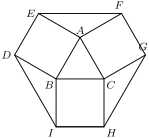
Equilateral has side length and squares lie outside the triangle. What is the area of hexagon
Answer: C
Small Hint:
Decompose the hexagon into the original triangle, three squares, and three outer triangles
Big Hint:
Each outer triangle has sides with included angle
Solution:
We can find the areas of all the individual pieces and then add them up together.
The area of the center equilateral triangle is
We have that the areas of all the squares is
We also have that
Also, and . Dropping the altitude from shows that and the altitude is , so . The other two outer triangles have the same area. Thus their combined area is .
The total area is then
Thus, C is the correct answer.
14.
The -intercepts, and of two perpendicular lines intersecting at the point have a sum of zero. What is the area of
Answer: D
Small Hint:
Let the y-intercepts be and
Big Hint:
Use perpendicular slopes through
Solution:
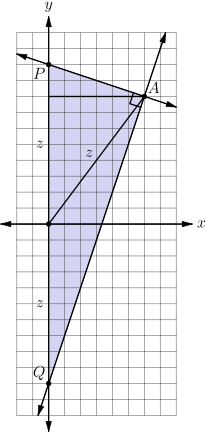
We have that the -intercepts are an equal distance from the origin since their values sum to
Let this distance be Because the two given lines are perpendicular, is right at . The origin is the midpoint of its hypotenuse , so it is equidistant from , , and . Hence the distance from to the origin is also .
We then know that by the distance formula. We know the altitude from to is (it is just the -value of ).
We also know that which tells us that the area
Thus, D is the correct answer.
15.
David drives from his home to the airport to catch a flight. He drives miles in the first hour, but realizes that he will be hour late if he continues at this speed. He increases his speed by miles per hour for the rest of the way to the airport and arrives minutes early. How many miles is the airport from his home?
Answer: C
Small Hint:
Compare the original too-slow schedule with the faster schedule
Big Hint:
The faster trip saves hours overall
Solution:
Note that David drives at miles per hour after one hour.
Then, if the airport is miles from David’s house, we know that: We solve this equation as follows: Therefore, the airport is miles from David’s house.
Thus, C is the correct answer.
16.
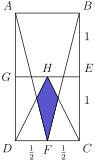
In rectangle and points and are midpoints of and respectively. Point is the midpoint of What is the area of the shaded region?
Answer: E
Small Hint:
Use similar triangles created by the crossing lines
Big Hint:
The shaded kite area is twice one small triangle area
Solution:
We can find the area of the shaded region by finding the area of and subtracting out the two unshaded triangles.
Extend so that it hits Let the intersection of and be
We have that Since , corresponding sides give .
This means that which means that the altitude of is the height of the rectangle.
The area of is then
The area of both unshaded triangles is then The area of is
The area of the shaded region is then
Thus, E is the correct answer.
17.
Three fair six-sided dice are rolled. What is the probability that the values shown on two of the dice sum to the value shown on the remaining die?
Answer: D
Small Hint:
List possible ordered dice pairs by their sum
Big Hint:
Remember to count ordered triples of dice rolls
Solution:
Note that if one die is the sum of the other two dice, then it is strictly greater than the other two dice.
There are ways to choose which of the dice is the sum of the other two, which makes it the greatest.
This die cannot be since there is no way to sum two positive integers to get
There is a chance that this die is any of the other numbers.
There is way to get a sum of ways for for for and for
We take these numbers of ways out of a total of possibilities. The desired probability is then
Thus, D is the correct answer.
18.
A square in the coordinate plane has vertices whose -coordinates are and What is the area of the square?
Answer: B
Small Hint:
Choose adjacent vertices whose y-coordinates differ by
Big Hint:
A side vector rotated creates a y-change of
Solution:
Opposite vertices of a square have the same average -coordinate. Thus the opposite pairs must have -coordinates and , the two pairs with equal sum. In particular, a vertex with -coordinate is adjacent to vertices with -coordinates and .
Let one vertex be , and let its adjacent vertex with -coordinate be with .
Rotating the side vector by gives the next side vector , so another vertex has y-coordinate . The remaining y-coordinates are and , hence .
The side length squared is , which is the area of the square.
Thus, B is the correct answer.
19.
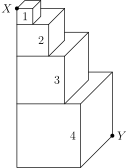
Four cubes with edge lengths and are stacked as shown. What is the length of the portion of contained in the cube with edge length
Answer: A
Small Hint:
The whole segment has vertical change
Big Hint:
The part inside the side- cube is the same fraction of the full segment as its vertical change
Solution:
The distance between and with respect to the -axis is
Both the distances along the and -axes are
Then
Using coordinates and , the line meets the top and bottom of the side- cube at and . Both points lie inside those square faces, so the portion inside this cube really does have vertical change .
Let the desired length be Then using similar triangles, we have that
Thus, A is the correct answer.
20.
The product where the second factor has digits, is an integer whose digits have a sum of What is
Answer: D
Small Hint:
Multiply a few examples to see the digit pattern
Big Hint:
For , the product has digits equal to
Solution:
The -digit number made entirely of s is , so the product is For , this is the number whose digits are , followed by ones, then .
This means that for any the sum of the digits in the product is
Finally, we get
Thus, D is the correct answer.
21.
Positive integers and are such that the graphs of and intersect the -axis at the same point. What is the sum of all possible -coordinates of these points of intersection?
Answer: E
Small Hint:
Set both x-intercepts equal
Big Hint:
Positive integer factor pairs of give all possibilities
Solution:
Note that the lines intersect the -axis when This gives us and which when solved gives us and
Setting these equal to each other, we have
We know that and are positive, which means that the only pairs of values that satisfy the above equation are
Plugging these values back into the equations gives us -values of The sum of all these values is
Thus, E is the correct answer.
22.
In rectangle and Let be a point on such that What is
Answer: E
Small Hint:
Construct a helpful point making a -- triangle
Big Hint:
Show the constructed point is the same as
Solution:
Let be the point on such that .
Since , triangle is a -- triangle, so and .
Also , so triangle is isosceles. Its vertex angle at is , so each base angle is .
Therefore , so , and .
Thus, E is the correct answer.
23.
A rectangular piece of paper whose length is times the width has area The paper is divided into three equal sections along the opposite lengths, and then a dotted line is drawn from the first divider to the second divider on the opposite side as shown. The paper is then folded flat along this dotted line to create a new shape with area What is the ratio
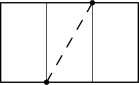
Answer: C
Small Hint:
Scale the rectangle to width
Big Hint:
The fold creates equilateral overlap triangles
Solution:
WLOG, let the width of the rectangle be and the length be
Draw the line perpendicular to the midpoint of the fold, as shown below.
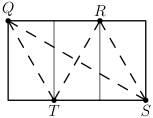
Note that and This tells us This means that is equilateral. Similarly, is equilateral. This makes the two triangles congruent.
This means that after the rectangle gets folded, this area will be overlapped. The area of the rectangle is The side length of this triangle is The area of it is then The area of the folded figure is then The desired ratio is then Therefore . Thus, C is the correct answer.
24.
A sequence of natural numbers is constructed by listing the first then skipping one, listing the next skipping listing skipping and on the th iteration, listing and skipping The sequence begins What is the th number in the sequence?
Answer: A
Small Hint:
Count how many terms have been listed after full iterations
Big Hint:
Then locate the desired term inside the next listed block
Solution:
After full iterations, the number of listed terms is .
We need the largest with . Since , after iterations there are listed numbers.
The first number listed in iteration is one more than the total of all listed and skipped numbers so far, namely .
The th listed number is the th number of this next block, so it is .
Thus, A is the correct answer.
25.
The number is between and How many pairs of integers are there such that and
Answer: B
Small Hint:
Each interval between consecutive powers of contains two or three powers of
Big Hint:
Use the total number of powers of before
Solution:
Since , each interval contains either two or three powers of . The desired inequality holds exactly for intervals containing three such powers.
For , let be the number of intervals with two powers of , and let be the number with three powers of . Then .
Because , these intervals contain powers of altogether, so .
Solving the system gives .
Thus, B is the correct answer.