
2024 AIME I Problems
Scroll down and press Start to try the exam! Or, go to the printable PDF, answer key, or professional solutions curated by LIVE by Po-Shen Loh.
All problems are used with official legal permission of the Mathematical Association of America (MAA).
Or jump straight to a single problem with its solution: 1 · 2 · 3 · 4 · 5 · 6 · 7 · 8 · 9 · 10 · 11 · 12 · 13 · 14 · 15
Want to learn professionally through interactive video classes?
Timed
3:00:00
1.
Every morning Aya goes for a -kilometer-long walk and stops at a coffee shop afterwards. When she walks at a constant speed of kilometers per hour, the walk takes her hours, including minutes spent in the coffee shop. When she walks kilometers per hour, the walk takes her hours and minutes, including minutes spent in the coffee shop. Suppose Aya walks at kilometers per hour. Find the number of minutes the walk takes her, including the minutes spent in the coffee shop.
Answer: 204
Small Hint:
Convert both trips into equations: and
Big Hint:
Subtracting the two equations eliminates and gives
Solution:
Measuring time in hours, the two scenarios say and Subtracting, so giving The positive root of is
Then so minutes. Walking at kilometers per hour takes hours, so the total is minutes.
2.
There exist real numbers and both greater than such that Find
Answer: 25
Small Hint:
Bring the exponents down: and
Big Hint:
Multiply the two equations: since the logarithms disappear
Solution:
Pulling the exponents out of the logarithms, the conditions become and Multiplying these equations and using gives so
Such and do exist. Set The continuous function tends to infinity as while at it is less than Hence it equals for some where
3.
Alice and Bob play the following game. A stack of tokens lies before them. The players take turns with Alice going first. On each turn, the player removes token or tokens from the stack. The player who removes the last token wins. Find the number of positive integers less than or equal to such that there is a strategy that guarantees that Bob wins, regardless of Alice’s moves.
Answer: 809
Small Hint:
Work out which small are losses for the player about to move: is a loss exactly when both and are wins
Big Hint:
The losing positions repeat with period they are or Bob wins exactly for those
Solution:
Call a losing position if the player about to move loses with best play. We claim the losing positions are exactly or From such an removing or tokens leaves — never again or — while from any one move reaches a position or (remove tokens respectively). Since is a loss for the player to move, induction confirms the pattern.
Bob wins exactly when is a losing position for Alice. Among there are multiples of and values (from to ), for a total of
4.
Jen enters a lottery by selecting distinct elements of Then four elements of are drawn at random. Jen wins a prize if at least two of her numbers were drawn, and wins the grand prize if all four of her numbers were drawn. The probability that Jen wins the grand prize given that Jen wins a prize is where and are relatively prime positive integers. Find
Answer: 116
Small Hint:
Winning the grand prize forces winning a prize, so the conditional probability is
Big Hint:
Count draws that share exactly or numbers with Jen’s ticket — every draw of numbers is equally likely
Solution:
All draws are equally likely. The number of draws sharing exactly numbers with Jen’s ticket is so the number winning a prize is and exactly of these wins the grand prize.
Since the grand prize implies a prize, the conditional probability is so
5.
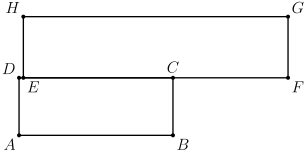
Rectangle has dimensions and and rectangle has dimensions and Points and lie on line in that order, and and lie on opposite sides of line as shown. Points and lie on a common circle. Find
Answer: 104
Small Hint:
Put line on the -axis with at the origin, and write the coordinates of and in terms of
Big Hint:
The circle’s center lies on (bisector of ) and on the vertical bisector of equate its distances to and
Solution:
Put line on the -axis with and so Let Then and the second rectangle sits above the line: and
The center of the circle through lies on the perpendicular bisector of the vertical segment the line and on the perpendicular bisector of the horizontal segment the line Equating the center’s squared distances to and to so and giving
Therefore
6.
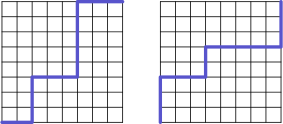
Consider the paths of length that follow the lines from the lower left corner to the upper right corner on an grid. Find the number of such paths that change direction exactly four times, as in the examples shown below.
Answer: 294
Small Hint:
A path with exactly four turns consists of five straight runs that alternate between rightward and upward
Big Hint:
If the path starts rightward, the three rightward runs and two upward runs are positive integers summing to each — count the compositions, then double
Solution:
A path that changes direction exactly four times consists of five maximal straight runs, alternating between rightward and upward moves. If the first run is rightward, the pattern is three rightward runs with positive lengths summing to and two upward runs with positive lengths summing to The counts of such compositions are and giving paths.
Paths starting upward are counted symmetrically, another The total is
7.
Find the largest possible real part of where is a complex number with Here
Answer: 540
Small Hint:
Write and take the real part of each term
Big Hint:
You get an expression of the form whose maximum is
Solution:
Write so The real part of is and the real part of is
The total real part is whose maximum over is
8.
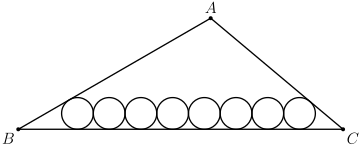
Eight circles of radius can be placed tangent to of so that the circles are sequentially tangent to each other, with the first circle being tangent to and the last circle being tangent to as shown. Similarly, circles of radius can be placed tangent to in the same manner. The inradius of can be expressed as where and are relatively prime positive integers. Find
Answer: 197
Small Hint:
The centers sit at height above spaced apart, and the end centers lie at distances and from and
Big Hint:
Both chains measure the same which determines the incircle satisfies
Solution:
For a chain of circles of radius tangent to the centers lie at height with consecutive centers apart. The first circle is tangent to and so its center lies on the bisector from at horizontal distance from similarly the last center is from Hence with
The two chains give so and whence
The incircle is a chain of one circle of radius Therefore and
9.
Let and be points on the hyperbola such that is a rhombus whose diagonals intersect at the origin. Find the largest number less than for all rhombuses
Answer: 480
Small Hint:
The diagonals are perpendicular lines through the origin; if with then
Big Hint:
The perpendicular diagonal must also meet the hyperbola, so both slopes squared lie strictly between and study as the slope varies
Solution:
The diagonals of a rhombus are perpendicular bisectors of each other, so and Let line have slope so with i.e. which requires Then Line has slope so it meets the hyperbola only when that is
On the interval the quantity is strictly increasing in as it tends to and as it grows without bound. Hence takes exactly the values in and never equals
The largest number that is less than for every such rhombus is therefore
10.
Let have side lengths and The tangents to the circumcircle of at and intersect at point and intersects the circumcircle at The length of is equal to where and are relatively prime integers. Find
Answer: 113
Small Hint:
By the tangent-chord angle, so
Big Hint:
Power of the point gives so compute from the law of cosines in triangle
Solution:
By the tangent-chord angle, so triangle is isosceles with The law of cosines gives and so
Since lies on the opposite side of from and The law of cosines in triangle then gives
The power of gives so and
11.
Each vertex of a regular octagon is independently colored either red or blue with equal probability. The probability that the octagon can then be rotated so that all of the blue vertices end up at positions where there had been red vertices is where and are relatively prime positive integers. Find
Answer: 371
Small Hint:
With blue vertices, the overlaps summed over the seven nonzero rotations equal so every coloring with works
Big Hint:
For a rotation must carry the blue set exactly onto its complement; count those sets separately for odd, and
Solution:
Label the vertices and let be the blue set, Rotation by works exactly when Since must fit inside the red positions, Summing over all eight rotations counts all pairs once (via ), a total of and the term contributes So for the seven nonzero rotations share only overlaps, and some rotation has none: all colorings with succeed.
For disjointness forces to be exactly the complement of If is odd, the cycle visits all vertices and must alternate between and its complement, so is the evens or the odds: sets. If then meets each of the -cycles and in an antipodal pair: sets, such as If then contains exactly one of each pair sets. The first two families contain both members of some antipodal pair while the third never does, and the evens/odds take both their antipodal pairs from one -cycle, so the three families are disjoint: sets.
In total of the colorings work, so the probability is and
12.
Define and Find the number of intersections of the graphs of and
Answer: 385
Small Hint:
As runs from to the value zigzags between and four times; count the monotone arcs of each graph
Big Hint:
Each bottom-to-top arc of one graph crosses each left-to-right arc of the other exactly once — then examine the corner which both graphs pass through
Solution:
Both right-hand sides take values in so every intersection lies in the unit square, and there we may write both curves using the first is and the second is As increases from to runs linearly with corners at For sweeps monotonically times, so the first graph consists of monotone arcs, each climbing or descending through the full range within a narrow vertical strip. Likewise sweeps monotonically times for so the second graph consists of monotone arcs, each crossing the full range within a narrow horizontal strip.
Take one arc of each graph, living in the vertical strip and the horizontal strip Inside the rectangle the first arc joins the bottom edge to the top edge and the second joins the left edge to the right edge, and each is monotone, so the two arcs cross exactly once. This yields intersection points.
One further point hides at the corner which lies on both graphs: and Near it the first graph is while the second satisfies so the two final arcs meet at their shared endpoint in addition to the transversal crossing already counted. The total is
13.
Let be the least prime number for which there exists an integer such that is divisible by Find the least positive integer such that is divisible by
Answer: 110
Small Hint:
If is divisible by then has order modulo so test the smallest such prime
Big Hint:
The fourth roots of modulo are and lift each to a solution modulo with a Hensel step and compare
Solution:
If is divisible by then and so has order modulo and is divisible by (and fails since ). The smallest prime is and indeed Because the derivative is not divisible by at such an each root lifts to a root modulo so
The fourth roots of modulo are and To lift set modulo so we need giving and
The same computation lifts and to and respectively, so the least positive is Indeed
14.
Let be a tetrahedron such that and There exists a point inside the tetrahedron such that the distances from to each of the faces of the tetrahedron are all equal. This distance can be written in the form where and are positive integers, and are relatively prime, and is not divisible by the square of any prime. Find
Answer: 104
Small Hint:
Equal opposite edges let you embed the tetrahedron in a rectangular box whose face diagonals are and
Big Hint:
The box is The equidistant point is the insphere center, and with all four faces congruent.
Solution:
A tetrahedron with equal opposite edges embeds in a rectangular box with the six edges as face diagonals. If the box has dimensions then and Adding gives so The box minus four corner tetrahedra of volume each leaves
All four faces are congruent triangles with sides By Heron’s formula in the form applied to the squared sides we get so
The point equidistant from all four faces is the insphere center, and decomposing the tetrahedron into four pyramids over the faces gives Hence and
15.
Let be the set of rectangular boxes with surface area and volume Let be the radius of the smallest sphere that can contain each of the rectangular boxes that are elements of The value of can be written as where and are relatively prime positive integers. Find
Answer: 721
Small Hint:
The constraints say and and the sphere must contain the space diagonal, so maximize
Big Hint:
and the extreme of occurs when two dimensions are equal — solve the resulting cubic in that common value
Solution:
For a box with dimensions the conditions are and so The smallest sphere containing a box has the box’s space diagonal as a diameter, so
With and fixed, ranges over an interval, and at an endpoint the cubic has a double root, meaning two dimensions coincide. Setting and so eliminating gives i.e. which factors as The roots are and
For and for is smaller. So the maximum of is giving and