
1999 AIME Problems
Scroll down and press Start to try the exam! Or, go to the printable PDF, answer key, or professional solutions curated by LIVE by Po-Shen Loh.
All problems are used with official legal permission of the Mathematical Association of America (MAA).
Or jump straight to a single problem with its solution: 1 · 2 · 3 · 4 · 5 · 6 · 7 · 8 · 9 · 10 · 11 · 12 · 13 · 14 · 15
Want to learn professionally through interactive video classes?
Timed
3:00:00
1.
Find the smallest prime that is the fifth term of an increasing arithmetic sequence, all four preceding terms also being prime.
Answer: 29
Small Hint:
If the common difference is not a multiple of one of the first three terms is divisible by
Big Hint:
The difference must be a multiple of so try five-term progressions with difference starting from small primes
Solution:
Let the terms be The even prime cannot be the first term: an even difference makes the second term even, while an odd difference makes the third term even. If were odd, consecutive terms would have opposite parity, so some term other than the first would be even and greater than — impossible. If were not a multiple of then would cover all residues mod so some term would be divisible by that term would have to be itself, forcing but then is composite. Hence is divisible by
With the fifth term is at least Trying and gives all prime, and no smaller fifth term is possible since (the starts and fail as above). The answer is
2.
Consider the parallelogram with vertices and A line through the origin cuts this figure into two congruent polygons. The slope of the line is where and are relatively prime positive integers. Find
Answer: 118
Small Hint:
A line cuts a parallelogram into two congruent pieces when it passes through the parallelogram’s center of symmetry
Big Hint:
The center is the midpoint of the diagonal from to
Solution:
Congruent pieces have equal area. For any fixed direction, there is only one line in that direction that bisects the area of a convex figure; because a parallelogram is centrally symmetric, that line passes through its center. Thus the required line through the origin must also pass through the center. Conversely, the rotation about the center swaps the two pieces cut by such a line, so they are congruent. The center is the midpoint of a diagonal:
The line through the origin and has slope and so
3.
Find the sum of all positive integers for which is a perfect square.
Answer: 38
Small Hint:
Multiply by and complete the square:
Big Hint:
If the expression equals then factor as a difference of squares in every way
Solution:
Suppose Multiplying by and completing the square gives so The two factors sum to so both are positive: the factor pairs are and
Subtracting the first factor from the second gives or so or Each indeed makes the expression a perfect square ( ), and the sum is
4.
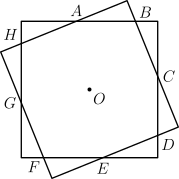
The two squares shown share the same center and have sides of length The length of is and the area of octagon is where and are relatively prime positive integers. Find
Answer: 185
Small Hint:
By the symmetries swapping the two squares and rotating by all eight sides of the octagon are congruent
Big Hint:
Cut the octagon into triangles with apex each side of the octagon lies on a side of a square, at distance from
Solution:
The whole configuration is unchanged by rotating about which cycles the octagon side to and it is also unchanged by the reflection that swaps the two squares, which carries those sides to So all eight sides of the octagon have the same length,
Segments from to the eight vertices cut the octagon into triangles. Each has base lying on a side of one of the unit squares, so its height from is the distance from the center to that side, namely The area is
Since the answer is
5.
For any positive integer let be the sum of the digits of and let be For example, How many values do not exceed
Answer: 223
Small Hint:
If adding causes no carrying, Carrying happens only when ends in or
Big Hint:
Track how the digit sum changes when ends in a run of nines; the carrying values form an arithmetic progression with common difference
Solution:
If the last digit of is at most adding changes no other digit, so Otherwise there is carrying. If ends in the digit preceded by exactly nines, then replaces by so and If ends in exactly nines, then replaces by so and
Both carrying families give exactly the values that is, for and every such value occurs. So the possible values of are together with all Requiring gives which is values, and adds one more, for a total of
6.
A transformation of the first quadrant of the coordinate plane maps each point to the point The vertices of quadrilateral are and Let be the area of the region enclosed by the image of quadrilateral Find the greatest integer that does not exceed
Answer: 314
Small Hint:
Instead of tracking the vertices, find what the map does to each of the four boundary lines
Big Hint:
and map to lines through the origin, while maps to an arc of
Solution:
Follow the four edges. Sides and lie on the lines and which map to the lines and — rays from the origin at angles and Sides and lie on and which map to arcs of the circles and
So the image is the part of the annulus between radii and lying between the and rays, one twelfth of the full annulus:
Since we have so the greatest integer not exceeding is
7.
There is a set of switches, each of which has four positions, called and When the position of any switch changes, it is only from to from to from to or from to Initially each switch is in position The switches are labeled with the different integers where and take on the values At step of a -step process, the th switch is advanced one step, and so are all the other switches whose labels divide the label on the th switch. After step has been completed, how many switches will be in position
Answer: 650
Small Hint:
The switch labeled is advanced once for every label that is a multiple of count those multiples in terms of the exponents
Big Hint:
The label advances times; count the triples for which this product is not a multiple of
Solution:
The switch labeled is advanced exactly once for each step whose label is a multiple of The multiples of among the labels are the with etc., so that switch advances times. It returns to position exactly when this count is a multiple of
Write each ranging over through We count the triples where is not divisible by either all three are odd, or exactly one is even but not divisible by Among there are odd values and values ( ) that are twice an odd number. That gives triples of the first kind and of the second, or in all.
Therefore switches end in position
8.
Let be the set of ordered triples of nonnegative real numbers that lie in the plane Let us say that supports when exactly two of the following are true: Let consist of those triples in that support The area of divided by the area of is where and are relatively prime positive integers. Find
Answer: 25
Small Hint:
is a triangle, and each condition like cuts off a corner with a line parallel to a side
Big Hint:
Since all three inequalities hold only at one boundary point; apart from that point, each two-inequality region is a triangle similar to
Solution:
is the triangle with vertices Because whenever two of the inequalities hold, the third can hold only at a boundary point of zero area. So is, up to measure zero, the union of the three regions where a specific pair of inequalities holds.
The region with and becomes, after substituting and a copy of with coordinate sum i.e. a triangle similar to with ratio and area of Likewise the pairs and give similar triangles with ratios and
The ratio of areas is so
9.
A function is defined on the complex numbers by where and are positive numbers. This function has the property that the image of each point in the complex plane is equidistant from that point and the origin. Given that and that where and are relatively prime positive integers, find
Answer: 259
Small Hint:
The condition says for every write both sides as a modulus times
Big Hint:
You need which pins down then use
Solution:
The condition is for all that is, Dividing by (for ) gives so which forces
Since we have so As the answer is
10.
Ten points in the plane are given, with no three collinear. Four distinct segments joining pairs of these points are chosen at random, all such segments being equally likely. The probability that some three of the segments form a triangle whose vertices are among the ten given points is where and are relatively prime positive integers. Find
Answer: 489
Small Hint:
Four segments can contain at most one triangle, because two different triangles always use at least five segments
Big Hint:
Count favorable choices as: pick a triangle from the possible ones, then pick any fourth segment
Solution:
There are segments, so equally likely choices. Two distinct triangles share at most one edge, so together they use at least segments; hence a set of segments contains at most one triangle, and the favorable sets are counted exactly once by choosing a triangle and then a fourth segment:
The probability is already in lowest terms (), so
11.
Given that where angles are measured in degrees, and and are relatively prime positive integers that satisfy find
Answer: 177
Small Hint:
Multiply the sum by and use to telescope
Big Hint:
The two surviving terms combine because finish with
Solution:
Multiply the sum by and apply so the sum telescopes:
Hence the sum equals Since and we get
12.
The inscribed circle of triangle is tangent to at and its radius is Given that and find the perimeter of the triangle.
Answer: 345
Small Hint:
Tangent segments from each vertex are equal, so the tangent lengths from are and an unknown
Big Hint:
Set the area two ways: and Heron’s formula; the resulting equation is linear in
Solution:
Tangent segments from a point are equal, so the tangent lengths from are and some Then the sides are the semiperimeter is and Heron’s formula gives area
The area also equals Squaring and dividing by gives so and
The perimeter is
13.
Forty teams play a tournament in which every team plays every other team exactly once. No ties occur, and each team has a chance of winning any game it plays. The probability that no two teams win the same number of games is where and are relatively prime positive integers. Find
Answer: 742
Small Hint:
Distinct win totals must be exactly and that ranking determines the winner of every single game
Big Hint:
The probability is divided by reduce by counting the factors of in
Solution:
There are games, hence equally likely outcomes. If all win totals are distinct, they must be exactly In that case the team with wins beat everyone, the team with wins beat everyone except that team, and so on: the assignment of totals to teams determines every game. Conversely each of the assignments arises from exactly one outcome, so the probability is
By Legendre’s formula the power of dividing is In lowest terms the denominator is therefore so
14.
Point is located inside triangle so that angles and are all congruent. The sides of the triangle have lengths and and the tangent of angle is where and are relatively prime positive integers. Find
Answer: 463
Small Hint:
Call the common angle and compute two ways, from triangles and with the law of sines
Big Hint:
The comparison simplifies to and each cotangent can be written in terms of the side lengths and the area
Solution:
Let In triangle the angles at and are and so and the law of sines gives In triangle the angles at and are and so and
Equating and substituting yields Expanding and dividing by and since the left side is Hence
Using and its analogues, where is the area, since the -- triangle has area So which is in lowest terms, and
15.
Consider the paper triangle whose vertices are and The vertices of its midpoint triangle are the midpoints of its sides. A triangular pyramid is formed by folding the triangle along the sides of its midpoint triangle. What is the volume of this pyramid?
Answer: 408
Small Hint:
The three folded corners meet at a single apex, whose distance to each midpoint equals half of the corresponding original side
Big Hint:
Keep the midpoint triangle in the plane and solve three distance equations for the apex
Solution:
The midpoints are and Folding the three corner triangles up along the sides of the midpoint triangle brings the corners together at one apex (each pair of glued half-sides has equal length). The apex keeps its folded distances: (half of the side of length that bisects), (half of ), and (half of ).
Keep the midpoint triangle in the plane and let Subtracting from gives so subtracting from gives so Then so the apex is at height
The base is the midpoint triangle, with area one quarter of the original triangle’s i.e. The volume is