
Soluciones del 1999 AMC 8
Desplázate hacia abajo para ver las soluciones preparadas profesionalmente de LIVE by Po-Shen Loh, imprime las soluciones en PDF, consulta la clave de respuestas, o haz el examen cronometrado completo.
Todos los problemas se usan con el permiso legal oficial de la Mathematical Association of America (MAA).
1.
Para que la afirmación sea verdadera, el signo de interrogación entre el y el debe reemplazarse por
To make this statement true, the question mark between the and the should be replaced by
Ninguna de estas
None of these
Pista pequeña:
Simplifica primero la parte sin el signo de interrogación
Simplify the part without the question mark first
Pista grande:
Halla la operación que hace
Find the operation that makes
Solución:
Tenemos que
Entonces
La única opción que funciona es
Por lo tanto, A es la respuesta correcta.
We have that
Then
The only choice that works is
Thus, A is the correct answer.
2.
¿Cuál es la medida en grados del ángulo más pequeño formado por las manecillas de un reloj a las en punto?
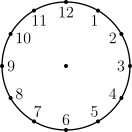
What is the degree measure of the smaller angle formed by the hands of a clock at o’clock?
Pista pequeña:
Cada marca de hora está separada
Each hour mark is apart
Pista grande:
A las en punto, las manecillas están separadas dos marcas de hora
At o’clock, the hands are two hour marks apart
Solución:
A las en punto, la manecilla de las horas está en el y la manecilla de los minutos está en el
Esto significa que las manecillas están separadas de todo el círculo. Esto es igual a
Por lo tanto, C es la respuesta correcta.
At o’clock, we have that the hour hand is at and the minute hand is at
This means that the hands are a of the entire circle apart. This is equal to
Thus, C is the correct answer.
3.
¿Cuál terna de números tiene una suma que NO es igual a ?
Which triplet of numbers has a sum NOT equal to
Pista pequeña:
Calcula primero las sumas que parezcan más fáciles
Compute the easiest-looking sums first
Pista grande:
Solo una de las ternas listadas no suma
Only one listed triplet fails to total
Solución:
A es igual a
B se reduce a
C suma
Sin embargo, D suma
Para asegurarnos, verificamos que E tiene una suma de
Por lo tanto, D es la respuesta correcta.
We have that A is the same as
B reduces to
C adds up to
D however adds to
To make sure, we check that E has a sum of
Thus, D is the correct answer.
4.
El diagrama muestra las millas recorridas por los ciclistas Alberto y Bjorn. Después de cuatro horas, ¿aproximadamente cuántas millas más ha recorrido Alberto que Bjorn?
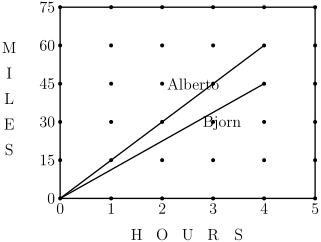
The diagram shows the miles traveled by bikers Alberto and Bjorn. After four hours, about how many more miles has Alberto biked than Bjorn?
Pista pequeña:
Lee ambas distancias a las horas
Read both distances at hours
Pista grande:
Resta la distancia de Bjorn a la de Alberto
Subtract Bjorn’s distance from Alberto’s
Solución:
Observando la gráfica, tenemos que Alberto ha recorrido millas y Bjorn millas después de horas.
La diferencia entre las dos distancias es millas.
Por lo tanto, A es la respuesta correcta.
Looking at the graph, we have that Alberto has biked miles and Bjorn miles after hours.
The difference between the two distances is miles.
Thus, A is the correct answer.
5.
Un jardín rectangular de pies de largo y pies de ancho está cercado por una valla. Para agrandar el jardín usando la misma valla, su forma se cambia a un cuadrado. ¿En cuántos pies cuadrados se agranda el jardín?
A rectangular garden feet long and feet wide is enclosed by a fence. To make the garden larger, while using the same fence, its shape is changed to a square. By how many square feet does this enlarge the garden?
Pista pequeña:
Mantén el mismo perímetro
Keep the perimeter the same
Pista grande:
El lado del cuadrado es un cuarto del perímetro anterior
The square side length is one-fourth of the old perimeter
Solución:
La longitud actual de la valla es pies. Si todos los lados se hacen iguales, entonces cada lado mide pies. Así, el área del cuadrado es pies cuadrados. Nota que el área original del jardín es pies cuadrados.
Por lo tanto, la diferencia es pies cuadrados.
Por lo tanto, D es la respuesta correcta.
The current length of the fence is feet. If all the sides become the same, then each side length is feet. As such, the area of the square is then square feet. Note that the original area of the garden is square feet.
Therefore, the difference is square feet.
Thus, D is the correct answer.
6.
Bo, Coe, Flo, Jo y Moe tienen cantidades diferentes de dinero. Ni Jo ni Bo tienen tanto dinero como Flo. Tanto Bo como Coe tienen más que Moe. Jo tiene más que Moe, pero menos que Bo. ¿Quién tiene la menor cantidad de dinero?
Bo, Coe, Flo, Jo, and Moe have different amounts of money. Neither Jo nor Bo has as much money as Flo. Both Bo and Coe have more than Moe. Jo has more than Moe, but less than Bo. Who has the least amount of money?
Bo
Coe
Flo
Jo
Moe
Pista pequeña:
Elimina a quien se sepa que tiene más que otra persona
Eliminate anyone known to have more than someone else
Pista grande:
Usa cada comparación para mostrar quién está por encima de Moe
Use each comparison to show who is above Moe
Solución:
Sean y la cantidad de dinero que tienen Bo, Coe, Flo, Jo y Moe respectivamente.
Entonces
También tenemos
Finalmente, se nos da
A partir de la primera y segunda desigualdades, obtenemos que
Esto muestra que todos tienen más dinero que Moe.
Por lo tanto, E es la respuesta correcta.
Let and represent the amount of money that Bo, Coe, Flo, Jo, and Moe have respectively.
Then
We also have
Finally, we are given
From the first and second inequalities, we can get that
This shows that everyone has more money than Moe.
Thus, E is the correct answer.
7.
La tercera salida de una autopista está en el marcador de milla y la décima salida está en el marcador de milla Hay un centro de servicio en la autopista ubicado a tres cuartos del camino desde la tercera salida hasta la décima salida. ¿En qué marcador de milla esperarías encontrar este centro de servicio?
The third exit on a highway is located at milepost and the tenth exit is at milepost There is a service center on the highway located three-fourths of the way from the third exit to the tenth exit. At what milepost would you expect to find this service center?
Pista pequeña:
Primero halla la distancia entre los marcadores de milla y
First find the distance between mileposts and
Pista grande:
Avanza de esa distancia desde el marcador de milla
Move of that distance past milepost
Solución:
Hay millas entre la tercera y la décima salida.
Esto significa que del camino se encuentra en el marcador de milla de la autopista.
Por lo tanto, E es la respuesta correcta.
There are miles between the third and tenth exits.
This means of the way is at the milepost.
Thus, E is the correct answer.
8.
Seis cuadrados están coloreados por delante y por detrás: significa rojo, azul, naranja, amarillo, verde y blanco. Están unidos con bisagras como se muestra, luego se doblan para formar un cubo. La cara opuesta a la cara blanca es
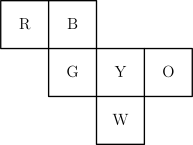
Six squares are colored, front and back ( = red, = blue, = orange, = yellow, = green, and = white). They are hinged together as shown, then folded to form a cube. The face opposite the white face is
Pista pequeña:
Dobla alrededor del cuadrado marcado
Fold around the square marked
Pista grande:
Sigue qué cara queda opuesta a
Track which face lands opposite
Solución:
Considera el cubo con la cara amarilla hacia arriba.
Entonces podemos doblar hacia abajo las caras blanca, verde y naranja.
Como la cara azul está unida a la cara verde, terminará doblándose hacia atrás.
Esto significa que la cara azul quedará opuesta a la cara blanca.
Por lo tanto, A es la respuesta correcta.
Consider the cube with the yellow face facing upwards.
Then we can fold the white, green, and orange faces down.
Since the blue face is attached to the green face, it will end up folding backwards.
This means that the blue face will end up facing opposite the white face.
Thus, A is the correct answer.
9.
Tres macizos de flores se superponen como se muestra. El macizo tiene plantas, el macizo tiene plantas y el macizo tiene plantas. Los macizos y comparten plantas, mientras que los macizos y comparten El número total de plantas es
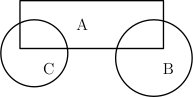
Three flower beds overlap as shown. Bed has plants, bed has plants, and bed has plants. Beds and share plants, while beds and share The total number of plants is
Pista pequeña:
Suma primero las cantidades de los tres macizos
Add the three bed counts first
Pista grande:
Resta las superposiciones que se contaron dos veces
Subtract the overlaps that were counted twice
Solución:
Nota que hay plantas que están en dos macizos y no hay plantas en los tres macizos a la vez.
Entonces el número total de plantas es Restamos las superposiciones para eliminar las plantas que contamos dos veces.
Por lo tanto, C es la respuesta correcta.
Note there are plants that are in two beds and there are no plants in all three beds.
The total number of plants is then We subtract to get rid of the plants that we counted twice.
Thus, C is the correct answer.
10.
Un ciclo completo de un semáforo dura segundos. Durante cada ciclo la luz está verde segundos, amarilla segundos y roja segundos. En un instante elegido al azar, ¿cuál es la probabilidad de que la luz NO esté verde?
A complete cycle of a traffic light takes seconds. During each cycle the light is green for seconds, yellow for seconds, and red for seconds. At a randomly chosen time, what is the probability that the light will NOT be green?
Pista pequeña:
No verde significa rojo o amarillo
Not green means red or yellow
Pista grande:
Usa el tiempo en que no está verde dividido por el tiempo total del ciclo
Use time not green over total cycle time
Solución:
Durante un ciclo dado, la luz no está verde durante segundos.
Entonces la probabilidad de que no esté verde es
Por lo tanto, E es la respuesta correcta.
During a given cycle, the light is not green for seconds.
Then the probability that it is not green is
Thus, E is the correct answer.
11.
Cada uno de los cinco números y se coloca en uno de los cinco cuadrados de modo que la suma de los tres números de la fila horizontal sea igual a la suma de los tres números de la columna vertical. El mayor valor posible para la suma horizontal o vertical es

Each of the five numbers and is placed in one of the five squares so that the sum of the three numbers in the horizontal row equals the sum of the three numbers in the vertical column. The largest possible value for the horizontal or vertical sum is
Pista pequeña:
El cuadrado central se cuenta en ambas sumas
The center square is counted in both sums
Pista grande:
Maximiza el número central, luego divide el total duplicado en partes iguales
Maximize the center number, then split the doubled total equally
Solución:
Sea el número del centro. La suma horizontal más la suma vertical cuenta cada número una vez, salvo el número central, que se cuenta dos veces.
Por tanto, el doble de la suma común es . Este valor es máximo cuando .
Así, la mayor suma común posible es a lo sumo , y se puede alcanzar: se coloca en el centro, y en los extremos de una fila, y y en los extremos de la otra. Ambas sumas son .
Por lo tanto, D es la respuesta correcta.
Let be the number in the center. The horizontal sum plus the vertical sum counts every number once, except the center number is counted twice.
So twice the common sum is . This is largest when .
The largest common sum is therefore at most , and it is attainable: put in the center, and at the ends of one row, and and at the ends of the other. Both sums are .
Thus, D is the correct answer.
12.
La razón entre el número de partidos ganados y el número de partidos perdidos (sin empates) por los Middle School Middies es Redondeado al porcentaje entero más cercano, ¿qué porcentaje de sus partidos perdió el equipo?
The ratio of the number of games won to the number of games lost (no ties) by the Middle School Middies is To the nearest whole percent, what percent of its games did the team lose?
Pista pequeña:
Usa victorias y derrotas como un grupo
Use wins and losses as one batch
Pista grande:
La fracción de partidos perdidos es el número de derrotas dividido entre el total de partidos
The lost fraction is losses over total games
Solución:
Se puede ver al equipo como ganando partidos y perdiendo partidos en cada grupo de partidos.
El porcentaje perdido es .
Por lo tanto, B es la respuesta correcta.
The team can be viewed as winning games and losing games in each batch of games.
The percent lost is .
Thus, B is the correct answer.
13.
La edad promedio de los miembros de un campamento de ciencias de la computación es de años. Hay chicas, chicos y adultos. Si la edad promedio de las chicas es y la edad promedio de los chicos es ¿cuál es la edad promedio de los adultos?
The average age of the members of a computer science camp is years. There are girls, boys, and adults. If the average age of the girls is and the average age of the boys is what is the average age of the adults?
Pista pequeña:
Convierte cada promedio en una edad total
Convert each average into a total age
Pista grande:
Resta los totales de las chicas y los chicos del total del campamento
Subtract the girls’ and boys’ totals from the camp total
Solución:
La suma de las edades de todos en el campamento es
La suma de las edades de las chicas es y la de los chicos es
Por lo tanto, sabemos que la suma de las edades de los adultos debe ser
Y por lo tanto, la edad promedio de los adultos es
Por lo tanto, C es la respuesta correcta.
The sum of the ages of everybody at the camp is
The sum of the ages of the girls is and of the boys is
As such, we know that the ages of the adults must be
And therefore, the average age of the adults is then
Thus, C is the correct answer.
14.
En el trapecio los lados y son iguales. El perímetro de es
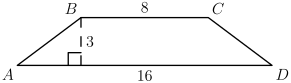
In trapezoid the sides and are equal. The perimeter of is
Pista pequeña:
Traza una altura desde
Drop an altitude from
Pista grande:
Los dos triángulos rectángulos laterales tienen cateto horizontal
The two side right triangles have horizontal leg
Solución:
Sea el punto donde la altura desde hasta interseca a
Entonces tenemos que ya que
Luego,
Por lo tanto, el perímetro es
Por lo tanto, D es la respuesta correcta.
Let be where the altitude from to intersects
Then we have that since
We then have that
Then the perimeter is
Thus, D is the correct answer.
15.
Las placas de bicicleta en Flatville contienen cada una tres letras. La primera se elige del conjunto la segunda de y la tercera de
Cuando Flatville necesitó más placas, agregaron dos letras nuevas. Ambas letras nuevas pueden agregarse a un mismo conjunto, o una letra puede agregarse a un conjunto y la otra a otro conjunto. ¿Cuál es el mayor número posible de placas adicionales que se pueden hacer agregando dos letras?
Bicycle license plates in Flatville each contain three letters. The first is chosen from the set the second from and the third from
When Flatville needed more license plates, they added two new letters. The new letters may both be added to one set or one letter may be added to one set and one to another set. What is the largest possible number of additional license plates that can be made by adding two letters?
Pista pequeña:
El número anterior de placas es
The old number of plates is
Pista grande:
Para maximizar un producto, haz que los tres factores estén lo más equilibrados posible
To maximize a product, make the three factors as balanced as possible
Solución:
Actualmente se pueden hacer placas.
Si ambas letras se agregan al primer conjunto, entonces hay placas posibles.
Si ambas se agregan al segundo, hay placas.
Si se agregan al tercero, hay opciones.
Si una se agrega al primer conjunto y la otra al segundo, hay placas.
Si una se agrega al primer conjunto y la otra al tercero, obtenemos placas posibles.
Finalmente, si las letras se agregan al segundo y tercer conjuntos, hay placas.
Vemos que es el mayor número de placas que podemos lograr. Esto son placas adicionales.
Por lo tanto, D es la respuesta correcta.
There are currently license plates that can be made.
If both letters are added to the first set, then there are possible plates.
If they are both added to the second, there are plates.
If they are added to the third, there are choices.
If one is added to the first set and the other to the second set, there are plates.
If the other is added to the third set, we get possible plates.
Finally, if the letters are added to the second and third sets, there are plates.
We see that is the greatest number of plates that we can achieve. This is an additional plates.
Thus, D is the correct answer.
16.
El examen de matemáticas de Tori tenía problemas: de aritmética, de álgebra y de geometría. Aunque respondió correctamente el de los de aritmética, el de los de álgebra y el de los de geometría, no aprobó el examen porque acertó menos del de los problemas.
¿Cuántos problemas más habría necesitado responder correctamente para obtener una calificación aprobatoria del ?
Tori’s mathematics test had problems: arithmetic, algebra, and geometry problems. Although she answered of the arithmetic, of the algebra, and of the geometry problems correctly, she did not pass the test because she got less than of the problems right.
How many more problems would she have needed to answer correctly to earn a passing grade?
Pista pequeña:
Calcula las respuestas correctas actuales de Tori por categoría
Compute Tori’s current correct answers by category
Pista grande:
Compara ese total con el de
Compare that total with of
Solución:
Respondió correctamente preguntas de aritmética. Respondió correctamente de álgebra. También acertó preguntas de geometría.
Esto significa que acertó un total de preguntas.
Por lo tanto, para obtener un Tori debía responder correctamente preguntas. Esto significa que habría necesitado responder correctamente preguntas adicionales.
Por lo tanto, B es la respuesta correcta.
She answered arithmetic questions correctly. She answered algebra ones correctly. She also got geometry questions correctly.
This means she got a total of questions correct.
As such, in order to get a Tori must have answered questions correctly. This means that she would have needed to answer an additional questions correctly.
Thus, B is the correct answer.
17.
Los problemas y se refieren a lo siguiente:
Galletas para una multitud
En Central Middle School los estudiantes que participan en el AMC se reúnen por la noche para hablar de problemas y comen en promedio dos galletas cada uno. Este año Walter y Gretel hornean las Bonnie’s Best Bar Cookies. Su receta, que hace una bandeja de galletas, incluye estos ingredientes: tazas de harina, huevos, cucharadas de mantequilla, de taza de azúcar y paquete de chispas de chocolate. Solo harán recetas completas, no recetas parciales.
Walter puede comprar huevos por media docena. ¿Cuántas medias docenas debe comprar para hacer suficientes galletas? (Pueden sobrar algunos huevos y algunas galletas.)
Problems and refer to the following:
Cookies For a Crowd
At Central Middle School the students who take the AMC meet in the evening to talk about problems and eat an average of two cookies apiece. Walter and Gretel are baking Bonnie’s Best Bar Cookies this year. Their recipe, which makes a pan of cookies, lists these items: cups of flour, eggs, tablespoons butter, cups sugar, and package of chocolate drops. They will make only full recipes, not partial recipes.
Walter can buy eggs by the half-dozen. How many half-dozens should he buy to make enough cookies? (Some eggs and some cookies may be left over.)
Pista pequeña:
Halla cuántas recetas completas se necesitan para galletas
Find how many full recipes are needed for cookies
Pista grande:
Cada receta completa usa huevos
Each full recipe uses eggs
Solución:
Como los estudiantes comen en promedio galletas cada uno, comerán un total de galletas.
Cada receta hace galletas, lo que significa que necesitamos recetas completas para hacer suficientes galletas.
Cada bandeja requiere huevos, lo que significa que necesitamos huevos. Hay huevos en media docena, así que necesitamos medias docenas.
Por lo tanto, C es la respuesta correcta.
Since the students eat an average of cookies each, they will eat a total of cookies.
Each recipe makes cookies, which means we need full recipes to make enough cookies.
Each pan requires eggs, which means we need eggs. There are eggs in a half-dozen, so we need half-dozens.
Thus, C is the correct answer.
18.
Se enteran de que hay un gran concierto programado para la misma noche y la asistencia bajará un ¿Cuántas recetas de galletas deben hacer para su fiesta más pequeña?
They learn that a big concert is scheduled for the same night and attendance will be down How many recipes of cookies should they make for their smaller party?
Pista pequeña:
Una caída del deja un de asistencia
A drop leaves attendance
Pista grande:
Redondea hacia arriba el número de recetas necesarias
Round the needed number of recipes up
Solución:
Ahora solo habrá personas en la fiesta. Esto significa que necesitamos recetas.
Por lo tanto, E es la respuesta correcta.
There will now only be people at the party. This means we need recipes.
Thus, E is the correct answer.
19.
El baterista se enferma. El concierto se cancela. Walter y Gretel deben hacer suficientes bandejas de galletas para proveer galletas. Hay cucharadas en una barra de mantequilla. ¿Cuántas barras de mantequilla se necesitarán? (Por supuesto, puede sobrar algo de mantequilla.)
The drummer gets sick. The concert is cancelled. Walter and Gretel must make enough pans of cookies to supply cookies. There are tablespoons in a stick of butter. How many sticks of butter will be needed? (Some butter may be left over, of course.)
Pista pequeña:
Primero redondea hacia arriba el número de bandejas
First round the number of pans up
Pista grande:
Convierte las cucharadas de mantequilla en barras y redondea hacia arriba
Convert tablespoons of butter to sticks and round up
Solución:
Para hacer galletas, tienen que hacer bandejas. Como cada bandeja requiere cucharadas de mantequilla, todas las bandejas necesitarán cucharadas.
Entonces necesitarán barras de mantequilla.
Por lo tanto, B es la respuesta correcta.
To make cookies, they have to make pans. Since each pan requires tablespoons of butter, all the pans will need tablespoons.
They will then need sticks of butter.
Thus, B is the correct answer.
20.
La figura se llama “mapa de pilas”. Los números indican cuántos cubos hay apilados en cada posición. La Fig. muestra estos cubos, y la Fig. muestra la vista de los cubos apilados vistos desde el frente.
¿Cuál de las siguientes es la vista frontal del mapa de pilas de la Fig. ?
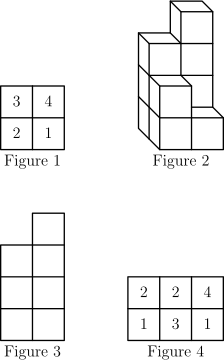
Figure is called a “stack map.” The numbers tell how many cubes are stacked in each position. Fig. shows these cubes, and Fig. shows the view of the stacked cubes as seen from the front.
Which of the following is the front view for the stack map in Fig.


Pista pequeña:
Una vista frontal conserva solo la pila más alta en cada columna
A front view keeps only the taller stack in each column
Pista grande:
Para cada columna, toma la mayor altura entre el frente y el fondo
For each column, take the larger front/back height
Solución:
Nota que la altura de la columna es la altura máxima entre las columnas del frente y del fondo.
En la columna izquierda, la columna del fondo es más alta con altura
En la columna del medio, la columna del frente es más alta con altura
Finalmente, la columna derecha tiene altura
Por lo tanto, B es la respuesta correcta.
Note that the height of the column is the maximum height of the front and back columns.
In the left column, we have that the back column is taller with height
In the middle column, we have that the front column is taller with height
Finally, the right column has height
Thus, B is the correct answer.
21.
La medida en grados del ángulo es
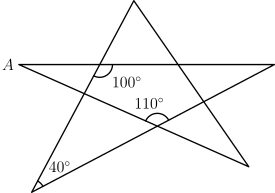
The degree measure of angle is
Pista pequeña:
Usa ángulos suplementarios en las dos intersecciones
Use supplementary angles at the two intersections
Pista grande:
Luego usa la suma de los ángulos de un triángulo cerca del ángulo de
Then use a triangle angle sum near the angle
Solución:
Marca los vértices como se muestra a continuación.
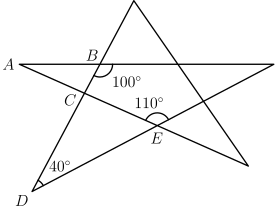
Por ángulos suplementarios, tenemos Luego, de nuevo por ángulos suplementarios, tenemos Usando que la suma de los ángulos interiores de un triángulo es obtenemos Luego, usando ángulos opuestos por el vértice, tenemos Finalmente, usando la suma de los ángulos interiores de un triángulo, obtenemos
Por lo tanto, B es la respuesta correcta.
Label the vertices as below.
We then have that by supplementary angles. Then we have again by supplementary angles. Using the sum of the interior angles of a triangle is we get Then, using vertical angles, we have Finally, using the sum of the interior angles of a triangle, we get
Thus, B is the correct answer.
22.
En una tierra lejana, tres peces se pueden cambiar por dos hogazas de pan, y una hogaza de pan se puede cambiar por cuatro bolsas de arroz. ¿Cuántas bolsas de arroz vale un pez?
In a far-off land three fish can be traded for two loaves of bread and a loaf of bread can be traded for four bags of rice. How many bags of rice is one fish worth?
Pista pequeña:
Convierte cada intercambio en una ecuación de valor
Turn each trade into a value equation
Pista grande:
Convierte peces a pan, luego pan a arroz
Convert fish to bread, then bread to rice
Solución:
Tres peces valen dos hogazas de pan, así que un pez vale de una hogaza.
Una hogaza vale bolsas de arroz, así que un pez vale bolsas de arroz.
Por lo tanto, D es la respuesta correcta.
Three fish are worth two loaves of bread, so one fish is worth of a loaf.
One loaf is worth bags of rice, so one fish is worth bags of rice.
Thus, D is the correct answer.
23.
El cuadrado tiene lados de longitud Los segmentos y dividen el área del cuadrado en tres partes iguales. ¿Cuánto mide el segmento ?
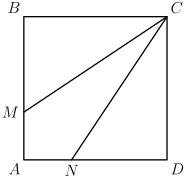
Square has sides of length Segments and divide the square’s area into three equal parts. How long is segment
Pista pequeña:
Cada una de las tres regiones tiene un área igual a un tercio del cuadrado
Each of the three regions has area one-third of the square
Pista grande:
Usa el área de para hallar
Use the area of to find
Solución:
El área del cuadrado es lo que significa que el área de una región es
Esto significa que el área de es lo que significa que
Como es rectángulo, tenemos
Por lo tanto, C es la respuesta correcta.
The area of the square is which means that the area of one region is
This means the area of is which means that
Since is right, we have
Thus, C is the correct answer.
24.
Cuando se divide entre el residuo es
When is divided by the remainder is
Pista pequeña:
Reduce módulo
Reduce modulo
Pista grande:
Las potencias pares de módulo tienen el mismo residuo
Even powers of modulo have the same remainder
Solución:
Nota que para hallar el residuo al dividir entre solo importa la cifra de las unidades.
Esto significa que solo tenemos que observar cómo funcionan las potencias de la cifra de las unidades, es decir, las potencias de
Luego, observando las potencias de vemos que la cifra de las unidades alterna entre y Esto significa que termina en ya que la potencia es par.
El residuo al dividir entre es entonces ya que es más que un múltiplo de
Por lo tanto, D es la respuesta correcta.
Note that to find the remainder when divided by we only care about the units digit.
This means we only have to observe how the powers of the units digit work, namely the powers of
Then, looking at powers of we see that the units digit alternates between and This means that ends in a since the power is even.
The remainder when divided by is then since it is more than a multiple of
Thus, D is the correct answer.
25.
Los puntos y son puntos medios de los lados del triángulo rectángulo Los puntos son puntos medios de los lados del triángulo etc. Si el proceso de dividir y sombrear se realiza veces (se muestran los primeros tres) y entonces el área total de los triángulos sombreados es lo más cercano a
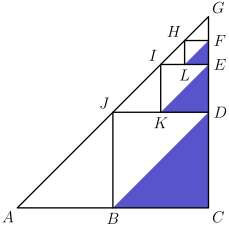
Points and are midpoints of the sides of right triangle Points are midpoints of the sides of triangle etc. If the dividing and shading process is done times (the first three are shown) and then the total area of the shaded triangles is nearest
Pista pequeña:
Los triángulos sombreados forman un patrón geométrico de áreas
The shaded triangles form a geometric area pattern
Pista grande:
Cada nuevo triángulo sombreado tiene un cuarto del área sombreada anterior
Each new shaded triangle has one-fourth the previous shaded area
Solución:
El primer triángulo sombreado tiene catetos y , así que su área es .
En cada paso posterior, el triángulo correspondiente tiene la mitad de la longitud del cateto, así que el área sombreada se multiplica por .
Por lo tanto, el área sombreada total después de muchos pasos es muy cercana a la suma geométrica
Después de pasos la cola omitida es diminuta, así que el área total es lo más cercana a .
Por lo tanto, A es la respuesta correcta.
The first shaded triangle has legs and , so its area is .
At each later step, the relevant triangle has half the leg length, so the shaded area is multiplied by .
The total shaded area after many steps is therefore very close to the geometric sum
After steps the omitted tail is tiny, so the total area is nearest .
Thus, A is the correct answer.