
Soluciones del 1983 AMC 12
Desplázate hacia abajo para ver las soluciones preparadas profesionalmente de LIVE by Po-Shen Loh, imprime las soluciones en PDF, consulta la clave de respuestas, o haz el examen cronometrado completo.
Todos los problemas se usan con el permiso legal oficial de la Mathematical Association of America (MAA).
1.
Si y entonces es igual a
If and then equals
Pista pequeña:
Usa para expresar en función de
Use to express in terms of
Pista grande:
Después de sustituir, descarta la solución que hace
After substitution, discard the solution that makes
Solución:
La segunda ecuación da Al sustituir en la primera se obtiene así que La condición descarta y quedan y
Por lo tanto, la respuesta correcta es E.
The second equation gives Substituting into the first gives so The condition rules out leaving and
Therefore, the correct answer is E.
2.
El punto está fuera del círculo en el plano. ¿A lo sumo cuántos puntos de están a cm de ?
Point is outside circle on the plane. At most how many points on are cm from
Pista pequeña:
Los puntos que están a una distancia fija de forman otro círculo
Points at a fixed distance from form another circle
Pista grande:
Cuenta los puntos comunes de los dos círculos; el máximo ocurre cuando se cruzan
Count the common points of the two circles; the maximum occurs when they cross
Solución:
Los puntos que están a cm de forman un círculo con centro en Dos círculos distintos se cortan a lo sumo en dos puntos, y es posible que haya dos intersecciones.
Por lo tanto, la respuesta correcta es B.
The points cm from form a circle centered at Two distinct circles intersect in at most two points, and two intersections are possible.
Therefore, the correct answer is B.
3.
Tres primos, y satisfacen y Entonces es igual a
Three primes, and satisfy and Then equals
Pista pequeña:
Todos los primos salvo uno son impares
Every prime except one is odd
Pista grande:
Si ambos sumandos fueran impares, su suma sería un número par mayor que
If both addends were odd, their sum would be an even number greater than
Solución:
Si tanto como fueran impares, entonces sería par y mayor que por lo que no sería primo. Así, uno de los sumandos es el único primo par, Como ese sumando es
Por lo tanto, la respuesta correcta es A.
If both and were odd, then would be even and greater than so it would not be prime. Thus one addend is the only even prime, Since that addend is
Therefore, the correct answer is A.
4.
En la figura plana adjunta, los lados y son paralelos, al igual que los lados y y los lados y Cada lado tiene longitud Además, El área de la figura es
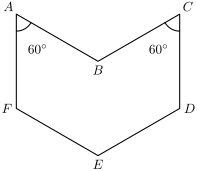
In the adjoining plane figure, sides and are parallel, as are sides and and sides and Each side has length Also, The area of the figure is
Pista pequeña:
Coloca y verticalmente y usa los ángulos de para asignar coordenadas
Place and vertically and use the angles to assign coordinates
Pista grande:
Los seis vértices pueden escribirse usando cambios horizontales de
The six vertices can be written using horizontal changes of
Solución:
Las direcciones paralelas y los ángulos de sitúan los vértices, salvo un movimiento rígido, en Al aplicar la fórmula del cordón a estos seis vértices se obtiene el área
Por lo tanto, la respuesta correcta es D.
The parallel directions and angles place the vertices, up to rigid motion, at Applying the shoelace formula to these six vertices gives area
Therefore, the correct answer is D.
5.
El triángulo tiene un ángulo recto en Si entonces es
Triangle has a right angle at If then is
Pista pequeña:
Los ángulos y son complementarios
Angles and are complementary
Pista grande:
Usa y
Use and
Solución:
Como se tiene Como tenemos y
Por lo tanto, la respuesta correcta es D.
Since Because we have and
Therefore, the correct answer is D.
6.
Al multiplicar y el producto es un polinomio de grado
When and are multiplied, the product is a polynomial of degree
Pista pequeña:
Sigue el mayor exponente que se obtiene al elegir un término de cada factor
Track the largest exponent produced by choosing one term from each factor
Pista grande:
El término principal proviene de
The leading term comes from
Solución:
El mayor exponente proviene de Todos los demás términos tienen exponentes menores, y el menor exponente posible es así que el producto es efectivamente un polinomio. Su grado es
Por lo tanto, la respuesta correcta es C.
The greatest exponent comes from Every other term has smaller exponent, and the smallest possible exponent is so the product is indeed a polynomial. Its degree is
Therefore, the correct answer is C.
7.
Alice vende un artículo a menos que el precio de lista y recibe el de su precio de venta como comisión. Bob vende el mismo artículo a menos que el precio de lista y recibe el de su precio de venta como comisión. Si ambos reciben la misma comisión, entonces el precio de lista es
Alice sells an item at less than the list price and receives of her selling price as her commission. Bob sells the same item at less than the list price and receives of his selling price as his commission. If they both get the same commission, then the list price is
Pista pequeña:
Sea el precio de lista y escribe cada comisión en función de
Let be the list price and write each commission in terms of
Pista grande:
Iguala a
Set equal to
Solución:
Si el precio de lista es la igualdad de las comisiones da Al multiplicar por y resolver se obtiene por lo que
Por lo tanto, la respuesta correcta es B.
If the list price is equality of commissions gives Multiplying by and solving gives so
Therefore, the correct answer is B.
8.
Sea Entonces, para es
Let Then for is
Pista pequeña:
Sustituye directamente en la fórmula
Substitute directly into the formula
Pista grande:
Multiplica el numerador y el denominador de por
Multiply numerator and denominator of by
Solución:
Tenemos La restricción hace que todas las cantidades mostradas estén definidas.
Por lo tanto, la respuesta correcta es A.
We have The restriction makes all displayed quantities defined.
Therefore, the correct answer is A.
9.
En cierta población, la razón entre el número de mujeres y el número de hombres es a Si la edad promedio (media aritmética) de las mujeres es y la de los hombres es entonces la edad promedio de la población es
In a certain population the ratio of the number of women to the number of men is to If the average (arithmetic mean) age of the women is and the average age of the men is then the average age of the population is
Pista pequeña:
Usa grupos de mujeres y hombres
Use groups of women and men
Pista grande:
Divide entre el número total de personas
Divide by the total number of people
Solución:
Con mujeres y hombres, la suma de todas las edades es Al dividir entre personas se obtiene
Por lo tanto, la respuesta correcta es D.
Using women and men, the total of all ages is Dividing by people gives
Therefore, the correct answer is D.
10.
El segmento es a la vez un diámetro de un círculo de radio y un lado de un triángulo equilátero El círculo también corta y en los puntos y respectivamente. La longitud de es
Segment is both a diameter of a circle of radius and a side of an equilateral triangle The circle also intersects and at points and respectively. The length of is
Pista pequeña:
Como es un diámetro, es un ángulo recto
Because is a diameter, is a right angle
Pista grande:
El triángulo es un triángulo -- con hipotenusa
Triangle is a -- triangle with hypotenuse
Solución:
Como está en el círculo de diámetro Además, porque es equilátero. Por tanto, es un triángulo -- con hipotenusa así que
Por lo tanto, la respuesta correcta es D.
Since is on the circle with diameter Also because is equilateral. Thus is a -- triangle with hypotenuse so
Therefore, the correct answer is D.
11.
Simplifica
Simplify
Pista pequeña:
Reconoce la identidad de adición del seno
Recognize the sine addition identity
Pista grande:
Aplica la fórmula de adición del seno con y
Apply the sine addition formula with and
Solución:
Tomando y la identidad de adición del seno da
Por lo tanto, la respuesta correcta es B.
Taking and the sine addition identity gives
Therefore, the correct answer is B.
12.
Si entonces es igual a
If then equals
ninguna de estas
none of these
Pista pequeña:
Deshaz los logaritmos uno por uno, comenzando por el exterior
Undo the logarithms one at a time, starting from the outside
Pista grande:
implica y después continúa hacia adentro
implies then continue inward
Solución:
La ecuación da así que y Por tanto, que no aparece entre las opciones A–D.
Por lo tanto, la respuesta correcta es E.
The equation gives so and Hence which is not among choices A–D.
Therefore, the correct answer is E.
13.
Si y y ninguna de estas cantidades es entonces es igual a
If and and none of these quantities is then equals
Pista pequeña:
Multiplica dos de y y divide entre la tercera
Multiply two of and then divide by the third
Pista grande:
Usa y
Use and
Solución:
De los tres productos, Al expresar la suma con denominador , obtenemos
Por lo tanto, la respuesta correcta es E.
From the three products, Putting their sum over denominator gives
Therefore, the correct answer is E.
14.
El dígito de las unidades de es
The units digit of is
Pista pequeña:
Reduce a al considerar los dígitos de las unidades
Reduce to when considering units digits
Pista grande:
Combina las dos potencias de y usa los ciclos de longitud de los dígitos de las unidades
Combine the two powers of and use the length- units-digit cycles
Solución:
Módulo porque las potencias de se repiten cada Además, Así, el producto tiene dígito de las unidades
Por lo tanto, la respuesta correcta es E.
Modulo because powers of repeat every Also Thus the product has units digit
Therefore, the correct answer is E.
15.
Se colocan en una urna tres bolas marcadas y Se extrae una bola, se anota su número y se devuelve la bola a la urna. Este proceso se repite y luego se repite una vez más; en cada ocasión, todas las bolas tienen la misma probabilidad de ser extraídas. Si la suma de los números anotados es ¿cuál es la probabilidad de que se haya extraído la bola número las tres veces?
Three balls marked and are placed in an urn. One ball is drawn, its number is recorded, and then the ball is returned to the urn. This process is repeated and then repeated once more, and each ball is equally likely to be drawn on each occasion. If the sum of the numbers recorded is what is the probability that the ball numbered was drawn all three times?
Pista pequeña:
Enumera las ternas ordenadas de cuya suma es
List the ordered triples from whose sum is
Pista grande:
Las posibilidades son las permutaciones de junto con
The possibilities are the permutations of together with
Solución:
Las ternas ordenadas con suma son las seis permutaciones de y la terna Todas tienen la misma probabilidad, y exactamente una de las siete tiene tres números . Por lo tanto, la probabilidad condicional es
Por lo tanto, la respuesta correcta es C.
The ordered triples with sum are the six permutations of and the triple They are equally likely, and exactly one of the seven has three ’s. The conditional probability is therefore
Therefore, the correct answer is C.
16.
Sea donde los dígitos se obtienen escribiendo en orden los enteros del al El dígito número a la derecha del punto decimal es
Let where the digits are obtained by writing the integers through in order. The rd digit to the right of the decimal point is
Pista pequeña:
Cuenta primero los dígitos aportados por los enteros de una y de dos cifras
First count the digits contributed by the one- and two-digit integers
Pista grande:
Después de dígitos, ubica la posición restante entre los enteros de tres cifras
After digits, locate the remaining position within the three-digit integers
Solución:
Los enteros de una cifra aportan dígitos y los de dos cifras aportan para un total de . Por tanto, el dígito buscado es el número entre los dígitos de los enteros de tres cifras. Como es el último dígito del º entero de tres cifras, a saber, Ese dígito es
Por lo tanto, la respuesta correcta es D.
The one-digit integers contribute digits and the two-digit integers contribute for total. Thus the desired digit is the th digit among the three-digit integers. Since it is the last digit of the th three-digit integer, namely That digit is
Therefore, the correct answer is D.
17.
El diagrama de la derecha muestra varios números en el plano complejo. El círculo es el círculo unitario centrado en el origen. Uno de estos números es el recíproco de ¿Cuál es?
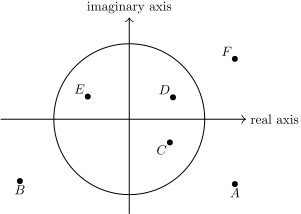
The diagram to the right shows several numbers in the complex plane. The circle is the unit circle centered at the origin. One of these numbers is the reciprocal of Which one?
Pista pequeña:
Para su recíproco tiene módulo
For its reciprocal has modulus
Pista grande:
El recíproco refleja el argumento respecto del eje real y se desplaza dentro del círculo unitario
The reciprocal reflects the argument across the real axis and moves inside the unit circle
Solución:
Si entonces Como está fuera del círculo unitario en el primer cuadrante, su recíproco está dentro del círculo unitario en el cuarto cuadrante, con el argumento reflejado. Solo el punto tiene esas propiedades.
Por lo tanto, la respuesta correcta es C.
If then Because is outside the unit circle in quadrant I, its reciprocal is inside the unit circle in quadrant IV, with the reflected argument. Only point has those properties.
Therefore, the correct answer is C.
18.
Sea una función polinómica tal que, para todo número real Para todo número real es
Let be a polynomial function such that, for all real For all real is
ninguna de estas
none of these
Pista pequeña:
Reescribe el lado derecho como un polinomio en
Rewrite the right side as a polynomial in
Pista grande:
Al tomar se obtiene
Setting gives
Solución:
Con Por tanto, Al sustituir , obtenemos
Por lo tanto, la respuesta correcta es B.
With Hence Substituting gives
Therefore, the correct answer is B.
19.
El punto está en el lado del triángulo Si y entonces la longitud de es
Point is on side of triangle If and then the length of is
Pista pequeña:
El teorema de la bisectriz da
The angle bisector theorem gives
Pista grande:
Sean y luego aplica la ley de los cosenos a los dos triángulos
Set and then apply the law of cosines to the two triangles
Solución:
Por el teorema de la bisectriz, escribimos y Sea La ley de los cosenos en los triángulos y cuyos ángulos en son ambos da Al restar cuatro veces la primera ecuación de la segunda se obtiene Como
Por lo tanto, la respuesta correcta es A.
By the angle bisector theorem, write and Let The law of cosines in triangles and whose angles at are both gives Subtracting four times the first equation from the second yields Since
Therefore, the correct answer is A.
20.
Si y son las raíces de y y son las raíces de entonces es necesariamente
If and are the roots of and and are the roots of then is necessarily
Pista pequeña:
Las raíces de la segunda cuadrática son los recíprocos de las raíces de la primera
The roots of the second quadratic are reciprocals of the roots of the first
Pista grande:
Usa las fórmulas de Vieta para expresar su suma y producto en función de
Use Vieta’s formulas to express their sum and product in terms of
Solución:
Sean las primeras raíces y Entonces y Las segundas raíces son y por lo que Por tanto,
Por lo tanto, la respuesta correcta es C.
Let the first roots be and Then and The second roots are and so Therefore
Therefore, the correct answer is C.
21.
Halla el menor número positivo entre los siguientes
Find the smallest positive number from the numbers below
Pista pequeña:
Compara los cuadrados para determinar cuáles de las diferencias dadas son positivas
Compare the squares to determine which listed differences are positive
Pista grande:
Racionaliza cada diferencia positiva usando
Rationalize each positive difference using
Solución:
Como la opción A es positiva; como la opción C es negativa; y como la opción D es positiva mientras que E es negativa. Los dos valores positivos satisfacen El segundo denominador es mayor, así que la opción D es el menor número positivo.
Por lo tanto, la respuesta correcta es D.
Since choice A is positive; since choice C is negative; and since choice D is positive while E is negative. The two positive values satisfy The second denominator is larger, so choice D is the smaller positive number.
Therefore, the correct answer is D.
22.
Considera las dos funciones donde la variable y las constantes y son números reales. Cada par de constantes y puede considerarse como un punto en un plano . Sea el conjunto de esos puntos para los cuales las gráficas de y no se cortan (en el plano ). El área de es
Consider the two functions where the variable and the constants and are real numbers. Each such pair of constants and may be considered as a point in an -plane. Let be the set of such points for which the graphs of and do not intersect (in the -plane). The area of is
infinita
infinite
Pista pequeña:
Iguala y exige que la cuadrática resultante no tenga raíces reales
Set and require the resulting quadratic to have no real roots
Pista grande:
Simplifica la condición de discriminante negativo en función de y
Simplify the negative-discriminant condition in terms of and
Solución:
Las intersecciones corresponden a las raíces de No hay raíces reales exactamente cuando su discriminante es negativo: Así, es el interior del círculo unitario en el plano , con área
Por lo tanto, la respuesta correcta es B.
Intersections correspond to roots of There are no real roots exactly when its discriminant is negative: Thus is the interior of the unit circle in the -plane, with area
Therefore, the correct answer is B.
23.
En la figura adjunta, los cinco círculos son tangentes consecutivamente entre sí y a las rectas y Si el radio del círculo mayor es y el del menor es entonces el radio del círculo central es
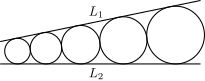
In the adjoining figure the five circles are tangent to one another consecutively and to the lines and If the radius of the largest circle is and that of the smallest one is then the radius of the middle circle is
Pista pequeña:
Cada par de círculos tangentes consecutivos tiene la misma forma después de un cambio de escala
Every pair of consecutive tangent circles has the same shape after scaling
Pista grande:
Los radios forman una progresión geométrica, de modo que el cuadrado del radio central es el producto de los extremos
The radii form a geometric sequence, so the middle radius squared is the product of the extremes
Solución:
Los centros se encuentran en la bisectriz del ángulo formado por y La semejanza de la configuración para cualesquiera dos círculos consecutivos muestra que los radios consecutivos tienen una razón constante. Así, los cinco radios forman una progresión geométrica. Si el radio central es la simetría de una progresión geométrica de cinco términos da por lo que
Por lo tanto, la respuesta correcta es A.
The centers lie on the angle bisector of and Similarity of the configuration for any two consecutive circles shows that consecutive radii have a constant ratio. Thus the five radii form a geometric sequence. If the middle radius is symmetry of a five-term geometric sequence gives so
Therefore, the correct answer is A.
24.
¿Cuántos triángulos rectángulos no congruentes hay cuyo perímetro en cm y cuya área en son numéricamente iguales?
How many non-congruent right triangles are there such that the perimeter in cm and area in are numerically equal?
ninguno
none
infinitos
infinitely many
Pista pequeña:
Comienza con cualquier triángulo rectángulo y multiplica las longitudes de todos sus lados por
Start with any shape of right triangle and scale all its side lengths by
Pista grande:
Al cambiar la escala, el perímetro se multiplica por , mientras que el área se multiplica por
Under scaling, perimeter is multiplied by while area is multiplied by
Solución:
Comienza con cualquier triángulo rectángulo de perímetro y área Multiplicar todos los lados por produce un perímetro y un área que son iguales. Existen infinitas formas de triángulos rectángulos no semejantes, por lo que los triángulos resultantes no son congruentes.
Por lo tanto, la respuesta correcta es E.
Start with any right triangle having perimeter and area Scaling every side by produces perimeter and area which are equal. Infinitely many nonsimilar right-triangle shapes exist, and the resulting triangles are therefore noncongruent.
Therefore, the correct answer is E.
25.
Si y entonces es
If and then is
Pista pequeña:
Expresa y como logaritmos en base
Express and as base- logarithms
Pista grande:
Usa y
Use and
Solución:
Como y Por tanto, el exponente es y
Por lo tanto, la respuesta correcta es B.
Since and Therefore the exponent is and
Therefore, the correct answer is B.
26.
La probabilidad de que ocurra el evento es la probabilidad de que ocurra el evento es Sea la probabilidad de que ocurran tanto como El menor intervalo que necesariamente contiene a es
The probability that event occurs is the probability that event occurs is Let be the probability that both and occur. The smallest interval necessarily containing is the interval
Pista pequeña:
Aplica inclusión-exclusión a los eventos y
Apply inclusion-exclusion to events and
Pista grande:
Acota entre y
Bound between and
Solución:
La inclusión-exclusión da Como se sigue que Ambos extremos pueden darse, así que este es el menor intervalo necesario.
Por lo tanto, la respuesta correcta es D.
Inclusion-exclusion gives Since it follows that Both endpoints can occur, so this is the smallest necessary interval.
Therefore, the correct answer is D.
27.
Una esfera grande se encuentra en un campo horizontal en un día soleado. En cierto momento, la sombra de la esfera se extiende m desde el punto donde la esfera toca el suelo. En el mismo instante, una vara de un metro (sostenida verticalmente con un extremo en el suelo) proyecta una sombra de m. ¿Cuál es el radio de la esfera en metros? (Supón que los rayos solares son paralelos y que la vara es un segmento de recta.)
A large sphere is on a horizontal field on a sunny day. At a certain time the shadow of the sphere reaches out a distance of m from the point where the sphere touches the ground. At the same instant a meter stick (held vertically with one end on the ground) casts a shadow of length m. What is the radius of the sphere in meters? (Assume the sun’s rays are parallel and the meter stick is a line segment.)
Pista pequeña:
En una sección transversal vertical, el rayo solar límite es tangente a un círculo
In a vertical cross-section, the limiting sun ray is tangent to a circle
Pista grande:
La vara muestra que el rayo asciende unidad por cada unidades horizontales
The meter stick shows that the ray rises unit for every horizontal units
Solución:
Toma el punto de contacto de la esfera con el suelo como y su centro como El rayo solar límite pasa por el extremo de la sombra y tiene pendiente así que su ecuación es La tangencia significa que la distancia de a esta recta es Por tanto,
Por lo tanto, la respuesta correcta es E.
Take the sphere’s ground-contact point as and its center as The limiting sun ray passes through the shadow endpoint and has slope so its equation is Tangency means the distance from to this line equals Hence
Therefore, the correct answer is E.
28.
El triángulo de la figura tiene área Los puntos y todos distintos de y están en los lados y , respectivamente, y Si el triángulo y el cuadrilátero tienen áreas iguales, entonces esa área es
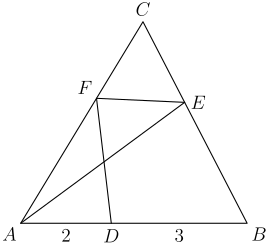
Triangle in the figure has area Points and all distinct from and are on sides and respectively, and If triangle and quadrilateral have equal areas, then that area is
no está determinada de manera única
not uniquely determined
Pista pequeña:
Traza y cancela el triángulo común de las áreas iguales
Draw and cancel the common triangle from the equal areas
Pista grande:
Las áreas iguales de y implican ; luego compara los triángulos y
Equal areas of and imply ; then compare triangles and
Solución:
Traza De la igualdad implica Su base común da entonces por lo que los triángulos y son semejantes. Así, Los triángulos y comparten la altura desde hasta de modo que
Por lo tanto, la respuesta correcta es C.
Draw From equality implies Their common base then gives so triangles and are similar. Hence Triangles and share the altitude from to so
Therefore, the correct answer is C.
29.
Un punto está en el mismo plano que un cuadrado dado de lado Sean y los vértices del cuadrado, tomados en sentido antihorario. Además, sean y las distancias respectivas de a y ¿Cuál es la mayor distancia posible de a si ?
A point lies in the same plane as a given square of side Let the vertices of the square, taken counterclockwise, be and Also, let the distances from to and respectively, be and What is the greatest distance that can be from if
Pista pequeña:
Coloca y
Place and
Pista grande:
Sustituye en la ecuación de las distancias y completa el cuadrado
Substitute into the distance equation and complete the square
Solución:
Coloca y con Entonces que se simplifica a Así, está en un círculo cuyo centro está a unidades de y cuyo radio es Su mayor distancia a es
Por lo tanto, la respuesta correcta es C.
Place and with Then which simplifies to Thus lies on a circle centered units from with radius Its greatest distance from is
Therefore, the correct answer is C.
30.
Los puntos distintos y están en un semicírculo de diámetro y centro El punto está en y Si entonces es igual a
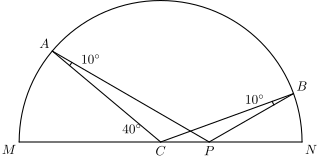
Distinct points and are on a semicircle with diameter and center The point is on and If then equals
Pista pequeña:
El arco de da
The arc gives
Pista grande:
Compara los triángulos y usando y la ley de los senos
Compare triangles and using and the law of sines
Solución:
Como el ángulo central es así que Por tanto, Al aplicar la ley de los senos a los triángulos y y usar obtenemos Como y son distintos, Por consiguiente, de modo que
Por lo tanto, la respuesta correcta es C.
Since the central angle so Hence Applying the law of sines in triangles and and using gives Because and are distinct, Therefore so
Therefore, the correct answer is C.