
2021 AMC 10A Fall 详解
向下滚动即可查看来自 LIVE by Po-Shen Loh 的精心整理的解答,打印PDF 解答,查看答案,或参加完整限时模拟考试。
所有题目均经美国数学协会(MAA)官方合法授权使用。
1.
2.
Menkara 有一张 的索引卡片。若她把这张卡片的一边长度缩短 英寸,卡片面积会变成 平方英寸。如果她改为把另一边长度缩短 英寸,那么卡片面积是多少平方英寸?
Menkara has a index card. If she shortens the length of one side of this card by inch, the card would have area square inches. What would the area of the card be in square inches if instead she shortens the length of the other side by inch?
小提示:
先判断缩短哪一边会得到面积 。
Figure out which side was shortened to get area
大提示:
然后改为缩短另一边。
Then shorten the other side instead
解答:
若把 英寸的一边缩短 英寸,就得到 的卡片,面积为 平方英寸。
因此题中原先缩短的是 英寸的一边。若改为缩短另一边,则得到 的卡片,面积为 。
所以正确答案是 E。
If she shortens the -inch side by she has a card, whose area is square inches.
Therefore the given shortening was on the -inch side. Shortening the other side instead gives a card, with area square inches.
Thus, E is the correct answer.
3.
半径为 的黏土球最多有多少个可以完全放进边长为 的立方体中?假设这些球在装入立方体之前可以重新塑形,但不能被压缩。
What is the maximum number of balls of clay with radius that can completely fit inside a cube of side length assuming that the balls can be reshaped but not compressed before they are packed in the cube?
小提示:
因为黏土可以重新塑形,所以比较体积。
Compare volumes because the clay can be reshaped
大提示:
个数为 。
The count is
解答:
立方体体积为 。一个黏土球的体积为 。
因为黏土可以重新塑形但不能压缩,最多的球数为
由于 ,可知 ,因此其整数部分为 。
所以正确答案是 D。
The cube has volume One ball of clay has volume
Because the clay may be reshaped but not compressed, the maximum number of balls is
Since we have Therefore the floor is
Thus, D is the correct answer.
4.
Lopez 先生上班有两条路线可选。路线 A 长 英里,他在这条路线上的平均速度为每小时 英里。路线 B 长 英里,他在这条路线上的平均速度为每小时 英里,但其中有一段 英里的学校区域,平均速度为每小时 英里。路线 B 比路线 A 快多少分钟?
Mr. Lopez has a choice of two routes to get to work. Route A is miles long, and his average speed along this route is miles per hour. Route B is miles long, and his average speed along this route is miles per hour, except for a -mile stretch in a school zone where his average speed is miles per hour. By how many minutes is Route B quicker than Route A?
小提示:
把每条路线的行驶时间都换算成分钟。
Convert each route’s travel time to minutes
大提示:
路线 B 中有 英里按每小时 英里行驶,另有 英里按每小时 英里行驶。
Route B has miles at mph and mile at mph
解答:
路线 A 所需时间为 分钟。
路线 B 所需时间为 分钟。
因此路线 B 快 分钟。
所以正确答案是 B。
Mr. Lopez would take minutes to travel on Route A.
On Route B, he would take minutes.
The difference in times along these routes is minutes.
Thus, B is the correct answer.
5.
六位数 只有在唯一一个数字 下是质数。求 。
The six-digit number is prime for only one digit What is
小提示:
先排除偶数和 。
Rule out even digits and first
大提示:
对剩下的奇数选项,用 和 的整除性检验。
Test the remaining odd choices with divisibility by and
解答:
注意 不能是偶数,否则这个数能被 整除。
也不能是 ,否则这个数能被 整除。
若 等于 或 ,则这个数的数位和分别为 和 。
这样这个数能被 整除,所以排除了这两个 值。
最后,若 等于 ,整个数为 。交错数位和之差为 所以这个数能被 整除。
除 外,每个选择都会使这个数成为合数。题目说明恰有一个数字符合条件,所以这个数字必须是 。(事实上,试除所有不超过 的质数,可确认 是质数。)
所以正确答案是 E。
Note that cannot be even, as then the number would be divisible by
also cannot be as that would make the number divisible by
If equaled or then the sum of the digits of the number would be and respectively.
This would make the number divisible by so that rules out equaling either of these numbers.
Finally, if equals then the whole number becomes If we look at the difference of the sums of alternating digits, we get which means the number is divisible by
Every choice except makes the number composite. Because the problem states that exactly one digit works, that digit must be (Indeed, trial division by the primes at most confirms that is prime.)
Thus, E is the correct answer.
6.
鸸鹋 Elmer 在乡村道路上相邻两根电线杆之间行走需要 个等长步幅。鸵鸟 Oscar 用 个等长跃步可以走完同一距离。电线杆等距排列,沿这条路第 根电线杆与第一根电线杆的距离正好是一英里,即 英尺。Oscar 的一次跃步比 Elmer 的一步长多少英尺?
Elmer the emu takes equal strides to walk between consecutive telephone poles on a rural road. Oscar the ostrich can cover the same distance in equal leaps. The telephone poles are evenly spaced, and the st pole along this road is exactly one mile ( feet) from the first pole. How much longer, in feet, is Oscar’s leap than Elmer’s stride?
小提示:
一英里内共有 个相等的电线杆间隔。
There are equal pole gaps in one mile
大提示:
先求一个电线杆间隔,再分别除以 和 。
Find one pole gap, then divide it by and by
解答:
第 根和第 根之间有 个间隔,所以相邻电线杆之间的距离为 英尺。
这说明 Elmer 的一步长为 英尺。类似地,Oscar 的一步长为 英尺。因此 Oscar 的跃步比 Elmer 的步幅长 英尺。
所以正确答案是 B。
There are gaps between the st and st pole, which means that the distance between consecutive poles is feet.
This means that each of Elmer’s strides is feet. Similarly, each of Oscar’s leaps is feet. This makes Oscar’s leap feet longer.
Thus, B is the correct answer.
7.
如下图所示,点 位于直线 所确定的、与点 相反的半平面内,且 。点 在 上,满足 ,并且 是正方形。 的度数是多少?
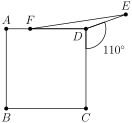
As shown in the figure below, point lies in the opposite half-plane determined by line from point so that Point lies on so that and is a square. What is the degree measure of
8.
一个两位正整数称为 可爱数,如果它等于其非零十位数字与个位数字平方之和。共有多少个两位正整数是可爱数?
A two-digit positive integer is said to be cuddly if it is equal to the sum of its nonzero tens digit and the square of its units digit. How many two-digit positive integers are cuddly?
小提示:
设十位数字为 ,个位数字为 。
Let the tens digit be and the units digit be
大提示:
数位方程可化为 。
The digit equation becomes
解答:
设 是一个 位可爱数。
由定义, 化简得 因为两个相邻整数不可能都被 整除,所以 和 中必有一个含有两个因数 。
对一位数 而言,只有 或 可能。前两个选择都给出 ,不能组成两位数;若 ,则 。检验可知 是可爱数,因此只有 个。
所以正确答案是 B。
Let be a -digit cuddly number.
Then Rearranging, we get Because consecutive integers cannot both be divisible by one of and must contain both factors of
For a digit this leaves or The first two choices give which does not make a two-digit number. If then Checking, we get that is a cuddly number. This shows that there is only two-digit cuddly number.
Thus, B is the correct answer.
9.
掷一枚不公平骰子时,出现偶数的可能性是出现奇数的 倍。掷这枚骰子两次,掷出点数和为偶数的概率是多少?
When a certain unfair die is rolled, an even number is times as likely to appear as an odd number. The die is rolled twice. What is the probability that the sum of the numbers rolled is even?
小提示:
设掷出奇数的概率为 ,则掷出偶数的概率为 。
Let the probability of odd be so even is
大提示:
和为偶数意味着两次都是奇数或两次都是偶数。
An even sum means two odds or two evens
解答:
设掷出奇数的概率为 ,则掷出偶数的概率为 。
和为偶数当且仅当两次结果奇偶性相同,其概率为
所以正确答案是 E。
Let be the probability that an odd number is rolled. Then is the probability an even number is rolled. We know that
The only way for the sum to be even is if both rolls have the same parity. This happens with a probability of
Thus, E is the correct answer.
10.
一所学校有 名学生和 名老师。第一节课中,每名学生上一门课,每名老师教一门课。五门课的学生人数分别为 ,,, 和 。若随机选一名老师并记录其班级人数,所得平均值为 。若随机选一名学生并记录其所在班级人数,包括该学生本人,所得平均值为 。求 ?
A school has students and teachers. In the first period, each student is taking one class, and each teacher is teaching one class. The enrollments in the classes are and Let be the average value obtained if a teacher is picked at random and the number of students in their class is noted. Let be the average value obtained if a student was picked at random and the number of students in their class, including the student, is noted. What is
11.
Emily 看见一艘船以恒定速度沿河的一段直线航行。她以比船更快的匀速平行于河岸行走。从船尾走到船头时,她数了 个等长步幅;反方向从船头走到船尾时,她数了 个同样大小的步幅。用 Emily 的步幅作单位,这艘船的长度是多少?
Emily sees a ship traveling at a constant speed along a straight section of a river. She walks parallel to the riverbank at a uniform rate faster than the ship. She counts equal steps walking from the back of the ship to the front. Walking in the opposite direction, she counts steps of the same size from the front of the ship to the back. In terms of Emily’s equal steps, what is the length of the ship?
小提示:
所有距离都用 Emily 的步幅作单位。
Measure all distances in Emily steps
大提示:
若船长为 ,同向时船移动 ,反向时船移动 。
With ship length the ship moves one way and the other way
解答:
设船长为 个步幅。Emily 走 步从船尾到船头时,船也向前移动了 个步幅。
反方向走 步时,船移动了 个步幅。船速与 Emily 速度恒定,所以 交叉相乘得
所以正确答案是 A。
Let be the length of the ship. Then in the time that Emily moves steps, the ship moves steps.
In the time that Emily moves steps, the ship moves steps. Since the ship and Emily move at a constant rate Cross-multiplying yields
Thus, A is the correct answer.
12.
数 的九进制表示为 。 除以 的余数是多少?
The base-nine representation of the number is What is the remainder when is divided by
13.
个球各自独立且等可能地被涂成黑色或白色。每个球都与其他 个球中超过一半的球颜色不同的概率是多少?
Each of balls is randomly and independently painted either black or white with equal probability. What is the probability that every ball is different in color from more than half of the other balls?
小提示:
每个球都必须看到至少 个另一种颜色的球。
Each ball must see at least balls of the other color
大提示:
这会迫使两种颜色各有 个球。
That forces exactly balls of each color
解答:
要使每个球都与超过一半的其他球颜色不同,任意一个球必须看到至少 个相反颜色的球。
因此必须正好有三颗黑球和三颗白球。所有涂色共有 种,其中选择哪三颗球为白色有 种。
所以所求概率为 。
所以正确答案是 D。
Note that for this restriction to hold, there must be balls of each color.
There are ways to color the balls and to choose which balls are white.
The desired probability is therefore
Thus, D is the correct answer.
14.
有多少个实数有序对 满足方程组
How many ordered pairs of real numbers satisfy the following system of equations?
小提示:
第二个方程给出 或 。
The second equation gives or
大提示:
用 ,并按 的符号范围检查。
Use and check the sign ranges for
解答:
令 。第二个方程给出 或 ,而第一个方程给出 。
若 ,则 。对于 ,代入可得 ,所以 或 。这些值给出 ,共有三个点。对于 ,代入可得 ,它没有实根。
若 ,则 。方程 给出 ,其唯一非负根是被排除的边界值 。方程 给出 ,它恰有一个正根 。这个根按 的两种符号给出两个点。
有序对总数为 。
所以正确答案是 D。
Put The second equation gives or while the first gives
If then For substitution gives so or These yield for three points. For substitution gives which has no real root.
If then The equation gives whose only nonnegative root is the excluded boundary value The equation gives with exactly one positive root It yields two points, one for each sign of
The total number of ordered pairs is
Thus, D is the correct answer.
15.
等腰三角形 满足 ,一个半径为 的圆分别与直线 、 相切于点 、。经过顶点 、、 的圆的面积是多少?
Isosceles triangle has and a circle with radius is tangent to line at and to line at What is the area of the circle that passes through vertices and
小提示:
连接切圆圆心与 和 。
Join the center of the tangent circle to and
大提示:
和 处的直角说明 四点共圆。
Right angles at and put on one circle
解答:
设 是与 和 相切的圆的圆心。则 ,所以 四点共圆。
因为 和 处的直角所对的弦是 ,所以线段 是这个圆的直径。设 为其圆心。同一个圆经过 和 ,所以它就是所求的外接圆。
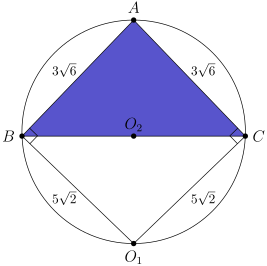
在 中应用勾股定理,得到 因此外接圆半径为 ,所求面积为 。
所以正确答案是 C。
Let be the center of the circle tangent to and Then so are concyclic.
Because the right angles at and subtend the segment is a diameter of this circle. Let be its center. The same circle passes through and so it is the desired circumcircle.
By the Pythagorean Theorem in Therefore, the circumradius is and the requested area is
Thus, C is the correct answer.
16.
考虑函数
它的图像关于下列哪一项对称?这里 表示不超过 的最大整数。
Consider the function
Its graph is symmetric about which of the following? (Here is the greatest integer not exceeding )
轴
the -axis
直线
the line
原点
the origin
点
the point
点
the point
17.
一位建筑师正在建造一个结构,要在水平地面上的正六边形 的各顶点竖立柱子。六根柱子将支撑一块不与地面平行的平面太阳能板。位于 、、 的柱高分别为 、、 米。位于 的柱子高度是多少米?
An architect is building a structure that will place vertical pillars at the vertices of regular hexagon which is lying horizontally on the ground. The six pillars will hold up a flat solar panel that will not be parallel to the ground. The heights of pillars at and are and meters, respectively. What is the height, in meters, of the pillar at
小提示:
平面太阳能板意味着高度是地面坐标的线性函数。
A flat panel means height is linear over the ground plane
大提示:
使用正六边形坐标,并设高度函数为 。
Use regular-hexagon coordinates and a function
解答:
取正六边形坐标 、、、。因为太阳能板是平面,高度可写成 。
由 ,,。后两式相减得 。再由 得 。代入 ,有 ,所以 。
因此
所以正确答案是 D。
Put a regular hexagon in coordinates with and Because the solar panel is flat, the height is an affine function
From and subtracting the last two equations gives Then so Using gives so
Therefore
Thus, D is the correct answer.
18.
一位农民的长方形田地被分成如下图所示的 乘 网格,共 个长方形区域。每个区域将种一种作物:玉米、小麦、大豆或土豆。农民不想让玉米和小麦种在任何共边的两个区域,也不想让大豆和土豆种在任何共边的两个区域。在这些限制下,农民有多少种方法为四个区域选择作物?
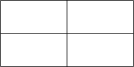
A farmer’s rectangular field is partitioned into a by grid of rectangular sections as shown in the figure. In each section the farmer will plant one crop: corn, wheat, soybeans, or potatoes. The farmer does not want to grow corn and wheat in any two sections that share a border, and the farmer does not want to grow soybeans and potatoes in any two sections that share a border. Given these restrictions, in how many ways can the farmer choose crops to plant in each of the four sections of the field?
小提示:
按两块对角区域是否种同一种作物分类。
Case on whether the two diagonal sections are the same crop
大提示:
每个共边限制都会排除一种作物选择。
Each shared-border restriction removes one crop choice
解答:
分为 种情况讨论右上和左下这两个对角区域。
情况 :右上和左下区域种同一种作物。
这两个区域所种的作物有 种选择。因为每种作物都恰有一种不能与它相邻的作物,所以另外两个区域各有 种选择。因此共有 种。
情况 :右上和左下区域种不同作物。
右上区域有 种选择,左下区域有 种与之不同的选择。另外两个区域都与这两块区域共边,所以各剩 种选择。因此这一类共有 种。
两种情况合计 种。
所以正确答案是 C。
There are cases.
Case the top-right and bottom-left sections have the same crop
There are options for which crop is in those sections. The other two sections have options for the crop since each crop has one restriction for crops next to it. This gives us combinations.
Case the top-right and bottom-left sections have different crops
There are options for the top-right crop and different options for the bottom-left crop. Each of the other two sections borders both of these crops, leaving choices for each. This gives us another configurations.
In total, there are combinations.
Thus, C is the correct answer.
19.
一个半径为 的圆盘沿边长为 的正方形内部滚动一整圈,并扫过面积为 的区域。另一个半径为 的圆盘沿同一个正方形外部滚动一整圈,并扫过面积为 的区域。 可写成 ,其中 , 和 为正整数,且 与 互质。求 ?
A disk of radius rolls all the way around the inside of a square of side length and sweeps out a region of area A second disk of radius rolls all the way around the outside of the same square and sweeps out a region of area The value of can be written as where and are positive integers and and are relatively prime. What is
小提示:
把内部扫过面积看成边界带状区域。
Find the swept area inside as a boundary band
大提示:
外部扫过面积由 个长方形和 个四分之一圆组成。
Outside, the swept area is rectangles plus quarter-circles
解答:

内圆盘圆心扫出的内侧正方形边长为 。
四个角还有一些小区域,它们的总面积为
因此
外圆盘扫出的区域由 个长方形和 个四分之一圆组成。每个长方形的面积为 ,四个四分之一圆合成一个半径为 、面积为 的圆。
所以
令两个表达式相等,得到 解得
所以正确答案是 A。
The side length of the inner square traced out by the inner circle is
There are also the small pieces remaining in the corner. These form a total area of
Therefore,
The outer disk traces out an area that is comprised of rectangles and quarter-circles. The rectangles have area and the quarter-circles form a circle with radius and area
This gives us
Equating the two equations we get Solving yields
Thus, A is the correct answer.
20.
有多少个正整数有序对 ,使得 和 都没有两个不同的实根?
For how many ordered pairs of positive integers does neither nor have two distinct real solutions?
小提示:
对每个二次方程使用判别式条件。
Use the discriminant condition for each quadratic
大提示:
两个不等式为 和 。
The inequalities are and
解答:
二次方程没有两个不同实根,当且仅当判别式非正。因此需要 也就是 且 。
由 得 。结合 ,得到 ,所以 。
逐一检查 ,分别得到
因此有序对共有 个。
所以正确答案是 B。
A quadratic fails to have two distinct real solutions exactly when its discriminant is nonpositive. Thus we need or and
From we get Combining this with gives so
Now check The inequalities give respectively
There are ordered pairs.
Thus, B is the correct answer.
21.
个球各自独立且随机地投入 个箱子之一。设 为某个箱子最终有 个球、另一个箱子有 个球、其余三个箱子各有 个球的概率。设 为每个箱子最终都有 个球的概率。求 ?
Each of balls is tossed independently and at random into one of the bins. Let be the probability that some bin ends up with balls, another with balls, and the other three with balls each. Let be the probability that every bin ends up with balls. What is
小提示:
可以把球和箱子都看作可区分。
Balls and bins can be treated as distinguishable
大提示:
在比值 中,大部分阶乘因子会抵消。
Most factorial factors cancel in the ratio
解答:
把球和箱子都看作可区分,则把有标号的球投入有标号的箱子的 种方法等可能。对于 ,符合条件的投放方法数为
对于 ,先用 种方法依次选出装 个球的箱子和装 个球的箱子。符合条件的投放方法数为
两种概率的共同分母可以约去,所以
所以正确答案是 E。
All assignments of the distinguishable balls to the labeled bins are equally likely. For the number of assignments is
For choose the bin with balls and the bin with balls in ways. The number of assignments is then
The common probability denominator cancels, so
Thus, E is the correct answer.
22.
一个底面半径为 、高为 的直圆锥内有三个全等球,半径均为 。每个球都与另外两个球相切,并且也与圆锥的底面和侧面相切。求 ?
Inside a right circular cone with base radius and height are three congruent spheres each with radius Each sphere is tangent to the other two spheres and also tangent to the base and side of the cone. What is
小提示:
三个球心在底面上方组成一个等边三角形。
The sphere centers form an equilateral triangle above the base
大提示:
在轴截面中,圆锥侧边所在直线为 。
In an axial cross-section, the cone side is
解答:
令圆锥底面在平面 ,底心在原点,顶点在 -轴上。三个球心组成边长为 的等边三角形,所以其中一个球心可取为离圆锥轴的水平距离 、高度为 。
在轴截面中,圆锥侧边所在直线为 ,其中 是到轴的水平距离。该球心坐标为 ,到这条直线的距离必须为 ,所以
因此 ,所以
所以正确答案是 B。
Let the cone have base in the plane center at the origin, and vertex on the -axis. The centers of the three spheres form an equilateral triangle of side so one sphere center may be taken at horizontal distance from the cone axis and height above the base.
In the axial cross-section through that center and the cone axis, the side of the cone is the line where is horizontal distance from the axis. The distance from to this line must be :
Thus so
Thus, B is the correct answer.
23.
对每个正整数 ,令 为 的正因数个数的两倍;对于 ,令 。有多少个 满足 ?
For each positive integer let be twice the number of positive integer divisors of and for let For how many values of is
小提示:
表示 有 个因数。
means has divisors
大提示:
还要检查 或 ,因为它们下一步会映到 。
Also check or since those map to next
解答:
数值 是固定点,因为 有 个正因数,所以 。
先找所有满足 且 的 ,也就是有 个因数的数:
再检查 在到达 之前能否取到上述其他值。由于 是因数个数的两倍,列表中只有 和 有用,分别表示 有 或 个因数。
对 ,额外的可能为 (有 个因数)和 (有 个因数)。因此共有 个 。
所以正确答案是 D。
The value is fixed by the function, since has positive divisors and therefore
First find all with meaning has divisors. These are
Now check whether can be one of these values before reaching Since is twice a divisor count, the only useful possibilities in that list are and meaning has or divisors.
For the additional possibilities are which has divisors, and which has divisors. Therefore there are values of
Thus, D is the correct answer.
24.
一个立方体的 条棱各被标为 或 。即使一个标法可由另一个标法通过一次或多次旋转和/或反射得到,这两个标法仍视为不同。有多少种这样的标法,使得立方体 个面中每个面的四条边标签和都等于 ?
Each of the edges of a cube is labeled or Two labelings are considered different even if one can be obtained from the other by a sequence of one or more rotations and/or reflections. For how many such labelings is the sum of the labels on the edges of each of the faces of the cube equal to
小提示:
先标定一个面,并按相对棱的标签分类。
Label one face first and split by opposite edge labels
大提示:
选定相邻棱后,其余标签会被各面和的条件强制确定。
Chosen adjacent edges force the remaining labels through face sums
解答:
先标记一个面为 。每个面必须包含两个 和两个 ,所以先按 四条棱的标签模式分类。
情形 : 的相对棱标签相同。 上有 种这样的模式;任选一条竖直棱(如 )的标签后,其余标签都被确定。因此共有 种标法。
情形 : 的相对棱标签不同。 上有 种这样的模式;对每种模式,相邻两条竖直棱的标签有 种选择,其余标签随即确定。因此共有 种标法。
总数为 。
所以正确答案是 E。
Label one face Each face must contain two s and two s, so first split by the pattern on the four edges of
Case opposite edges of have the same label. There are such patterns on For either pattern, once the label of one vertical edge, say is chosen, the face-sum conditions force all remaining labels. This gives labelings.
Case opposite edges of have different labels. There are such patterns on For each, the labels of two adjacent vertical edges may be chosen in ways, and then the remaining labels are forced by the face-sum conditions. This gives labelings.
The total is
Thus, E is the correct answer.
25.
一个首项系数为 、实系数的二次多项式 称为 无礼的,如果方程 恰好有三个实数解。在所有无礼的二次多项式中,存在唯一一个多项式 ,使其根之和最大。求 ?
A quadratic polynomial with real coefficients and leading coefficient is called disrespectful if the equation is satisfied by exactly three real numbers. Among all the disrespectful quadratic polynomials, there is a unique such polynomial for which the sum of the roots is maximized. What is
小提示:
若 是 的根,分别解 和 。
If are roots of solve and
大提示:
这两个二次方程中恰有一个必须判别式为 。
Exactly one of those quadratics must have discriminant
解答:
这个多项式必须有两个不同的实根:如果只有一个重实根,则 至多有两个实数解;如果没有实根,则没有实数解。设它的两个根为 和 ,则 方程 等价于 或 。
要恰好有三个实数解,其中一个二次方程必须有重根,另一个必须有两个不同实根。设 有重根。它的判别式为 所以 ,从而 。
另一个方程 的判别式为 ,且必须为正。因此 ,所以 ,即 。
根之和为 。令 ,则该和为 ,在 时最大。因此 ,。
于是得到多项式 ,并且
所以正确答案是 A。
The polynomial must have two distinct real roots: a repeated real root produces at most two real solutions of while nonreal roots produce none. Let its roots be and so The equation is equivalent to or
For exactly three real solutions, one of these two quadratic equations must have a double root and the other must have two distinct real roots. Suppose has the double root. Its discriminant is so forcing
The other equation, has discriminant which must be positive. Hence so and
The sum of the roots is Let so this is maximized at Thus and
Therefore and
Thus, A is the correct answer.