
2015 AMC 10B 详解
向下滚动即可查看来自 LIVE by Po-Shen Loh 的精心整理的解答,打印PDF 解答,查看答案,或参加完整限时模拟考试。
所有题目均经美国数学协会(MAA)官方合法授权使用。
1.
2.
Marie 连续做三项耗时相同的任务,中间不休息。她下午 开始第一项任务,下午 完成第二项任务。她什么时候完成第三项任务?
Marie does three equally time-consuming tasks in a row without taking breaks. She begins the first task at PM and finishes the second task at PM. When does she finish the third task?
下午
PM
下午
PM
下午
PM
下午
PM
下午
PM
小提示:
两项任务共用 分钟。
Two tasks take minutes
大提示:
在下午 后再加一项 分钟的任务。
Add one more -minute task after PM
解答:
完成 项任务共用 分钟。因此在 之后还需要 分钟,也就是 。
所以正确答案是 B。
The time it takes to do tasks is minutes. Thus, it takes more minutes after which is
Thus, the correct answer is B .
3.
Isaac 写下了某个整数两次,另一个整数三次。这五个数的和为 ,并且其中一个数是 。另一个数是多少?
Isaac has written down one integer two times and another integer three times. The sum of the five numbers is and one of the numbers is What is the other number?
小提示:
分别测试 是被写了两次还是三次。
Test whether is repeated two or three times
大提示:
剩余总和必须能被剩余次数整除。
The remaining total must divide by the remaining count
解答:
设写了两次的数为 ,写了三次的数为 。。
若 ,则 ,所以 不可能是整数。因此 ,从而 ,所以 。
所以正确答案是 A。
Let the number written twice be , and let the number written three times be . Then .
If , then , impossible for an integer . Therefore , and , so .
Thus, the correct answer is A.
4.
四个兄弟姐妹点了一张特大披萨。Alex 吃了披萨的 ,Beth 吃了 ,Cyril 吃了 。Dan 吃了剩下的部分。按吃掉披萨的份额从大到小排列,顺序是什么?
Four siblings ordered an extra large pizza. Alex ate Beth and Cyril of the pizza. Dan got the leftovers. What is the sequence of the siblings in decreasing order of the part of the pizza they consumed?
Alex, Beth, Cyril, Dan
Beth, Cyril, Alex, Dan
Beth, Cyril, Dan, Alex
Beth, Dan, Cyril, Alex
Dan, Beth, Cyril, Alex
小提示:
Dan 得到 。
Dan receives
大提示:
把所有份额都化为分母 的分数来比较。
Compare all shares with denominator
解答:
因为 ,所以 Beth 吃得比 Cyril 多,Cyril 吃得比 Alex 多。因此这三人的顺序已经确定。
Dan 吃了 这大于 ,小于 ,所以 Dan 排在 Cyril 和 Alex 之间,顺序为 Beth、Cyril、Dan、Alex。
所以正确答案是 C。
Since we know Beth ate more than Cyril and Cyril ate more than Alex. Thus, those three are in order.
The amount Dan ate is This is greater than and less than so Dan is in between Cyril and Alex. This makes the order Beth, Cyril, Dan, Alex.
Thus, the correct answer is C .
5.
David、Hikmet、Jack、Marta、Rand 和 Todd 与另外 人参加了一场 人赛跑。Rand 比 Hikmet 早 个名次完成。Marta 比 Jack 晚 个名次。David 比 Hikmet 晚 个名次。Jack 比 Todd 晚 个名次。Todd 比 Rand 晚 个名次。Marta 得第 名。谁得第 名?
David, Hikmet, Jack, Marta, Rand, and Todd were in a -person race with other people. Rand finished places ahead of Hikmet. Marta finished place behind Jack. David finished places behind Hikmet. Jack finished places behind Todd. Todd finished place behind Rand. Marta finished in th place. Who finished in th place?
David
Hikmet
Jack
Rand
Todd
小提示:
从 Marta 的第 名往回推。
Work backward from Marta’s th place
大提示:
Hikmet 比 Rand 晚 个名次。
Hikmet is places behind Rand
解答:
Marta 是第 名,所以 Jack 是第 名。Jack 比 Todd 晚 个名次,所以 Todd 是第 名;Todd 比 Rand 晚 个名次,所以 Rand 是第 名。
Hikmet 比 Rand 晚 个名次,所以 Hikmet 是第 名。
所以正确答案是 B。
Marta finished th, so Jack finished th. Since Jack finished places behind Todd, Todd finished rd. Since Todd finished place behind Rand, Rand finished nd.
Hikmet finished places behind Rand, so Hikmet finished th.
Thus, the correct answer is B.
6.
Marley 一周中每天恰好练习一项运动。她每周跑步三天,但从不连续两天跑步。星期一她打篮球,两天后打高尔夫。她还游泳和打网球,但她从不在跑步或游泳的后一天打网球。Marley 星期几游泳?
Marley practices exactly one sport each day of the week. She runs three days a week but never on two consecutive days. On Monday she plays basketball and two days later golf. She swims and plays tennis, but she never plays tennis the day after running or swimming. Which day of the week does Marley swim?
星期日
Sunday
星期二
Tuesday
星期四
Thursday
星期五
Friday
星期六
Saturday
小提示:
星期一和星期三已经确定。
Monday and Wednesday are fixed
大提示:
星期二必须是跑步日。
Tuesday must be a running day
解答:
Marley 星期一打篮球,星期三打高尔夫。若星期二不跑步,则三天跑步只能安排在星期四到星期日之间,必然有连续两天跑步,所以星期二必须跑步。
从星期四到星期日,她必须安排两天跑步、一天游泳和一天打网球。打网球不能排在跑步或游泳的后一天,所以只能在星期四。剩下两天跑步必须是星期五和星期日,因此星期六游泳。
所以正确答案是 E。
Marley plays basketball on Monday and golf on Wednesday. She cannot fit all three running days among Thursday, Friday, Saturday, and Sunday without having two consecutive running days, so Tuesday must be a running day.
From Thursday through Sunday, she must run twice, swim once, and play tennis once. Tennis cannot be the day after running or swimming, so tennis must be Thursday. Then the two remaining running days must be Friday and Sunday, leaving Saturday for swimming.
Thus, the correct answer is E.
7.
8.
下图中的字母 F 先绕原点顺时针旋转 ,再关于 轴反射,然后绕原点旋转半圈。最终图像是哪一个?

The letter F shown below is rotated clockwise around the origin, then reflected in the -axis, and then rotated a half turn around the origin. What is the final image?


小提示:
跟踪三次变换对坐标轴方向的作用。
Track what happens to the axes under the three transformations
大提示:
在关于 轴反射后再旋转半圈,等价于关于 轴反射。
A half turn after a -reflection is a reflection in the -axis
解答:
第一次旋转把字母 F 移到 轴下方。
旋转半圈等价于依次关于两条坐标轴反射,因此最后的半圈旋转抵消了前面关于 轴的反射,只留下关于 轴的反射。
把旋转后的图形关于 轴反射,就得到选项 E。
所以正确答案是 E。
The first rotation puts the F below the -axis.
A half turn is equivalent to reflecting in both coordinate axes. Therefore the final half turn cancels the preceding reflection in the -axis and leaves a reflection in the -axis.
Reflecting the rotated figure in the -axis produces choice E.
Thus, the correct answer is E .
9.
下图阴影区域称为鲨鱼鳍形弓月,是 Leonardo da Vinci 研究过的图形。它由第一象限内圆心为 、半径为 的圆弧,第一象限内圆心为 、半径为 的圆弧,以及从 到 的线段围成。该鲨鱼鳍形弓月的面积是多少?
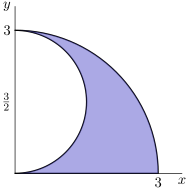
The shaded region below is called a shark’s fin falcata, a figure studied by Leonardo da Vinci. It is bounded by the portion of the circle of radius and center that lies in the first quadrant, the portion of the circle with radius and center that lies in the first quadrant, and the line segment from to What is the area of the shark’s fin falcata?
小提示:
用较大的四分之一圆减去较小的半圆。
Subtract the smaller semicircle from the larger quarter circle
大提示:
较小圆的半径为 。
The smaller circle has radius
解答:
外边界是半径为 的四分之一圆,所以面积为 。
内边界是半径为 的圆的右半部分,所以面积为 。
阴影面积就是二者之差,。
所以正确答案是 B。
The larger boundary is a quarter circle of radius , so its area is .
The inner boundary is the right half of a circle of radius , so its area is .
The shaded area is the difference, .
Thus, the correct answer is B.
10.
所有严格大于 的负奇整数的乘积,其符号和个位数字是什么?
What are the sign and units digit of the product of all the odd negative integers strictly greater than
它是一个个位为 的负数。
It is a negative number ending with a
它是一个个位为 的正数。
It is a positive number ending with a
它是一个个位为 的负数。
It is a negative number ending with a
它是一个个位为 的正数。
It is a positive number ending with a
它是一个个位为 的负数。
It is a negative number ending with a
小提示:
先数有多少个负奇数因子。
Count how many odd negative factors there are
大提示:
奇数乘积若含因子 ,个位数字为 。
An odd product with a factor of has units digit
解答:
大于 的负奇整数共有 个。
负因子个数为奇数,所以乘积为负。
乘积包含因子 ,所以是 的倍数,个位只能是 或 。
又因为所有因子都是奇数,所以乘积不可能是偶数,个位不能为零,只能为 。
所以正确答案是 C。
There are odd numbers greater than
Our product is of an odd number of negative numbers, so the result is negative.
Also, we multiply by in there, so the product is a multiple of making it end in or None of our factors are even, so the product can’t be even.
Therefore, the product must end in
Thus, the correct answer is C .
11.
在小于 的正整数中,每一位数字都是质数的数被等可能地选出一个。所选数是质数的概率是多少?
Among the positive integers less than each of whose digits is a prime number, one is selected at random. What is the probability that the selected number is prime?
小提示:
列出一位质数,以及只使用 的两位数。
List one-digit primes and two-digit numbers using only
大提示:
两位质数不能以二或五结尾,只需检查以 或 结尾的情况。
Two-digit primes ending in or must still pass divisibility tests
解答:
可用数字为 。一位数有 个,两位数有 个,共 个选择。
所有 个一位选择都是质数。两位质数不能以 或 结尾,所以检查以 和 结尾的情况,得到两位质数 。
因此共有 个质数;总选择数为 ,所以概率为 。
所以正确答案是 B。
The available digits are . There are one-digit numbers and two-digit numbers, for total choices.
All one-digit choices are prime. A two-digit prime cannot end in or , so checking endings and gives the two-digit primes .
Thus of the choices are prime, and the probability is .
Thus, the correct answer is B.
12.
有多少个整数 ,使点 位于以 为圆心、半径为 的圆内或圆上?
For how many integers is the point inside or on the circle of radius centered at
13.
直线 与坐标轴围成一个三角形。这个三角形三条高的长度之和是多少?
The line forms a triangle with the coordinate axes. What is the sum of the lengths of the altitudes of this triangle?
小提示:
两个截距为 和 。
The intercepts are and
大提示:
用面积求到斜边的高。
Use area to find the altitude to the hypotenuse
解答:
这个三角形是直角三角形,两条直角边为 和 ,因此斜边为 。
两条直角边对应的高分别为 和 。用面积公式 ,其中 是底、 是高。
三角形面积为 ,设斜边上的高为 ,则 ,所以这条高为 。
三条高之和为
所以正确答案是 E。
The triangle is a right triangle with legs of and This makes the hypotenuse
Two of the altitudes are then and Also, for any side, where is the base and is the altitude.
The area is so the other altitude can be found with Thus, this altitude is
Therefore, the sum is
Thus, the correct answer is E .
14.
设 、、 是三个不同的一位数。下面方程的根之和的最大值是多少?
Let and be three distinct one-digit numbers. What is the maximum value of the sum of the roots of the equation
小提示:
提取公因子 。
Factor out
大提示:
用不同的一位数最大化 。
Maximize using distinct one-digit numbers
解答:
将左边因式分解,得到 因此两根是 和 ,根之和为
在这个和中, 的系数是 或 的系数的两倍,所以把最大的数字赋给 。接下来两个最大的不同数字应赋给 和 。
取 、,得到
所以正确答案是 D。
Factoring the left-hand side gives Thus the roots are and whose sum is
The coefficient of in this sum is twice the coefficient of either or so assign the largest digit to The next two largest distinct digits should be and
Taking and gives
Thus, the correct answer is D .
15.
Hamlet 镇中,每一匹马对应 个人;每一头牛对应 只羊;每一个人对应 只鸭。下列哪个数不可能是 Hamlet 镇中人、马、羊、牛、鸭的总数?
The town of Hamlet has people for each horse, sheep for each cow, and ducks for each person. Which of the following could not possibly be the total number of people, horses, sheep, cows, and ducks in Hamlet?
小提示:
把总数写成 。
Write the total as
大提示:
对每个选项,减去 的倍数后检查是否为 的倍数。
Check each option modulo after subtracting multiples of
解答:
若有 匹马和 头牛,则有 个人、 只鸭和 只羊,总数为 。
除 外,其余选项都可表示为所需形式: 对 ,减去 后分别得到 ,没有一个是 的倍数。
所以正确答案是 B。
If there are horses and cows, then there are people, ducks, and sheep. The total is therefore .
The listed values except can be written in that form: For , subtracting leaves , none of which is divisible by .
Thus, the correct answer is B.
16.
Al、Bill 和 Cal 将各自随机分到一个 到 之间的整数,且三人得到的数两两不同。Al 的数是 Bill 的数的正整数倍,并且 Bill 的数是 Cal 的数的正整数倍的概率是多少?
Al, Bill, and Cal will each randomly be assigned a whole number from to inclusive, with no two of them getting the same number. What is the probability that Al’s number will be a whole number multiple of Bill’s and Bill’s number will be a whole number multiple of Cal’s?
小提示:
数有序三元组 ,其中 是 的倍数, 是 的倍数。
Count ordered triples with a multiple of and a multiple of
大提示:
从整除链中的最小数 开始列举。
Start with the smallest number in the divisibility chain
解答:
设 Al、Bill、Cal 的数分别为 。需要 是 的倍数,且 是 的倍数,同时三个数互不相同。
满足条件的三元组为 共有 种有利的分配。
总分配数为 ,所以概率为 。
所以正确答案是 C。
Let be the numbers assigned to Al, Bill, and Cal. We need to be a multiple of , and to be a multiple of , with all three numbers distinct.
The valid triples are There are favorable assignments.
The total number of assignments is , so the probability is .
Thus, the correct answer is C.
17.
如下图所示,把长方体各个面的中心连接起来,形成一个八面体。这个八面体的体积是多少?
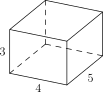
The centers of the faces of the right rectangular prism shown below are joined to create an octahedron. What is the volume of this octahedron?
小提示:
把八面体看成两个以中央菱形为底的棱锥。
View the octahedron as two pyramids with a central rhombus base
大提示:
底面菱形的对角线为 和 。
The base rhombus has diagonals and
解答:
这个八面体可看成两个全等棱锥,它们共用的底面是通过四个侧面中心的菱形。该菱形对角线为 和 ,面积为 。
两个棱锥的高都为 ,即长方体高的一半,所以八面体体积为
所以正确答案是 B。
The octahedron can be viewed as two congruent pyramids whose shared base is the rhombus through the centers of the four side faces. This rhombus has diagonals and , so its area is .
Each pyramid has height , half the prism’s height. Thus the total volume is
Thus, the correct answer is B.
18.
Johann 有 枚公平硬币。他抛所有硬币。任何反面朝上的硬币都再抛一次。第二次仍为反面的硬币再抛第三次。现在正面朝上的硬币的期望数量是多少?
Johann has fair coins. He flips all the coins. Any coin that lands on tails is tossed again. Coins that land on tails on the second toss are tossed a third time. What is the expected number of coins that are now heads?
小提示:
一枚硬币最终为反面,当且仅当前三次都是反面。
A coin is tails at the end only after three tails
大提示:
使用期望的线性性。
Use linearity of expectation
解答:
一枚硬币最后仍为反面,当且仅当它连续 次都是反面,概率为 。因此任意一枚硬币最后为正面的概率为 。
由于一枚硬币为正面的概率是 ,且一共有 枚硬币,所以现在正面朝上的硬币期望数为
所以正确答案是 D。
A coin ends as tails if and only if it has flips that are tails, which happens with probability Thus, the probability of any coin being heads is
Since each of the coins ends as heads with probability linearity of expectation gives the expected number of coins that are now heads:
Thus, the correct answer is D .
19.
在 中,,且 。在三角形外侧作正方形 和 。点 ,, 与 共圆。求该三角形的周长。
In and Squares and are constructed outside of the triangle. The points and lie on a circle. What is the perimeter of the triangle?
小提示:
该圆圆心也是直角三角形的外心。
The circle center is the circumcenter of the right triangle
大提示:
把外心放在斜边中点。
Put the circumcenter at the midpoint of the hypotenuse
解答:
过 的圆心在 和 的垂直平分线上,也就是在 和 的垂直平分线上,所以同一点也是直角三角形 的外心。
因此圆心是斜边中点 ,其中斜边为 ,所以 。令 、,则 。
由 上的正方形可得 。由 上的正方形可知,对应半径也给出 。因此 从这个方程减去 ,得到 。但同样有 ,所以 。由于 ,得到 。
于是 ,所以周长为 。
所以正确答案是 C。
The center of the circle through lies on the perpendicular bisectors of and . These are also the perpendicular bisectors of and , so the same point is the circumcenter of right triangle .
Therefore the center is the midpoint of hypotenuse , so . Let and . Then .
From the square on , . From the square on , the corresponding radius also gives . Hence Subtracting from this equation gives . But as well, so . Since , we get .
Thus , and the perimeter is .
Thus, the correct answer is C.
20.
蚂蚁 Erin 从立方体的一个指定顶点出发,沿着恰好 条棱爬行,正好访问每个顶点一次,然后发现无法沿一条棱回到起点。有多少条路径满足这些条件?
Erin the ant starts at a given corner of a cube and crawls along exactly edges in such a way that she visits every corner exactly once and then finds that she is unable to return along an edge to her starting point. How many paths are there meeting these conditions?
小提示:
前两步之后,起始面上的下一个顶点被迫确定。
After two moves, the next vertex on the starting face is forced
大提示:
再沿对面完成路径,并只保留不能回到起点的路径。
Finish around the opposite face and keep only paths that cannot return
解答:
前两条棱可用 种方式选择。这两条棱确定了立方体的一个起始面。
下一步必须访问该面上唯一尚未访问的顶点;否则以后到达它时,它的所有相邻顶点都已经访问过,路径将无法继续。剩余四个顶点都在对面,可以按两个环绕方向访问。
这两个方向中,恰有一个会终止在与起点不相邻的顶点。因此共有 条合格路径。
所以正确答案是 A。
The first two edges can be chosen in ways. These two edges determine an initial face of the cube. After those moves, there is one unvisited vertex on that initial face.
That remaining vertex must be visited next; otherwise Erin would later reach it after all of its neighbors had already been visited, and the path could not continue. The last four vertices are then on the opposite face and can be visited in two cyclic orders.
Of those two orders, exactly one ends at a vertex not adjacent to the starting point. Hence there are valid paths.
Thus, the correct answer is A.
21.
猫 Cozy 和狗 Dash 正在爬一段有若干台阶的楼梯。不过他们不是一级一级地走上去,而是跳着上。
Cozy 每次跳上两级台阶(若有必要,他会只跳最后一级)。
Dash 每次跳上五级台阶(若有必要,当剩下不足 级时,他会直接跳完剩下的台阶)。
假设 Dash 到达楼顶所需跳数比 Cozy 少 次。令 为所有可能台阶数的和。求 的各位数字之和。
Cozy the Cat and Dash the Dog are going up a staircase with a certain number of steps. However, instead of walking up the steps one at a time, both Cozy and Dash jump.
Cozy goes two steps up with each jump (though if necessary, he will just jump the last step).
Dash goes five steps up with each jump (though if necessary, he will just jump the last steps if there are fewer than steps left).
Suppose Dash takes fewer jumps than Cozy to reach the top of the staircase. Let denote the sum of all possible numbers of steps this staircase can have. What is the sum of the digits of
小提示:
设 Dash 跳 次,Cozy 跳 次。
Let Dash take jumps and Cozy take
大提示:
将 同时放入 和 的可能范围。
Match between and
解答:
设 Dash 跳 次,则台阶数 是 中的一个。Cozy 多跳 次,所以 Cozy 跳 次,这意味着 是 或 。
匹配这些可能性,整数解来自 对应 。
因此 ,各位数字之和为 。
所以正确答案是 D。
Suppose Dash takes jumps. Then the number of steps is one of Cozy takes more jumps, so Cozy takes jumps, which means is either or .
Matching these possibilities, the integer solutions are They give , respectively.
Thus , and the sum of its digits is .
Thus, the correct answer is D.
22.
在下图中, 是正五边形,且 。求 的值。
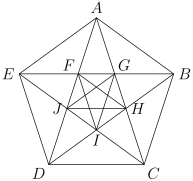
In the figure shown below, is a regular pentagon and What is
小提示:
使用相似三角形,设 、、。
Use similar triangles with side lengths , , and
大提示:
第一个相似关系给出 。
The first similarity gives
解答:
由对称性,,且三角形 与三角形 全等,所以 。设 、。
正五边形中的相似三角形给出 和 第一式为 ,所以 。于是 。
因此
所以正确答案是 D。
By symmetry, , and triangles and are congruent, so . Let , and let .
The similar triangles in the pentagon give and The first equation is , so . Then .
Therefore
Thus, the correct answer is D.
23.
设 是大于 的正整数, 以十为底表示时末尾有 个零,而 以十为底表示时末尾有 个零。令 为四个最小可能的 值之和。求 的各位数字之和。
Let be a positive integer greater than such that the decimal representation of ends in zeros and the decimal representation of ends in zeros. Let denote the sum of the four least possible values of What is the sum of the digits of
小提示:
统计 和 中因子 的个数。
Count factors of in and
大提示:
先测试 和 的最早范围。
Test the first ranges where and
解答:
阶乘末尾零的个数等于其中因子 的个数。对 , 有 个零;要使 有 个零,需要 ,所以 。
对 , 有 个零;要使 有 个零,需要 ,所以 。
这就是四个最小值,所以 。 的各位数字和为 。
所以正确答案是 B。
The number of trailing zeros is the number of factors of . For , has zero. We need to have zeros, which happens when . Thus .
For , has zeros. We need to have zeros, which happens when . Thus .
These are the four least possible values, so . The sum of the digits of is .
Thus, the correct answer is B.
24.
蚂蚁 Aaron 按如下规则在坐标平面上行走。
他从原点 出发,面向东方,走一个单位到达 。
对 ,,,,每次到达点 后,若 Aaron 可以向左转 并走一个单位到达一个尚未访问过的点 ,他就这样做。否则,他直走一个单位到达 。因此点列继续为 如此形成逆时针螺旋。求 。
Aaron the ant walks on the coordinate plane according to the following rules.
He starts at the origin facing to the east and walks one unit, arriving at
For right after arriving at the point if Aaron can turn left and walk one unit to an unvisited point he does that. Otherwise, he walks one unit straight ahead to reach Thus the sequence of points continues in a counterclockwise spiral pattern. What is
小提示:
将 与 比较。
Compare to
大提示:
使用 ,再沿路径倒推。
Use and step backward
解答:
当 Aaron 到达 时,他刚好完成了包含所有坐标介于 与 之间的格点的方形螺旋。因此
取 ,得到 。因为 ,沿底边倒推时, 坐标减去 ,所以
所以正确答案是 D。
When Aaron reaches , he has just completed the square spiral containing all grid points with coordinates between and . Therefore
With , this gives . Since , stepping backward along the bottom edge subtracts from the -coordinate, so
Thus, the correct answer is D.
25.
一个长方体尺寸为 ,其中 、、 是整数,且 该长方体的体积和表面积在数值上相等。可能的有序三元组 有多少个?
A rectangular box measures where and are integers and The volume and the surface area of the box are numerically equal. How many ordered triples are possible?
小提示:
从 开始。
Start from
大提示:
固定 ,再因式分解剩余方程。
Fix and factor the remaining equation
解答:
条件为 因为 ,所以 。此外, 和 都没有正整数解,因此只需检查 。
当 时,,得到 。当 时,,得到 。
当 时,,满足 的唯一解是 。当 时,,满足 的唯一解是 。
所以三元组总数为 。
所以正确答案是 B。
The condition is Since , we have . Also and give no positive solutions, so test .
For , , giving . For , , giving .
For , , and the only solution with is . For , , and the only solution with is .
The total number of triples is .
Thus, the correct answer is B.