
2022 AIME I 详解
向下滚动即可查看来自 LIVE by Po-Shen Loh 的精心整理的解答,打印PDF 解答,查看答案,或参加完整限时模拟考试。
所有题目均经美国数学协会(MAA)官方合法授权使用。
1.
二次多项式 和 的首项系数分别为 和 ,这两个多项式的图像都经过 和 两点。求 。
Quadratic polynomials and have leading coefficients of and respectively. The graphs of both polynomials pass through the two points and Find
小提示:
考虑 :二次项会抵消,所以 是一次函数
Consider the quadratic terms cancel, so is linear
大提示:
经过 和 ;把这条直线延伸回
passes through and extend that line back to
解答:
令 。首项系数 和 抵消,所以 是一次函数。因为两个图像都经过 和 ,所以 且 。
的斜率为 ,所以
Let The leading coefficients and cancel, so is a linear function. Since both graphs pass through and we get and
The slope of is so
2.
求三位正整数 ,它的九进制表示为 ,其中 、、 是(不一定互不相同的)数字。
Find the three-digit positive integer whose representation in base nine is where and are (not necessarily distinct) digits.
小提示:
将条件写成 并化简
Write the condition as and simplify
大提示:
由 ,模 化简以确定 与 的关系,再测试较小的 。
From reduce modulo to pin down in terms of then test small values of
解答:
条件表示 ,化简为 。由于这些数字也出现在一个以九为底的数中,每个数字都至多为 。模 化简,得到 ,所以 。
当 时, 会使 超过 ;当 时, 给出 ,所以 。对每个 ,所需的 都会迫使 落在区间 之外,因此没有其他解。
这个数是 ,并且确实有 。
The condition says which simplifies to Since the digits also appear in a base-nine numeral, each is at most Reducing modulo gives so
For makes exceed for gives so For each the required forces outside the range so there is no other solution.
The number is and indeed
3.
在等腰梯形 中,平行底边 与 的长度分别为 和 ,且 。 与 的角平分线相交于 , 与 的角平分线相交于 。求 。
In isosceles trapezoid parallel bases and have lengths and respectively, and The angle bisectors of and meet at and the angle bisectors of and meet at Find
小提示:
设 的角平分线与 交于 :内错角说明三角形 是等腰三角形,且
Let the bisector of meet at alternate interior angles make triangle isosceles with
大提示:
在等腰三角形 中,从 出发的角平分线也是中线,所以 是 的中点;对 同理,再使用坐标
In isosceles triangle the bisector from is also the median, so is the midpoint of Do the same for and use coordinates.
解答:
设 的角平分线与 交于 。因为 ,有 ,所以三角形 是等腰三角形,且 。于是 的角平分线也是这个三角形中从 出发的中线,因此同时位于两条角平分线上的 是 的中点。类似地, 是 的中点,其中 在 上且 。
令 、,则对适当的高 有 和 。于是 ,且 ,所以
因此 。
Let the bisector of meet at Since we have so triangle is isosceles with The bisector of is then the median from in this triangle, so which lies on both bisectors, is the midpoint of Symmetrically, is the midpoint of where is on with
Place and so and for the appropriate height Then and so
Therefore
4.
设 ,,其中 。求满足方程 的有序数对 的个数,其中两个分量都是不超过 的正整数。
Let and where Find the number of ordered pairs of positive integers not exceeding that satisfy the equation
小提示:
两个数都在单位圆上: 的辐角是 , 的辐角是 ,而 的辐角是
Both numbers lie on the unit circle: has argument and has argument while has argument
大提示:
比较辐角得 ,即 ;数出 在每个余数类中的个数
Matching arguments gives i.e. count how many hit each residue
解答:
与 的模都是 :极坐标形式为 、,而 。因此方程 等价于以下辐角条件:也就是
对每个 ,这确定了 :当 、、或 时,余数 分别为 、 或 (模 )。在 中,满足 的有 个,满足 或 的各有 个。在 中,满足 的有 个,另外两个余数类各有 个。
总数为 。
Both and have modulus in polar form and while The equation is therefore a statement about arguments: i.e.
For each this determines the residue is or modulo according as or Among there are values with and values each with or Among there are values with and values in each of the other two classes.
The count is
5.
一条笔直的河宽 米,水流以每分钟 米的速度自西向东流。Melanie 和 Sherry 坐在河的南岸,Melanie 位于 Sherry 下游 米处。相对于水,Melanie 的游泳速度为每分钟 米,Sherry 的游泳速度为每分钟 米。两人同时开始沿直线游向北岸上的同一点,该点到她们的起点距离相等。两人同时到达该点。求 。
A straight river that is meters wide flows from west to east at a rate of meters per minute. Melanie and Sherry sit on the south bank of the river with Melanie a distance of meters downstream from Sherry. Relative to the water, Melanie swims at meters per minute, and Sherry swims at meters per minute. At the same time, Melanie and Sherry begin swimming in straight lines to a point on the north bank of the river that is equidistant from their starting positions. The two women arrive at this point simultaneously. Find
小提示:
交汇点位于两人中点的正北方。每位游泳者相对于水的速度等于其对地速度减去水流速度 。
The meeting point is due north of the midpoint between them. Each swimmer’s velocity relative to the water is her ground velocity minus the current
大提示:
令 ,将两个速度方程相减,得到
With subtracting the two speed equations gives
解答:
把 Sherry 放在原点,Melanie 放在南岸的 。北岸上到两人等距的点是 。若两人都在时间 到达,则每位游泳者相对于水的速度等于她的对地速度减去水流速度 ,所以
令 。将两式相减,得到 ,所以 。代回可得 ,因此 ,。
因此 。
Put Sherry at the origin and Melanie at on the south bank. A point on the north bank equidistant from both is If both arrive at time then each swimmer’s velocity relative to the water is her ground velocity minus the current so
Subtracting, with so Substituting back, gives so
Therefore
6.
求整数有序数对 的个数,使得序列 严格递增,并且任意四个(不一定连续的)项都不能组成等差数列。
Find the number of ordered pairs of integers such that the sequence is strictly increasing and no set of four (not necessarily consecutive) terms forms an arithmetic progression.
小提示:
先数坏的数对:在满足 的 种选择中,每个四项等差数列都必须用到 或
Count the bad pairs among the choices with every four-term progression must use or
大提示:
除了 和 之外,恰有三个数对 会和两个固定项补成等差数列。注意重复计数。
Beyond and exactly three pairs complete a progression with two of the fixed terms. Watch for double counting.
解答:
序列严格递增当且仅当 ,共有 个数对。六个固定项中没有四项等差数列,所以每个等差数列都必须包含 或 。如果只包含其中一个,则三个固定项本身必须已经在同一个等差数列中: 只能延伸出 ,而 只能延伸出 。所以单变量违规情形为 ( 个数对)以及 ( 个数对),它们在数对 上重合。
如果 和 都参与,则它们与两个固定项补成等差数列。检查可能的位置: 给出 ; 给出 ; 给出 ; 给出 ; 给出 ,超出范围;而 给出 。其中 和 已经被计入,所以只有 、、 是新的坏数对。
有效数对数为 。
The sequence is increasing exactly when giving pairs. The six fixed terms contain no four-term arithmetic progression, so every progression must involve or If only one of them is involved, three fixed terms must already be in progression: extends only by and extends only by So the single-variable violations are ( pairs) and ( pairs), which overlap in the pair
If both and are involved, two fixed terms complete the progression. Checking the possible positions: gives gives gives gives gives out of range; and gives Of these, and are already counted, so and are the only new bad pairs.
The number of valid pairs is
7.
设 、、、、、、、、 是从 到 中取出的互不相同的整数。式子 的最小正值可写成 ,其中 与 是互质正整数。求 。
Let be distinct integers from to The minimum possible positive value of can be written as where and are relatively prime positive integers. Find
小提示:
目标是让分子为 :寻找两个由不同数字组成的三元组,使它们的乘积恰好相差
Aim for a numerator of look for two triples of distinct digits whose products differ by exactly
大提示:
把剩下最大的三个数字留给分母,再通过证明更大的分母会迫使分子差至少为 来排除它们
Save the three largest leftover digits for the denominator, then rule out bigger denominators by showing they force a numerator difference of at least
解答:
先尝试让分子等于 ,同时把较大的数字留在分母中。乘积 与 相差 ,并留下 作分母,给出
若要更小,就需要分子为 且分母大于 。超过 的分母依次为 、、、、、,分别来自 、、、、、。在每种情况下,把剩余六个数字分成两个三元组,最小的正分子差依次为 、、、、、。由此得到的下界 都大于 。
所以最小正值为 ,且 。
Try to make the numerator equal to while keeping large digits in the denominator. The products and differ by and leave for the denominator, giving the value
To beat this, a fraction would need numerator with denominator greater than The denominators exceeding are and coming respectively from and Splitting the remaining six digits into two triples, the smallest positive numerator differences are respectively and The resulting lower bounds all exceed
So the minimum positive value is and
8.
等边三角形 内接于半径为 的圆 。圆 与边 和 相切,并与 内切。圆 和 类似定义。圆 、、 两两相交,共有六个交点,每对圆有两个交点。最靠近 各顶点的三个交点构成 内部的一个较大等边三角形,其余三个交点构成 内部的一个较小等边三角形。较小等边三角形的边长可写成 ,其中 和 是正整数。求 。
Equilateral triangle is inscribed in circle with radius Circle is tangent to sides and and is internally tangent to Circles and are defined analogously. Circles and meet in six points — two points for each pair of circles. The three intersection points closest to the vertices of are the vertices of a large equilateral triangle in the interior of and the other three intersection points are the vertices of a smaller equilateral triangle in the interior of The side length of the smaller equilateral triangle can be written as where and are positive integers. Find
小提示:
先找 :它的圆心在直线 上,半径是它到 距离的一半,而与 内切会固定所有量
Find first: its center lies on line its radius is half its distance from and internal tangency to fixes everything
大提示:
与 的两个交点在直线 上,每个等边三角形的外接圆半径就是该点到中心 的距离
The two intersection points of and lie on line and each triangle’s circumradius is the distance from that point to the center
解答:
设 为 的圆心。 的圆心在直线 上(即 的角平分线),设它到 的距离为 。因为 与 成 角,所以半径为 。与 内切要求该圆心到 的距离为 ,这迫使圆心越过 :,所以 、,圆心在 的另一侧 个单位处。
将 放在原点,令 。则三个圆心为 以及 ,半径均为 。 与 的交点在 轴上:,给出 。点 更接近 ,属于较大的三角形,所以较小三角形的一个顶点是 ,它到 的距离为 。
由对称性,较小三角形是等边三角形,外接圆半径为 ,因此边长为 。故 。
Let be the center of The center of lies on line (the bisector of ) at some distance from since makes a angle with the radius is Internal tangency to requires the center to be from which forces the center past so and the center is beyond
Place at the origin with Then the three centers are and all with radius The intersections of and lie on the -axis: gives The point is closer to and belongs to the larger triangle, so the smaller triangle has vertex at distance from
By symmetry the smaller triangle is equilateral with circumradius so its side is Thus
9.
Ellina 有十二个积木块,红色()、蓝色()、黄色()、绿色()、橙色()和紫色()各两个。若同色两个积木块之间隔着偶数个积木块,则称一个排列为偶排列。例如,排列 是偶排列。Ellina 将这些积木块随机排成一行。她的排列是偶排列的概率为 ,其中 与 是互质正整数。求 。
Ellina has twelve blocks, two each of red (), blue (), yellow (), green (), orange (), and purple (). Call an arrangement of blocks even if there is an even number of blocks between each pair of blocks of the same color. For example, the arrangement is even. Ellina arranges her blocks in a row in random order. The probability that her arrangement is even is where and are relatively prime positive integers. Find
小提示:
位置 与 之间有偶数个积木块,恰好当 与 奇偶性相反
There is an even number of blocks between positions and exactly when and have opposite parity
大提示:
因此每种颜色必须占据一个奇数位置和一个偶数位置:六个奇数位置各放一种颜色,六个偶数位置也各放一种颜色
So each color must occupy one odd and one even position: the six odd slots hold all six colors once, as do the six even slots
解答:
如果一种颜色占据位置 ,它们之间的积木块数是 ,这个数为偶数恰好当 与 奇偶性相反。因此一个排列是偶排列,当且仅当每种颜色都占据一个奇数位置和一个偶数位置,也就是说,六个奇数位置恰好包含六种颜色各一次,六个偶数位置也一样。
计算十二个积木块的排列数(同色积木不可区分),总数为 。偶排列有 个(奇数位置是六种颜色的一个排列,偶数位置也是六种颜色的一个排列)。概率为
因为 ,答案为 。
If a color occupies positions the number of blocks between them is which is even exactly when and have opposite parity. So an arrangement is even precisely when every color occupies one odd position and one even position — that is, the six odd slots contain each color exactly once, and so do the six even slots.
Counting arrangements of the twelve blocks (blocks of the same color identical), there are in total, and even ones (a permutation of the six colors in the odd slots and another in the even slots). The probability is
Since the answer is
10.
三个半径分别为 、、 的球两两外切。一个平面与这三个球相交,得到三个全等圆,它们的圆心分别为 、、,并且三个球的球心都在该平面的同一侧。已知 。求 。
Three spheres with radii and are mutually externally tangent. A plane intersects the spheres in three congruent circles centered at and respectively, and the centers of the spheres all lie on the same side of this plane. Suppose that Find
小提示:
若球心在平面上方高度为 ,球与平面截得的圆的半径平方为 ;三个截圆全等会关联三个高度
If a sphere’s center sits at height above the plane, its circle has radius squared congruence ties the three heights together
大提示:
与 是球心在平面上的垂足,所以 ;再结合
and are the feet of the centers, so combine with
解答:
设三个球心到平面的高度分别为 。每个截圆的圆心是对应球心到平面的垂足,公共截圆半径 满足 。
前两个球相切,所以球心相距 。投影到平面上,有 。因此 。截圆全等给出 ,所以 且 (另一个符号会给出负的和),得到 、,并且 。于是 ,所以 。
第一和第三个球心相距 ,所以
Let the sphere centers be at heights above the plane. Each circle’s center is the foot of the perpendicular from the sphere’s center, and the common circle radius satisfies
The first two spheres are tangent, so their centers are apart, and projecting onto the plane, Thus Congruence gives so and (the other sign gives a negative sum), yielding and Then so
The first and third centers are apart, so
11.
设 是一个平行四边形,且 。一个圆与边 、、 相切,并与对角线 交于点 和 ,其中 ,如图所示。已知 、、。则 的面积可表示为 ,其中 和 是正整数,且 不被任何质数的平方整除。求 。
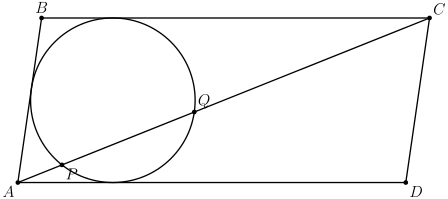
Let be a parallelogram with A circle tangent to sides and intersects diagonal at points and with as shown. Suppose that and Then the area of can be expressed in the form where and are positive integers, and is not divisible by the square of any prime. Find
小提示:
点的幂: 且 ,所以从 与 引出的切线长分别为 和
Power of a point: and give tangent lengths from and from
大提示:
相等切线长迫使 ,而圆与平行线 和 都相切,给出 ;最后对 使用余弦定理
Equal tangents force and tangency to both parallel lines and gives finish with the law of cosines on
解答:
由点的幂,,且 ,所以从 和 引出的切线长分别为 和 。 上的切点距 为 ,因此距 为 。从 引出的两条切线等长,所以 上的切点距 也是这个距离,从而它距 的距离为 ,即 。
设 。圆心位于 的角平分线上,且从 引出的切线长为 ,所以半径为 。圆与平行线 和 都相切,而这两条线的距离为 ,故 ,化简为 。在三角形 中,,且 ,由余弦定理,代入 和 , 项抵消;再用 ,方程化为 ,所以 ,且 。
因此 ,面积为 所以 。
By power of a point, and so the tangent lengths from and are and The tangent point on is from hence from equal tangents from put the tangent point on at that same distance from so its distance from is giving
Let The center lies on the bisector of with the tangent length from equal to so the radius is The circle is tangent to both parallel lines and whose distance apart is so which simplifies to In triangle and so the law of cosines gives Substituting and the terms cancel and, using the equation collapses to so and
Then and the area is so
12.
对任意有限集合 ,令 表示 中元素的个数。定义 其中求和遍历所有有序数对 ,满足 和 都是 的子集且 。例如,,因为求和遍历以下子集对: 所以 。设 ,其中 和 是互质正整数。求 除以 的余数。
For any finite set let denote the number of elements in Define where the sum is taken over all ordered pairs such that and are subsets of with For example, because the sum is taken over the pairs of subsets giving Let where and are relatively prime positive integers. Find the remainder when is divided by
小提示:
交换求和顺序:对每个元素,数满足 且两个集合都包含它的数对
Swap the order of summation: for each element, count the pairs with that contain it in both sets
大提示:
,所以 ;然后化简相邻两项的比值
so then simplify the ratio of consecutive terms
解答:
按元素计数: 等于三元组 的个数,其中 且 。固定 和集合大小 后,包含 的 和 各有 种选择,所以由范德蒙德恒等式,
因此 因为 ,它不整除 、 或 ,所以该分数已最简:,且 。
于是 ,除以 的余数为 。
Count element by element: equals the number of triples with and For a fixed and size there are choices for each of and containing so by the Vandermonde identity
Therefore Since divides neither nor this fraction is in lowest terms: and
Then whose remainder modulo is
13.
设 为所有能表示成循环小数 的有理数的集合,其中数字 、、、 中至少有一个非零。将 中的数写成最简分数时,设 为可能出现的不同分子个数。例如, 和 都会被计入 中的数所产生的这些不同分子中,因为 ,且 。求 除以 的余数。
Let be the set of all rational numbers that can be expressed as a repeating decimal in the form where at least one of the digits or is nonzero. Let be the number of distinct numerators obtained when numbers in are written as fractions in lowest terms. For example, both and are counted among the distinct numerators for numbers in because and Find the remainder when is divided by
小提示:
中每个元素都是 ,其中 ,且
Every element of is with and
大提示:
是一个分子,当且仅当对 的某个因数 有 且 。按 、、 中哪些整除 来分类。
is a numerator exactly when and for some divisor of Classify by which of or divide it.
解答:
中每个元素都等于 ,其中 ,且 。化为最简形式后为 ,其中 整除 、,且 ;反过来,任何这样的 都可由 得到。所以 计数的是这样的整数 :它不超过 的某个因数 ,并且与该因数互质。
按质数 、、 中哪些整除 来分类,每次都使用与 互质的最大因数 。如果 ,取 :这样的 有 个。如果只有 整除 ,取 :不超过 且不被 或 整除的 的倍数有 个。如果只有 整除 ,取 :得到 个。如果只有 整除 ,则 ,没有可行值。如果 能被 整除但不能被 整除,取 :数值 、、 再给出 个;而任何被 或 整除的 都会要求 ,不可能。
因此 ,除以 的余数为 。
Every element of equals for some where In lowest terms this is where divides and conversely any such arises from So counts the integers that are at most, and coprime to, some divisor of
Classify by which of the primes or divide it, always using the largest divisor coprime to If take there are such If only divides take multiples of up to avoiding and number If only divides take that gives If only divides then admits none. If is divisible by but not by take the values and give more, and any divisible by or would need which is impossible.
Therefore and the remainder modulo is
14.
给定 以及其一条边上的点 。若直线 经过 ,并把 分成两个周长相等的多边形,则称 为 经过 的 分割线。设 是一个三角形,其中 ,且 和 都是正整数。令 和 分别为 和 的中点,并且 经过 和 的两条分割线相交成 。求 的周长。
Given and a point on one of its sides, call line the splitting line of through if passes through and divides into two polygons of equal perimeter. Let be a triangle where and and are positive integers. Let and be the midpoints of and respectively, and suppose that the splitting lines of through and intersect at Find the perimeter of
小提示:
证明经过 的分割线平行于从 出发的角平分线:它与 交于 ,且 ,并有
Show the splitting line through is parallel to the angle bisector from it meets at with and
大提示:
从 和 出发的角平分线相交成 ,所以 条件迫使 ;接着使 成为完全平方数
The bisectors from and cross at so the condition forces then make a perfect square
解答:
记 、、,并令 为半周长。经过 的分割线与 交于点 。令两部分的周长相等,并消去两边共有的线段 ,得到 所以 。在三角形 中,正弦定理说明 :这需要 ,而它可由 以及 化简为 。这个等式成立,因为这两个角互余。因此经过 的分割线平行于从 出发的角平分线;类似地,经过 的分割线平行于从 出发的角平分线。
从 和 出发的内角平分线相交成 ,所以两条分割线的锐角夹角为 ,从而 。由余弦定理,设 ,则 ,且 、 是 的根,因此要求 是完全平方数 。于是 整除 且 整除 ;写 、,条件变为 。三角形不等式 与 将范围限制为 ,检查后只有 可行,此时 。
所以 ,且 ,给出 ,这是一个有效三角形。周长为 。
Write and for the semiperimeter. The splitting line through meets at the point Equating the two piece perimeters and cancelling their common segment gives so In triangle the law of sines shows this needs which reduces via and to true because those angles are complementary. Hence the splitting line through is parallel to the angle bisector from and likewise the one through is parallel to the bisector from
The internal bisectors from and meet at so the acute angle between the two splitting lines is forcing The law of cosines gives Set so and and are roots of requiring to be a perfect square Then divides and divides writing and turns the condition into The triangle inequality and restrict and checking these, only works, with
So and giving — a valid triangle. The perimeter is
15.
设 、、 为正实数,满足方程组 则 可写成 ,其中 与 是互质正整数。求 。
Let and be positive real numbers satisfying the system of equations Then can be written as where and are relatively prime positive integers. Find
小提示:
将每个根式分解为 ,并代换 、、
Factor each radical as and substitute
大提示:
每个方程都由和角公式化为 等形式;解这个小型角度线性方程组,再使用
Each equation collapses by the addition formula to etc.; solve the little linear system for the angles and use
解答:
每个被开方数都可分解:,其余同理,所以 。令 ,,,其中 。则 ,每个方程都由正弦和角公式化为
一个可行选择是 ,,,得到 ,,。与 一致的另一个分支使用两两之和 ,得到 ,,;其下述乘积是第一个分支乘积的相反数,所以所求平方相同。对第一个分支,倍角公式给出 ,,且 。
因此 其平方为 。所以 。
Each radicand factors: and so on, so Substitute with Then and each equation collapses by the sine addition formula:
One admissible choice is which gives The only other branch consistent with uses pairwise sums giving its product below is the negative of the first branch’s product, so the requested square is identical. For the first branch, the double-angle identity gives and
Therefore whose square is Thus