
2011 AMC 12B Problems
Scroll down and press Start to try the exam! Or, go to the printable PDF, answer key, or professional solutions curated by LIVE by Po-Shen Loh.
All problems are used with official legal permission of the Mathematical Association of America (MAA).
Or jump straight to a single problem with its solution: 1 · 2 · 3 · 4 · 5 · 6 · 7 · 8 · 9 · 10 · 11 · 12 · 13 · 14 · 15 · 16 · 17 · 18 · 19 · 20 · 21 · 22 · 23 · 24 · 25
Want to learn professionally through interactive video classes?
Timed
1:15:00
1.
What is
Answer: C
Small Hint:
Add the terms in each numerator and denominator first
Big Hint:
The expression becomes
Solution:
The sums are and so the expression equals
Over a common denominator this is
Thus, the correct answer is C.
2.
Josanna’s test scores to date are and Her goal is to raise her test average at least points with her next test. What is the minimum test score she would need to accomplish this goal?
Answer: E
Small Hint:
Find the current average of the five scores
Big Hint:
The six scores must total times the target average
Solution:
The five scores sum to giving an average of The goal is a new average of at least
Six tests averaging must total so the sixth score must be at least
Thus, the correct answer is E.
3.
LeRoy and Bernardo went on a week-long trip together and agreed to share the costs equally. Over the week, each of them paid for various joint expenses such as gasoline and car rental. At the end of the trip it turned out that LeRoy had paid dollars and Bernardo had paid dollars, where How many dollars must LeRoy give to Bernardo so that they share the costs equally?
Answer: C
Small Hint:
Each person should end up paying
Big Hint:
LeRoy must cover the gap between what he paid and his fair share
Solution:
The total cost is so each person’s fair share is
LeRoy paid which is less than his share, so he must give Bernardo
Thus, the correct answer is C.
4.
In multiplying two positive integers and Ron reversed the digits of the two-digit number His erroneous product was What is the correct value of the product of and
Answer: E
Small Hint:
Factor into primes
Big Hint:
The reversed is the two-digit factor; reverse it back before multiplying
Solution:
Since the only two-digit factor is This must be the reversed value of so the true value of is and
The correct product is
Thus, the correct answer is E.
5.
Let be the second smallest positive integer that is divisible by every positive integer less than What is the sum of the digits of
Answer: A
Small Hint:
Find the least common multiple of through
Big Hint:
The valid numbers are the multiples of that value; take the second one
Solution:
A number divisible by every integer from to must be a multiple of
The second smallest positive multiple of is whose digit sum is
Thus, the correct answer is A.
6.
Two tangents to a circle are drawn from a point The points of contact and divide the circle into arcs with lengths in the ratio What is the degree measure of
Answer: C
Small Hint:
The two arcs split in the ratio
Big Hint:
A tangent meets the radius at its point of contact at ; use quadrilateral
Solution:
Let be the center. The arcs measure and with so and the minor arc gives central angle
The radii to and are perpendicular to the tangents, so In quadrilateral
Thus, the correct answer is C.
7.
Let and be two-digit positive integers with mean What is the maximum value of the ratio
Answer: B
Small Hint:
The mean condition gives
Big Hint:
To maximize make as large and as small as allowed
Solution:
Since we have To maximize we make small.
Because it follows that Taking and gives the maximum
Thus, the correct answer is B.
8.
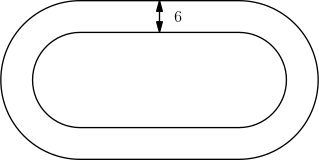
Keiko walks once around a track at exactly the same constant speed every day. The sides of the track are straight, and the ends are semicircles. The track has width meters, and it takes her seconds longer to walk around the outside edge of the track than around the inside edge. What is Keiko’s speed in meters per second?
Answer: A
Small Hint:
The straight portions have the same length on both edges, so only the curved ends differ
Big Hint:
The two semicircular ends form full circles whose radii differ by
Solution:
The straight sides are the same length for both paths, so the difference in length comes only from the two semicircular ends. If the inner radius is those ends combine into a full circle, and the extra length is
If her speed is meters per second, then the extra time gives so
Thus, the correct answer is A.
9.
Two real numbers are selected independently at random from the interval What is the probability that the product of those numbers is greater than zero?
Answer: D
Small Hint:
The product is positive exactly when both numbers share the same sign
Big Hint:
Each number is negative with probability and positive with probability
Solution:
The interval has length with of it negative and of it positive. So each number is positive with probability and negative with probability
The product is positive when both are positive or both are negative:
Thus, the correct answer is D.
10.
Rectangle has and Point is chosen on side so that What is the degree measure of
Answer: E
Small Hint:
Since the angle equals
Big Hint:
That makes isosceles with so is --
Solution:
Because we have Combined with this gives so is isosceles with
Then is right-angled at with hypotenuse and leg so it is a -- triangle with
Finally, so giving
Thus, the correct answer is E.
11.
A frog located at with both and integers, makes successive jumps of length and always lands on points with integer coordinates. Suppose that the frog starts at and ends at What is the smallest possible number of jumps the frog makes?
Answer: B
Small Hint:
One jump is impossible since the distance is not
Big Hint:
A midpoint of two jumps would lie on which has no lattice points; try three jumps
Solution:
One jump cannot work, since and are only apart. Two jumps also fail: the intermediate point would be at distance from both, forcing it onto the perpendicular bisector which contains no lattice points.
Three jumps suffice, for example where each step has length
Thus, the correct answer is B.
12.
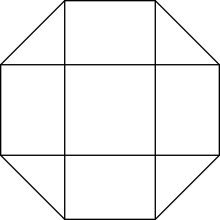
A dart board is a regular octagon divided into regions as shown. Suppose that a dart thrown at the board is equally likely to land anywhere on the board. What is the probability that the dart lands within the center square?
Answer: A
Small Hint:
Set the octagon’s edge to and split it into the center square, four rectangles, and four corner triangles
Big Hint:
The corner triangles are right isosceles with legs
Solution:
Assume the octagon has edge length The four corner triangles are right isosceles with legs and area each. The four rectangles are by with area each, and the center square has area
The total area is The probability of hitting the center square is
Thus, the correct answer is A.
13.
Brian writes down four integers whose sum is The pairwise positive differences of these numbers are and What is the sum of the possible values for
Answer: B
Small Hint:
The largest difference is and the smallest positive difference must be
Big Hint:
The second largest difference is either or ; handle each case
Solution:
The largest difference is For either interior number we have The only pairs among the listed differences that sum to are and so the remaining difference must be
The second largest difference is either or If the numbers are so and If the numbers are so and
The possible values are and which sum to
Thus, the correct answer is B.
14.
A segment through the focus of a parabola with vertex is perpendicular to and intersects the parabola in points and What is
Answer: D
Small Hint:
Let Use the focus-directrix property to find and then
Big Hint:
Find then via the double angle formula
Solution:
Let and let the directrix be Projecting and onto the focus-directrix property gives (the distance from to ), and by the Pythagorean Theorem
Then Since
Thus, the correct answer is D.
15.
How many positive two-digit integers are factors of
Answer: D
Small Hint:
Repeatedly apply the difference of squares to factor
Big Hint:
The prime factorization is list two-digit products
Solution:
Factoring, which equals
Since is a three-digit prime, the two-digit factors come from They are for a total of
Thus, the correct answer is D.
16.
Rhombus has side length and Region consists of all points inside the rhombus that are closer to vertex than any of the other three vertices. What is the area of
Answer: C
Small Hint:
The boundary of lies along the perpendicular bisectors of the sides through
Big Hint:
is a pentagon made of four congruent -- triangles, each with a leg of length
Solution:
Let and be the midpoints of and The perpendicular bisector of through meets diagonal at and the perpendicular bisector of through meets at The region is the pentagon
Triangle is a -- triangle with so its area is Triangles and are congruent to it, and is equilateral, splitting into two more copies.
Hence consists of four congruent triangles, giving area
Thus, the correct answer is C.
17.
Let and for integers What is the sum of the digits of
Small Hint:
Simplify to a linear function
Big Hint:
Iterating gives as a number whose digits are all ’s ending in a
Solution:
First,
Iterating, Therefore is an -digit integer whose units digit is and all of whose other digits are
For the digit sum is
Thus, the correct answer is B.
18.
A pyramid has a square base with sides of length and has lateral faces that are equilateral triangles. A cube is placed within the pyramid so that one face is on the base of the pyramid and its opposite face has all its edges on the lateral faces of the pyramid. What is the volume of this cube?
Answer: A
Small Hint:
Slice the pyramid through the plane containing a diagonal of the base and the apex
Big Hint:
That cross-section is an isosceles right triangle with hypotenuse the cube meets it in a rectangle of height and width
Solution:
Let the apex be and the base be square Then and so is an isosceles right triangle.
Let the cube have edge length Its intersection with the plane of is a rectangle of height and width whose top corners lie on and Because the legs and meet the base at each portion of outside the rectangle has length so which reduces to
The volume is
Thus, the correct answer is A.
19.
A lattice point in an -coordinate system is any point where both and are integers. The graph of passes through no lattice point with for all such that What is the maximum possible value of
Answer: B
Small Hint:
For each find the smallest slope from that reaches a lattice point at that
Big Hint:
Compare the minimum slopes for even and odd the tighter bound wins
Solution:
For the nearest lattice point above the line is if is even and if is odd.
The slope from to that point is for even and for odd The minimum such slope is for even and for odd
Since the line avoids all these lattice points exactly when so the maximum is
Thus, the correct answer is B.
20.
Triangle has and The points and are the midpoints of and respectively. Let be the intersection of the circumcircles of and What is
Answer: C
Small Hint:
Use the parallel midsegments and the Inscribed Angle Theorem to show is equidistant from
Big Hint:
is the circumcenter, so where
Solution:
Since and we get By the Inscribed Angle Theorem, and so With this forces
Also The chord formula in gives while the same formula in gives Thus The point at distance from both and on this side of is the circumcenter of so
The area of the -- triangle is by Heron’s formula, so and
Thus, the correct answer is C.
21.
The arithmetic mean of two distinct positive integers and is a two-digit integer. The geometric mean of and is obtained by reversing the digits of the arithmetic mean. What is
Answer: D
Small Hint:
Write the arithmetic mean as and the geometric mean as
Big Hint:
Compute it factors as
Solution:
Let the arithmetic mean be and the geometric mean be Then and
Therefore Since the arithmetic mean exceeds the geometric mean for distinct positive numbers, Put and Then and For to be a square, must contain an odd power of Therefore because and Now is a square, so is a square. Also and have the same parity, leaving or The latter gives not a digit, so and
Then so (Indeed )
Thus, the correct answer is D.
22.
Let be a triangle with sides and For if and and are the points of tangency of the incircle of to the sides and respectively, then is a triangle with side lengths and if it exists. What is the perimeter of the last triangle in the sequence
Answer: D
Small Hint:
The tangent lengths satisfy and similarly for and
Big Hint:
Each triangle keeps the form with halving; it fails the triangle inequality once
Solution:
For a triangle with sides the tangent lengths are and If has sides then has sides
Starting from with middle side the middle side halves each step and the perimeter of is the perimeter of A triangle of this form exists only while its middle side exceeds
The middle side of is This first drops to or below at so the last valid triangle is whose middle side is and whose perimeter is
Thus, the correct answer is D.
23.
A bug travels in the coordinate plane, moving only along the lines that are parallel to the -axis or -axis. Let and Consider all possible paths of the bug from to of length at most How many points with integer coordinates lie on at least one of these paths?
Answer: C
Small Hint:
A point lies on such a path iff its taxicab distances satisfy
Big Hint:
This is count by symmetry across the axes
Solution:
A lattice point lies on some path exactly when This expression is unchanged when or so we count points with multiply by and correct for the axes.
If and all points work. If and then giving points. If and then giving points. Finally, for and the condition is giving points. Thus there are in the first quadrant, including on the nonnegative axes. By symmetry the total is
Thus, the correct answer is C.
24.
Let What is the minimum perimeter among all the -sided polygons in the complex plane whose vertices are precisely the zeros of
Answer: B
Small Hint:
Treat as a quadratic in and factor as
Big Hint:
Since the eight roots lie on two squares; the shortest edges have length
Solution:
Factoring in The first factor gives the roots Since and writing the other four roots are
The eight roots are symmetric about the origin with -fold symmetry, and every segment joining two of them has length at least Thus any such polygon has perimeter at least and the polygon with vertices achieves it.
Thus, the correct answer is B.
25.
For every and integers with odd, denote by the integer closest to For every odd integer let be the probability that for an integer randomly chosen from the interval What is the minimum possible value of over the odd integers in the interval
Answer: D
Small Hint:
Whether works depends only on and each residue class is equally likely
Big Hint:
Write with then
Solution:
Because whether satisfies the identity depends only on Since is divisible by for every residue class is equally likely.
Write and choosing both remainders in If no carry occurs precisely when this gives residue classes. The case similarly gives classes. Hence in both cases
To minimize we maximize If then and the largest possible is the divisor of If then because is prime, only is possible. In every remaining case so For
Thus, the correct answer is D.