
2011 AMC 12A Problems
Scroll down and press Start to try the exam! Or, go to the printable PDF, answer key, or professional solutions curated by LIVE by Po-Shen Loh.
All problems are used with official legal permission of the Mathematical Association of America (MAA).
Or jump straight to a single problem with its solution: 1 · 2 · 3 · 4 · 5 · 6 · 7 · 8 · 9 · 10 · 11 · 12 · 13 · 14 · 15 · 16 · 17 · 18 · 19 · 20 · 21 · 22 · 23 · 24 · 25
Want to learn professionally through interactive video classes?
Timed
1:15:00
1.
A cell phone plan costs each month, plus ¢ per text message sent, plus ¢ for each minute used over hours. In January Michelle sent text messages and talked for hours. How much did she have to pay?
Answer: D
Small Hint:
hours is minutes over the -hour allowance
Big Hint:
Add the base fee, ¢ times the texts, and ¢ times the overage minutes
Solution:
The text charge is cents She talked minutes past the -hour allowance, so the overage is cents
The total is
Thus, the correct answer is D.
2.
There are coins placed flat on a table according to the figure. What is the order of the coins from top to bottom?
Answer: E
Small Hint:
A coin whose outline is a complete, unbroken circle lies on top
Big Hint:
At each overlap, the coin whose arc is drawn without interruption is the higher one
Solution:
Coin is drawn as a complete, unbroken circle, so nothing covers it and it lies on top.
Reading the remaining overlaps, each coin’s uncovered arc shows it sits above the next: covers covers covers and covers while lying under the others. This gives the top-to-bottom order
Thus, the correct answer is E.
3.
A small bottle of shampoo can hold milliliters of shampoo, whereas a large bottle can hold milliliters of shampoo. Jasmine wants to buy the minimum number of small bottles necessary to completely fill a large bottle. How many bottles must she buy?
Answer: E
Small Hint:
Divide by
Big Hint:
Since bottles fall short of round the quotient up
Solution:
Fourteen bottles hold milliliters, which is not enough. Fifteen bottles hold milliliters, which suffices.
So Jasmine needs bottles.
Thus, the correct answer is E.
4.
At an elementary school, the students in third grade, fourth grade, and fifth grade run an average of and minutes per day, respectively. There are twice as many third graders as fourth graders, and twice as many fourth graders as fifth graders. What is the average number of minutes run per day by these students?
Answer: C
Small Hint:
Let the number of fifth graders be so fourth graders is and third graders is
Big Hint:
The average is
Solution:
Take the grade sizes in the ratio for third, fourth, and fifth grades. The weighted average is
Thus, the correct answer is C.
5.
Last summer of the birds living on Town Lake were geese, were swans, were herons, and were ducks. What percent of the birds that were not swans were geese?
Answer: C
Small Hint:
The non-swan birds make up of the total
Big Hint:
Compute as a percent
Solution:
The birds that are not swans make up of the total, and geese are of the total. The requested fraction is
Thus, the correct answer is C.
6.
The players on a basketball team made some three-point shots, some two-point shots, and some one-point free throws. They scored as many points with two-point shots as with three-point shots. Their number of successful free throws was one more than their number of successful two-point shots. The team’s total score was points. How many free throws did they make?
Answer: A
Small Hint:
Let be the number of two-point shots; the points from two-point and three-point shots are each
Big Hint:
The free throws number so the total is
Solution:
Let be the number of two-point shots. The two-point shots score points, and the three-point shots score the same points. The free throws number and score points.
The total is so and the free throws number
Thus, the correct answer is A.
7.
A majority of the students in Ms. Demeanor’s class bought pencils at the school bookstore. Each of these students bought the same number of pencils, and this number was greater than The cost of a pencil in cents was greater than the number of pencils each student bought, and the total cost of all the pencils was What was the cost of a pencil in cents?
Answer: B
Small Hint:
Factor and let (students)(pencils)(cost)
Big Hint:
A majority means more than students, so the number of students is
Solution:
Total cents is Writing (students)(pencils each)(cost per pencil) the number of students is a divisor of that is a majority of hence more than The only such divisor is
Then (pencils)(cost) with cost pencils forcing pencils at cents each.
Thus, the correct answer is B.
8.
In the eight-term sequence the value of is and the sum of any three consecutive terms is What is
Answer: C
Small Hint:
Consecutive triples having equal sums forces the sequence to repeat every three terms
Big Hint:
So equals which means is the same as
Solution:
Since we get and likewise the sequence repeats with period Thus the eighth term, equals
From and we have
Thus, the correct answer is C.
9.
At a twins and triplets convention, there were sets of twins and sets of triplets, all from different families. Each twin shook hands with all the twins except his/her sibling and with half the triplets. Each triplet shook hands with all the triplets except his/her siblings and with half the twins. How many handshakes took place?
Answer: B
Small Hint:
There are twins and triplets; count twin-twin, triplet-triplet, and twin-triplet handshakes separately
Big Hint:
Each twin greets twins and each triplet greets triplets; divide those two totals by
Solution:
There are twins and triplets.
Twin-twin handshakes: each twin shakes other twins, giving
Triplet-triplet handshakes: each triplet shakes other triplets, giving
Twin-triplet handshakes: each twin shakes half the triplets, giving (each such handshake counted once).
The total is
Thus, the correct answer is B.
10.
A pair of standard -sided fair dice is rolled once. The sum of the numbers rolled determines the diameter of a circle. What is the probability that the numerical value of the area of the circle is less than the numerical value of the circle’s circumference?
Answer: B
Small Hint:
With diameter the area is and the circumference is
Big Hint:
The inequality reduces to
Solution:
For diameter area circumference means i.e. Since this needs a sum of or
A sum of has probability and a sum of has probability totaling
Thus, the correct answer is B.
11.
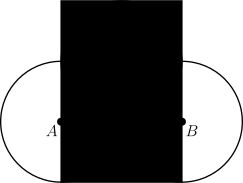
Circles and each have radius Circles and share one point of tangency. Circle has a point of tangency with the midpoint of What is the area inside circle but outside circle and circle
Answer: C
Small Hint:
Place the centers at and the distance from to each of is
Big Hint:
The wanted area is the area of minus the two lens-shaped overlaps of with and with
Solution:
Place so their tangency point is the origin, the midpoint of Then since passes through the origin.
The distance from to (and to ) is Two unit circles whose centers are apart overlap in a lens of area
Circles and meet only at the origin, so the two lenses do not overlap. The wanted area is
Thus, the correct answer is C.
12.
A power boat and a raft both left dock on a river and headed downstream. The raft drifted at the speed of the river current. The power boat maintained a constant speed with respect to the river. The power boat reached dock downriver, then immediately turned and traveled back upriver. It eventually met the raft on the river hours after leaving dock How many hours did it take the power boat to go from to
Answer: D
Small Hint:
Work in the frame of the water, in which the raft stays put
Big Hint:
Relative to the water the boat travels at the same speed going out and coming back, so it takes equal times each way
Solution:
Measure everything relative to the water. In that frame the raft is stationary at the point where the boat started, and the boat moves at its constant speed relative to the water, both downstream and upstream.
The boat leaves the raft, travels away for some time, then returns to it at the same relative speed, so it spends equal times going and returning. Hence the outbound leg to takes half of which is hours.
Thus, the correct answer is D.
13.
Triangle has side-lengths and The line through the incenter of parallel to intersects at and at What is the perimeter of
Answer: B
Small Hint:
Let be the incenter. Since the angle equals
Big Hint:
That makes isosceles with and similarly
Solution:
Let be the incenter. Because bisects and alternate angles give so is isosceles with Similarly
Therefore the perimeter of is
Thus, the correct answer is B.
14.
Suppose and are single-digit positive integers chosen independently and at random. What is the probability that the point lies above the parabola
Answer: E
Small Hint:
The point is above the parabola when i.e.
Big Hint:
Count valid in for each only allow any
Solution:
Substituting the point is above the parabola when i.e.
For all values work. For so giving For so giving For no works.
The count is out of so the probability is
Thus, the correct answer is E.
15.
The circular base of a hemisphere of radius rests on the base of a square pyramid of height The hemisphere is tangent to the other four faces of the pyramid. What is the edge-length of the base of the pyramid?
Answer: A
Small Hint:
Take the cross-section through the apex and the midpoints of two opposite base edges
Big Hint:
In that cross-section, the slant line runs from to and its distance from the center is
Solution:
Let the base have side centered at the origin, with apex at height Cut with the vertical plane through the apex and the midpoints of two opposite base edges. The slant face appears as the line from to
This line is The hemisphere is tangent to the face, so the distance from the origin to this line is the radius
Then so and giving
Thus, the correct answer is A.
16.
Each vertex of convex pentagon is to be assigned a color. There are colors to choose from, and the ends of each diagonal must have different colors. How many different colorings are possible?
Answer: C
Small Hint:
The five diagonals form a single -cycle among the vertices
Big Hint:
The number of proper colorings of a cycle of length with colors is
Solution:
The diagonals connect the vertices in the order which is a -cycle. The condition is exactly that this cycle is properly colored.
The number of proper -colorings of a cycle of length is With and
Thus, the correct answer is C.
17.
Circles with radii and are mutually externally tangent. What is the area of the triangle determined by the points of tangency?
Answer: D
Small Hint:
The centers form a triangle with sides i.e. a -- right triangle
Big Hint:
Put the right angle at the center of the radius- circle and locate each tangency point on the connecting segment
Solution:
The centers are separated by the sums of radii: and a right triangle with the right angle at the radius- center. Place that center at the radius- center at and the radius- center at
The tangency points lie on the segments at distances equal to the radii: and on the hypotenuse at
By the shoelace formula the area is
Thus, the correct answer is D.
18.
Suppose that What is the maximum possible value of
Answer: D
Small Hint:
The equation means the boundary of the square
Big Hint:
On that square, is largest when and
Solution:
The identity turns the condition into the boundary of the square with and
On this region increases as decreases and as increases, so the maximum is at
Thus, the correct answer is D.
19.
At a competition with players, the number of players given elite status is equal to Suppose that players are given elite status. What is the sum of the two smallest possible values of
Note: is the greatest integer less than or equal to
Answer: C
Small Hint:
Let so
Big Hint:
For that to be consistent, which forces
Solution:
Let so the elite count is giving
Consistency requires i.e. so
The two smallest choices are giving and giving Their sum is
Thus, the correct answer is C.
20.
Let where and are integers. Suppose that and for some integer What is
Answer: C
Small Hint:
From so and
Big Hint:
The bounds force and
Solution:
Since we have Then
From we get and from we get Subtracting, then and
So which lies in giving
Thus, the correct answer is C.
21.
Let and for integers let If is the largest value of for which the domain of is nonempty, the domain of is What is
Small Hint:
Build the domains outward: needs to lie in the domain of
Big Hint:
The first three domains are and continue while remembering that a square root is nonnegative
Solution:
Each step requires to lie in the domain of Tracking the domains:
(only the value is possible).
For we would need impossible, so the domain is empty. Hence and
Thus, the correct answer is A.
22.
Let be a square region and an integer. A point in the interior of is called -ray partitional if there are rays emanating from that divide into triangles of equal area. How many points are -ray partitional but not -ray partitional?
Answer: C
Small Hint:
The -ray partitional points form a grid: for they are the interior points an array
Big Hint:
A point is both - and -ray partitional exactly when it is -ray partitional
Solution:
Scale the square to and write The rays must include those through the four vertices. Every small triangle has area The triangles whose bases partition the bottom side together have area so their number is Similarly, the numbers along the top, left, and right sides are and
These four numbers must be positive integers. Hence is even and Conversely, partitioning each side into the indicated number of equal segments and joining the division points to produces equal-area triangles. Thus these are exactly the partitional points.
For the points are with giving Such a point is also -ray partitional exactly when and for integers Thus and must both be multiples of There are choices for each, so the overlap has points.
So the count is
Thus, the correct answer is C.
23.
Let and where and are complex numbers. Suppose that and for all for which is defined. What is the difference between the largest and smallest possible values of
Answer: C
Small Hint:
Represent by the matrix then means is the identity
Big Hint:
The order- case forces which gives
Solution:
Direct composition gives where and
The matrix represents For to be the identity, its square must be scalar. Comparing the off-diagonal entries and the two diagonal entries gives two possibilities: either and or The first gives (with ); the second gives
In the second case, As runs around the unit circle, ranges from to so Both endpoints occur: take and The separate case also has Therefore the requested difference is
Thus, the correct answer is C.
24.
Consider all quadrilaterals such that and What is the radius of the largest possible circle that fits inside or on the boundary of such a quadrilateral?
Answer: C
Small Hint:
If a circle of radius fits, splitting from its center shows the quadrilateral’s area is at least
Big Hint:
Bretschneider’s inequality bounds the area by the cyclic case; the equality case is also tangential because opposite side sums are equal
Solution:
Suppose a circle of radius centered at fits in one of the quadrilaterals. If are the distances from to the four side lines, then each Splitting the quadrilateral into four triangles gives
Bretschneider’s inequality bounds the area of any quadrilateral with these sides by the cyclic case:
Therefore Equality is attainable: the cyclic quadrilateral with these sides is also tangential because and its incircle has radius
Thus, the correct answer is C.
25.
Triangle has and Let and be the orthocenter, incenter, and circumcenter of respectively. Assume that the area of the pentagon is the maximum possible. What is
Answer: D
Small Hint:
Because the points all lie on one circle
Big Hint:
On that circle, maximize the quadrilateral by making the three consecutive subarcs from to equal
Solution:
Write and Since we have so The standard angle formulas give Hence lie on one circle.
Also and fix the circumradius so and the circle through are fixed. Angle chasing at gives Thus the corresponding chords satisfy
The pentagon’s area is the fixed area plus For two points dividing a fixed arc an inscribed quadrilateral has greatest area when its three consecutive subarcs are equal (equivalently, maximize the sum of their sines). Hence at the maximum
In Equal chords make and each of these angles is Therefore so and
Thus, the correct answer is D.