
2007 AMC 12B Problems
Scroll down and press Start to try the exam! Or, go to the printable PDF, answer key, or professional solutions curated by LIVE by Po-Shen Loh.
All problems are used with official legal permission of the Mathematical Association of America (MAA).
Or jump straight to a single problem with its solution: 1 · 2 · 3 · 4 · 5 · 6 · 7 · 8 · 9 · 10 · 11 · 12 · 13 · 14 · 15 · 16 · 17 · 18 · 19 · 20 · 21 · 22 · 23 · 24 · 25
Want to learn professionally through interactive video classes?
Timed
1:15:00
1.
Isabella’s house has bedrooms. Each bedroom is feet long, feet wide, and feet high. Isabella must paint the walls of all the bedrooms. Doorways and windows, which will not be painted, occupy square feet in each bedroom. How many square feet of walls must be painted?
Small Hint:
The four walls of a room form a band of height wrapping around the floor
Big Hint:
The painted area per room is (floor perimeter)(height)
Solution:
The perimeter of each bedroom floor is feet.
So the wall area in one bedroom is square feet. Across all three bedrooms, Isabella paints square feet.
Thus, the correct answer is E.
2.
A college student drove his compact car miles home for the weekend and averaged miles per gallon. On the return trip the student drove his parents’ SUV and averaged only miles per gallon. What was the average gas mileage, in miles per gallon, for the round trip?
Answer: B
Small Hint:
Average mileage is total miles divided by total gallons, not the average of the two rates
Big Hint:
The car uses gallons and the SUV uses gallons
Solution:
The trip home uses gallons, and the return trip uses gallons.
The round trip covers miles on gallons, so the average is
Thus, the correct answer is B.
3.
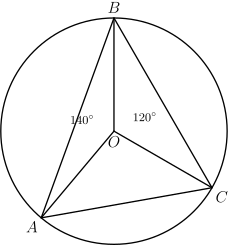
The point is the center of the circle circumscribed about with and as shown. What is the degree measure of
Answer: D
Small Hint:
The three central angles at add up to
Big Hint:
The inscribed angle is half of the central angle
Solution:
The angles around sum to so
By the inscribed angle theorem, subtends the same arc as the central angle so
Thus, the correct answer is D.
4.
At Frank’s Fruit Market, bananas cost as much as apples, and apples cost as much as oranges. How many oranges cost as much as bananas?
Answer: B
Small Hint:
First convert bananas into an equivalent number of apples
Big Hint:
Then convert those apples into oranges using apples oranges
Solution:
Since bananas cost as much as apples, bananas cost as much as apples.
Since apples cost as much as oranges, apples cost as much as oranges. Therefore bananas cost as much as oranges.
Thus, the correct answer is B.
5.
The AMC contests will be scored by awarding points for each correct response, points for each incorrect response, and points for each problem left unanswered. After looking over the problems, Sarah has decided to attempt the first and leave the last unanswered. How many of the first problems must she solve correctly in order to score at least points?
Answer: D
Small Hint:
The unanswered problems already contribute points
Big Hint:
Solve and round the number correct up to a whole number
Solution:
The three unanswered problems give points.
So Sarah needs at least points from correct answers. Since she must solve at least problems correctly, which would give her points.
Thus, the correct answer is D.
6.
Triangle has side lengths and Two bugs start simultaneously from and crawl along the sides of the triangle in opposite directions at the same speed. They meet at point What is
Answer: D
Small Hint:
Together the two bugs cover the whole perimeter, so each crawls half of it
Big Hint:
One bug travels a distance of
Solution:
The perimeter is so each bug crawls before they meet.
The bug going reaches on side having traveled Since we get
Thus, the correct answer is D.
7.
All sides of the convex pentagon are of equal length, and What is the degree measure of
Answer: E
Small Hint:
The sides and the two right angles make a square
Big Hint:
Then is equilateral, and
Solution:
Because and quadrilateral is a square, so and equals the common side length.
Then so is equilateral and Therefore
Thus, the correct answer is E.
8.
Tom’s age is years, which is also the sum of the ages of his three children. His age years ago was twice the sum of their ages then. What is
Answer: D
Small Hint:
years ago Tom was each child was years younger
Big Hint:
The children then totaled set
Solution:
Tom’s age years ago was His three children were each years younger, so their ages then totaled
The condition gives so and
Thus, the correct answer is D.
9.
A function has the property that for all real numbers What is
Answer: A
Small Hint:
Pick so that
Big Hint:
With that compute
Solution:
Setting gives
Then
Thus, the correct answer is A.
10.
Some boys and girls are having a car wash to raise money for a class trip to China. Initially of the group are girls. Shortly thereafter two girls leave and two boys arrive, and then of the group are girls. How many girls were initially in the group?
Answer: C
Small Hint:
Two leave and two arrive, so the group size stays the same
Big Hint:
The two departing girls represent of the group
Solution:
Since two girls leave while two boys arrive, the total group size is unchanged. The drop from to girls corresponds to the two girls who left.
So those two girls are of the group, meaning the group has people. The initial number of girls was of or
Thus, the correct answer is C.
11.
The angles of quadrilateral satisfy What is the degree measure of rounded to the nearest whole number?
Answer: D
Small Hint:
Let then
Big Hint:
The four angles of a quadrilateral sum to
Solution:
Let Then and
The angle sum gives so
Thus, the correct answer is D.
12.
A teacher gave a test to a class in which of the students are juniors and are seniors. The average score on the test was The juniors all received the same score, and the average score of the seniors was What score did each of the juniors receive on the test?
Answer: C
Small Hint:
Assume a convenient class of students: junior and seniors
Big Hint:
Total points must satisfy
Solution:
Take a class of students, so there is junior and seniors.
The total of all scores is and the seniors contribute So the junior scored
Thus, the correct answer is C.
13.
A traffic light runs repeatedly through the following cycle: green for seconds, then yellow for seconds, and then red for seconds. Leah picks a random three-second time interval to watch the light. What is the probability that the color changes while she is watching?
Answer: D
Small Hint:
One full cycle lasts seconds
Big Hint:
A change is seen only if her interval begins within seconds before one of the three color switches
Solution:
The cycle length is seconds, with three color changes per cycle.
Leah sees a change exactly when her three-second interval starts within the seconds before a switch. That gives favorable seconds out of a probability of
Thus, the correct answer is D.
14.
Point is inside equilateral Points and are the feet of the perpendiculars from to and respectively. Given that and what is
Answer: D
Small Hint:
Split into using the perpendiculars as heights
Big Hint:
Their areas sum to which also equals
Solution:
Let Joining to the vertices splits the triangle into and with areas and
Their total is which must equal the area of the equilateral triangle. So giving
Thus, the correct answer is D.
15.
The geometric series has a sum of and the terms involving odd powers of have a sum of What is
Answer: E
Small Hint:
The even-power terms sum to
Big Hint:
The odd-power series is times the even-power series, so
Solution:
The odd-power terms are that is, times the even-power terms. The even-power terms sum to
So giving Then and
Thus, the correct answer is E.
16.
Each face of a regular tetrahedron is painted either red, white, or blue. Two colorings are considered indistinguishable if two congruent tetrahedra with those colorings can be rotated so that their appearances are identical. How many distinguishable colorings are possible?
Answer: A
Small Hint:
The tetrahedron has rotational symmetries; apply Burnside’s lemma
Big Hint:
Count colorings fixed by the identity, the vertex rotations, and the edge rotations
Solution:
The rotation group of the tetrahedron has elements: the identity, rotations of order about a vertex-face axis, and rotations of order about an edge-midpoint axis.
The identity fixes all colorings. Each vertex rotation fixes one face and cycles the other three, so it fixes colorings; likewise each edge rotation swaps two pairs of faces and fixes
By Burnside’s lemma the number of distinguishable colorings is
Thus, the correct answer is A.
17.
If is a nonzero integer and is a positive number such that what is the median of the set
Answer: D
Small Hint:
Since for all we have
Big Hint:
Rule out by checking whether can be a nonzero integer
Solution:
For we have hence If then If then so could not be an integer.
Hence so and Thus and the middle value of the sorted set is
Thus, the correct answer is D.
18.
Let and be digits with The three-digit integer lies one third of the way from the square of a positive integer to the square of the next larger integer. The integer lies two thirds of the way between the same two squares. What is
Answer: C
Small Hint:
Let the two squares be and their difference is
Big Hint:
Subtracting the two positions gives
Solution:
Let the smaller square be so the larger is and the gap is Then
Subtracting, so Since is farther along the interval, is positive; and because the right side is odd, is odd. If then and is not three digits.
So giving The points one third and two thirds of the way from to are and so
Thus, the correct answer is C.
19.
Rhombus with side length is rolled to form a cylinder of volume by taping to What is
Answer: A
Small Hint:
Taping to makes a side of length the base circumference, so the radius is
Big Hint:
The cylinder’s height is the rhombus altitude set the volume equal to
Solution:
Let The base circle has circumference so its radius is The height of the cylinder is the rhombus altitude
The volume is so
Thus, the correct answer is A.
20.
The parallelogram bounded by the lines and has area The parallelogram bounded by the lines and has area Given that and are positive integers, what is the smallest possible value of
Answer: D
Small Hint:
The first parallelogram has area the second has area
Big Hint:
Subtracting gives then minimize with small positive integers
Solution:
Two vertices of the first parallelogram lie at and and the other two have -coordinates Its area works out to The same computation for the second gives
So and Subtracting, i.e.
Thus is even, so is smallest with and is a multiple of so is smallest with These satisfy all conditions, giving
Thus, the correct answer is D.
21.
The first positive integers are each written in base How many of these base- representations are palindromes? (A palindrome is a number that reads the same forward and backward.)
Answer: A
Small Hint:
Count base- palindromes by their number of digits; note
Big Hint:
Total all palindromes with up to digits, then remove the -digit ones exceeding
Solution:
A palindrome is fixed by its first half. Counting base- palindromes by length gives of length or of length or of length or and of length
That totals palindromes with at most digits. Since the -digit palindromes larger than it are and which is of them.
Therefore the count is
Thus, the correct answer is A.
22.
Two particles move along the edges of equilateral in the direction starting simultaneously and moving at the same speed. One starts at and the other starts at the midpoint of The midpoint of the line segment joining the two particles traces out a path that encloses a region What is the ratio of the area of to the area of
Answer: A
Small Hint:
Because both particles move linearly, the midpoint also moves linearly between key instants; call the traced triangle
Big Hint:
That triangle is centered at the centroid compare its circumradius to
Solution:
Let be the midpoints of respectively, and let be the midpoints of respectively. Track a third point halfway between the two particles. It is at when the particles are at at when they are at and at when they are at
Between these instants both particle positions vary linearly, so their midpoint traces the segments Thus the enclosed path is the equilateral triangle which by symmetry shares the center of Because is the midpoint of the median while
So the ratio of circumradii is and the area ratio is
Thus, the correct answer is A.
23.
How many non-congruent right triangles with positive integer leg lengths have areas that are numerically equal to times their perimeters?
Answer: A
Small Hint:
With legs write and isolate the radical
Big Hint:
Squaring and simplifying yields check the factor-pair candidates in the original equation to remove extraneous ones
Solution:
Let the legs be The condition is so
Squaring and simplifying gives hence The positive integer solutions are
The pair is extraneous: its area is while its perimeter is and three times that is So exactly triangles work.
Thus, the correct answer is A.
24.
How many pairs of positive integers are there such that and is an integer?
infinitely many
Answer: A
Small Hint:
Clearing shows is an integer, and since is divisible by
Big Hint:
Similarly is divisible by so and test the coprime pairs
Solution:
Let be the integer value of the original expression. Multiplying by and subtracting gives an integer. Since it follows that is divisible by Multiplying instead by and subtracting gives so is divisible by
Thus and Checking the coprime candidates, the expression is an integer only for
So there are such pairs.
Thus, the correct answer is A.
25.
Points and are located in -dimensional space with and The plane of is parallel to What is the area of
Answer: C
Small Hint:
Place and put in a horizontal plane
Big Hint:
The right angles at and put on radius- circles; use to find
Solution:
Set and and let lie in the plane Because and are right angles, and lie on radius- circles centered at and in the planes and so with
Since which forces Taking gives so and is or
In the first case with in the second with Either way has legs and so its area is
Thus, the correct answer is C.