
2006 AMC 12B Problems
Scroll down and press Start to try the exam! Or, go to the printable PDF, answer key, or professional solutions curated by LIVE by Po-Shen Loh.
All problems are used with official legal permission of the Mathematical Association of America (MAA).
Or jump straight to a single problem with its solution: 1 · 2 · 3 · 4 · 5 · 6 · 7 · 8 · 9 · 10 · 11 · 12 · 13 · 14 · 15 · 16 · 17 · 18 · 19 · 20 · 21 · 22 · 23 · 24 · 25
Want to learn professionally through interactive video classes?
Timed
1:15:00
1.
What is
Answer: C
Small Hint:
equals when is even and when is odd
Big Hint:
Group the terms into consecutive pairs
Solution:
Since for odd and for even the terms alternate
There are terms, forming pairs, each equal to The total is
Thus, the correct answer is C.
2.
For real numbers and define What is
Answer: A
Small Hint:
Note that
Big Hint:
Evaluate the inner first, then apply the operation again
Solution:
Since the inner value is
Then
Thus, the correct answer is A.
3.
A football game was played between two teams, the Cougars and the Panthers. The two teams scored a total of points, and the Cougars won by a margin of points. How many points did the Panthers score?
Answer: A
Small Hint:
Let and be the two scores, with and
Big Hint:
Subtracting the two equations isolates
Solution:
Let and be the Cougars’ and Panthers’ scores. Then and
Subtracting gives so
Thus, the correct answer is A.
4.
Mary is about to pay for five items at the grocery store. The prices of the items are and Mary will pay with a twenty-dollar bill. Which of the following is closest to the percentage of the that she will receive in change?
Answer: A
Small Hint:
Round each price to the nearest dollar to estimate the total quickly
Big Hint:
The change is minus the total; compare it to as a fraction
Solution:
The prices total so the change is As a percentage of this is The closest listed percentage is
Thus, the correct answer is A.
5.
John is walking east at a speed of miles per hour, while Bob is also walking east, but at a speed of miles per hour. If Bob is now mile west of John, how many minutes will it take for Bob to catch up to John?
Answer: A
Small Hint:
Bob gains ground at the difference of the two speeds
Big Hint:
He must close a -mile gap at miles per hour
Solution:
Bob closes the gap at a relative speed of miles per hour. To cover the -mile gap takes hour, or minutes.
Thus, the correct answer is A.
6.
Francesca uses grams of lemon juice, grams of sugar, and grams of water to make lemonade. There are calories in grams of lemon juice and calories in grams of sugar. Water contains no calories. How many calories are in grams of her lemonade?
Answer: B
Small Hint:
Find the total calories and total grams of the whole batch first
Big Hint:
grams is one third of the full -gram batch
Solution:
The full batch weighs grams and contains calories.
Since grams is one third of the batch, it has calories.
Thus, the correct answer is B.
7.
Mr. and Mrs. Lopez have two children. When they get into their family car, two people sit in the front, and the other two sit in the back. Either Mr. Lopez or Mrs. Lopez must sit in the driver’s seat. How many seating arrangements are possible?
Answer: B
Small Hint:
Fill the seats in order: driver, then front passenger, then the two back seats
Big Hint:
There are choices for the driver and for the front passenger, then orders in back
Solution:
The driver is one of the two parents: choices.
Any of the remaining people can sit in the front passenger seat, and the last people fill the back in orders.
The total is
Thus, the correct answer is B.
8.
The lines intersect at the point What is
Answer: E
Small Hint:
Substitute and into both equations
Big Hint:
Solve each equation for and separately, then add
Solution:
Substituting gives and
Therefore
Thus, the correct answer is E.
9.
How many even three-digit integers have the property that their digits, read left to right, are in strictly increasing order?
Answer: B
Small Hint:
The units digit is even; the two smaller digits must both be less than it
Big Hint:
For each even units digit count the ways to choose two increasing digits below
Solution:
Let the digits be with even. Since no digit is zero, and (there is no room for two smaller nonzero digits).
Once the units digit is fixed, any two distinct digits below it can be arranged in increasing order in exactly one way. So the count for each is
For this gives
Thus, the correct answer is B.
10.
In a triangle with integer side lengths, one side is three times as long as a second side, and the length of the third side is What is the greatest possible perimeter of the triangle?
Answer: A
Small Hint:
Let the sides be and then apply the triangle inequality
Big Hint:
The binding condition is which caps how large can be
Solution:
Let the sides be and The triangle inequality requires so and so
The perimeter is largest when giving
Thus, the correct answer is A.
11.
Joe and JoAnn each bought ounces of coffee in a -ounce cup. Joe drank ounces of his coffee and then added ounces of cream. JoAnn added ounces of cream, stirred the coffee well, and then drank ounces. What is the resulting ratio of the amount of cream in Joe’s coffee to that in JoAnn’s coffee?
Answer: E
Small Hint:
Joe adds cream after drinking, so all ounces of his cream remain
Big Hint:
JoAnn drinks from a well-mixed -ounce cup, removing cream in proportion
Solution:
Joe adds the cream last, so his cup holds all ounces of cream.
JoAnn’s cup has ounces of mixture containing ounces of cream. Drinking ounces removes a fraction of everything, leaving ounces of cream.
The ratio is
Thus, the correct answer is E.
12.
The parabola has vertex and -intercept where What is
13.
Rhombus is similar to rhombus The area of rhombus is and What is the area of rhombus
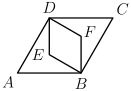
Answer: C
Small Hint:
Since triangle is equilateral, so equals a side
Big Hint:
If the diagonals meet at then is a –– triangle; compare the long and short diagonals
Solution:
Let the diagonals of meet at They bisect each other at right angles, and since triangle is a –– triangle. Hence the half-diagonals satisfy
The segment is the short diagonal of and the long diagonal of the similar rhombus Thus the smaller-to-larger length ratio is Areas scale by the square of this ratio, so the area of is
Thus, the correct answer is C.
14.
Elmo makes sandwiches for a fundraiser. For each sandwich he uses globs of peanut butter at ¢ per glob and blobs of jam at ¢ per blob. The cost of the peanut butter and jam to make all the sandwiches is Assume that and are positive integers with What is the cost of the jam Elmo uses to make the sandwiches?
Answer: D
Small Hint:
The total cost is cents; factor
Big Hint:
Test then determine the numbers of peanut-butter globs and jam blobs
Solution:
The total cost in cents is Since the value of is or
If then and if then neither has a positive integer solution.
So and whose only positive solution is
The jam costs ¢ cents, or
Thus, the correct answer is D.
15.
Circles with centers and have radii and respectively, and are externally tangent. Points and are on the circle centered at and points and are on the circle centered at such that and are common external tangents to the circles. What is the area of hexagon
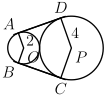
Answer: B
Small Hint:
The centers are apart, and the radii to the tangent points are perpendicular to the tangent
Big Hint:
is a right trapezoid; find its slant side with the Pythagorean theorem, then double the area
Solution:
The circles are externally tangent, so In quadrilateral both and are perpendicular to the tangent line making it a right trapezoid.
Drawing the line through parallel to creates a right triangle with hypotenuse and one leg so
The trapezoid has area
By symmetry the hexagon is made of two such trapezoids, so its area is
Thus, the correct answer is B.
16.
Regular hexagon has vertices and at and respectively. What is its area?
Answer: C
Small Hint:
and are two vertices apart, so is a short diagonal of the hexagon
Big Hint:
For side length the short diagonal is the area is
Solution:
The distance is In a regular hexagon with side the distance between vertices two apart is so giving
The hexagon’s area is
Thus, the correct answer is C.
17.
For a particular peculiar pair of dice, the probabilities of rolling and on each die are in the ratio What is the probability of rolling a total of on the two dice?
Answer: C
Small Hint:
The probability of rolling is
Big Hint:
Sum over the pairs that total
Solution:
Since the weights sum to the probability of rolling is
A total of comes from so the probability is
Thus, the correct answer is C.
18.
An object in the plane moves from one lattice point to another. At each step, the object may move one unit to the right, one unit to the left, one unit up, or one unit down. If the object starts at the origin and takes a ten-step path, how many different points could be the final point?
Answer: B
Small Hint:
After steps the endpoint satisfies with even
Big Hint:
Count lattice points with even coordinate sum inside the diamond
Solution:
Each step changes the coordinate sum by so after steps the endpoint has even, and Any such point is reachable: walk steps to it, then use the remaining even number of steps going out and back.
The reachable points lie on the lines for Each such line meets the diamond in exactly lattice points.
With lines and points each, there are points.
Thus, the correct answer is B.
19.
Mr. Jones has eight children of different ages. On a family trip his oldest child, who is spots a license plate with a -digit number in which each of two digits appears two times. “Look, daddy!” she exclaims. “That number is evenly divisible by the age of each of us kids!” “That’s right,” replies Mr. Jones, “and the last two digits just happen to be my age.” Which of the following is not the age of one of Mr. Jones’s children?
Answer: B
Small Hint:
The oldest child is so the number is divisible by forcing the two digits to sum to
Big Hint:
A number ending in a two-digit age cannot end in so think about which small ages it must avoid
Solution:
The number has the form or Divisibility by means is a multiple of so
The eight distinct ages are eight of the nine integers from through so at least one of ages and occurs. Therefore the number is divisible by The possibilities become
Since the last two digits are Mr. Jones’s age, is impossible, and none of the others is a multiple of So the children’s ages cannot include Indeed is divisible by
Thus, the correct answer is B.
20.
Let be chosen at random from the interval What is the probability that Here denotes the greatest integer that is less than or equal to
Answer: C
Small Hint:
The condition says and have the same power-of-ten magnitude
Big Hint:
On each interval the condition holds for
Solution:
The equation says i.e. and lie in the same interval
This holds exactly when and that is
Within the favorable fraction is
Since this fraction is the same on every such interval, the overall probability is
Thus, the correct answer is C.
21.
Rectangle has area An ellipse with area passes through and and has foci at and What is the perimeter of the rectangle? (The area of an ellipse is where and are the lengths of its axes.)
Answer: C
Small Hint:
For the ellipse, the sum of distances from to the foci equals a rectangle diagonal plus a side
Big Hint:
Let the sides be then and the diagonal
Solution:
Let the rectangle’s sides be and Point is on the ellipse with foci and so The distance between the foci is the diagonal, so
Then so The area gives hence
The ellipse area gives so and
The perimeter is
Thus, the correct answer is C.
22.
Suppose and are positive integers with and where and are integers and is not divisible by What is the smallest possible value of
Answer: B
Small Hint:
Factors of are scarcer than factors of so counts the factors of in
Big Hint:
Use at each power of
Solution:
Since factors of are more plentiful than factors of equals the number of factors of in namely
For each Summing over (as ) gives
Equality is attainable, for example with and So the minimum is
Thus, the correct answer is B.
23.
Isosceles has a right angle at Point is inside such that and Legs and have length where and are positive integers. What is

Answer: E
Small Hint:
Rotate by about so that maps onto
Big Hint:
The image of forms an isosceles right triangle with which pins down
Solution:
Rotate by about sending to and to Then and so is an isosceles right triangle with
Also Since triangle has a right angle at Hence
By the Law of Cosines in
So giving and
Thus, the correct answer is E.
24.
Let be the set of all points in the coordinate plane such that and What is the area of the subset of for which
Answer: C
Small Hint:
Treat the expression as a quadratic in and find where it equals
Big Hint:
The boundary reduces to giving straight lines in
Solution:
Fixing solve as a quadratic in
Within gives the line while gives for and for
These lines split into regions; testing the corners shows the inequality holds only in the middle band. Its area is
Thus, the correct answer is C.
25.
A sequence of non-negative integers is defined by the rule for If and how many different values of are possible?
Answer: B
Small Hint:
The terms and always share the same parity; use this with
Big Hint:
Every term is a multiple of so note
Solution:
The rule gives so has the same parity as thus is odd.
Every term is a multiple of and forces Since we need not divisible by or
Among the odd integers in there are removing the multiples of and multiples of then adding back the multiples of leaves
Each such works. For consecutive positive terms the update reduces their maximum within at most two steps. Since both initial terms are at most some occurs by
The gcd of each consecutive pair is invariant, so the equal terms immediately before that zero both equal The sequence then cycles through Finally, so has the same odd parity as in this cycle it must therefore be
Thus, the correct answer is B.