
2005 AMC 12A Problems
25 problems · 75 minutes
Scroll down and press Start to try the exam! Or, go to the printable PDF, answer key, or professional solutions curated by LIVE by Po-Shen Loh.
Or jump straight to a single problem with its solution: 1 · 2 · 3 · 4 · 5 · 6 · 7 · 8 · 9 · 10 · 11 · 12 · 13 · 14 · 15 · 16 · 17 · 18 · 19 · 20 · 21 · 22 · 23 · 24 · 25
All problems are used with official legal permission of the Mathematical Association of America (MAA).
Want to learn professionally through interactive video classes?
Learn LIVETimed
1:15:00
1.
Two is of and of What is
Answer: D
Small hint:
of means
Big hint:
Solve and separately
Solution:
From we get and from we get
Therefore
Thus, the correct answer is D.
2.
The equations and have the same solution for What is the value of
Answer: B
Small hint:
Solve for first
Big hint:
Substitute that value of into and solve for
Solution:
From we get Substituting, so and
Thus, the correct answer is B.
3.
A rectangle with a diagonal of length is twice as long as it is wide. What is the area of the rectangle?
Answer: B
Small hint:
Let the width be then the length is
Big hint:
By the Pythagorean theorem solve for and then find the area
Solution:
Let the width be so the length is Then giving The area is
Thus, the correct answer is B.
4.
A store normally sells windows at each. This week the store is offering one free window for each purchase of four. Dave needs seven windows and Doug needs eight windows. How many dollars will they save if they purchase the windows together rather than separately?
Answer: A
Small hint:
Every four windows purchased comes with a fifth window free
Big hint:
Compare buying alone ( windows and windows) with buying all together
Solution:
Alone, Dave pays for windows and receives one free to reach costing Doug pays for and receives one free to reach costing Separately they pay Together they need windows: buying yields free, for The savings are dollars.
Thus, the correct answer is A.
5.
The average (mean) of numbers is and the average of other numbers is What is the average of all numbers?
Answer: B
Small hint:
An average multiplied by the count gives the total sum
Big hint:
Add the two totals, then divide by
Solution:
The combined sum is The average of all numbers is
Thus, the correct answer is B.
6.
Josh and Mike live miles apart. Yesterday Josh started to ride his bicycle toward Mike’s house. A little later Mike started to ride his bicycle toward Josh’s house. When they met, Josh had ridden for twice the length of time as Mike and at four-fifths of Mike’s rate. How many miles had Mike ridden when they met?
Answer: B
Small hint:
Distance equals rate times time; write Josh’s distance in terms of Mike’s
Big hint:
Josh’s distance is of Mike’s, and the two distances add to
Solution:
Let Mike ride miles. Josh rides the rate for times the time, so Josh’s distance is Together they cover so giving
Thus, the correct answer is B.
7.
Square is inside square so that each side of can be extended to pass through a vertex of Square has side length is between and and What is the area of the inner square

Answer: C
Small hint:
By symmetry the four corner triangles are congruent right triangles
Big hint:
In right triangle the leg
Solution:
By the symmetry of the figure, triangles and are congruent right triangles. Hence
Since lies between and the side of the inner square is
Therefore the area of is
Thus, the correct answer is C.
8.
Let and be digits with What is
Answer: D
Small hint:
Factor into primes
Big hint:
The digit sum is at most which pins down which factor it equals
Solution:
Since and the digit sum can only be or It cannot be because then Thus it must be the smaller nontrivial factor:
Reading off the digits, and
Thus, the correct answer is D.
9.
There are two values of for which the equation has only one solution for What is the sum of those values of
Answer: A
Small hint:
A quadratic has exactly one solution when its discriminant equals
Big hint:
Combine the linear terms into then set
Solution:
Writing the equation as there is one solution exactly when the discriminant Then so or and their sum is
Thus, the correct answer is A.
10.
A wooden cube units on a side is painted red on all six faces and then cut into unit cubes. Exactly one-fourth of the total number of faces of the unit cubes are red. What is
Answer: B
Small hint:
Each of the unit cubes has faces, so there are faces in all
Big hint:
Only the original surface is red, contributing red faces; set
Solution:
The unit cubes have faces total, of which the original surface accounts for red faces. Then so
Thus, the correct answer is B.
11.
How many three-digit numbers satisfy the property that the middle digit is the average of the first and the last digits?
Answer: E
Small hint:
The middle digit is an integer only when the first and last digits share the same parity
Big hint:
Count first-and-last digit pairs that are both odd or both even, remembering the first digit cannot be
Solution:
The first and last digits must have the same parity so their average is a digit. Both odd gives pairs. Both even, with a nonzero leading digit, gives pairs. Each pair fixes the middle digit, for a total of numbers.
Thus, the correct answer is E.
12.
A line passes through and How many other points with integer coordinates are on the line and strictly between and
Answer: D
Small hint:
Reduce the slope to lowest terms
Big hint:
Points on the line take the form count integer strictly between the endpoints
Solution:
The slope is
So every point on the line has the form which is a lattice point exactly when is an integer. The point is strictly between and when
There are such integers giving lattice points.
Thus, the correct answer is D.
13.
In the five-sided star shown, the letters and are replaced by the numbers and although not necessarily in that order. The sums of the numbers at the ends of the line segments and form an arithmetic sequence, although not necessarily in that order. What is the middle term of the arithmetic sequence?

Answer: D
Small hint:
Each of the five numbers is an endpoint of exactly two of the segments
Big hint:
The five segment sums total and the middle term of a five-term arithmetic sequence is its mean
Solution:
Every number is an endpoint of two segments, so the five segment sums total The middle term of a five-term arithmetic sequence equals its mean, which is
Thus, the correct answer is D.
14.
On a standard die one of the dots is removed at random with each dot equally likely to be chosen. The die is then rolled. What is the probability that the top face has an odd number of dots?
Answer: D
Small hint:
A standard die has dots, so the removed dot comes from face with probability
Big hint:
Removing a dot from an even face makes it odd; removing from an odd face makes it even
Solution:
The die has dots, so a dot is removed from the face with dots with probability
If a dot is removed from an odd face, that face becomes even, leaving two odd faces and hence probability of an odd top. If a dot is removed from an even face, that face becomes odd, leaving four odd faces and hence probability The removed dot lies on an odd face with probability and on an even face with probability
Hence the answer is
Thus, the correct answer is D.
15.
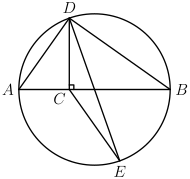
Let be a diameter of a circle and be a point on with Let and be points on the circle such that and is a second diameter. What is the ratio of the area of to the area of
Answer: C
Small hint:
Let be the center. Since and find
Big hint:
and have equal areas because is the midpoint of
Solution:
Let be the center. Since we have and so
Triangles and share the same altitude from to line so
Because is the midpoint of triangles and have equal areas, so
Thus, the correct answer is C.
16.
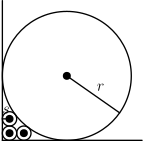
Three circles of radius are drawn in the first quadrant of the -plane. The first circle is tangent to both axes, the second is tangent to the first circle and the -axis, and the third is tangent to the first circle and the -axis. A circle of radius is tangent to both axes and to the second and third circles. What is
Answer: D
Small hint:
Place the centers by their radii: the big circle is at and the second small circle at
Big hint:
The distance between the big center and a tangent small center equals apply the Pythagorean theorem to the horizontal and vertical gaps
Solution:
Put the big circle’s center at and the second small circle’s center at They are externally tangent, so the distance between centers is
The horizontal and vertical gaps are and so
Expanding gives Since we get so
Thus, the correct answer is D.
17.
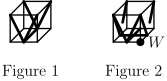
A unit cube is cut twice to form three triangular prisms, two of which are congruent, as shown in Figure The cube is then cut in the same manner along the dashed lines shown in Figure This creates nine pieces. What is the volume of the piece that contains vertex
Answer: A
Small hint:
The piece at is a pyramid; identify its base and apex
Big hint:
If its base area is and height is use
Solution:
The two perpendicular sets of cuts each run from top edges to midlines of the bottom face. Near they carve out a square pyramid. Its base is the quarter of the bottom face adjacent to and its apex lies one unit above the center of the bottom face.
Thus its base is a square of side and its altitude is the full height Therefore the volume is
Thus, the correct answer is A.
18.
Call a number “prime-looking” if it is composite but not divisible by or The three smallest prime-looking numbers are and There are prime numbers less than How many prime-looking numbers are there less than
Answer: A
Small hint:
Use inclusion-exclusion to count the numbers below divisible by or
Big hint:
From the numbers coprime to remove the primes and the number
Solution:
Among the numbers from to inclusion-exclusion gives that are divisible by or
That leaves numbers coprime to Of these, are primes (the primes minus ), and is neither prime nor composite.
The remaining numbers are prime-looking.
Thus, the correct answer is A.
19.
A faulty car odometer proceeds from digit to digit always skipping the digit regardless of position. For example, after traveling one mile the odometer changed from to If the odometer now reads how many miles has the car actually traveled?
Answer: B
Concepts:number base
Small hint:
The odometer only ever shows distinct digits, so it is really counting in base
Big hint:
Map each shown digit to its base- value: stand for
Solution:
Because the odometer never displays a it uses only symbols and counts in base where its digits represent the base- digits
The reading therefore corresponds to in base which equals
Thus, the correct answer is B.
20.
For each in define Let and for each integer For how many values of in is
Small hint:
Let be the number of solutions of find a recursion for
Big hint:
Because maps each of and onto all of each solution splits into two, giving
Solution:
Let count the solutions of in Since maps each of the two halves and onto all of every solution of comes from two values of (one in each half).
The boundary value satisfies so no solutions are lost, giving
Since we conclude
Thus, the correct answer is E.
21.
How many ordered triples of integers with and satisfy both and
Answer: C
Small hint:
Rewrite the first condition as
Big hint:
If then is astronomically larger than only and can work
Solution:
The condition means
If then which vastly exceeds so is impossible.
For so gives For so gives
There are such triples.
Thus, the correct answer is C.
22.
A rectangular box is inscribed in a sphere of radius The surface area of is and the sum of the lengths of its edges is What is
Answer: B
Small hint:
Let the dimensions be The edge sum gives and the surface area gives
Big hint:
The sphere’s diameter is the space diagonal:
Solution:
Let the dimensions be The edges give so and the surface area gives
The space diagonal is a diameter of the sphere, so
Thus and
Thus, the correct answer is B.
23.
Two distinct numbers and are chosen randomly from the set What is the probability that is an integer?
Answer: B
Small hint:
Write and so
Big hint:
For each count the multiples of among other than itself, namely
Solution:
Let and Then which is an integer exactly when is a multiple of
For each the number of valid in is Summing over gives ordered pairs
Since there are ordered pairs of distinct elements, the probability is
Thus, the correct answer is B.
24.
Let For how many polynomials does there exist a polynomial of degree such that
Answer: B
Small hint:
Compare degrees: has degree and has degree so
Big hint:
For the right side is so each of lies in discard the triples giving degree less than
Solution:
Since has degree and has degree we need A quadratic is determined by the ordered triple
At the right side vanishes, so forcing each of into That gives triples.
Five of them give a polynomial of degree less than the constants from and the linear from and from The other triples are non-collinear and yield genuine quadratics.
Thus, the correct answer is B.
25.
Let be the set of all points with coordinates where and are each chosen from the set How many equilateral triangles have all their vertices in
Answer: C
Small hint:
An equilateral triangle in this grid must have all three sides equal, so each side is a face diagonal or a specific slanted segment
Big hint:
Count separately the triangles whose sides are unit-cube face diagonals, big-cube face diagonals, and edge-midpoint-to-edge-midpoint segments of length
Solution:
The three equal sides of such a triangle must all have the same length. Checking the possible squared lengths in the grid, only three families of side occur.
Face diagonals of a unit cube (length ): each of the unit cubes contributes triangles, one at each corner, for
Face diagonals of the cube (length ): the three faces meeting at a vertex form one triangle, giving triangles.
Edge-midpoint segments (length joining midpoints of two edges): each of the edge midpoints is a vertex of two such triangles, for
The total is
Thus, the correct answer is C.