
1964 AMC 12 Problems
Scroll down and press Start to try the exam! Or, go to the printable PDF, answer key, or professional solutions curated by LIVE by Po-Shen Loh.
All problems are used with official legal permission of the Mathematical Association of America (MAA).
Or jump straight to a single problem with its solution: 1 · 2 · 3 · 4 · 5 · 6 · 7 · 8 · 9 · 10 · 11 · 12 · 13 · 14 · 15 · 16 · 17 · 18 · 19 · 20 · 21 · 22 · 23 · 24 · 25 · 26 · 27 · 28 · 29 · 30 · 31 · 32 · 33 · 34 · 35 · 36 · 37 · 38 · 39 · 40
Want to learn professionally through interactive video classes?
Timed
1:15:00
1.
What is the value of
Answer: E
Small Hint:
Evaluate the inner logarithm first
Big Hint:
After multiplying by take the base- logarithm and then square
Solution:
Since the expression inside the square brackets is Its square is
Therefore, the correct answer is E.
2.
The graph of is:
a parabola
an ellipse
a pair of straight lines
a point
none of these
Answer: C
Small Hint:
Factor the left side as a difference of squares
Big Hint:
Set each linear factor equal to zero
Solution:
Factoring gives Thus every point lies on or a pair of straight lines.
Therefore, the correct answer is C.
3.
When a positive integer is divided by a positive integer the quotient is and the remainder is where and are integers. What is the remainder when is divided by
Answer: D
Small Hint:
Write
Big Hint:
Adding a multiple of does not change the remainder upon division by
Solution:
The division algorithm gives Hence The first term is divisible by so the remainder is
Therefore, the correct answer is D.
4.
The expression
where and is equivalent to:
Answer: A
Small Hint:
First substitute and
Big Hint:
Simplify using a common denominator
Solution:
Since and the expression becomes
Therefore, the correct answer is A.
5.
If varies directly as and if when the value of when is:
Answer: A
Small Hint:
Write direct variation as
Big Hint:
Use the first pair to find
Solution:
Direct variation gives From Therefore, when
Thus, the correct answer is A.
6.
If are in geometric progression, the fourth term is:
Answer: B
Small Hint:
For three consecutive nonzero terms, the middle term squared equals the product of its neighbors
Big Hint:
After finding multiply the third term by the common ratio
Solution:
The geometric-mean relation gives Under the examination’s ratio convention for a geometric progression, the consecutive ratios must be defined, so Dividing by yields and The first three terms are with ratio The fourth is
Therefore, the correct answer is B.
7.
Let be the number of real values of for which the roots of
are equal. Then equals:
a finite number greater than
an infinitely large number
Answer: C
Small Hint:
Equal roots make the discriminant zero
Big Hint:
Solve
Solution:
Equal roots require Thus or giving two real values.
Therefore, the correct answer is C.
8.
The smaller root of the equation
is:
Answer: C
Small Hint:
Factor out the common expression
Big Hint:
The remaining linear factor is
Solution:
Combining the two terms and factoring gives Hence the roots are and of which is smaller.
Therefore, the correct answer is C.
9.
A jobber buys an article at less He then wishes to sell the article at a gain of of his cost after allowing a discount on his marked price. At what price, in dollars, should the article be marked?
none of these
Answer: E
Small Hint:
Compute the discounted cost first, then increase it by one third
Big Hint:
The selling price is of the marked price
Solution:
The cost is dollars. A gain of one third makes the desired selling price dollars. If is the marked price, then so This is not listed.
Thus, the correct answer is E.
10.
Given a square with side of length On a diagonal as base a triangle with three unequal sides is constructed so that its area equals that of the square. The length of the altitude drawn to the base is:
Answer: A
Small Hint:
The square’s diagonal has length
Big Hint:
Set
Solution:
The triangle’s base is the square’s diagonal, If its altitude is equality of areas gives so
Therefore, the correct answer is A.
11.
Given and find the value of
Answer: D
Small Hint:
Rewrite as and as
Big Hint:
Equate exponents to obtain two linear equations in and
Solution:
Writing both equations with common bases gives Substitution yields and so
Therefore, the correct answer is D.
12.
Which of the following is the negation of the statement: For all of a certain set,
For all
For all
For no
For some
For some
Answer: E
Small Hint:
The negation of “for all” begins with “for some”
Big Hint:
Negating gives
Solution:
The negation of a universal statement is an existential statement, and the negation of is Thus the negation is: for some
Therefore, the correct answer is E.
13.
A circle is inscribed in a triangle with side lengths and Let the segments of the side of length made by a point of tangency, be and with What is the ratio
Answer: A
Small Hint:
Compute the semiperimeter of the triangle
Big Hint:
A tangency segment adjacent to a vertex equals the semiperimeter minus the opposite side
Solution:
The semiperimeter is At the endpoints of the side of length the tangent lengths are and Thus
Therefore, the correct answer is A.
14.
A farmer bought sheep. He sold of them for the price paid for the sheep. The remaining sheep were sold at the same price per head as the other Based on the cost, the percent gain on the entire transaction is:
Answer: C
Small Hint:
Let the total purchase cost be
Big Hint:
The selling price per sheep is
Solution:
Let the total cost be Since the first sheep sell for each sheep sells for Total revenue is therefore a gain.
Thus, the correct answer is C.
15.
A line through the point cuts from the second quadrant a triangular region with area The equation of the line is:
none of these
Answer: B
Small Hint:
If the positive -intercept is then
Big Hint:
Use the intercept form
Solution:
Let the -intercept be The second-quadrant triangle has area so The intercept form is Clearing denominators gives
Therefore, the correct answer is B.
16.
Let and let be the set of integers The number of members of such that has remainder zero when divided by is:
Answer: E
Small Hint:
Factor as
Big Hint:
The product is always even; determine which residue of modulo fails
Solution:
We have a product of consecutive integers, so it is always even. It is divisible by unless Among nine values are multiples of Thus values work.
Therefore, the correct answer is E.
17.
Given the distinct points and Line segments are drawn connecting these points to each other and to the origin Of the three possibilities: parallelogram, straight line, trapezoid, figure depending upon the location of the points and can be:
only
only
only
or only
all three
Answer: D
Small Hint:
Interpret the position vectors as
Big Hint:
Separate the cases in which the vectors and are independent or dependent
Solution:
The relation makes opposite sides of parallel and equal whenever and are not collinear, so the figure is a parallelogram. If the two vectors are dependent, all four points lie on a straight line. It cannot be a genuine trapezoid.
Thus, the correct answer is D.
18.
Let be the number of pairs of values of and such that and have the same graph. Then is:
finite but more than
greater than any finite number
Answer: C
Small Hint:
Coincident line equations have proportional coefficient triples
Big Hint:
Set and use the first and third coordinates
Solution:
For the same graph, Thus and so Each value determines one pair through and Hence there are two pairs.
Therefore, the correct answer is C.
19.
If and the numerical value of is:
Answer: A
Small Hint:
Solve both linear equations for and in terms of
Big Hint:
The equations give and
Solution:
Solving the equations gives and Therefore
Thus, the correct answer is A.
20.
The sum of the numerical coefficients of all the terms in the expansion of is:
Answer: B
Small Hint:
A polynomial’s coefficient sum is found by setting every variable equal to
Big Hint:
Evaluate
Solution:
Set The sum of all numerical coefficients is then
Therefore, the correct answer is B.
21.
If where and then equals:
Answer: D
Small Hint:
Let
Big Hint:
The equation becomes
Solution:
Let Then and Thus so and Hence
Therefore, the correct answer is D.
22.
Given parallelogram with the midpoint of diagonal Point is connected to a point in so that What is the ratio of the area of triangle to the area of quadrilateral
Answer: C
Small Hint:
Use vectors and
Big Hint:
Then and ; compute both areas as fractions of the parallelogram
Solution:
Let the parallelogram’s area be with and Then and Determinants give For quadrilateral the two determinant contributions give The desired ratio is
Therefore, the correct answer is C.
23.
Two numbers are such that their difference, their sum, and their product are to one another as The product of the two numbers is:
Answer: D
Small Hint:
Represent the difference, sum, and product by and
Big Hint:
The two numbers are and
Solution:
Let the difference be and the sum be The numbers are and so their product is But the ratio also says the product is For distinct numbers so and the product is
Therefore, the correct answer is D.
24.
Let constants. For what value of is a minimum?
Answer: A
Small Hint:
Expand and collect the terms in
Big Hint:
Complete the square or use the vertex formula
Solution:
Expanding and completing the square gives The squared term is minimized at
Therefore, the correct answer is A.
25.
The set of values of for which has two factors, with integer coefficients, which are linear in and is precisely:
Answer: B
Small Hint:
Write the factors as
Big Hint:
The missing -term and the -term force
Solution:
Write the factorization as Comparing the and coefficients gives and so take The other coefficients give Hence If then otherwise and Both values produce valid integer factorizations.
Therefore, the correct answer is B.
26.
In a ten-mile race First beats Second by miles and First beats Third by miles. If the runners maintain constant speeds throughout the race, by how many miles does Second beat Third?
Answer: C
Small Hint:
When First finishes, Second and Third have run and miles
Big Hint:
Compare Third’s distance when Second completes miles
Solution:
Relative to First’s speed, Second’s speed is and Third’s is Thus Third runs as fast as Second. When Second finishes miles, Third has run miles, so Second wins by miles.
Therefore, the correct answer is C.
27.
If is a real number and where then:
Answer: E
Small Hint:
Interpret the sum as the distances from to and
Big Hint:
Find its minimum for , remembering the inequality is strict
Solution:
By the triangle inequality, Equality holds for every between and Therefore the strict inequality has a real solution exactly when
Thus, the correct answer is E.
28.
The sum of terms of an arithmetic progression is and the common difference is If the first term is an integer, and then the number of possible values for is:
Answer: D
Small Hint:
If the first term is the sum is
Big Hint:
List the divisors of that exceed
Solution:
The arithmetic-series formula simplifies to Thus must divide and every such gives an integer The divisors greater than are and so there are five possibilities.
Therefore, the correct answer is D.
29.
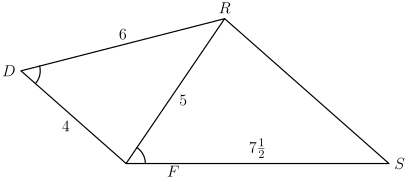
In this figure inches, inches, inches, and inches. The length of in inches, is:
undetermined
Answer: E
Small Hint:
Compare triangles and around the marked equal angles
Big Hint:
The adjacent side ratios are
Solution:
At the equal included angles, Thus by SAS. Side corresponds to so
Therefore, the correct answer is E.
30.
If
the larger root minus the smaller root is:
Answer: D
Small Hint:
Notice that
Big Hint:
For the root difference is
Solution:
Let and The discriminant is Hence the root difference is
Therefore, the correct answer is D.
31.
Let
Then expressed in terms of equals:
32.
If then:
must equal
must equal zero
either or or both
if
Answer: C
Small Hint:
Cross-multiply the two fractions
Big Hint:
Move all terms to one side and factor out
Solution:
Cross-multiplication gives Subtracting the right side and factoring yields Hence either or the sum is zero, and both may occur.
Therefore, the correct answer is C.
33.
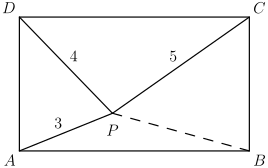
is a point interior to rectangle and such that inches, inches, and inches. Then in inches, equals:
Answer: B
Small Hint:
Use the rectangle identity
Big Hint:
Substitute the three known distances and solve for
Solution:
For any point in a rectangle, the British flag theorem gives Thus so and
Therefore, the correct answer is B.
34.
If is a multiple of the sum
where equals:
Answer: C
Small Hint:
Group the terms in blocks of four powers of
Big Hint:
Each complete block beginning with coefficient sums to
Solution:
Write For the four terms with exponents through sum to The final term is Therefore
Thus, the correct answer is C.
35.
The sides of a triangle are of lengths and The altitudes of the triangle meet at point If is the altitude to the side of length what is the ratio
Answer: B
Small Hint:
The -- triangle has area , so the altitude to side is
Big Hint:
The altitude foot divides the side of length into segments and ; use coordinates to locate
Solution:
Heron’s formula gives area so The adjacent -side has projection leaving on the base. Put Line has slope so the altitude through has slope and meets at height Thus giving
Therefore, the correct answer is B.
36.
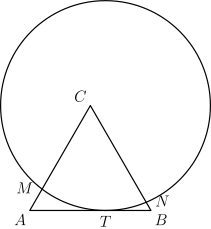
In this figure the radius of the circle is equal to the altitude of the equilateral triangle The circle is made to roll along the side remaining tangent to it at a variable point and intersecting lines and in variable points and respectively. Let be the number of degrees in arc Then for all permissible positions of the circle:
varies from to
varies from to
varies from to
remains constant at
remains constant at
Answer: E
Small Hint:
The circle’s center and vertex are the same distance above , so
Big Hint:
Extend through to meet the circle again at , then use reflection across line
Solution:
Let be the circle’s center. Both and are one triangle altitude above so Extend through to meet the circle again at Since is opposite to The line parallel to bisects this angle. Reflection across fixes the circle and interchanges rays and so it interchanges and Hence and isosceles triangle has base angles
Because are collinear, This inscribed angle subtends arc whose measure is therefore for every permissible circle position.
Thus, the correct answer is E.
37.
Given two positive numbers such that Let A.M. be their arithmetic mean and let G.M. be their positive geometric mean. Then A.M. minus G.M. is always less than:
Answer: D
Small Hint:
Rewrite using
Big Hint:
Factor to compare with choice D
Solution:
We have After canceling the positive factor comparison with choice D reduces to This is true because Thus A.M. minus G.M. is always less than the expression in choice D.
Therefore, the correct answer is D.
38.
The sides and of triangle are respectively of lengths inches and inches. The median is inches. Then in inches, is:
Answer: D
Small Hint:
Use Apollonius’s theorem for the median to
Big Hint:
Substitute
Solution:
Apollonius’s theorem gives Therefore
Thus, the correct answer is D.
39.
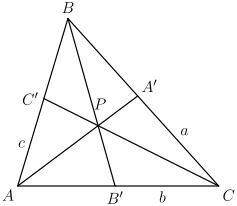
The magnitudes of the sides of triangle are as shown, with Through interior point and the vertices lines are drawn meeting the opposite sides in respectively. Let Then, for all positions of point is less than:
Answer: A
Small Hint:
A point on a segment is closer to a fixed vertex than the farther endpoint of that segment
Big Hint:
Bound , , and separately using their adjacent side lengths
Solution:
For a fixed vertex, squared distance is a convex function along the opposite side, so its maximum occurs at an endpoint. Since each cevian endpoint is interior to its side, Adding gives
Therefore, the correct answer is A.
40.
A watch loses minutes per day. It is set right at P.M. on March Let be the positive correction, in minutes, to be added to the time shown by the watch at a given time. When the watch shows A.M. on March equals:
Answer: A
Small Hint:
The watch advances as fast as real time
Big Hint:
From the displayed P.M. on March to A.M. on March is displayed minutes
Solution:
The watch runs at of the correct rate. The displayed elapsed time is days hours, or minutes. Thus the real elapsed time is and the correction is
Therefore, the correct answer is A.