
1955 AMC 12 Problems
Scroll down and press Start to try the exam! Or, go to the printable PDF, answer key, or professional solutions curated by LIVE by Po-Shen Loh.
All problems are used with official legal permission of the Mathematical Association of America (MAA).
Or jump straight to a single problem with its solution: 1 · 2 · 3 · 4 · 5 · 6 · 7 · 8 · 9 · 10 · 11 · 12 · 13 · 14 · 15 · 16 · 17 · 18 · 19 · 20 · 21 · 22 · 23 · 24 · 25 · 26 · 27 · 28 · 29 · 30 · 31 · 32 · 33 · 34 · 35 · 36 · 37 · 38 · 39 · 40 · 41 · 42 · 43 · 44 · 45 · 46 · 47 · 48 · 49 · 50
Want to learn professionally through interactive video classes?
Timed
1:15:00
1.
Which one of the following is not equivalent to
Answer: D
Small Hint:
Rewrite every choice with the same power of
Big Hint:
The decimal is
Solution:
The given decimal is Choices A and B state this directly, while and But which is ten times smaller.
Thus, the correct answer is D.
2.
The smaller angle between the hands of a clock at p.m. is:
Answer: B
Small Hint:
In minutes, the minute hand moves
Big Hint:
The hour hand moves per minute
Solution:
At the minute hand is past while the hour hand is Their smaller separation is
Thus, the correct answer is B.
3.
If each number in a set of ten numbers is increased by the arithmetic mean (average) of the original ten numbers:
remains the same
is increased by
is increased by
is increased by
is increased by
Answer: B
Small Hint:
Increasing all ten entries adds to their sum
Big Hint:
The new total is still divided by
Solution:
If the original sum is the new sum is Hence the new mean is The mean is increased by
Thus, the correct answer is B.
4.
The equality is satisfied by:
no real values of
either or
only
only
only
Answer: E
Small Hint:
Cross-multiply, while remembering that
Big Hint:
Solve
Solution:
For cross-multiplication gives so This value makes both original denominators nonzero and satisfies the equality.
Thus, the correct answer is E.
5.
varies inversely as the square of When When equals:
Answer: D
Small Hint:
Write the variation as
Big Hint:
Use the first pair of values to determine
Solution:
Inverse-square variation gives Since we have At
Thus, the correct answer is D.
6.
A merchant buys a number of oranges at for ¢ and an equal number at for ¢. To “break even” he must sell all at:
for ¢
for ¢
for ¢
for ¢
for ¢
Answer: B
Small Hint:
Use oranges in each equal-sized purchase so that both quoted rates divide evenly
Big Hint:
Compare the total cost of oranges with each proposed selling rate
Solution:
Suppose he buys oranges at each rate. The first cost ¢ and the second cost ¢, for ¢ total. Thus oranges must sell for ¢, which is equivalent to for ¢.
Therefore, the correct answer is B.
7.
If a worker receives a percent cut in wages, he may regain his original pay exactly by obtaining a raise of:
percent
percent
percent
Answer: B
Small Hint:
After the cut, the wage is of the original
Big Hint:
Find the percent of the reduced wage represented by the missing of the original
Solution:
If the original wage is the reduced wage is The needed increase is which as a fraction of the reduced wage is
Thus, the correct answer is B.
8.
The graph of
is a hyperbola intersecting only the -axis
is a hyperbola intersecting only the -axis
is a hyperbola intersecting neither axis
is a pair of straight lines
does not exist
Answer: D
Small Hint:
Factor the difference of squares
Big Hint:
A product is zero when at least one of its two linear factors is zero
Solution:
Factoring, Thus the graph is the union of the two straight lines and
The correct answer is D.
9.
A circle is inscribed in a triangle with sides and The radius of the circle is:
Answer: D
Small Hint:
The side lengths form a Pythagorean triple
Big Hint:
For a right triangle,
Solution:
Because the triangle is right. Its inradius is
Thus, the correct answer is D.
10.
How many hours does it take a train traveling at an average rate of mph between stops to travel miles if it makes stops of minutes each?
Answer: A
Small Hint:
The moving time is hours
Big Hint:
Convert the total stopping time from minutes to hours before adding
Solution:
The train moves for hours and is stopped for hours. Hence the total time is
Thus, the correct answer is A.
11.
The negation of the statement “No slow learners attend this school,” is:
All slow learners attend this school.
All slow learners do not attend this school.
Some slow learners attend this school.
Some slow learners do not attend this school.
No slow learners do not attend this school.
Answer: C
Small Hint:
“No” means that there does not exist even one example
Big Hint:
Negating a universal exclusion asserts the existence of a counterexample
Solution:
The original statement says that every slow learner is absent from the school. Its negation is that at least one slow learner attends the school.
Thus, “Some slow learners attend this school” is correct, so the answer is C.
12.
The solution of is:
Answer: D
Small Hint:
The real-domain restriction gives
Big Hint:
Test the simplest endpoint before squaring the equation
Solution:
The domain requires At the left side is so works. To see that there is no other solution, note that both radicals are nondecreasing for and is strictly increasing. Therefore the sum exceeds for every
Thus, the correct answer is D.
13.
The fraction is equal to:
Answer: C
Small Hint:
Regard as a difference of squares
Big Hint:
Factor it using and
Solution:
Factoring the numerator, Where the original fraction is defined, canceling the common factor leaves
Thus, the correct answer is C.
14.
The length of rectangle is percent more than the side of square The width of the rectangle is percent less than the side of the square. The ratio of the areas, is:
Answer: A
Small Hint:
Let the square’s side length be
Big Hint:
The rectangle’s area is
Solution:
If the square side is then the rectangle has dimensions and Therefore
Thus, the correct answer is A.
15.
The ratio of the areas of two concentric circles is If the radius of the smaller is then the difference between the radii is best approximated by:
Answer: D
Small Hint:
Area ratios are the squares of radius ratios
Big Hint:
The larger radius is , so estimate
Solution:
If the larger radius is then so The difference is
Thus, the best approximation is and the correct answer is D.
16.
The value of when and is:
any finite number
meaningless
Answer: E
Small Hint:
Substitute the two given values into the denominator first
Big Hint:
A fraction with denominator is undefined
Solution:
Substitution gives Hence the expression becomes which is undefined.
Thus, the expression is meaningless and the correct answer is E.
17.
If then equals:
either or
Answer: C
Small Hint:
Move to the other side
Big Hint:
Use and combine logarithms
Solution:
Using common logarithms, Therefore
The correct answer is C.
18.
The discriminant of the equation is zero. Hence, its roots are:
real and equal
rational and equal
rational and unequal
irrational and unequal
imaginary
Answer: A
Small Hint:
Use the quadratic formula with the discriminant term equal to zero
Big Hint:
Then inspect the resulting value for the requested classifications
Solution:
The quadratic formula gives twice because the discriminant is zero. The root is irrational, but the requested description that applies is “real and equal.”
Thus, the correct answer is A.
19.
Two numbers whose sum is and the absolute value of whose difference is are roots of the equation:
Answer: B
Small Hint:
Solve and after choosing an order
Big Hint:
A monic quadratic with roots is
Solution:
Taking the larger number first, gives and Their product is so the monic equation with these roots is
Thus, the correct answer is B.
20.
The expression equals zero for:
no real or imaginary values of
no real values of only
no imaginary values of only
Answer: A
Small Hint:
Isolate the radical before doing any algebra
Big Hint:
If you square, check every candidate in the original equation because the radical has a prescribed sign
Solution:
For the expression to vanish, one would need The radical sign denotes the principal square root. It is nonnegative for a nonnegative real radicand and, over the complex numbers, is chosen with nonnegative real part; it therefore cannot equal Squaring would introduce the extraneous candidate for which the original expression is
Thus, no real or imaginary value works, and the correct answer is A.
21.
Represent the hypotenuse of a right triangle by and the area by The altitude on the hypotenuse is:
Answer: B
Small Hint:
Use the hypotenuse as the base of the triangle
Big Hint:
If the corresponding altitude is then
Solution:
Taking the hypotenuse as the base and writing its altitude as Solving gives
Thus, the correct answer is B.
22.
On a order a merchant has a choice between three successive discounts of and and three successive discounts of and By choosing the better offer, he can save:
nothing at all
Answer: D
Small Hint:
Successive discounts multiply the remaining-price factors
Big Hint:
Compare with
Solution:
The first offer leaves a fraction of the price. The second leaves The second is cheaper by of the order, or dollars.
Thus, the correct answer is D.
23.
In checking the petty cash a clerk counts quarters, dimes, nickels, and cents. Later he discovers that of the nickels were counted as quarters and of the dimes were counted as cents. To correct the total obtained the clerk must:
make no correction
subtract ¢
subtract ¢
add ¢
add ¢
Answer: C
Small Hint:
Each nickel counted as a quarter makes the total too large by ¢
Big Hint:
Each dime counted as a cent makes the total too small by ¢
Solution:
The nickels counted as quarters overstate the total by ¢. The dimes counted as cents understate it by ¢. The net overstatement is cents, so that amount must be subtracted.
Thus, the correct answer is C.
24.
The function
always increases as increases
always decreases as decreases to
cannot equal
has a maximum value when is negative
has a minimum value of
Answer: E
Small Hint:
Complete the square in
Big Hint:
Factor from the quadratic terms before forming
Solution:
Completing the square, The squared term is nonnegative, so the minimum value is attained at
Thus, the correct answer is E.
25.
One of the factors of is:
none of these
Answer: E
Small Hint:
Rewrite the polynomial as
Big Hint:
Factor the resulting difference of squares and compare both factors with the choices
Solution:
We have Neither factor appears among choices A through D.
Thus, the correct answer is E.
26.
Mr. owns a house worth He sells it to Mr. at profit. Mr. sells the house back to Mr. at a loss. Then:
Mr. comes out even
Mr. makes
Mr. makes
Mr. loses
none of the above is correct
Answer: E
Small Hint:
The first sale price is
Big Hint:
Mr. ’s loss is of what he paid, not of the original house value
Solution:
Mr. first receives dollars. Mr. then sells at a loss of of his -dollar cost, so Mr. buys the house back for dollars. Mr. again owns the house and has gained dollars; Mr. has lost dollars. None of the stated amounts is correct.
Thus, the correct answer is E.
27.
If and are the roots of then equals:
Answer: B
Small Hint:
Use and
Big Hint:
Expand and isolate
Solution:
By Vieta’s formulas, and Therefore
Thus, the correct answer is B.
28.
On the same set of axes are drawn the graph of and the graph of the equation obtained by replacing by in the given equation. If and these two graphs intersect:
in two points, one on the -axis and one on the -axis
in one point located on neither axis
only at the origin
in one point on the -axis
in one point on the -axis
Answer: E
Small Hint:
The reflected graph is
Big Hint:
Set the two expressions for equal and use
Solution:
Replacing by gives At an intersection, so Since we must have and then There is exactly one intersection, on the -axis.
Thus, the correct answer is E.
29.
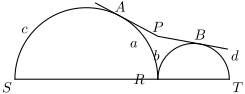
In the figure is tangent to semicircle is tangent to semicircle is a straight line; the arcs are indicated in the figure. Angle is measured by:
Answer: E
Small Hint:
Draw , which is tangent to both semicircles at
Big Hint:
Use the tangent-tangent angle theorem on each circle, then use
Solution:
The line is tangent to both semicircles at their common endpoint For the larger circle, the tangent-tangent angle theorem gives For the smaller circle, the same theorem gives Thus the reflex angle from to through has measure Hence the other angle between the tangents is because each upper semicircle has measure
Thus, the correct answer is E.
30.
Each of the equations has:
two integral roots
no root greater than
no root zero
only one root
one negative root and one positive root
Answer: B
Small Hint:
Solve each equation separately and compare the properties of their roots
Big Hint:
For the radical equation, reject candidates that make either radicand negative
Solution:
The first equation gives Factoring the difference of squares in the second gives so or Squaring the third gives with candidates and only satisfies the real-domain restrictions. Every root obtained is at most
Thus, each equation has no root greater than and the correct answer is B.
31.
An equilateral triangle whose side is is divided into a triangle and a trapezoid by a line drawn parallel to one of its sides. If the area of the trapezoid equals one-half of the area of the original triangle, the length of the median of the trapezoid is:
Answer: D
Small Hint:
The small triangle has half the original area, so determine its side using similarity
Big Hint:
The trapezoid median is the average of its two parallel side lengths
Solution:
The small triangle also has half the original area. If its side parallel to the original base has length similarity gives so The parallel sides of the trapezoid have lengths and so its median has length
Thus, the correct answer is D.
32.
If the discriminant of is zero, then another true statement about and is that:
they form an arithmetic progression
they form a geometric progression
they are unequal
they are all negative numbers
only is negative and and are positive
Answer: B
Small Hint:
Set equal to zero
Big Hint:
Compare the resulting relation with the defining tests for arithmetic and geometric progressions
Solution:
A zero discriminant gives hence Equivalently, where the ratios are defined, which is the defining relation for to form a geometric progression.
Thus, the correct answer is B.
33.
Henry starts a trip when the hands of the clock are together between a.m. and a.m. He arrives at his destination between p.m. and p.m. when the hands of the clock are exactly apart. The trip takes:
hr.
hr. min.
hr. min.
hr. min.
none of these
Answer: A
Small Hint:
At the start, the minute hand must close a gap at per minute
Big Hint:
Compute the corresponding time after when the hands are opposite and compare the two offsets
Solution:
At the hour hand is ahead. The minute hand gains at per minute, so the hands coincide minutes after At the hour hand is ahead. For the hands to be apart in the relevant direction, the minute hand must gain again taking minutes. The start and finish therefore have the same minute offset within their hours, exactly six hours apart.
Thus, the correct answer is A.
34.
A -inch-diameter pole and an -inch-diameter pole are placed together and bound together with wire. The length of the shortest wire that will go around them is:
Answer: C
Small Hint:
The wire consists of two common external tangent segments and one exposed arc on each circle
Big Hint:
Use radii and ; each tangent segment has length
Solution:
The centers are inches apart and their radii differ by Thus each common external tangent segment has length contributing in all. The geometry of the tangent lines leaves a exposed arc on the radius- circle and a exposed arc on the radius- circle. Their lengths total Hence the wire length is
Thus, the correct answer is C.
35.
Three boys agree to divide a bag of marbles in the following manner. The first boy takes one more than half the marbles. The second takes a third of the number remaining. The third boy finds that he is left with twice as many marbles as the second boy. The original number of marbles:
is none of the following
cannot be determined from the given data
is or
is or
is or
Answer: B
Small Hint:
Let the original number be and express the remainder after the first boy
Big Hint:
Translate the last two boys’ share condition into an equation and see whether it determines uniquely
Solution:
The first boy takes leaving The second takes one third of that remainder, and the third receives the other two thirds, automatically twice the second boy’s share. Thus the share condition imposes no unique value of It only requires to be a nonnegative multiple of so many values such as work.
Therefore the original number cannot be determined, and the correct answer is B.
36.
A cylindrical oil tank, lying horizontally, has an interior length of feet and an interior diameter of feet. If the rectangular surface of the oil has an area of square feet, the depth of the oil is:
either or
Answer: E
Small Hint:
The oil surface is a rectangle of length , so its width is
Big Hint:
In the circular end, a chord of length lies from the center
Solution:
The rectangular surface has length so its chord width in the circular cross-section is Half the chord is and the radius is so the distance from the center to the chord is A chord of this length can lie either below or above the center. Measured from the bottom of the tank, the corresponding depths are and
Thus, the correct answer is E.
37.
A three-digit number has, from left to right, the digits and with When the number with the digits reversed is subtracted from the original number, the units’ digit in the difference is The next two digits, from right to left, are:
and
and
impossible to tell
and
and
Answer: B
Small Hint:
Subtract algebraically:
Big Hint:
Find the digit for which ends in
Solution:
The difference is Since is an integer from through and the units digit is we need This gives so the difference is Moving from right to left after the units digit the next digits are and
Thus, the correct answer is B.
38.
Four positive integers are given. Select any three of these integers, find their arithmetic average, and add this result to the fourth integer. Thus the numbers and are obtained. One of the original integers is:
Answer: B
Small Hint:
If the original sum is and the singled-out integer is the result is
Big Hint:
Sum all four reported results to determine
Solution:
If the original integers sum to the result associated with singled-out integer is Summing all four reported results counts the total as so The result therefore comes from
Thus, one original integer is and the correct answer is B.
39.
If then if the least possible value of is zero, is equal to:
Answer: B
Small Hint:
Complete the square in
Big Hint:
The minimum occurs when
Solution:
Completing the square, Its least value is Setting this equal to zero gives
Thus, the correct answer is B.
40.
If the fractions and are unequal if:
and
Answer: A
Small Hint:
Cross-multiply the equality
Big Hint:
After cancellation, equality is governed by
Solution:
Where the fractions are defined, equality would require which simplifies to Under choice A, gives and so equality is impossible. Each of B through E instead forces equality directly.
Thus, the fractions are unequal under choice A.
41.
A train traveling from Aytown to Beetown meets with an accident after hr. It is stopped for hr., after which it proceeds at four-fifths of its usual rate, arriving at Beetown hr. late. If the train had covered miles more before the accident, it would have been just hr. late. The usual rate of the train is:
mph
mph
mph
mph
mph
Answer: A
Small Hint:
Traveling at speed adds one-fourth of the normal time for the affected distance
Big Hint:
Compare the two delays; moving the accident point miles changes the delay by hour
Solution:
Let the usual rate be mph and the total distance be After the first hour, the normal time for the remaining distance is Traveling it at adds one-fourth of that time, so If the accident occurs miles later, Subtracting the second equation from the first gives hence mph.
Thus, the correct answer is A.
42.
If and are positive integers, the radicals and are equal when and only when:
and
and is any value
and
Answer: C
Small Hint:
Both sides are positive, so square the equality
Big Hint:
Multiply the resulting equation by and isolate
Solution:
Because all quantities are positive, squaring is reversible: Multiplying by gives so
Thus, the correct answer is C.
43.
The pairs of values of and that are the common solutions of the equations and are:
real pairs
real pairs
imaginary pairs
real and imaginary pairs
real and imaginary pairs
Answer: E
Small Hint:
Rewrite the second equation as
Big Hint:
Substitute to obtain a cubic in
Solution:
Substitution into gives The three cube roots of consist of one real root and two nonreal roots. Each determines exactly one corresponding value Therefore there is one real pair and two imaginary pairs.
Thus, the correct answer is E.
44.
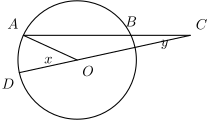
In circle chord is produced so that equals a radius of the circle. is drawn and extended to is drawn. Which of the following expresses the relationship between angles and
there is no special relationship between and
or depending upon the length of
Answer: A
Small Hint:
Since triangle is isosceles
Big Hint:
Use the exterior angle at , then use
Solution:
Because triangle is isosceles, so Its exterior angle at is therefore Since triangle is also isosceles and In triangle the angles at and are and so Angle is supplementary to hence
Thus, the correct answer is A.
45.
Given a geometric sequence with the first term and and an arithmetic sequence with the first term A third sequence is formed by adding corresponding terms of the two given sequences. The sum of the first ten terms of the third sequence is:
not possible to determine from the information given
Answer: A
Small Hint:
Write the two sequences as and
Big Hint:
Use the first three sums and the condition to determine
Solution:
The first three termwise sums give Substituting yields Since we have and The first ten geometric terms sum to while the first ten arithmetic terms sum to Their combined sum is
Thus, the correct answer is A.
46.
The graphs of and intersect in:
points
point
points
no points
an unlimited number of points
Answer: B
Small Hint:
Solve the first two linear equations simultaneously
Big Hint:
Check whether that solution also satisfies each of the last two displayed equations
Solution:
Adding the first two equations gives so Substitution gives hence This point also lies on the last two given lines. Therefore all four graphs have the single common point
Thus, the correct answer is B.
47.
The expressions and are:
always equal
never equal
equal when
equal when
equal only when
Answer: C
Small Hint:
Expand
Big Hint:
Subtract and factor the difference
Solution:
The difference is In particular, whenever this difference is zero and the expressions are equal.
Thus, the correct answer is C.
48.
Given triangle with medians parallel and equal in length to and are drawn; extended meets in Which one of the following statements is not necessarily correct?
is a parallelogram
is a median of triangle
Answer: B
Small Hint:
Place and compute the midpoints
Big Hint:
Use , then locate where reaches height
Solution:
Set Then Since we get The horizontal line meets halfway from to at These coordinates verify that is a parallelogram, and is the midpoint of making a median. But which are not generally equal.
Thus, statement B is not necessarily correct.
49.
The graphs of and intersect in:
one point whose abscissa is
one point whose abscissa is
no points
two distinct points
two identical points
Answer: C
Small Hint:
Factor , but keep the original restriction
Big Hint:
Compare the algebraic intersection of the simplified lines with that domain restriction
Solution:
For The lines and would meet at But is excluded from the original rational function, so that point is a hole and there is no intersection.
Thus, the correct answer is C.
50.
In order to pass going mph on a two-lane highway going mph, must gain feet. Meantime, feet from is headed toward him at mph. If and maintain their speeds, then, in order to pass safely, must increase his speed by:
mph
mph
mph
mph
mph
Answer: C
Small Hint:
Let be ’s new speed and equate the passing time to the time before and meet
Big Hint:
Use relative distances and speeds:
Solution:
Let be ’s new speed. Relative to gains at mph, so the passing time is proportional to and close their -foot separation at mph, so their meeting time is proportional to At the limiting safe time, Thus giving mph. must increase his original speed by mph.
Therefore, the correct answer is C.