
1952 AMC 12 Problems
Scroll down and press Start to try the exam! Or, go to the printable PDF, answer key, or professional solutions curated by LIVE by Po-Shen Loh.
All problems are used with official legal permission of the Mathematical Association of America (MAA).
Or jump straight to a single problem with its solution: 1 · 2 · 3 · 4 · 5 · 6 · 7 · 8 · 9 · 10 · 11 · 12 · 13 · 14 · 15 · 16 · 17 · 18 · 19 · 20 · 21 · 22 · 23 · 24 · 25 · 26 · 27 · 28 · 29 · 30 · 31 · 32 · 33 · 34 · 35 · 36 · 37 · 38 · 39 · 40 · 41 · 42 · 43 · 44 · 45 · 46 · 47 · 48 · 49 · 50
Want to learn professionally through interactive video classes?
Timed
1:15:00
1.
If the radius of a circle is a rational number, its area is given by a number which is:
Rational
Irrational
Integral
A perfect square
None of these
Answer: B
Small Hint:
Write the area in terms of the radius and
Big Hint:
A circle’s radius is positive, so its rational square is nonzero
Solution:
If the positive rational radius is then its area is The factor is a nonzero rational number, and a nonzero rational multiple of the irrational number is irrational.
Thus, the correct answer is B.
2.
Two high school classes took the same test. One class of students made an average grade of ; the other class of students made an average grade of The average grade for all students in both classes is:
None of these
Answer: B
Small Hint:
Weight each class average by the number of students in that class
Big Hint:
The combined average is
Solution:
The two classes earned a combined total of percentage points among students. Their combined average is
Thus, the correct answer is B.
3.
The expression equals:
None of these
Answer: A
Small Hint:
View the expression as a difference of two cubes
Big Hint:
Use with
Solution:
Apply the difference-of-cubes identity with and Since
Thus, the correct answer is A.
4.
The cost of sending a parcel post package weighing pounds, an integer, is cents for the first pound and cents for each additional pound. The formula for the cost is:
Answer: C
Small Hint:
Only the pounds after the first are charged at the additional-pound rate
Big Hint:
A -pound package has additional pounds
Solution:
The first pound costs cents. The remaining pounds cost cents, so
Thus, the correct answer is C.
5.
The points and are connected by a straight line. Another point on this line is:
Answer: A
Small Hint:
Find the slope through the two given points
Big Hint:
The line has equation
Solution:
The slope is so the line is Substituting gives
Thus, the correct answer is A.
6.
The difference of the roots of is:
Answer: E
Small Hint:
Write the two roots using the quadratic formula
Big Hint:
Their separation is the square root of the discriminant because the leading coefficient is
Solution:
The roots are and Their positive difference is therefore
Thus, the correct answer is E.
7.
When simplified, is equal to:
Answer: B
Small Hint:
First combine into one fraction
Big Hint:
The exponent then takes the reciprocal
Solution:
Combining the terms and then taking the reciprocal gives
Thus, the correct answer is B.
8.
Two equal circles in the same plane cannot have the following number of common tangents:
None of these
Answer: A
Small Hint:
Consider intersecting, externally tangent, and disjoint equal circles
Big Hint:
An internal tangency would require unequal radii unless the circles coincide
Solution:
Two distinct equal circles have common tangents when they intersect, when externally tangent, and when disjoint. They cannot be internally tangent, because internal tangency requires the center distance to equal the difference of the radii, which is At center distance the equal circles coincide and have infinitely many common tangents.
Thus exactly common tangent is impossible, so the correct answer is A.
9.
If then equals:
Answer: D
Small Hint:
Clear the denominator before collecting the terms containing
Big Hint:
The equation becomes
Solution:
Clearing the denominator gives Hence , so
Thus, the correct answer is D.
10.
An automobile went up a hill at a speed of miles an hour and down the same distance at a speed of miles an hour. The average speed for the round trip was:
mph
mph
mph
mph
None of these
Answer: B
Small Hint:
Use equal distances rather than averaging the two speeds directly
Big Hint:
For a one-mile trip each way, divide the total distance by the total time
Solution:
For one mile in each direction, the total time is hour. Thus the average speed is
Thus, the correct answer is B.
11.
If then it is incorrect to say:
Answer: C
Small Hint:
Check the domain of the rational function before evaluating it
Big Hint:
The denominator vanishes at one of the listed inputs
Solution:
The function is undefined at because its denominator is zero there, so is false. The other statements hold: solving gives and this same formula shows that is its own inverse.
Thus, the correct answer is C.
12.
The sum to infinity of the terms of an infinite geometric progression is The sum of the first two terms is The first term of the progression is:
or
or
Answer: E
Small Hint:
Let the first term be and the common ratio be
Big Hint:
Use in the equation
Solution:
Let the first term be and the common ratio be The infinite sum gives The first two terms therefore satisfy Thus so gives while gives
Thus, the correct answer is E.
13.
The function with and greater than zero has its minimum value when:
Answer: E
Small Hint:
Complete the square in the terms
Big Hint:
The squared term is minimized when
Solution:
Completing the square gives The square is least when
Thus, the correct answer is E.
14.
A house and store were sold for each. The house was sold at a loss of of the cost, and the store at a gain of of the cost. The entire transaction resulted in:
No loss or gain
Loss of
Gain of
Gain of
None of these
Answer: B
Small Hint:
Recover each original cost from its selling price separately
Big Hint:
The house sold for of cost, while the store sold for of cost
Solution:
The house cost dollars, and the store cost dollars. The combined cost was dollars, while the combined selling price was dollars, producing a loss of dollars.
Thus, the correct answer is B.
15.
The sides of a triangle are in the ratio Then:
The triangle is obtuse
The angles are in the ratio
The triangle is acute
The angle opposite the largest side is double the angle opposite the smallest side
None of these
Answer: C
Small Hint:
Compare the square of the largest side with the sum of the squares of the other two
Big Hint:
Here is less than
Solution:
For a triangle with largest side By the converse of the Pythagorean inequality, the angle opposite side is acute. Since it is the largest angle, every angle is acute.
Thus, the correct answer is C.
16.
If the base of a rectangle is increased by and the area is unchanged, then the altitude is decreased by:
Answer: E
Small Hint:
The new altitude must be divided by the same factor by which the base was multiplied
Big Hint:
A base increase multiplies the base by
Solution:
To keep the area fixed, the altitude is multiplied by Its fractional decrease is which is
Thus, the correct answer is E.
17.
A merchant bought some goods at a discount of of the list price. He wants to mark them at such a price that he can give a discount of of the marked price and still make a profit of of the selling price. The percent of the list price at which he should mark them is:
Answer: C
Small Hint:
Normalize the list price to and distinguish cost, marked price, and selling price
Big Hint:
A profit equal to of selling price means the cost is of selling price
Solution:
Let the list price be The merchant’s cost is If the selling price is then so If the marked price is the discount gives hence
The marked price must therefore be of the list price, so the correct answer is C.
18.
only if:
Answer: D
Small Hint:
Combine the logarithms on the left before equating their positive arguments
Big Hint:
Solve for
Solution:
The logarithm product rule changes the equation to so the positive arguments must satisfy Therefore giving Its admissible values have which also keeps all logarithm arguments positive.
Thus, the correct answer is D.
19.
Angle of triangle is trisected by and which meet at and respectively. Then:
Answer: D
Small Hint:
Compare the areas of triangles and in two different ways
Big Hint:
They have bases on , and their included angles at are equal trisection angles
Solution:
Triangles and have bases and on the same line so their common altitude from gives Also, because both are one-third of angle Using two sides and the included angle for the same area ratio gives
Thus, the correct answer is D.
20.
If then the incorrect expression in the following is:
Answer: E
Small Hint:
Let and
Big Hint:
Pay attention to the sign of
Solution:
Set and The first four expressions become and respectively. But not
Thus, the correct answer is E.
21.
The sides of a regular polygon of sides, are extended to form a star. The number of degrees at each point of the star is:
Answer: B
Small Hint:
Relate a star point to the exterior angle at each of its two base vertices
Big Hint:
The angle at a star point and two exterior angles of the regular polygon form a straight-angle triangle
Solution:
Each exterior angle of a regular -gon is degrees. The two sides forming a point of the star, together with the intervening polygon side, make a triangle whose two base angles are those exterior angles. Hence its point angle is
Thus, the correct answer is B.
22.
On hypotenuse of a right triangle a second right triangle is constructed with hypotenuse If and then equals:
Answer: B
Small Hint:
Use triangle first to express the common hypotenuse
Big Hint:
Then apply the Pythagorean theorem to triangle , whose hypotenuse is
Solution:
In the first right triangle, In the second right triangle, is the hypotenuse and so Therefore
Thus, the correct answer is B.
23.
If has roots which are numerically equal but of opposite signs, the value of must be:
Answer: A
Small Hint:
Clear the denominator and collect the equation as a quadratic in
Big Hint:
Opposite roots have sum zero, so the coefficient of must vanish
Solution:
Cross-multiplication gives Roots that are equal in magnitude and opposite in sign have sum so the coefficient of is Thus and
Thus, the correct answer is A.
24.
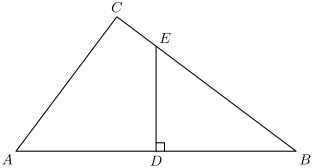
In the figure, it is given that angle and The area of quadrilateral is:
None of these
Answer: B
Small Hint:
Place on the -axis and find the coordinates of from the two side lengths
Big Hint:
The perpendicular through midpoint meets at ; then use the shoelace formula on
Solution:
Since and angle is right, Put and Solving gives Also
The line meets at The shoelace formula for now gives
Thus, the correct answer is B.
25.
A powderman set a fuse for a blast to take place in seconds. He ran away at a rate of yards per second. Sound travels at the rate of feet per second. When the powderman heard the blast, he had run approximately:
yd.
yd.
yd.
yd.
yd.
Answer: D
Small Hint:
Let be the total number of seconds from lighting the fuse until the sound is heard
Big Hint:
At time , the sound has traveled for seconds and must cover the runner’s distance
Solution:
Let be the total time in seconds. The powderman is yards, or feet, from the blast. Because the sound starts after seconds, Thus seconds, and the distance he ran is
Approximately yards is the listed value, so the correct answer is D.
26.
If then equals
Answer: C
Small Hint:
Let and express the requested sum in terms of
Big Hint:
Use
Solution:
Let Expanding gives Since this becomes
Thus the value is so the correct answer is C.
27.
The ratio of the perimeter of an equilateral triangle having an altitude equal to the radius of a circle, to the perimeter of an equilateral triangle inscribed in the circle is:
Answer: E
Small Hint:
Express each equilateral triangle’s side length in terms of the same circle radius
Big Hint:
An equilateral triangle of altitude has side , while an inscribed one has side
Solution:
An equilateral triangle with side has altitude Thus the first triangle has side and perimeter An equilateral triangle inscribed in a circle of radius has side and perimeter
The perimeter ratio is therefore so the correct answer is E.
28.
In the table shown, the formula relating and is:
None of these
Answer: C
Small Hint:
Look at the first and second differences of the -values
Big Hint:
The constant second difference suggests a monic quadratic; test the listed quadratic
Solution:
The successive differences of the -values are whose successive differences are all Thus the data fit a monic quadratic. Substitution shows gives at respectively.
Thus, the correct answer is C.
29.
In a circle of radius units, and are perpendicular diameters. A chord cutting at is units long. The diameter is divided into two segments whose dimensions are:
None of these
Answer: A
Small Hint:
Put the center at the origin, take , and represent the other endpoint of the chord by coordinates
Big Hint:
Use and , then find where line crosses the horizontal diameter
Solution:
Put the circle at the origin with and let The equations give and Taking does not change the segment lengths.
The line from to crosses at Its distances to the endpoints and of diameter are therefore
Thus, the correct answer is A.
30.
When the sum of the first ten terms of an arithmetic progression is four times the sum of the first five terms, the ratio of the first term to the common difference is:
Answer: A
Small Hint:
Write both partial sums in terms of the first term and common difference
Big Hint:
Use and simplify
Solution:
The sum formula gives The equation becomes so Hence
Thus, the correct answer is A.
31.
Given points in a plane no three of which are collinear, the number of lines they determine is:
None of these
Answer: D
Small Hint:
Each line is determined by choosing two of the points
Big Hint:
The condition that no three are collinear ensures that different pairs determine different lines
Solution:
Every pair of points determines one line, and no line is counted by more than one pair because no three points are collinear. Therefore the number of lines is
Thus, the correct answer is D.
32.
takes minutes less time than to travel a distance of miles. travels mile per hour faster than If is ’s rate of speed in miles per hour, then ’s time for the distance is:
Answer: D
Small Hint:
Use the basic relation
Big Hint:
The question asks only for ’s time, and both ’s distance and rate are already given
Solution:
For the distance is miles and the rate is miles per hour. Thus The comparison with is not needed for this expression.
Thus, the correct answer is D.
33.
A circle and a square have the same perimeter. Then:
Their areas are equal
The area of the circle is the greater
The area of the square is the greater
The area of the circle is times the area of the square
None of these
Answer: B
Small Hint:
Call the common perimeter and express each area in terms of
Big Hint:
The circle has area , while the square has area
Solution:
With common perimeter the circle’s radius is , so its area is The square’s side is so its area is Since
The circle has the greater area, so the correct answer is B.
34.
The price of an article was increased Later the new price was decreased If the last price was one dollar, the original price was:
One dollar
Answer: E
Small Hint:
Represent the increase and decrease by multiplicative factors
Big Hint:
If the original price is then
Solution:
If the original price is dollars, then after both changes its price is Setting this equal to gives
Thus, the correct answer is E.
35.
With a rational denominator, the expression is equivalent to:
None of these
Answer: A
Small Hint:
First treat the denominator as and multiply by its conjugate
Big Hint:
After the first rationalization, a denominator containing remains; use another conjugate
Solution:
Multiply first by the conjugate This gives Multiplying numerator and denominator by yields
Thus, the correct answer is A.
36.
To be continuous at the value of is taken to be:
Small Hint:
Factor both numerator and denominator before substituting
Big Hint:
Cancel the common factor and evaluate the remaining expression
Solution:
For Its limit at is Assigning this value removes the discontinuity.
Thus, the correct answer is E.
37.
Two equal parallel chords are drawn inches apart in a circle of radius inches. The area of that part of the circle that lies between the chords is:
Small Hint:
Equal parallel chords lie the same distance from the center, so each is inches from it
Big Hint:
Subtract the two congruent outer circular segments from the whole circle
Solution:
The equal chords are symmetrically inches from the center. For either chord, the half-angle at the center satisfies so Each outer segment is a sector minus the isosceles triangle: The area between the chords is therefore
Thus, the correct answer is B.
38.
The area of a trapezoidal field is square yards. Its altitude is yards. Find the two bases, if the number of yards in each base is an integer divisible by The number of solutions to this problem is:
None
One
Two
Three
More than three
Answer: D
Small Hint:
Use the trapezoid area formula to find the sum of the two bases
Big Hint:
List the unordered pairs of positive multiples of with that sum
Solution:
If the bases are then so The unordered positive pairs of multiples of are There are three solutions.
Thus, the correct answer is D.
39.
If the perimeter of a rectangle is and its diagonal is the difference between the length and width of the rectangle is:
Answer: A
Small Hint:
Let the side lengths be and , and write equations for and
Big Hint:
Write , then subtract to obtain
Solution:
The perimeter and diagonal give Hence Taking the nonnegative square root gives
Thus, the correct answer is A.
40.
In order to draw a graph of a table of values was constructed. These values of the function for a set of equally spaced increasing values of were and The one which is incorrect is:
None of these
Answer: E
Small Hint:
A quadratic sampled at equally spaced inputs has constant second differences
Big Hint:
The surrounding values also suggest consecutive perfect squares; check every displayed table value before checking which values appear among the choices
Solution:
The values are intended to be the consecutive squares These are Thus the incorrect table entry is but it is not one of choices A-D.
Consequently none of the four listed numbers is incorrect, so the correct answer is E.
41.
Increasing the radius of a cylinder by units increases the volume by cubic units. Increasing the altitude of the cylinder by units also increases the volume by cubic units. If the original altitude is then the original radius is:
Small Hint:
Let the original radius be and write each of the two volume increases
Big Hint:
Equate and
Solution:
With original height and radius increasing the radius adds cubic units. Increasing the height by adds cubic units. Equating these gives or Its positive root is
Thus, the correct answer is C.
42.
Let represent a repeating decimal. If denotes the figures of which do not repeat themselves, and denotes the figures which do repeat themselves, then the incorrect expression is:
Answer: D
Small Hint:
Shift the decimal point first past the nonrepeating digits and then past one block of repeating digits
Big Hint:
Subtract from and compare the result with choice D
Solution:
After shifting past the nonrepeating block, and after shifting one repeating block farther, Subtracting yields the standard relation This is not as stated in choice D.
Thus, the incorrect expression, and hence the correct answer, is D.
43.
The diameter of a circle is divided into equal parts. On each part a semicircle is constructed. As becomes very large, the sum of the lengths of the arcs of the semicircles approaches a length:
Equal to the semi-circumference of the original circle
Equal to the diameter of the original circle
Greater than the diameter but less than the semi-circumference of the original circle
That is infinite
Greater than the semi-circumference but finite
Answer: A
Small Hint:
Let the original diameter be , so each small semicircle has diameter
Big Hint:
Multiply the arc length of one small semicircle by the number of parts
Solution:
Each small semicircle has diameter so its arc length is The sum of all arc lengths is exactly the semi-circumference of the original circle. This equality holds for every positive not merely in the limit.
Thus, the correct answer is A.
44.
If an integer of two digits is times the sum of its digits, the number formed by interchanging the digits is the sum of the digits multiplied by:
Answer: C
Small Hint:
Let the two digits be and , and express both the original and reversed numbers
Big Hint:
The two numbers add to
Solution:
Let the original number be The reversed number is Since the reversed number equals
Thus, the correct answer is C.
45.
If and are two unequal positive numbers, then:
Answer: E
Small Hint:
Recognize the arithmetic, geometric, and harmonic means of and
Big Hint:
For unequal positive numbers, the mean inequalities are strict
Solution:
The arithmetic-geometric mean inequality gives for unequal positive Applying the same inequality to and gives Therefore the decreasing order is arithmetic mean, geometric mean, harmonic mean.
Thus, the correct answer is E.
46.
The base of a new rectangle equals the sum of the diagonal and the greater side of a given rectangle, while the altitude of the new rectangle equals the difference of the diagonal and the greater side of the given rectangle. The area of the new rectangle is:
Greater than the area of the given rectangle
Equal to the area of the given rectangle
Equal to the area of a square with its side equal to the smaller side of the given rectangle
Equal to the area of a square with its side equal to the greater side of the given rectangle
Equal to the area of a rectangle whose dimensions are the diagonal and shorter side of the given rectangle
Answer: C
Small Hint:
Let be the diagonal and the greater and smaller sides
Big Hint:
The new area is
Solution:
Let the greater and smaller side lengths be and and let the diagonal be The new rectangle’s area is The Pythagorean theorem gives so the new area is This is the area of a square whose side equals the smaller side of the original rectangle.
Thus, the correct answer is C.
47.
In the set of equations the integral roots in the order are:
Answer: D
Small Hint:
Compare exponents in to express in terms of
Big Hint:
For the intended positive solution, gives ; substitute both relations into the sum
Solution:
For the intended positive integral solution, the first equation gives The second equation is so and Substituting into gives The positive integral solution is which gives and Direct substitution verifies all three displayed equations.
Thus, the intended listed answer is D.
48.
Two cyclists, miles apart, and starting at the same time, would be together in hours if they traveled in the same direction, but would pass each other in hours if they traveled in opposite directions. The ratio of the speed of the faster cyclist to that of the slower is:
Answer: A
Small Hint:
Let the faster and slower speeds be and , and write the same-direction and opposite-direction relative-speed equations
Big Hint:
Use and , then solve for
Solution:
Let the speeds be The two meeting conditions give Adding and subtracting these equations yields Therefore
Thus, the correct answer is A.
49.
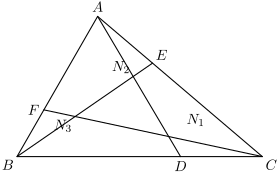
In the figure, and are one-third of their respective sides. It follows that and similarly for lines and Then the area of triangle is:
None of these
Answer: C
Small Hint:
Area ratios are affine-invariant, so choose convenient coordinates for triangle
Big Hint:
Locate by the one-third conditions, intersect the three cevians, and compare the two areas with determinants
Solution:
Use Then Intersecting in pairs gives The determinant area formula gives Hence
Thus, the correct answer is C.
50.
A line initially inch long grows according to the following law, where the first term is the initial length. If the growth process continues forever, the limit of the length of the line is:
Answer: D
Small Hint:
Group each pair having the same power of
Big Hint:
The terms after the initial equal
Solution:
After the initial term, each power appears once by itself and once multiplied by Since the limit is
Thus, the correct answer is D.