
2023 AIME I Problem 14
Attempt Problem 14 of the 2023 AIME I below, then check your answer against the professionally curated solution from LIVE by Po-Shen Loh. You can also try the full timed exam, view all 2023 AIME I solutions, or check the answer key.
All problems are used with official legal permission of the Mathematical Association of America (MAA).
14.
The following analog clock has two hands that can move independently of each other.
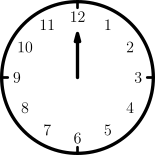
Initially, both hands point to the number The clock performs a sequence of hand movements so that on each movement, one of the two hands moves clockwise to the next number on the clock face while the other hand does not move.
Let be the number of sequences of hand movements such that during the sequence, every possible positioning of the hands appears exactly once, and at the end of the movements, the hands have returned to their initial position. Find the remainder when is divided by
Answer: 608
Small Hint:
Track the ordered pair of hand positions in sort the positions into rows by one hand’s value and mark where the other hand moves.
Big Hint:
Covering each row once forces each row’s exit set to be the previous row’s shifted by the tour is a single cycle exactly when the exits per row are coprime to
Solution:
Record the hands as an ordered pair each movement replaces by or so a valid sequence is a closed tour through all positions — equivalently, a choice, at each position, of which hand moves next. Sort the positions into rows according to and let be the set of -values at which the tour leaves row (a -move). A -move from row enters row at the same -value, and the tour then runs through consecutive -values until its next exit. For these runs to cover row exactly once they must partition which forces each entry point to sit one step past an exit: In particular every has the same size and
Leaving row at its -th exit (in cyclic order) leads to a run ending at the -st exit of row each -move advances the row index by modulo and the exit index by modulo The tour therefore closes after -moves, while a full tour must use all exits, so the tour is a single cycle through all positions precisely when Conversely, every choice of with yields exactly one valid movement sequence from the starting position.
Hence and the remainder when is divided by is
Problem 14 in Other Years
1983 AIME · 1984 AIME · 1985 AIME · 1986 AIME · 1987 AIME · 1988 AIME · 1989 AIME · 1990 AIME · 1991 AIME · 1992 AIME · 1993 AIME · 1994 AIME · 1995 AIME · 1996 AIME · 1997 AIME · 1998 AIME · 1999 AIME · 2000 AIME I · 2000 AIME II · 2001 AIME I · 2001 AIME II · 2002 AIME I · 2002 AIME II · 2003 AIME I · 2003 AIME II · 2004 AIME I · 2004 AIME II · 2005 AIME I · 2005 AIME II · 2006 AIME I · 2006 AIME II · 2007 AIME I · 2007 AIME II · 2008 AIME I · 2008 AIME II · 2009 AIME I · 2009 AIME II · 2010 AIME I · 2010 AIME II · 2011 AIME I · 2011 AIME II · 2012 AIME I · 2012 AIME II · 2013 AIME I · 2013 AIME II · 2014 AIME I · 2014 AIME II · 2015 AIME I · 2015 AIME II · 2016 AIME I · 2016 AIME II · 2017 AIME I · 2017 AIME II · 2018 AIME I · 2018 AIME II · 2019 AIME I · 2019 AIME II · 2020 AIME I · 2020 AIME II · 2021 AIME I · 2021 AIME II · 2022 AIME I · 2022 AIME II · 2023 AIME II · 2024 AIME I · 2024 AIME II · 2025 AIME I · 2025 AIME II · 2026 AIME I · 2026 AIME II