
2023 AIME I Solutions

Scroll down to view professionally curated solutions from LIVE by Po-Shen Loh, print PDF solutions, view answer key, or take the full timed exam.

All problems are used with official legal permission of the Mathematical Association of America (MAA).

1.

Five men and nine women stand equally spaced around a circle in random order. The probability that every man stands diametrically opposite a woman is mn,\frac{m}{n}, where mm and nn are relatively prime positive integers. Find m+n.m + n.

Concepts:basic probabilitycombinationspairing and grouping
Difficulty rating: 2170
Small Hint:

The 1414 positions split into 77 diametrically opposite pairs, and only the set of positions the men occupy matters.

Big Hint:

Count sets where no pair has two men: choose 55 of the 77 pairs to hold a man, then a position in each; compare with (145).\binom{14}{5}.

Solution:

The 1414 positions split into 77 diametrically opposite pairs. Only the set of positions occupied by the men matters, and all (145)=2002\binom{14}{5} = 2002 five-element sets are equally likely. Every man stands opposite a woman exactly when no pair contains two men, so choose which 55 of the 77 pairs contain a man ((75)=21\binom{7}{5} = 21 ways) and which position of each chosen pair the man occupies (25=322^5 = 32 ways), for 2132=67221 \cdot 32 = 672 favorable sets.

The probability is 6722002=48143,\frac{672}{2002} = \frac{48}{143}, so m+n=48+143=191.m + n = 48 + 143 = 191.

2.

Positive real numbers b1b \ne 1 and nn satisfy the equations logbn=logbn\sqrt{\log_b n} = \log_b \sqrt{n} and blogbn=logb(bn).b \cdot \log_b n = \log_b (bn). The value of nn is jk,\frac{j}{k}, where jj and kk are relatively prime positive integers. Find j+k.j + k.

Difficulty rating: 2100
Small Hint:

Set x=logbnx = \log_b n and rewrite both equations in terms of xx and b.b.

Big Hint:

The first equation forces x=x2;\sqrt{x} = \frac{x}{2}; discard the root that breaks the second equation, which reads bx=1+x.bx = 1 + x.

Solution:

Let x=logbn.x = \log_b n. The first equation says x=logbn12=x2,\sqrt{x} = \log_b n^{\frac{1}{2}} = \frac{x}{2}, so x=x24,x = \frac{x^2}{4}, giving x=0x = 0 or x=4.x = 4. If x=0x = 0 then n=1,n = 1, and the second equation would read 0=logbb=1,0 = \log_b b = 1, impossible; so x=4.x = 4.

The second equation says bx=logbb+logbn=1+x,bx = \log_b b + \log_b n = 1 + x, so 4b=54b = 5 and b=54.b = \frac{5}{4}. Then n=b4=(54)4=625256,n = b^4 = \left(\frac{5}{4}\right)^4 = \frac{625}{256}, which is in lowest terms, so j+k=625+256=881.j + k = 625 + 256 = 881.

3.

A plane contains 4040 lines, no 22 of which are parallel. Suppose that there are 33 points where exactly 33 lines intersect, 44 points where exactly 44 lines intersect, 55 points where exactly 55 lines intersect, 66 points where exactly 66 lines intersect, and no points where more than 66 lines intersect. Find the number of points where exactly 22 lines intersect.

Difficulty rating: 2090
Small Hint:

Since no two lines are parallel, every pair of lines meets at exactly one intersection point.

Big Hint:

A point where exactly kk lines cross accounts for (k2)\binom{k}{2} of the (402)\binom{40}{2} pairs of lines.

Solution:

Since no two of the 4040 lines are parallel, every two lines cross, giving (402)=780\binom{40}{2} = 780 pairs of lines, and each pair meets at exactly one point. A point where exactly kk lines meet accounts for exactly (k2)\binom{k}{2} of these pairs.

The given points account for 3(32)+4(42)3\binom{3}{2} + 4\binom{4}{2} +5(52)+6(62)+ 5\binom{5}{2} + 6\binom{6}{2} =9+24+50+90=173= 9 + 24 + 50 + 90 = 173 pairs of lines. Each remaining pair meets at a point where exactly 22 lines intersect, one point per pair, so there are 780173=607780 - 173 = 607 such points.

4.

The sum of all positive integers mm such that 13!m\frac{13!}{m} is a perfect square can be written as 2a3b5c7d11e13f,2^a 3^b 5^c 7^d 11^e 13^f, where a,a, b,b, c,c, d,d, e,e, and ff are positive integers. Find a+b+c+d+e+f.a + b + c + d + e + f.

Difficulty rating: 2330
Small Hint:

Factor 13!=21035527111313! = 2^{10} \cdot 3^5 \cdot 5^2 \cdot 7 \cdot 11 \cdot 13 and decide which prime exponents mm can have.

Big Hint:

Each exponent of mm must match the parity of the corresponding exponent of 13!,13!, so the sum of all valid mm factors as a product of geometric sums.

Solution:

Since 13!=210355271113,13! = 2^{10} \cdot 3^5 \cdot 5^2 \cdot 7 \cdot 11 \cdot 13, a valid m=2x3y5z7w11u13vm = 2^x 3^y 5^z 7^w 11^u 13^v must leave every exponent of 13!m\frac{13!}{m} even: x{0,2,4,6,8,10},x \in \{0, 2, 4, 6, 8, 10\}, y{1,3,5},y \in \{1, 3, 5\}, z{0,2},z \in \{0, 2\}, and w=u=v=1.w = u = v = 1.

The choices are independent, so the sum of all such mm factors as (1+4++1024)(3+27+243)(1+25)71113=1365273261001. \begin{aligned} &(1 + 4 + \cdots + 1024) \\ &\quad {}\cdot (3 + 27 + 243) \\ &\quad {}\cdot (1 + 25) \cdot 7 \cdot 11 \cdot 13 \\ &= 1365 \cdot 273 \cdot 26 \cdot 1001. \end{aligned} Since 1365=35713,1365 = 3 \cdot 5 \cdot 7 \cdot 13, 273=3713,273 = 3 \cdot 7 \cdot 13, 26=213,26 = 2 \cdot 13, and 1001=71113,1001 = 7 \cdot 11 \cdot 13, the sum equals 21325173111134,2^1 3^2 5^1 7^3 11^1 13^4, and a+b+c+d+e+fa + b + c + d + e + f =1+2+1+3+1+4= 1 + 2 + 1 + 3 + 1 + 4 =12.= 12.

5.

Let PP be a point on the circle circumscribing square ABCDABCD that satisfies PAPC=56PA \cdot PC = 56 and PBPD=90.PB \cdot PD = 90. Find the area of ABCD.ABCD.

Difficulty rating: 2400
Small Hint:

Put the center at the origin with A=(R,0),A = (R, 0), B=(0,R),B = (0, R), C=(R,0),C = (-R, 0), D=(0,R),D = (0, -R), and P=(Rcosθ,Rsinθ).P = (R\cos\theta, R\sin\theta).

Big Hint:

Show PAPC=2R2sinθPA \cdot PC = 2R^2|\sin\theta| and PBPD=2R2cosθ;PB \cdot PD = 2R^2|\cos\theta|; a Pythagorean identity links the two products.

Solution:

Let the circle have center OO and radius R,R, with A=(R,0),A = (R, 0), B=(0,R),B = (0, R), C=(R,0),C = (-R, 0), D=(0,R),D = (0, -R), and P=(Rcosθ,Rsinθ).P = (R\cos\theta, R\sin\theta). Then PA2=2R2(1cosθ)PA^2 = 2R^2(1 - \cos\theta) and PC2=2R2(1+cosθ),PC^2 = 2R^2(1 + \cos\theta), so PAPC=2R2sinθ=56.PA \cdot PC = 2R^2|\sin\theta| = 56. In the same way PBPD=2R2cosθ=90.PB \cdot PD = 2R^2|\cos\theta| = 90.

Squaring and adding, 4R4=562+902=11236,4R^4 = 56^2 + 90^2 = 11236, so 2R2=11236=106.2R^2 = \sqrt{11236} = 106. The square has diagonal 2R,2R, hence area (2R)22=2R2=106.\frac{(2R)^2}{2} = 2R^2 = 106.

6.

Alice knows that 33 red cards and 33 black cards will be revealed to her one at a time in random order. Before each card is revealed, Alice must guess its color. If Alice plays optimally, the expected number of cards she will guess correctly is mn,\frac{m}{n}, where mm and nn are relatively prime positive integers. Find m+n.m + n.

Difficulty rating: 2600
Small Hint:

Guessing the color with more cards remaining is optimal; let E(r,b)E(r, b) be the expected number correct with rr red and bb black left.

Big Hint:

E(r,b)=max(r,b)r+bE(r,b) = \frac{\max(r,b)}{r+b} +rE(r1,b)+bE(r,b1)r+b;+ \frac{r\,E(r-1,b) + b\,E(r,b-1)}{r+b}; build up from E(1,1).E(1,1).

Solution:

Whatever Alice guesses, the deck evolves the same way; only the immediate success probability depends on her guess, so it is optimal to guess a color with the most cards remaining. Let E(r,b)E(r, b) be the expected number of correct guesses from a state with rr red and bb black cards left. Then E(r,0)=r,E(r, 0) = r, E(0,b)=b,E(0, b) = b, and E(r,b)=max(r,b)r+b+rE(r1,b)r+b+bE(r,b1)r+b. \begin{aligned} E(r, b) &= \frac{\max(r, b)}{r + b} \\ &\quad {}+ \frac{r\,E(r-1,b)}{r+b} \\ &\quad {}+ \frac{b\,E(r,b-1)}{r+b}. \end{aligned}

By symmetry E(r,b)=E(b,r).E(r, b) = E(b, r). Computing upward: E(1,1)=32,E(1,1) = \frac{3}{2}, E(2,1)=23+232+23=73,E(2,1) = \frac{2}{3} + \frac{2 \cdot \frac{3}{2} + 2}{3} = \frac{7}{3}, E(2,2)=12+73=176,E(2,2) = \frac{1}{2} + \frac{7}{3} = \frac{17}{6}, E(3,1)=34+373+34=134,E(3,1) = \frac{3}{4} + \frac{3 \cdot \frac{7}{3} + 3}{4} = \frac{13}{4}, E(3,2)=35+3176+21345=185,E(3,2) = \frac{3}{5} + \frac{3 \cdot \frac{17}{6} + 2 \cdot \frac{13}{4}}{5} = \frac{18}{5}, and finally E(3,3)=12+185=4110.E(3,3) = \frac{1}{2} + \frac{18}{5} = \frac{41}{10}.

So the expected number of correct guesses is 4110,\frac{41}{10}, and m+n=41+10=51.m + n = 41 + 10 = 51.

7.

Call a positive integer nn extra-distinct if the remainders when nn is divided by 2,2, 3,3, 4,4, 5,5, and 66 are distinct. Find the number of extra-distinct positive integers less than 1000.1000.

Difficulty rating: 2560
Small Hint:

The remainder mod 22 is forced by the remainders mod 44 and mod 6,6, and the remainder mod 33 by the one mod 66 — few patterns survive.

Big Hint:

Everything depends only on nmod60;n \bmod 60; exactly three residues work, so count each class below 1000.1000.

Solution:

Write rkr_k for the remainder of nn modulo k,k, and note r2r4(mod2),r_2 \equiv r_4 \pmod 2, r2r6(mod2),r_2 \equiv r_6 \pmod 2, and r3r6(mod3).r_3 \equiv r_6 \pmod 3. If r2=0:r_2 = 0: then r4r_4 is even and different from r2,r_2, so r4=2;r_4 = 2; then r6r_6 is even and avoids {0,2},\{0, 2\}, so r6=4,r_6 = 4, which gives r3=1;r_3 = 1; finally r5r_5 avoids {0,1,2,4},\{0, 1, 2, 4\}, so r5=3.r_5 = 3. These say n2n \equiv -2 modulo each of 2,3,4,5,6,2, 3, 4, 5, 6, i.e. n58(mod60).n \equiv 58 \pmod{60}.

If r2=1:r_2 = 1: similarly r4=3,r_4 = 3, then r6=5,r_6 = 5, giving r3=2,r_3 = 2, and r5r_5 avoids {1,2,3,5},\{1, 2, 3, 5\}, so r5{0,4}.r_5 \in \{0, 4\}. The choice r5=4r_5 = 4 gives n1(mod60),n \equiv -1 \pmod{60}, i.e. n59;n \equiv 59; the choice r5=0r_5 = 0 gives n11(mod12)n \equiv 11 \pmod{12} with 55 dividing n,n, i.e. n35(mod60).n \equiv 35 \pmod{60}.

Below 10001000 there are 1717 integers congruent to 35,35, 1616 congruent to 58,58, and 1616 congruent to 5959 modulo 60,60, for a total of 17+16+16=49.17 + 16 + 16 = 49.

8.

Rhombus ABCDABCD has BAD<90.\angle BAD \lt 90^\circ. There is a point PP on the incircle of the rhombus such that the distances from PP to the lines DA,DA, AB,AB, and BCBC are 9,9, 5,5, and 16,16, respectively. Find the perimeter of ABCD.ABCD.

Difficulty rating: 2920
Small Hint:

The distances from PP to the parallel lines DADA and BCBC add up to the height of the rhombus, so the height is 25.25.

Big Hint:

Center the incircle at the origin: P=(±12,72),P = (\pm 12, \frac{7}{2}), and the distance-55 condition to the tangent line ABAB becomes an equation in sinBAD.\sin \angle BAD.

Solution:

The distances from an interior point to the parallel lines DADA and BCBC add up to the distance between them, the height of the rhombus. So the height is 9+16=25,9 + 16 = 25, and the incircle, tangent to both lines, has radius 252.\frac{25}{2}. Center the incircle at the origin with DA: y=252DA:\ y = \frac{25}{2} and BC: y=252.BC:\ y = -\frac{25}{2}. Then PP has yy-coordinate 2529=72,\frac{25}{2} - 9 = \frac{7}{2}, and x2+(72)2=(252)2x^2 + \left(\frac{7}{2}\right)^2 = \left(\frac{25}{2}\right)^2 gives x=±12.x = \pm 12.

Let α=BAD.\alpha = \angle BAD. Line ABAB is tangent to the incircle and makes angle α\alpha with the horizontal, so (orienting the figure suitably) it is xsinα+ycosα=252,x \sin\alpha + y \cos\alpha = -\frac{25}{2}, and interior points satisfy xsinα+ycosα+252>0.x\sin\alpha + y\cos\alpha + \frac{25}{2} \gt 0. The condition dist(P,AB)=5\operatorname{dist}(P, AB) = 5 reads xsinα+72cosα+252=5.x \sin\alpha + \frac{7}{2}\cos\alpha + \frac{25}{2} = 5. For x=12x = 12 the left side exceeds 252,\frac{25}{2}, so x=12,x = -12, and the equation becomes 24sinα7cosα=15.24\sin\alpha - 7\cos\alpha = 15.

Substituting 7cosα=24sinα157\cos\alpha = 24\sin\alpha - 15 into sin2α+cos2α=1\sin^2\alpha + \cos^2\alpha = 1 yields 625sin2α720sinα625\sin^2\alpha - 720\sin\alpha +176=0,+ 176 = 0, so sinα=45\sin\alpha = \frac{4}{5} or 44125.\frac{44}{125}. The root 44125\frac{44}{125} makes cosα=24sinα157\cos\alpha = \frac{24\sin\alpha - 15}{7} negative, contradicting BAD<90.\angle BAD \lt 90^\circ. So sinα=45,\sin\alpha = \frac{4}{5}, the side length is 25sinα=1254,\frac{25}{\sin\alpha} = \frac{125}{4}, and the perimeter is 41254=125.4 \cdot \frac{125}{4} = 125.

9.

Find the number of cubic polynomials p(x)=x3+ax2+bx+c,p(x) = x^3 + ax^2 + bx + c, where a,a, b,b, and cc are integers in {20,19,18,,18,19,20},\{-20, -19, -18, \ldots, 18, 19, 20\}, such that there is a unique integer m2m \ne 2 with p(m)=p(2).p(m) = p(2).

Difficulty rating: 2920
Small Hint:

cc is irrelevant: p(m)p(2)=(m2)q(m),p(m)-p(2)=(m-2)q(m), where the three terms of the quadratic q(m)q(m) are m2,m^2, (a+2)m,(a+2)m, and 2a+b+4.2a+b+4.

Big Hint:

A monic integer quadratic with one integer root has two, so its root set must be {2,k}\{2, k\} or a double root k,k, with k2.k \ne 2.

Solution:

Since p(m)p(2)p(m) - p(2) does not involve c,c, each valid pair (a,b)(a, b) contributes 4141 polynomials. Factoring, p(x)p(2)=(x2)q(x),q(x)=x2+(a+2)x+(2a+b+4), \begin{aligned} p(x)-p(2) &= (x-2)q(x), \\ q(x) &= x^2+(a+2)x \\ &\quad {}+(2a+b+4), \end{aligned} so we need the quadratic factor q(x)q(x) to have exactly one integer root different from 2.2. If qq has any integer root, its other root is also an integer (their sum (a+2)-(a+2) is an integer); if qq has no integer root, then no mm exists at all. So either qq has roots 22 and kk with k2,k \ne 2, or a double root k2.k \ne 2.

Roots 22 and k:k: Vieta’s formulas give a=4ka = -4 - k and b=4k+4.b = 4k + 4. The constraint 20b20-20 \le b \le 20 forces 6k4-6 \le k \le 4 (and then aa is automatically in range), so excluding k=2k = 2 leaves 1010 pairs. Double root k:k: here a=2k2a = -2k - 2 and b=k2+4k,b = k^2 + 4k, and b20b \le 20 forces 6k2,-6 \le k \le 2, all valid for a,a, so excluding k=2k = 2 leaves 88 pairs.

That is 1818 pairs (a,b),(a, b), hence 1841=73818 \cdot 41 = 738 polynomials.

10.

There exists a unique positive integer aa for which the sum U=n=12023n2na5U = \sum_{n=1}^{2023} \left\lfloor \frac{n^2 - na}{5} \right\rfloor is an integer strictly between 1000-1000 and 1000.1000. For that unique a,a, find a+U.a + U.

(Note that x\lfloor x \rfloor denotes the greatest integer that is less than or equal to x.x.)

Difficulty rating: 2990
Small Hint:

Without the floor the sum is 15(n2an);\frac{1}{5}\bigl(\sum n^2 - a\sum n\bigr); there is an integer aa making it exactly 0.0.

Big Hint:

For that a,a, U=15((n2na)mod5),U = -\frac{1}{5}\sum\bigl((n^2 - na) \bmod 5\bigr), and the residues repeat with period 5.5.

Solution:

Ignoring the floors, n=12023n2na5\sum_{n=1}^{2023} \frac{n^2 - na}{5} =15(n2an)= \frac{1}{5}\left(\sum n^2 - a\sum n\right) vanishes exactly when a=n2n=22023+13=1349,a = \frac{\sum n^2}{\sum n} = \frac{2 \cdot 2023 + 1}{3} = 1349, an integer. For any other integer aa the raw sum has absolute value at least 15n=202310125409455,\frac{1}{5}\sum n = \frac{2023 \cdot 1012}{5} \approx 409455, while taking floors changes the total by less than 2023,2023, so only a=1349a = 1349 can put UU strictly between 1000-1000 and 1000.1000.

With a=1349,a = 1349, each term is n21349nrn5\frac{n^2 - 1349n - r_n}{5} with rn=(n21349n)mod5,r_n = (n^2 - 1349n) \bmod 5, so U=15rn.U = -\frac{1}{5}\sum r_n. Since 13494(mod5),1349 \equiv 4 \pmod 5, we have n21349nn^2 - 1349n n(n+1)(mod5),\equiv n(n+1) \pmod 5, whose residues for n0,1,2,3,4n \equiv 0, 1, 2, 3, 4 are 0,2,1,2,0,0, 2, 1, 2, 0, summing to 55 per block of five. With 2023=5404+3,2023 = 5 \cdot 404 + 3, the leftover terms n1,2,3n \equiv 1, 2, 3 contribute 2+1+2=5,2 + 1 + 2 = 5, so rn=4055=2025.\sum r_n = 405 \cdot 5 = 2025.

So U=20255=405,U = -\frac{2025}{5} = -405, which indeed lies strictly between 1000-1000 and 1000,1000, and a+U=1349405=944.a + U = 1349 - 405 = 944.

11.

Find the number of subsets of {1,2,3,,10}\{1, 2, 3, \ldots, 10\} that contain exactly one pair of consecutive integers. Examples of such subsets are {1,2,5}\{\mathbf{1}, \mathbf{2}, 5\} and {1,3,6,7,10}.\{1, 3, \mathbf{6}, \mathbf{7}, 10\}.

Difficulty rating: 2650
Small Hint:

The number of subsets of mm consecutive integers with no two consecutive elements is the Fibonacci number Fm+2.F_{m+2}.

Big Hint:

If the pair is {k,k+1},\{k, k+1\}, the other elements must avoid k1k-1 and k+2k+2 and be non-consecutive inside the two remaining blocks.

Solution:

First, the number of subsets of a block of mm consecutive integers containing no two consecutive elements is the Fibonacci number Fm+2F_{m+2} (with F1=F2=1F_1 = F_2 = 1): conditioning on whether the last element is used gives the Fibonacci recursion, and the counts start 1,2,3,5,.1, 2, 3, 5, \ldots.

Suppose the unique consecutive pair is {k,k+1}\{k, k+1\} for some 1k9.1 \le k \le 9. The remaining elements must exclude k1k - 1 and k+2k + 2 (either would create a second consecutive pair) and must contain no consecutive pair within {1,,k2}\{1, \ldots, k-2\} or within {k+3,,10},\{k+3, \ldots, 10\}, blocks of sizes k2k - 2 and 8k.8 - k. So the count for this kk is FkF10k.F_k \cdot F_{10-k}.

Summing over k=1,,9:k = 1, \ldots, 9: k=19FkF10k=34+21+26+24+25+24+26+21+34=235. \begin{aligned} \sum_{k=1}^{9} F_k F_{10-k} &= 34 + 21 + 26 \\ &\quad {}+ 24 + 25 + 24 \\ &\quad {}+ 26 + 21 + 34 \\ &= 235. \end{aligned}

12.

Let ABC\triangle ABC be an equilateral triangle with side length 55.55. Points D,D, E,E, and FF lie on BC,\overline{BC}, CA,\overline{CA}, and AB,\overline{AB}, respectively, with BD=7,BD = 7, CE=30,CE = 30, and AF=40.AF = 40. Point PP inside ABC\triangle ABC has the property that AEP=BFP=CDP.\angle AEP = \angle BFP = \angle CDP. Find tan2(AEP).\tan^2(\angle AEP).

Difficulty rating: 3270
Small Hint:

Decompose each vector from E,E, F,F, DD to PP into a part along the side and the distance to that side; the along-part equals the distance times cotθ.\cot\theta.

Big Hint:

Add the three relations: the unit directions CA,C \to A, AB,A \to B, BCB \to C sum to zero, and the three distances sum to the height (Viviani).

Solution:

Place B=(0,0),B = (0, 0), C=(55,0),C = (55, 0), A=(552,5532),A = \left(\frac{55}{2}, \frac{55\sqrt{3}}{2}\right), so that D=(7,0),D = (7, 0), E=(40,153),E = (40, 15\sqrt{3}), and F=(152,1532).F = \left(\frac{15}{2}, \frac{15\sqrt{3}}{2}\right). Let θ\theta be the common angle and let u1,u2,u3\mathbf{u}_1, \mathbf{u}_2, \mathbf{u}_3 be the unit vectors in the directions CA,C \to A, AB,A \to B, BCB \to C — the directions from EE toward A,A, from FF toward B,B, and from DD toward C.C. Splitting PEP - E into its component along u1\mathbf{u}_1 and its component perpendicular to side CA,CA, whose length is the distance d1d_1 from PP to line CA,CA, the angle condition gives (PE)u1=d1cotθ;(P - E)\cdot\mathbf{u}_1 = d_1\cot\theta; similarly (PF)u2=d2cotθ(P - F)\cdot\mathbf{u}_2 = d_2\cot\theta and (PD)u3=d3cotθ.(P - D)\cdot\mathbf{u}_3 = d_3\cot\theta.

Now add all three relations. Since u1+u2+u3=0\mathbf{u}_1 + \mathbf{u}_2 + \mathbf{u}_3 = \mathbf{0} (the directed sides of a triangle close up), PP drops out, and by Viviani’s theorem d1+d2+d3d_1 + d_2 + d_3 equals the height 5532.\frac{55\sqrt{3}}{2}. With u1=(12,32),\mathbf{u}_1 = \left(-\frac{1}{2}, \frac{\sqrt{3}}{2}\right), u2=(12,32),\mathbf{u}_2 = \left(-\frac{1}{2}, -\frac{\sqrt{3}}{2}\right), and u3=(1,0),\mathbf{u}_3 = (1, 0), we get Eu1=52,E \cdot \mathbf{u}_1 = \frac{5}{2}, Fu2=15,F \cdot \mathbf{u}_2 = -15, and Du3=7,D \cdot \mathbf{u}_3 = 7, so 5532cotθ=(5215+7)=112. \begin{aligned} \frac{55\sqrt{3}}{2}\,\cot\theta &= -\left(\frac{5}{2} - 15 + 7\right) \\ &= \frac{11}{2}. \end{aligned}

Hence cotθ=11553=153,\cot\theta = \frac{11}{55\sqrt{3}} = \frac{1}{5\sqrt{3}}, so tan2(AEP)=(53)2=75.\tan^2(\angle AEP) = \left(5\sqrt{3}\right)^2 = 75.

13.

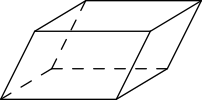
Each face of two noncongruent parallelepipeds is a rhombus whose diagonals have lengths 21\sqrt{21} and 31.\sqrt{31}. The ratio of the volume of the larger of the two polyhedra to the volume of the smaller is mn,\frac{m}{n}, where mm and nn are relatively prime positive integers. Find m+n.m + n. A parallelepiped is a solid with six parallelogram faces such as the one shown below.
Difficulty rating: 3160
Small Hint:

Every edge has length 13,\sqrt{13}, and each pair of edge vectors has dot product ±52\pm\frac{5}{2} from the two face diagonals.

Big Hint:

The squared volume is the Gram determinant of the three edge vectors; only the sign of the product of the three dot products matters.

Solution:

A rhombus with diagonals 21\sqrt{21} and 31\sqrt{31} has side 214+314=13,\sqrt{\frac{21}{4} + \frac{31}{4}} = \sqrt{13}, so the three edge vectors u,\mathbf{u}, v,\mathbf{v}, w\mathbf{w} all have squared length 13.13. In the face spanned by u\mathbf{u} and v\mathbf{v} the diagonals are u±v,\mathbf{u} \pm \mathbf{v}, with u±v2=26±2uv;|\mathbf{u} \pm \mathbf{v}|^2 = 26 \pm 2\,\mathbf{u}\cdot\mathbf{v}; matching {21,31}\{21, 31\} gives uv=±52,\mathbf{u}\cdot\mathbf{v} = \pm\frac{5}{2}, and likewise for the other two pairs.

The squared volume is the Gram determinant V2=det(13xyx13zyz13)=219713(x2+y2+z2)+2xyz=21979754+2xyz \begin{aligned} V^2 &= \det\begin{pmatrix} 13 & x & y \\ x & 13 & z \\ y & z & 13 \end{pmatrix} \\ &= 2197 - 13(x^2 + y^2 + z^2) \\ &\quad {}+ 2xyz \\ &= 2197 - \frac{975}{4} \\ &\quad {}+ 2xyz \end{aligned} with x,y,z{±52}.x, y, z \in \left\{\pm\frac{5}{2}\right\}. Negating an edge vector flips the signs of two of x,y,z,x, y, z, so only the sign of xyzxyz matters: 2xyz=±1254,2xyz = \pm\frac{125}{4}, giving V2=79384V^2 = \frac{7938}{4} or 76884.\frac{7688}{4}.

The ratio of the volumes is 79387688=39693844=6362,\sqrt{\frac{7938}{7688}} = \sqrt{\frac{3969}{3844}} = \frac{63}{62}, already in lowest terms, so m+n=63+62=125.m + n = 63 + 62 = 125.

14.

The following analog clock has two hands that can move independently of each other.
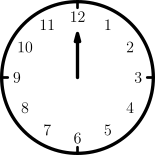
Initially, both hands point to the number 12.12. The clock performs a sequence of hand movements so that on each movement, one of the two hands moves clockwise to the next number on the clock face while the other hand does not move.

Let NN be the number of sequences of 144144 hand movements such that during the sequence, every possible positioning of the hands appears exactly once, and at the end of the 144144 movements, the hands have returned to their initial position. Find the remainder when NN is divided by 1000.1000.

Difficulty rating: 3500
Small Hint:

Track the ordered pair of hand positions in Z12×Z12;\mathbb{Z}_{12} \times \mathbb{Z}_{12}; sort the 144144 positions into rows by one hand’s value and mark where the other hand moves.

Big Hint:

Covering each row once forces each row’s exit set to be the previous row’s shifted by 1;1; the tour is a single cycle exactly when the exits per row are coprime to 12.12.

Solution:

Record the hands as an ordered pair (a,b)Z12×Z12;(a, b) \in \mathbb{Z}_{12} \times \mathbb{Z}_{12}; each movement replaces (a,b)(a, b) by (a+1,b)(a+1, b) or (a,b+1),(a, b+1), so a valid sequence is a closed tour through all 144144 positions — equivalently, a choice, at each position, of which hand moves next. Sort the positions into 1212 rows according to b,b, and let SbZ12S_b \subseteq \mathbb{Z}_{12} be the set of aa-values at which the tour leaves row bb (a bb-move). A bb-move from row b1b - 1 enters row bb at the same aa-value, and the tour then runs through consecutive aa-values until its next exit. For these runs to cover row bb exactly once they must partition Z12,\mathbb{Z}_{12}, which forces each entry point to sit one step past an exit: Sb1=Sb+1.S_{b-1} = S_b + 1. In particular every SbS_b has the same size c,c, and Sb=S0b.S_b = S_0 - b.

Leaving row bb at its ii-th exit (in cyclic order) leads to a run ending at the (i+1)(i+1)-st exit of row b+1:b + 1: each bb-move advances the row index by 11 modulo 1212 and the exit index by 11 modulo c.c. The tour therefore closes after lcm(12,c)\operatorname{lcm}(12, c) bb-moves, while a full tour must use all 12c12c exits, so the tour is a single cycle through all 144144 positions precisely when gcd(c,12)=1.\gcd(c, 12) = 1. Conversely, every choice of S0S_0 with gcd(S0,12)=1\gcd(|S_0|, 12) = 1 yields exactly one valid movement sequence from the starting position.

Hence N=(121)+(125)+(127)+(1211)=12+792+792+12=1608, \begin{aligned} N &= \binom{12}{1} + \binom{12}{5} \\ &\quad {}+ \binom{12}{7} + \binom{12}{11} \\ &= 12 + 792 + 792 \\ &\quad {}+ 12 = 1608, \end{aligned} and the remainder when NN is divided by 10001000 is 608.608.

15.

Find the largest prime number p<1000p \lt 1000 for which there exists a complex number zz satisfying

• the real and imaginary part of zz are both integers;

z=p,|z| = \sqrt{p}, and

• there exists a triangle whose three side lengths are p,p, the real part of z3,z^3, and the imaginary part of z3.z^3.

Difficulty rating: 3370
Small Hint:

Write z=a+biz = a + bi with a2+b2=p;a^2 + b^2 = p; up to signs and swapping, the triangle needs Rez3Imz3<p.\bigl||\operatorname{Re} z^3| - |\operatorname{Im} z^3|\bigr| \lt p.

Big Hint:

Rez3Imz3\operatorname{Re} z^3 - \operatorname{Im} z^3 =(a+b)(a2+b24ab),= (a + b)(a^2 + b^2 - 4ab), so 4ab4ab must be within p\sqrt{p} of p.p.

Solution:

Write z=a+biz = a + bi with a2+b2=p.a^2 + b^2 = p. The prime p=2p = 2 does qualify: for z=1+iz = -1 + i we have z3=2+2i,z^3 = 2 + 2i, but it cannot be the largest answer. Hence consider an odd prime p,p, so p1(mod4)p \equiv 1 \pmod 4 and the pair {a,b}\{|a|, |b|\} is unique. Replacing zz by ±z,\pm z, ±zˉ,\pm\bar{z}, ±iz,\pm iz, ±izˉ\pm i\bar{z} only changes the real and imaginary parts of z3z^3 by signs and swaps, so we may take a>b>0,a \gt b \gt 0, and the two candidate side lengths are Rez3|\operatorname{Re} z^3| and Imz3.|\operatorname{Im} z^3|. Expanding z3=(a33ab2)+(3a2bb3)iz^3 = (a^3 - 3ab^2) + (3a^2b - b^3)i and factoring, Rez3+Imz3=(ab)(p+4ab),Rez3Imz3=(a+b)(p4ab). \begin{aligned} &\operatorname{Re} z^3 + \operatorname{Im} z^3 \\ &\quad = (a - b)(p + 4ab), \qquad \\ &\operatorname{Re} z^3 - \operatorname{Im} z^3 \\ &\quad = (a + b)(p - 4ab). \end{aligned} The triangle exists exactly when ReIm<p\bigl||\operatorname{Re}| - |\operatorname{Im}|\bigr| \lt p <Re+Im,\lt |\operatorname{Re}| + |\operatorname{Im}|, and those two quantities are, in some order, the absolute values above. Since a>ba \gt b forces (ab)(p+4ab)>p,(a - b)(p + 4ab) \gt p, the whole condition reduces to (a+b)p4ab<p.(a + b)\,|p - 4ab| \lt p.

Because a+b>a2+b2=p,a+b\gt\sqrt{a^2+b^2}=\sqrt p, this requires Δ=p4ab<p.\Delta=|p-4ab|\lt\sqrt p. The bound p=a2+b2<1000p=a^2+b^2\lt1000 gives 1b<a31;1\le b\lt a\le31; moreover b21,b \le 21, because b22b \ge 22 would force a23a \ge 23 and p222+232>1000.p \ge 22^2 + 23^2 \gt 1000. Substituting p=a2+b2p=a^2+b^2 into (a2+b24ab)2<a2+b2 (a^2+b^2-4ab)^2\lt a^2+b^2 and checking these bounded integers gives the complete list of possible values p{10,17,53,68,130,153,212,241,272,349,386,520,565,725,778,905,964}. \begin{aligned} p \in \{&10,17,53,68,130,153, \\ &212,241,272,349,386,520, \\ &565,725,778,905,964\}. \end{aligned} Only four values in this list are prime, at (a,b,p,Δ)=(4,1,17,1),(7,2,53,3),(15,4,241,1),(18,5,349,11). \begin{aligned} (a,b,p,\Delta)&=(4,1,17,1), \\ &\quad (7,2,53,3), \\ &\quad (15,4,241,1), \\ &\quad (18,5,349,11). \end{aligned} The corresponding values of (a+b)Δ(a+b)\Delta are 5,27,19,253,5,27,19,253, respectively, all below p,p, so all four also pass the full triangle inequality. Thus the largest possible prime is 349.349.

Indeed for z=18+5iz = 18 + 5i we get z3=4482+4735i,z^3 = 4482 + 4735i, and the lengths 349,349, 4482,4482, 47354735 form a valid triangle. The answer is 349.349.