2022 AIME II Problems

Scroll down and press Start to try the exam! Or, go to the printable PDF, answer key, or professional solutions curated by LIVE by Po-Shen Loh.

All problems are used with official legal permission of the Mathematical Association of America (MAA).

Or jump straight to a single problem with its solution: 1 · 2 · 3 · 4 · 5 · 6 · 7 · 8 · 9 · 10 · 11 · 12 · 13 · 14 · 15

Want to learn professionally through interactive video classes?

Learn LIVE

Timed

3:00:00

1.

Adults made up 512\frac{5}{12} of the crowd of people at a concert. After a bus carrying 5050 more people arrived, adults made up 1125\frac{11}{25} of the people at the concert. Find the minimum number of adults who could have been at the concert after the bus arrived.

Answer: 154
Concepts:fractiondivisibilityoptimization
Difficulty rating: 1920
Small Hint:

Let the original crowd be 12k12k people, so that the adult count 51212k=5k\frac{5}{12} \cdot 12k = 5k is a whole number

Big Hint:

The new total 12k+5012k + 50 must be divisible by 25,25, which forces kk to be a multiple of 2525

Solution:

Let the original crowd have 12k12k people, of whom 5k5k are adults. After the bus arrives there are 12k+5012k + 50 people, and the number of adults is 1125(12k+50).\frac{11}{25}(12k + 50). For this to be an integer, 2525 must divide 12k+50,12k + 50, so 2525 divides 12k,12k, and since gcd(12,25)=1\gcd(12, 25) = 1 this means kk is a multiple of 25.25.

The adult count 1125(12k+50)\frac{11}{25}(12k + 50) increases with k,k, so the minimum occurs at k=25:k = 25: the new total is 350350 and the number of adults is 1125350=154.\frac{11}{25} \cdot 350 = 154. This is achievable, for example if the bus carries 2929 adults and 2121 non-adults, so the answer is 154.154.

2.

Azar, Carl, Jon, and Sergey are the four players left in a singles tennis tournament. They are randomly assigned opponents in the semifinal matches, and the winners of those matches play each other in the final match to determine the winner of the tournament. When Azar plays Carl, Azar will win the match with probability 23.\frac{2}{3}. When either Azar or Carl plays either Jon or Sergey, Azar or Carl will win the match with probability 34.\frac{3}{4}. Assume that outcomes of different matches are independent. The probability that Carl will win the tournament is pq,\frac{p}{q}, where pp and qq are relatively prime positive integers. Find p+q.p + q.

Answer: 125
Difficulty rating: 2180
Small Hint:

There are three equally likely pairings, and Carl’s semifinal opponent is Azar in exactly one of them

Big Hint:

If Carl’s semifinal opponent is Jon or Sergey, his opponent in the final is Azar with probability 34\frac{3}{4} and Jon or Sergey with probability 14\frac{1}{4}

Solution:

The three ways to pair the four players are equally likely, so Carl plays Azar in the semifinal with probability 13.\frac{1}{3}. In that case Carl beats Azar with probability 13\frac{1}{3} and then beats the Jon–Sergey winner with probability 34,\frac{3}{4}, so Carl wins the tournament with probability 1334=14.\frac{1}{3} \cdot \frac{3}{4} = \frac{1}{4}.

Otherwise (probability 23\frac{2}{3}) Carl plays Jon or Sergey and wins with probability 34.\frac{3}{4}. His opponent in the final is Azar with probability 34\frac{3}{4} (Carl then wins with probability 13\frac{1}{3}) and is Jon or Sergey with probability 14\frac{1}{4} (Carl then wins with probability 34\frac{3}{4}). So in this case Carl wins the tournament with probability 34(3413+1434)=34716=2164. \begin{aligned} &\frac{3}{4}\left(\frac{3}{4} \cdot \frac{1}{3} + \frac{1}{4} \cdot \frac{3}{4}\right) \\ &= \frac{3}{4} \cdot \frac{7}{16} \\ &= \frac{21}{64}. \end{aligned}

The total probability is 1314+232164=112+732=2996,\frac{1}{3} \cdot \frac{1}{4} + \frac{2}{3} \cdot \frac{21}{64} = \frac{1}{12} + \frac{7}{32} = \frac{29}{96}, so p+q=29+96=125.p + q = 29 + 96 = 125.

3.

A right square pyramid with volume 5454 has a base with side length 6.6. The five vertices of the pyramid all lie on a sphere with radius mn,\frac{m}{n}, where mm and nn are relatively prime positive integers. Find m+n.m + n.

Answer: 21
Difficulty rating: 2110
Small Hint:

The volume determines the height: 1336h=54\frac{1}{3} \cdot 36 \cdot h = 54

Big Hint:

The sphere’s center lies on the pyramid’s axis; set its distance to the apex equal to its distance to a base vertex, which sits 323\sqrt{2} from the axis

Solution:

The base has area 36,36, so 1336h=54\frac{1}{3} \cdot 36 \cdot h = 54 gives height h=92.h = \frac{9}{2}. By symmetry the sphere’s center lies on the pyramid’s axis, say at height zz above the base. Each base vertex is at distance 323\sqrt{2} from the axis, so the center’s distance to a base vertex is z2+18,\sqrt{z^2 + 18}, while its distance to the apex is 92z.\frac{9}{2} - z.

Setting (92z)2=z2+18\left(\frac{9}{2} - z\right)^2 = z^2 + 18 gives 8149z=18,\frac{81}{4} - 9z = 18, so z=14.z = \frac{1}{4}. The radius is 9214=174,\frac{9}{2} - \frac{1}{4} = \frac{17}{4}, and m+n=17+4=21.m + n = 17 + 4 = 21.

4.

There is a positive real number xx not equal to either 120\frac{1}{20} or 12\frac{1}{2} such that log20x(22x)=log2x(202x).\log_{20x}(22x) = \log_{2x}(202x). The value log20x(22x)\log_{20x}(22x) can be written as log10(mn),\log_{10}\left(\frac{m}{n}\right), where mm and nn are relatively prime positive integers. Find m+n.m + n.

Answer: 112
Difficulty rating: 2350
Small Hint:

Change both sides to a common base: ln22xln20x=ln202xln2x\frac{\ln 22x}{\ln 20x} = \frac{\ln 202x}{\ln 2x}

Big Hint:

If pq=rs,\frac{p}{q} = \frac{r}{s}, then both fractions also equal rpsq.\frac{r - p}{s - q}. Apply this and simplify the resulting quotient.

Solution:

Let yy be the common value. In natural logarithms, y=ln22xln20x=ln202xln2x.y = \frac{\ln 22x}{\ln 20x} = \frac{\ln 202x}{\ln 2x}. When two fractions are equal, each also equals the quotient of the differences of numerators and denominators: y=ln202xln22xln2xln20x=ln10111ln110=log1010111=log1011101. \begin{aligned} y &= \frac{\ln 202x - \ln 22x}{\ln 2x - \ln 20x} \\ &= \frac{\ln \frac{101}{11}}{\ln \frac{1}{10}} \\ &= -\log_{10}\frac{101}{11} \\ &= \log_{10}\frac{11}{101}. \end{aligned}

To check existence rather than merely use the promised x,x, note that y1.y \ne 1. Setting lnx=yln20ln221y \ln x=\frac{y\ln 20-\ln 22}{1-y} makes ln(22x)=yln(20x).\ln(22x)=y\ln(20x). Also ln(202x)ln(22x)=ln10111=yln110, \begin{aligned} \ln(202x)-\ln(22x) &= \ln\frac{101}{11} \\ &= y\ln\frac{1}{10}, \end{aligned} so ln(202x)=yln(2x)\ln(202x)=y\ln(2x) as well. This positive xx is neither excluded value (neither one satisfies the displayed linear equation), so both logarithm bases are valid. Since gcd(11,101)=1,\gcd(11,101)=1, we get m+n=11+101=112.m+n=11+101=112.

5.

Twenty distinct points are marked on a circle and labeled 11 through 2020 in clockwise order. A line segment is drawn between every pair of points whose labels differ by a prime number. Find the number of triangles formed whose vertices are among the original 2020 points.

Answer: 72
Difficulty rating: 2400
Small Hint:

For labels i<j<k,i \lt j \lt k, all three differences must be prime, and kik - i is the sum of the other two

Big Hint:

Two odd primes sum to an even number, so one difference must be 2:2: the differences are 2,p,p+22, p, p + 2 with pp and p+2p + 2 both prime

Solution:

A triangle has vertices i<j<ki \lt j \lt k where ji,j - i, kj,k - j, and kik - i are all prime. Since ki=(ji)+(kj)k - i = (j - i) + (k - j) is a prime that is a sum of two primes, and the sum of two odd primes is even, one of the two smaller differences must equal 2.2. So the differences are {2,p}\{2, p\} in some order with pp and p+2p + 2 both prime: the twin prime pairs with p+219p + 2 \le 19 are (3,5),(3, 5), (5,7),(5, 7), (11,13),(11, 13), and (17,19).(17, 19).

For each pair, the middle vertex can be at distance 22 or at distance pp from the smallest, and the total span is p+2,p + 2, so there are 2(20(p+2))2\bigl(20 - (p + 2)\bigr) triangles. This gives 215=30,2 \cdot 15 = 30, 213=26,2 \cdot 13 = 26, 27=14,2 \cdot 7 = 14, and 21=22 \cdot 1 = 2 for the four pairs.

The total is 30+26+14+2=72.30 + 26 + 14 + 2 = 72.

6.

Let x1x2x100x_1 \le x_2 \le \cdots \le x_{100} be real numbers such that x1+x2++x100=1|x_1| + |x_2| + \cdots + |x_{100}| = 1 and x1+x2++x100=0.x_1 + x_2 + \cdots + x_{100} = 0. Among all such 100100-tuples of numbers, the greatest value that x76x16x_{76} - x_{16} can achieve is mn,\frac{m}{n}, where mm and nn are relatively prime positive integers. Find m+n.m + n.

Answer: 841
Difficulty rating: 2600
Small Hint:

The two conditions force the positive terms to sum to 12\frac{1}{2} and the negative terms to sum to 12-\frac{1}{2}

Big Hint:

If x16x_{16} were below 132,-\frac{1}{32}, the first 1616 terms alone would sum below 12;-\frac{1}{2}; bound x76x_{76} the same way using the last 2525 terms

Solution:

Since the terms sum to 00 while their absolute values sum to 1,1, the positive terms sum to 12\frac{1}{2} and the negative terms sum to 12.-\frac{1}{2}. If x16<132,x_{16} \lt -\frac{1}{32}, then x1,,x16x_1, \ldots, x_{16} are all less than 132-\frac{1}{32} and would sum below 12,-\frac{1}{2}, a contradiction; hence x16132.x_{16} \ge -\frac{1}{32}. Similarly, if x76>150x_{76} \gt \frac{1}{50} then x76,,x100x_{76}, \ldots, x_{100} are 2525 terms each exceeding 150,\frac{1}{50}, summing above 12;\frac{1}{2}; hence x76150.x_{76} \le \frac{1}{50}.

Therefore x76x16150+132x_{76} - x_{16} \le \frac{1}{50} + \frac{1}{32} =16+25800= \frac{16 + 25}{800} =41800,= \frac{41}{800}, and this is achieved by taking x1==x16=132,x_1 = \cdots = x_{16} = -\frac{1}{32}, x17==x75=0,x_{17} = \cdots = x_{75} = 0, and x76==x100=150.x_{76} = \cdots = x_{100} = \frac{1}{50}.

Since gcd(41,800)=1,\gcd(41, 800) = 1, the answer is 41+800=841.41 + 800 = 841.

7.

A circle with radius 66 is externally tangent to a circle with radius 24.24. Find the area of the triangular region bounded by the three common tangent lines of these two circles.

Answer: 192
Difficulty rating: 2510
Small Hint:

The two external tangents meet at a point PP on the line through the centers, whose distances to the centers are in ratio 24:624 : 6

Big Hint:

The third side is the common tangent at the point of tangency, perpendicular to the center line. Use sinθ=2440\sin\theta = \frac{24}{40} for the half-angle at P.P.

Solution:

The centers O1O_1 (radius 2424) and O2O_2 (radius 66) are 3030 apart. The two external tangents meet at a point PP on line O1O2O_1O_2 beyond the small circle, with PO1PO2=246=4.\frac{PO_1}{PO_2} = \frac{24}{6} = 4. Combined with PO1PO2=30,PO_1 - PO_2 = 30, this gives PO1=40PO_1 = 40 and PO2=10.PO_2 = 10. Each external tangent makes angle θ\theta with the center line, where sinθ=2440=35,\sin\theta = \frac{24}{40} = \frac{3}{5}, so tanθ=34.\tan\theta = \frac{3}{4}.

The third common tangent is the tangent at the point of tangency T,T, which is perpendicular to O1O2O_1O_2 at distance 2424 from O1.O_1. The triangle bounded by the three tangents has apex PP and base on this line, with height PT=4024=16PT = 40 - 24 = 16 and half-base 16tanθ=12.16\tan\theta = 12.

Its area is 122416=192.\frac{1}{2} \cdot 24 \cdot 16 = 192.

8.

Find the number of positive integers n600n \le 600 whose value can be uniquely determined among all positive integers when the values of n4,\left\lfloor \frac{n}{4} \right\rfloor, n5,\left\lfloor \frac{n}{5} \right\rfloor, and n6\left\lfloor \frac{n}{6} \right\rfloor are given, where x\lfloor x \rfloor denotes the greatest integer less than or equal to the real number x.x.

Answer: 80
Difficulty rating: 2840
Small Hint:

The integers sharing a given triple of floor values form a block of consecutive integers, so nn is determined exactly when its block has size 11

Big Hint:

The block has size 11 exactly when each of nn and n+1n + 1 is divisible by at least one of 4,5,6.4, 5, 6. Count such nn in one period of 60.60.

Solution:

The set of positive integers sharing a given triple (n4,n5,n6)\left(\left\lfloor \frac{n}{4} \right\rfloor, \left\lfloor \frac{n}{5} \right\rfloor, \left\lfloor \frac{n}{6} \right\rfloor\right) is an intersection of three intervals, hence a block of consecutive integers. So nn is uniquely determined exactly when neither n1n - 1 nor n+1n + 1 gives the same triple: some floor must drop at n1,n - 1, meaning 4,5,4, 5, or 66 divides n,n, and some floor must jump at n+1,n + 1, meaning 4,5,4, 5, or 66 divides n+1.n + 1.

Since nn and n+1n + 1 cannot both be even, the divisor pairs for (n,n+1)(n, n + 1) are (4,5),(4, 5), (5,4),(5, 4), (5,6),(5, 6), and (6,5).(6, 5). Working modulo 60:60: 44 dividing nn and 55 dividing n+1n + 1 gives n4,24,44;n \equiv 4, 24, 44; 55 dividing nn and 44 dividing n+1n + 1 gives n15,35,55;n \equiv 15, 35, 55; 55 dividing nn and 66 dividing n+1n + 1 gives n5,35;n \equiv 5, 35; and 66 dividing nn and 55 dividing n+1n + 1 gives n24,54.n \equiv 24, 54. The union is the 88 residues {4,5,15,24,35,44,54,55}\{4, 5, 15, 24, 35, 44, 54, 55\} modulo 60.60.

Each residue occurs 1010 times among 1n600,1 \le n \le 600, so the count is 810=80.8 \cdot 10 = 80. (Note n=600n = 600 fails: 601601 is divisible by none of 4,5,6,4, 5, 6, so 601,602,603601, 602, 603 share 600600’s triple.)

9.

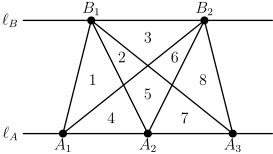
Let A\ell_A and B\ell_B be two distinct parallel lines. For positive integers mm and n,n, distinct points A1,A_1, A2,A_2, A3,A_3, ,\ldots, AmA_m lie on A,\ell_A, and distinct points B1,B_1, B2,B_2, B3,B_3, ,\ldots, BnB_n lie on B.\ell_B. Additionally, when segments AiBj\overline{A_iB_j} are drawn for all i=1,i = 1, 2,2, 3,3, ,\ldots, mm and j=1,j = 1, 2,2, 3,3, ,\ldots, n,n, no point strictly between A\ell_A and B\ell_B lies on more than two of the segments. Find the number of bounded regions into which this figure divides the plane when m=7m = 7 and n=5.n = 5. The figure shows that there are 88 regions when m=3m = 3 and n=2.n = 2.

Answer: 244
Difficulty rating: 2840
Small Hint:

Each choice of two AA’s and two BB’s produces exactly one interior crossing, so there are (72)(52)\binom{7}{2}\binom{5}{2} crossing points

Big Hint:

Use Euler’s formula VE+F=2:V - E + F = 2: each crossing splits two segments, so the segments contribute mn+2(m2)(n2)mn + 2\binom{m}{2}\binom{n}{2} edges

Solution:

Two segments AiBj\overline{A_iB_j} and AkBl\overline{A_kB_l} cross strictly between the lines exactly when one of the AA’s comes first and the other’s BB comes first, which happens for exactly one pairing of any two AA’s with any two BB’s. By the general-position hypothesis these crossings are distinct, so there are X=(m2)(n2)X = \binom{m}{2}\binom{n}{2} of them.

Clip the two lines to long segments and apply Euler’s formula. The vertices are the m+nm + n marked points, the XX crossings, and the 44 clipped line ends, so V=m+n+X+4.V = m + n + X + 4. Line A\ell_A is divided into m+1m + 1 edges and B\ell_B into n+1;n + 1; each crossing splits two segments, so the drawn segments contribute mn+2Xmn + 2X edges, giving E=mn+m+n+2X+2.E = mn + m + n + 2X + 2. Then F=EV+2=mn+X,F = E - V + 2 = mn + X, of which one face is unbounded, so there are mn+X1mn + X - 1 bounded regions. For m=3,m = 3, n=2n = 2 this gives 6+31=8,6 + 3 - 1 = 8, matching the figure.

For m=7m = 7 and n=5:n = 5: 35+(72)(52)135 + \binom{7}{2}\binom{5}{2} - 1 =35+21101= 35 + 21 \cdot 10 - 1 =244.= 244.

10.

Find the remainder when ((32)2)+((42)2)++((402)2)\binom{\binom{3}{2}}{2} + \binom{\binom{4}{2}}{2} + \cdots + \binom{\binom{40}{2}}{2} is divided by 1000.1000.

Answer: 4
Difficulty rating: 2650
Small Hint:

Expand: ((n2)2)\binom{\binom{n}{2}}{2} equals (n+1)n(n1)(n2)8,\frac{(n+1)n(n-1)(n-2)}{8}, a polynomial in nn

Big Hint:

That expression is 3(n+14);3\binom{n+1}{4}; sum it with the hockey stick identity

Solution:

Since (n2)=n(n1)2\binom{n}{2} = \frac{n(n-1)}{2} and (n2)1=(n+1)(n2)2,\binom{n}{2} - 1 = \frac{(n+1)(n-2)}{2}, ((n2)2)=12n(n1)2(n+1)(n2)2=(n+1)n(n1)(n2)8=3(n+14). \begin{aligned} \binom{\binom{n}{2}}{2} \\ &= \frac{1}{2} \cdot \frac{n(n-1)}{2} \\ &\quad {}\cdot \frac{(n+1)(n-2)}{2} \\ &= \small \frac{(n+1)n(n-1)(n-2)}{8} \\ &= 3\binom{n+1}{4}. \end{aligned}

By the hockey stick identity, n=3403(n+14)=3k=441(k4)=3(425)=3850668=2552004. \begin{aligned} \sum_{n=3}^{40} 3\binom{n+1}{4} &= 3\sum_{k=4}^{41}\binom{k}{4} \\ &= 3\binom{42}{5} \\ &= 3 \cdot 850668 \\ &= 2552004. \end{aligned}

The remainder upon division by 10001000 is 4.4.

11.

Let ABCDABCD be a convex quadrilateral with AB=2,AB = 2, AD=7,AD = 7, and CD=3CD = 3 such that the bisectors of acute angles DAB\angle DAB and ADC\angle ADC intersect at the midpoint of BC.\overline{BC}. Find the square of the area of ABCD.ABCD.

Answer: 180
Difficulty rating: 3160
Small Hint:

Reflect BB over the bisector from AA and CC over the bisector from D:D: both reflections land on AD\overline{AD}

Big Hint:

Since MB=MC,MB = MC, the midpoint MM is equidistant from the two reflections, which lie on AD\overline{AD} at distances 22 from AA and 33 from DD

Solution:

Place A=(0,0)A = (0, 0) and D=(7,0)D = (7, 0) with B,CB, C above the axis, and let MM be the midpoint of BC.\overline{BC}. Reflecting BB over the bisector line AMAM carries ray ABAB to ray AD,AD, so BB maps to B=(2,0),B' = (2, 0), and reflecting CC over the bisector DMDM gives C=(4,0).C' = (4, 0). Since MM lies on both mirror lines, MB=MB=MC=MC,MB' = MB = MC = MC', so MM is equidistant from BB' and CC' and hence M=(3,h)M = (3, h) for some h>0.h \gt 0.

Write DAB=2α\angle DAB = 2\alpha and ADC=2δ,\angle ADC = 2\delta, so tanα=h3\tan\alpha = \frac{h}{3} and tanδ=h4.\tan\delta = \frac{h}{4}. Then B=(2cos2α,2sin2α)B = (2\cos 2\alpha,\, 2\sin 2\alpha) and C=(73cos2δ,3sin2δ),C = (7 - 3\cos 2\delta,\, 3\sin 2\delta), and the midpoint condition on the xx-coordinates reads 2cos2α3cos2δ=1.2\cos 2\alpha - 3\cos 2\delta = -1. Substituting cos2α=9h29+h2\cos 2\alpha = \frac{9 - h^2}{9 + h^2} and cos2δ=16h216+h2\cos 2\delta = \frac{16 - h^2}{16 + h^2} and clearing denominators gives 2h4=10h2,2h^4 = 10h^2, so h2=5.h^2 = 5. (The yy-coordinate condition is then satisfied automatically: 2sin2α2\sin 2\alpha +3sin2δ{}+ 3\sin 2\delta =657+857= \frac{6\sqrt{5}}{7} + \frac{8\sqrt{5}}{7} =2h.= 2h.)

Now cos2α=27,\cos 2\alpha = \frac{2}{7}, sin2α=357,\sin 2\alpha = \frac{3\sqrt{5}}{7}, cos2δ=1121,\cos 2\delta = \frac{11}{21}, sin2δ=8521,\sin 2\delta = \frac{8\sqrt{5}}{21}, so B=(47,657)B = \left(\frac{4}{7}, \frac{6\sqrt{5}}{7}\right) and C=(387,857).C = \left(\frac{38}{7}, \frac{8\sqrt{5}}{7}\right). The shoelace formula on A,B,C,DA, B, C, D gives area 65,6\sqrt{5}, whose square is 180.180.

12.

Let a,a, b,b, x,x, and yy be real numbers with a>4a \gt 4 and b>1b \gt 1 such that x2a2+y2a216=(x20)2b21+(y11)2b2=1. \begin{aligned} \frac{x^2}{a^2} + \frac{y^2}{a^2 - 16} &= \frac{(x - 20)^2}{b^2 - 1} \\ &\quad {}+ \frac{(y - 11)^2}{b^2} \\ &= 1. \end{aligned} Find the least possible value of a+b.a + b.

Answer: 23
Difficulty rating: 3160
Small Hint:

Both equations are ellipses through a common point: the first has foci (±4,0),(\pm 4, 0), the second has foci (20,10)(20, 10) and (20,12)(20, 12)

Big Hint:

2a+2b2a + 2b is the sum of the four focal distances of the common point; pair the foci so the triangle inequality gives segments that actually intersect

Solution:

The first ellipse has c2=a2(a216)=16,c^2 = a^2 - (a^2 - 16) = 16, hence foci F1=(4,0)F_1 = (-4, 0) and F2=(4,0),F_2 = (4, 0), with distance sum 2a.2a. The second is centered at (20,11)(20, 11) with vertical major axis and c2=b2(b21)=1,c^2 = b^2 - (b^2 - 1) = 1, hence foci G1=(20,10)G_1 = (20, 10) and G2=(20,12),G_2 = (20, 12), with distance sum 2b.2b. If P=(x,y)P = (x, y) lies on both, then 2a+2b=(PF1+PG1)+(PF2+PG2)F1G1+F2G2=242+102+162+122=26+20=46, \begin{aligned} 2a + 2b \\ &= (PF_1 + PG_1) \\ &\quad {}+ (PF_2 + PG_2) \\ &\ge F_1G_1 + F_2G_2 \\ &= \sqrt{24^2 + 10^2} \\ &\quad {}+ \sqrt{16^2 + 12^2} \\ &= 26 + 20 \\ &= 46, \end{aligned} so a+b23.a + b \ge 23.

Equality requires PP to lie on both segments F1G1\overline{F_1G_1} and F2G2.\overline{F_2G_2}. These segments do intersect, at P=(14,152):P = \left(14, \frac{15}{2}\right): then PF1=392,PF_1 = \frac{39}{2}, PF2=252,PF_2 = \frac{25}{2}, so 2a=32,2a = 32, a=16>4;a = 16 \gt 4; and PG1=132,PG_1 = \frac{13}{2}, PG2=152,PG_2 = \frac{15}{2}, so 2b=14,2b = 14, b=7>1.b = 7 \gt 1.

Hence the least possible value of a+ba + b is 16+7=23.16 + 7 = 23.

13.

There is a polynomial P(x)P(x) with integer coefficients such that P(x)=(x23101)61(x1051)(x701)1(x421)(x301) \begin{aligned} P(x) &= (x^{2310}-1)^6 \\ &\quad {}\cdot \frac{1}{(x^{105}-1)(x^{70}-1)} \\ &\quad {}\cdot \frac{1}{(x^{42}-1)(x^{30}-1)} \end{aligned} holds for every 0<x<1.0 \lt x \lt 1. Find the coefficient of x2022x^{2022} in P(x).P(x).

Answer: 220
Difficulty rating: 3270
Small Hint:

Write P(x)=(1x2310)611xkP(x) = (1 - x^{2310})^6 \prod \frac{1}{1 - x^k} for k=105,70,42,30;k = 105, 70, 42, 30; since 2022<2310,2022 \lt 2310, the numerator contributes only its constant term

Big Hint:

Count solutions of 105a+70b+42c+30d=2022105a + 70b + 42c + 30d = 2022 by reducing modulo 2,3,5,72, 3, 5, 7 to pin down a,b,c,da, b, c, d modulo 2,3,5,72, 3, 5, 7

Solution:

For 0<x<1,0 \lt x \lt 1, P(x)=(1x2310)61(1x10⁵)(1x70)1(1x42)(1x30), \begin{aligned} P(x) &= (1-x^{2310})^6 \\ &\quad {}\cdot \frac{1}{(1-x^{105})(1-x^{70})} \\ &\quad {}\cdot \frac{1}{(1-x^{42})(1-x^{30})}, \end{aligned} and each factor 11xk\frac{1}{1 - x^k} expands as a geometric series. Since 2022<2310,2022 \lt 2310, the factor (1x2310)6(1 - x^{2310})^6 contributes only its constant term 1,1, so the coefficient of x2022x^{2022} is the number of nonnegative integer solutions of 105a+70b+42c+30d=2022.105a + 70b + 42c + 30d = 2022.

Reducing modulo 22 gives 105a2022,105a \equiv 2022, so aa is even; modulo 33 gives 70b20220,70b \equiv 2022 \equiv 0, so 33 divides b;b; modulo 55 gives 2c20222,2c \equiv 2022 \equiv 2, so c1(mod5);c \equiv 1 \pmod 5; modulo 77 gives 2d20226,2d \equiv 2022 \equiv 6, so d3(mod7).d \equiv 3 \pmod 7. Writing a=2a,a = 2a', b=3b,b = 3b', c=5c+1,c = 5c' + 1, d=7d+3d = 7d' + 3 turns the equation into 210(a+b+c+d)+42+90=2022, \begin{aligned} &210(a' + b' + c' + d') + 42 \\ &\quad {}+ 90 = 2022, \end{aligned} so a+b+c+d=9.a' + b' + c' + d' = 9.

By stars and bars there are (123)=220\binom{12}{3} = 220 solutions, so the coefficient is 220.220.

14.

For positive integers a,a, b,b, and cc with a<b<c,a \lt b \lt c, consider collections of postage stamps in denominations a,a, b,b, and cc cents that contain at least one stamp of each denomination. If there exists such a collection that contains sub-collections worth every whole number of cents up to 10001000 cents, let f(a,b,c)f(a, b, c) be the minimum number of stamps in such a collection. Find the sum of the three least values of cc such that f(a,b,c)=97f(a, b, c) = 97 for some choice of aa and b.b.

Answer: 188
Difficulty rating: 3500
Small Hint:

Making 11 cent forces a=1.a = 1. A collection works exactly when the ones reach b1,b - 1, the ones and bb’s together reach c1,c - 1, and the total value is at least 1000.1000.

Big Hint:

For fixed cc the stamp count is largest at b=c1,b = c - 1, where it equals c3+1003c;c - 3 + \lceil \frac{1003}{c} \rceil; for 12c8712 \le c \le 87 this never reaches 9797

Solution:

To form 11 cent we need a=1.a = 1. Suppose the collection has xx ones, yy stamps of b,b, and zz of c.c. The value b1b - 1 must be made from ones alone, so xb1;x \ge b - 1; the value c1c - 1 must be made from ones and bb’s, so x+ybc1;x + yb \ge c - 1; and the total x+yb+zcx + yb + zc must be at least 1000.1000. Conversely these three conditions suffice: with xb1x \ge b - 1 the ones and bb’s make every value up to x+yb,x + yb, and then cc’s extend this to every value up to the total. So the optimum takes x=b1,x = b - 1, then the least yy with x+ybc1,x + yb \ge c - 1, then the least zz reaching 1000.1000.

For fixed c,c, no bb can require more stamps than b=c1.b=c-1. Indeed, for any 2b<c,2\le b\lt c, take b1b-1 ones and cbc-b stamps of b.b. These c1c-1 lower-denomination stamps have total value b1+b(cb)2c3, b-1+b(c-b)\ge 2c-3, because the difference is (b2)(cb1)0.(b-2)(c-b-1)\ge0. Adding 1003c2\left\lceil\frac{1003}{c}\right\rceil-2 stamps of cc therefore gives a working collection of at most c3+1003cc-3+\left\lceil\frac{1003}{c}\right\rceil stamps. Equality is attained when b=c1:b=c-1: the mandatory c2c-2 ones and one c1c-1 stamp have value 2c3,2c-3, and stamps of value at most cc cannot reach 10001000 with fewer than c3+1003c c-3+\left\lceil\frac{1003}{c}\right\rceil stamps in total.

For 12c87,12\le c\le87, the endpoint bounds c(99c)1003c(99-c)\ge1003 give 1003c99c,\left\lceil\frac{1003}{c}\right\rceil\le99-c, so this maximum is at most 9696 and no bb gives 97.97. For c10,c\le10, any 9797 stamps have total value at most 97c970,97c\le970, so they cannot cover every value through 1000.1000.

For c=11,c = 11, taking b=7b = 7 gives 66 ones, one 77 (reaching 131013 \ge 10), and 98711=90\left\lceil \frac{987}{11} \right\rceil = 90 elevens: f(1,7,11)=6+1+90=97.f(1, 7, 11) = 6 + 1 + 90 = 97. For c=88c = 88 and c=89,c = 89, taking b=87b = 87 gives 8686 ones, one 8787 (reaching 173173), and 82788=82789=10\left\lceil \frac{827}{88} \right\rceil = \left\lceil \frac{827}{89} \right\rceil = 10 stamps of c,c, for 86+1+10=9786 + 1 + 10 = 97 in both cases. So the three least values of cc are 11,88,89,11, 88, 89, with sum 188.188.

15.

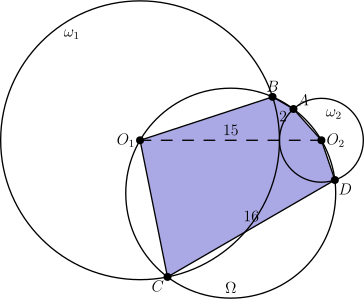
Two externally tangent circles ω1\omega_1 and ω2\omega_2 have centers O1O_1 and O2,O_2, respectively. A third circle Ω\Omega passing through O1O_1 and O2O_2 intersects ω1\omega_1 at BB and CC and ω2\omega_2 at AA and D,D, as shown. Suppose that AB=2,AB = 2, O1O2=15,O_1O_2 = 15, CD=16,CD = 16, and ABO1CDO2ABO_1CDO_2 is a convex hexagon. Find the area of this hexagon.
Answer: 140
Difficulty rating: 3700
Small Hint:

All six vertices lie on Ω,\Omega, and O1B=O1C=r1O_1B = O_1C = r_1 and O2A=O2D=r2O_2A = O_2D = r_2 are chords of Ω\Omega with r1+r2=15r_1 + r_2 = 15

Big Hint:

Write each chord as 2Rsin(half its arc),2R\sin(\text{half its arc}), then add and subtract the 1616 and 22 equations with sum-to-product, using both facts worth 1515

Solution:

All six hexagon vertices lie on Ω:\Omega: O1O_1 and O2O_2 by hypothesis, and A,B,C,DA, B, C, D as intersection points with Ω.\Omega. Let RR be the radius of Ω,\Omega, and let the arcs cut off by the sides AB,AB, BO1,BO_1, O1C,O_1C, CD,CD, DO2,DO_2, O2AO_2A be 2α,2β,2β,2γ,2δ,2δ2\alpha, 2\beta, 2\beta, 2\gamma, 2\delta, 2\delta (the two β\beta’s because chords BO1=O1C=r1,BO_1 = O_1C = r_1, the radius of ω1,\omega_1, and likewise O2A=O2D=r2O_2A = O_2D = r_2), so α+2β+γ+2δ=π.\alpha + 2\beta + \gamma + 2\delta = \pi. Each chord equals 2Rsin(half its arc):2R\sin(\text{half its arc}): 2Rsinα=2,2R\sin\alpha = 2, 2Rsinγ=16,2R\sin\gamma = 16, and the chord O1O2\overline{O_1O_2} subtends 2β+2γ+2δ,2\beta + 2\gamma + 2\delta, giving 2Rsin(α+σ)=152R\sin(\alpha + \sigma) = 15 where σ=β+δ.\sigma = \beta + \delta. External tangency gives a second equation worth 15:15: r1+r2=2R(sinβ+sinδ)=15.r_1 + r_2 = 2R(\sin\beta + \sin\delta) = 15.

Since γ=πα2σ,\gamma = \pi - \alpha - 2\sigma, we have sinγ=sin(α+2σ).\sin\gamma = \sin(\alpha + 2\sigma). Sum-to-product then gives 18=2R[sin(α+2σ)+sinα]=4Rsin(α+σ)cosσ=30cosσ, \begin{aligned} 18 &= 2R\left[\sin(\alpha + 2\sigma) + \sin\alpha\right] \\ &= 4R\sin(\alpha + \sigma)\cos\sigma \\ &= 30\cos\sigma, \end{aligned} so cosσ=35,\cos\sigma = \frac{3}{5}, and similarly 14=4Rcos(α+σ)sinσ14 = 4R\cos(\alpha + \sigma)\sin\sigma gives Rcos(α+σ)=358.R\cos(\alpha + \sigma) = \frac{35}{8}. Combining with 2Rsin(α+σ)=152R\sin(\alpha + \sigma) = 15 yields 4R2=225+122516,4R^2 = 225 + \frac{1225}{16}, so R2=482564.R^2 = \frac{4825}{64}. Also 15=2R(sinβ+sinδ)15 = 2R(\sin\beta + \sin\delta) =4Rsinσ2cosβδ2= 4R\sin\frac{\sigma}{2}\cos\frac{\beta - \delta}{2} with sinσ2=15,\sin\frac{\sigma}{2} = \frac{1}{\sqrt{5}}, so cosβδ2=1554R\cos\frac{\beta - \delta}{2} = \frac{15\sqrt{5}}{4R} and cos(βδ)=11258R21.\cos(\beta - \delta) = \frac{1125}{8R^2} - 1.

Joining the center of Ω\Omega to the six vertices splits the hexagon into six triangles, so its area is 12R2\frac{1}{2}R^2 [sin2α+2sin2β+2sin2δ+sin2γ].{}\cdot \small \left[\sin 2\alpha + 2\sin 2\beta + 2\sin 2\delta + \sin 2\gamma\right]. Now R2(sin2β+sin2δ)R^2(\sin 2\beta + \sin 2\delta) =2R2sinσcos(βδ)= 2R^2 \sin\sigma\cos(\beta - \delta) =85(11258R2)= \frac{8}{5}\left(\frac{1125}{8} - R^2\right) =8358,= \frac{835}{8}, while sin2α+sin2γ\sin 2\alpha + \sin 2\gamma =2sin2σcos(2(α+σ))= -2\sin 2\sigma \cos\bigl(2(\alpha + \sigma)\bigr) =22425(95193)= -2 \cdot \frac{24}{25} \cdot \left(-\frac{95}{193}\right) since cos(2(α+σ))=122254R2\cos\bigl(2(\alpha+\sigma)\bigr) = 1 - \frac{2 \cdot 225}{4R^2} =95193,= -\frac{95}{193}, so 12R2(sin2α+sin2γ)\frac{1}{2}R^2(\sin 2\alpha + \sin 2\gamma) =12482564912965= \frac{1}{2} \cdot \frac{4825}{64} \cdot \frac{912}{965} =2858.= \frac{285}{8}. The area is 8358+2858=140.\frac{835}{8} + \frac{285}{8} = 140.