
2013 AIME I Problems
Scroll down and press Start to try the exam! Or, go to the printable PDF, answer key, or professional solutions curated by LIVE by Po-Shen Loh.
All problems are used with official legal permission of the Mathematical Association of America (MAA).
Or jump straight to a single problem with its solution: 1 · 2 · 3 · 4 · 5 · 6 · 7 · 8 · 9 · 10 · 11 · 12 · 13 · 14 · 15
Want to learn professionally through interactive video classes?
Timed
3:00:00
1.
The AIME Triathlon consists of a half-mile swim, a -mile bicycle ride, and an eight-mile run. Tom swims, bicycles, and runs at constant rates. He runs five times as fast as he swims, and he bicycles twice as fast as he runs. Tom completes the AIME Triathlon in four and a quarter hours. How many minutes does he spend bicycling?
Answer: 150
Small Hint:
Tom runs times as fast as he swims and bicycles times as fast, so write each leg’s time using only his swimming speed
Big Hint:
The total time is hours; solve for the swimming speed
Solution:
Let Tom’s swimming speed be miles per hour. Then he runs at and bicycles at The total time in hours is so miles per hour.
He bicycles at miles per hour, so the ride takes hours, which is minutes.
2.
Find the number of five-digit positive integers, that satisfy the following conditions:
• the number is divisible by
• the first and last digits of are equal, and
• the sum of the digits of is divisible by
Answer: 200
Small Hint:
Divisibility by makes the last digit or and the first digit cannot be
Big Hint:
With both outer digits pick the second and third digits freely; exactly values of the fourth digit make the digit sum a multiple of
Solution:
Since is divisible by its last digit is or since the first digit equals the last digit and cannot be both are The outer digits contribute to the digit sum, so the three middle digits must also sum to a multiple of
Choose the second and third digits freely, in ways. Whatever their sum is, the fourth digit must land in a prescribed residue class modulo and exactly of the digits through lie in each class. The count is
3.
Let be a square, and let and be points on and respectively. The line through parallel to and the line through parallel to divide into two squares and two nonsquare rectangles. The sum of the areas of the two squares is of the area of square Find
Answer: 18
Small Hint:
Let and the two squares then have sides and and has side
Big Hint:
Expand and notice that the requested quantity equals
Solution:
Let and so the square has side and the two smaller squares have sides and The condition says Multiplying by and expanding, so
Dividing by gives
4.
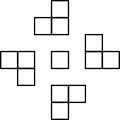
In the array of squares shown below, squares are colored red, and the remaining squares are colored blue. If one of all possible such colorings is chosen at random, the probability that the chosen colored array appears the same when rotated around the central square is where is a positive integer. Find
Answer: 429
Small Hint:
A coloring unchanged by the rotation is determined by one L-shaped arm: the four arms must be colored identically
Big Hint:
To get red and blue, the center must be blue and each arm needs red and blue; compare with total colorings
Solution:
The rotation cycles the four L-shaped arms, so a symmetric coloring colors all four arms identically, and the outer squares contain copies of whatever the arm shows. The number of red squares among the outer twelve is therefore a multiple of Since there are red squares in all, the center must be blue and each arm must contain exactly red squares and blue square.
The blue square within the arm can be chosen in ways, so exactly of the equally likely colorings are symmetric. The probability is so
5.
The real root of the equation can be written in the form where and are positive integers. Find
Answer: 98
Small Hint:
Move to one side: the equation becomes
Big Hint:
Take cube roots to get then rationalize using
Solution:
Rewrite the equation as Taking real cube roots, so
Multiply numerator and denominator by the denominator becomes so Thus
6.
Melinda has three empty boxes and textbooks, three of which are mathematics textbooks. One box will hold any three of her textbooks, one will hold any four of her textbooks, and one will hold any five of her textbooks. If Melinda packs her textbooks into these boxes in random order, the probability that all three mathematics textbooks end up in the same box can be written as where and are relatively prime positive integers. Find
Answer: 47
Small Hint:
Compute separately the probability that all three math books land in the -box, the -box, and the -box
Big Hint:
For the box holding books, that probability is add the three fractions
Solution:
Focus on one box at a time. The box of books receives a uniformly random -subset of the books, so the probability that it contains all three math books is For and this gives and
The events are disjoint, so the total probability is and
7.
A rectangular box has width inches, length inches, and height inches, where and are relatively prime positive integers. Three faces of the box meet at a corner of the box. The center points of those three faces are the vertices of a triangle with an area of square inches. Find
Answer: 41
Small Hint:
Place the corner at the origin so the box is and write down the three face centers
Big Hint:
The centers are a cross product gives the triangle’s area as
Solution:
Let the height be and place the corner at the origin, so the box is The three faces meeting at the origin have centers and
Then and whose cross product is The area is so and
Therefore
8.
The domain of the function is a closed interval of length where and are positive integers and Find the remainder when the smallest possible sum is divided by
Answer: 371
Small Hint:
The domain requires so runs over which has length
Big Hint:
Then Since must divide and the smallest minimizes the sum.
Solution:
The function is defined when that is so the domain is with length Hence Since is relatively prime to must divide
Because the sum grows with so take the smallest factor then and
The remainder upon division by is
9.
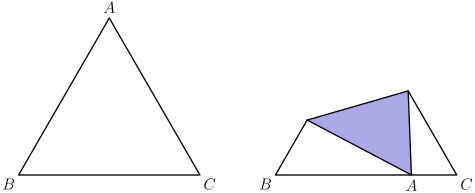
A paper equilateral triangle has side length The paper triangle is folded so that vertex touches a point on side a distance from point The length of the line segment along which the triangle is folded can be written as where and are positive integers, and are relatively prime, and is not divisible by the square of any prime. Find
Answer: 113
Small Hint:
Folding preserves distances: if the crease meets at then is equidistant from and from the landing point on
Big Hint:
The law of cosines in the corner triangles at and locates both crease endpoints; then apply the law of cosines once more at
Solution:
Let be the landing point, with and and let the crease meet at and at Folding preserves distances, so and In triangle with and the law of cosines gives which simplifies to so Similarly, in triangle gives so
Finally, in triangle with so Thus
10.
There are nonzero integers and such that the complex number is a zero of the polynomial For each possible combination of and let be the sum of the zeros of Find the sum of the ’s for all possible combinations of and
Answer: 80
Small Hint:
Real coefficients force the zeros to be and a real with
Big Hint:
List the ways a factor of is a sum of two nonzero squares; for each, the choices cancel in the sum, leaving only the ’s
Solution:
Since has real coefficients, is also a zero, and the third zero is real. The sum of the zeros is so is a nonzero integer. Their product is so is a factor of With and nonzero, the possibilities are (with ), (with ), and (with ).
For each representation the zero can have or giving distinct polynomials (the sign of changes nothing). The sum of the zeros is and over the four choices the terms cancel, leaving from each representation.
The total is
11.
Ms. Math’s kindergarten class has registered students. The classroom has a very large number, of play blocks which satisfies the conditions:
• If or students are present in the class, then in each case all the blocks can be distributed in equal numbers to each student, and
• There are three integers such that when or students are present and the blocks are distributed in equal numbers to each student, there are exactly three blocks left over.
Find the sum of the distinct prime divisors of the least possible value of satisfying the above conditions.
Answer: 148
Small Hint:
is a multiple of and every positive integer below except and divides
Big Hint:
So and must be and solve modulo and by the Chinese remainder theorem
Solution:
Divisibility by and means where Every positive integer less than divides except and and a divisor of leaves remainder not So necessarily and we need modulo each of
Since the first congruence is i.e. Since we need i.e. Since we need By the Chinese remainder theorem these combine to so the least is
Then and since is prime, the sum of the distinct prime divisors is
12.
Let be a triangle with and A regular hexagon with side length is drawn inside so that side lies on side lies on and one of the remaining vertices lies on There are positive integers and such that the area of can be expressed in the form where and are relatively prime, and is not divisible by the square of any prime. Find
Answer: 21
Small Hint:
The hexagon’s angles make the corner triangle at equilateral, so set up coordinates with at the origin and along the -axis
Big Hint:
Vertex sits directly above at height and the line through gives
Solution:
Note Because the hexagon’s interior angles are segment cuts off a corner triangle at with two base angles, so triangle is equilateral and Put at the origin with along the positive -axis. Then and the hexagon’s vertices are
Since line has slope If it passed through it would be which puts (with ) outside the triangle; so the vertex on is and is the line It meets the -axis at and the line (line ) where giving height
The area is so
13.
Triangle has side lengths and For each positive integer points and are located on and respectively, creating three similar triangles The area of the union of all triangles for can be expressed as where and are relatively prime positive integers. Find
Answer: 961
Small Hint:
Match up corresponding sides: has ratio
Big Hint:
With triangle has ratio so the disjoint triangles’ areas form a geometric series with first term and ratio
Solution:
By Heron’s formula with the area of is In the similarity side corresponds to so the ratio is and (corresponding to ) equals Hence which is the similarity ratio of to
Segments and split into the three pieces, so Each successive stage repeats the construction inside scaling all areas by and the triangles have disjoint interiors.
The union’s area is the geometric series Since shares no factor with the answer is
14.
For let and so that Then where and are relatively prime positive integers. Find
Answer: 36
Small Hint:
Combine the two series as the terms become a geometric series with ratio
Big Hint:
Summing gives Set it equal to square, and keep the root with
Solution:
The signs and the alternation between sines and cosines suggest powers of indeed Since multiplying by the conjugate gives so
Setting and squaring, which rearranges to
Since forces we get (and then consistent with the positive ratio). Thus
15.
Let be the number of ordered triples of integers satisfying the conditions
•
• there exist integers and and prime where
• divides and and
• each ordered triple and each ordered triple form arithmetic sequences.
Find
Answer: 272
Small Hint:
If and are the common differences of and then mod both and so is divisible by
Big Hint:
Since that forces and count triples with
Solution:
Let be the common difference of so and whence Let be the common difference of Reducing mod we get and so is divisible by Since the prime cannot divide so then gives and
So the valid triples are exactly the increasing arithmetic progressions in with Write with the difference satisfies so with The constraint is i.e. and every such pair works.
For each there are choices of so