
2002 AIME II Problems
Scroll down and press Start to try the exam! Or, go to the printable PDF, answer key, or professional solutions curated by LIVE by Po-Shen Loh.
All problems are used with official legal permission of the Mathematical Association of America (MAA).
Or jump straight to a single problem with its solution: 1 · 2 · 3 · 4 · 5 · 6 · 7 · 8 · 9 · 10 · 11 · 12 · 13 · 14 · 15
Want to learn professionally through interactive video classes?
Timed
3:00:00
1.
Given that
and are both integers between and inclusive;
is the number formed by reversing the digits of and
How many distinct values of are possible?
Answer: 9
Small Hint:
Write then and compute
Big Hint:
and both and are at least because and are both three-digit numbers
Solution:
Write with digits Then so
Since both and are three-digit numbers, both and run from to so can be any of Each choice gives a different multiple of so there are distinct values of
2.
Three of the vertices of a cube are and What is the surface area of the cube?
Answer: 294
Small Hint:
Compute the three pairwise distances and
Big Hint:
Three mutually equidistant vertices of a cube are joined by face diagonals, and a face diagonal of a cube with edge has length
Solution:
Compute the squared distances: and So and form an equilateral triangle with side
Three mutually equidistant vertices of a cube must be joined by face diagonals, and a face diagonal of a cube with edge has length Thus and the surface area is
3.
It is given that where and are positive integers that form an increasing geometric sequence and is the square of an integer. Find
Answer: 111
Small Hint:
Combine the logs: In a geometric sequence so
Big Hint:
With write and require that divide
Solution:
Adding the logs gives so In a geometric sequence hence so and
Since the sequence is increasing, is a positive perfect square, so for some giving candidates Also must divide and of the candidates only does, with
Indeed is geometric with ratio and
4.
Patio blocks that are regular hexagons unit on a side are used to outline a garden by placing the blocks edge to edge with on each side. The diagram indicates the path of blocks around the garden when
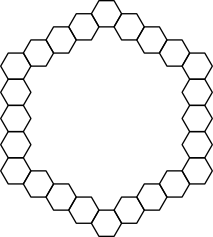
If then the area of the garden enclosed by the path, not including the path itself, is square units, where is a positive integer. Find the remainder when is divided by
Answer: 803
Small Hint:
The garden is itself a hexagonal block of unit hexagons with on each side; count it as a center hexagon plus rings of
Big Hint:
The garden holds hexagons, and each unit hexagon is equilateral triangles of side
Solution:
The garden enclosed by the path is itself a hexagonal arrangement of unit hexagons with on each side. Counting from the center outward in rings of hexagons, it contains blocks, which for is
Each unit hexagon consists of equilateral triangles of side so its area is The garden’s area is therefore times so and the remainder upon division by is
5.
Find the sum of all positive integers where and are non-negative integers, for which is not a divisor of
Answer: 42
Small Hint:
so fails to divide exactly when or
Big Hint:
If and are both at least then and so only pure powers of or of can work
Solution:
With which fails to be an integer exactly when or
If then (since ) and similarly so no such works. If the condition is which holds for giving If the condition is which holds for giving (For the condition fails.)
The sum is
6.
Find the integer that is closest to
Answer: 521
Small Hint:
Factor and use partial fractions to make the sum telescope
Big Hint:
Only survive at the front, minus four tiny tail terms near
Solution:
Since the sum telescopes:
Let be times the sum of the four positive tail fractions. Then The value of the expression is so it lies strictly between and Hence the closest integer is
7.
It is known that, for all positive integers Find the smallest positive integer such that is a multiple of
Answer: 112
Small Hint:
You need to be a multiple of and the factor comes for free
Big Hint:
is odd, so must divide or separately must divide or Compare the smallest solutions of the combined congruences.
Solution:
The sum is a multiple of exactly when is a multiple of The factor always divides (if then is divisible by ), so only and matter.
Since is odd and cannot both be even, must divide or so or Similarly must divide one of giving or Combining each pair of congruences modulo the smallest positive solutions are and
The least is indeed is a multiple of
8.
Find the least positive integer for which the equation has no integer solutions for (The notation means the greatest integer less than or equal to )
Answer: 49
Small Hint:
has a solution exactly when some integer lies in
Big Hint:
That interval has length so it always contains an integer when Then compute for
Solution:
The value is attained exactly when some integer satisfies that is, when the interval contains an integer. Its length is which is at least whenever — so every is attained.
For larger check directly: give Since and the value is never attained, so the least such is
9.
Let be the set Let be the number of sets of two non-empty disjoint subsets of (Disjoint sets are defined as sets that have no common elements.) Find the remainder obtained when is divided by
Answer: 501
Small Hint:
Build an ordered pair of disjoint subsets by sending each of the elements to to or to neither
Big Hint:
Subtract the pairs where or is empty by inclusion-exclusion, then divide by to make the pairs unordered
Solution:
Count ordered pairs of disjoint subsets first: each of the elements goes in in or in neither, for pairs. Among these, have empty and have empty, with the pair counted in both, so ordered pairs have both subsets non-empty.
Disjoint non-empty subsets are never equal, so each set is counted twice, giving The remainder mod is
10.
While finding the sine of a certain angle, an absent-minded professor failed to notice that his calculator was not in the correct angular mode. He was lucky to get the right answer. The two least positive real values of for which the sine of degrees is the same as the sine of radians are and where and are positive integers. Find
Answer: 900
Small Hint:
degrees is radians, so solve
Big Hint:
Two angles have equal sines when they differ by a multiple of or add up to plus a multiple of take the smallest positive case of each
Solution:
An angle of degrees is radians, so we need Two angles have equal sines exactly when they differ by a multiple of or sum to plus a multiple of
The first case gives so with least positive value The second gives so with least positive value The next value in the second family is three times its first and therefore exceeds the first family’s least value; all later values are larger. Thus these are the two smallest solutions.
Matching and gives so
11.
Two distinct, real, infinite geometric series each have a sum of and have the same second term. The third term of one of the series is and the second term of both series can be written in the form where and are positive integers and is not divisible by the square of any prime. Find
Answer: 518
Small Hint:
A geometric series with ratio and sum has first term so its second term is
Big Hint:
Equal second terms force the ratios to satisfy then becomes a cubic that factors after substituting
Solution:
A geometric series with ratio and sum has first term so its second term is If the two ratios are and then gives and since the series are distinct, forcing
Say the series with ratio has third term i.e. Substituting gives The root makes (the series would coincide), and forces which diverges. So
The common second term is so and
12.
A basketball player has a constant probability of of making any given shot, independent of previous shots. Let be the ratio of shots made to shots attempted after shots. The probability that and for all such that is given to be where and are primes, and and are positive integers. Find
Answer: 660
Small Hint:
Track (shots attempted, shots made) as a lattice path; the condition caps the number made at after each shot
Big Hint:
Count the constrained paths to by adding the counts of the two predecessors at each point; every valid sequence has probability
Solution:
Record the player’s progress as a path through points where is the number of shots made after attempts. The condition caps at which for is and means the path ends at
Count the allowed paths by adding, at each point, the counts of its two predecessors (a miss keeps a make raises it by ). The counts at the maximum allowed heights for come out to and the tenth shot must be a make, so shot sequences qualify. Each consists of makes and misses, so the probability is
Thus and giving
13.
In triangle point is on with and point is on with and and and intersect at Points and lie on so that is parallel to and is parallel to It is given that the ratio of the area of triangle to the area of triangle is where and are relatively prime positive integers. Find
Answer: 901
Small Hint:
Mass points: masses at balance both cevians and locate extend to meet at
Big Hint:
Triangle is the image of triangle under the homothety centered at taking to so the area ratio is
Solution:
Assign masses at at and at Then balances () and balances (), so the cevians and meet at the center of mass of total mass Extending to meet at the mass at is so on segment we get that is,
The homothety centered at with ratio sends to and maps line to itself; it carries line to the parallel line through — which is line — and line to line Hence it maps triangle onto triangle and
Since the answer is
14.
The perimeter of triangle is and angle is a right angle. A circle of radius with center on is drawn so that it is tangent to and Given that where and are relatively prime positive integers, find
Answer: 98
Small Hint:
The circle touches at itself, so the tangents from give where is the tangency point on
Big Hint:
Right triangles and are similar, and the small one’s perimeter is comparing perimeter ratios gives an equation in alone
Solution:
Let be the point where the circle touches Since and lies on at a distance from line equal to the circle is tangent to at itself, so the two tangents from give Right triangles and (right angles at and ) share angle so they are similar with ratio
The small triangle’s perimeter is and since Perimeters of similar triangles are in the ratio of similarity, so which simplifies to Thus
The ratio of similarity is then so From the perimeter, and so giving and Hence
15.
Circles and intersect at two points, one of which is and the product of their radii is The -axis and the line where are tangent to both circles. It is given that can be written in the form where and are positive integers, is not divisible by the square of any prime, and and are relatively prime. Find
Answer: 282
Small Hint:
Both centers lie on the bisector of the angle between the two tangent lines; if the angle from the -axis to the bisector is then and each radius is
Big Hint:
Plugging into the circle equation gives the same quadratic in for both centers, so by Vieta; combine with
Solution:
Both circles are tangent to the -axis and to so both centers lie on the bisector of the first-quadrant angle between those lines. If the angle from the -axis to the bisector is then and each center has the form with radius (its distance to the -axis).
Since lies on each circle, which expands to Both and satisfy this one quadratic, so by Vieta’s formulas Then so and
Finally, so