
Soluciones del 1974 AMC 12
Desplázate hacia abajo para ver las soluciones preparadas profesionalmente de LIVE by Po-Shen Loh, imprime las soluciones en PDF, consulta la clave de respuestas, o haz el examen cronometrado completo.
Todos los problemas se usan con el permiso legal oficial de la Mathematical Association of America (MAA).
1.
Si y tampoco es , y y tampoco es entonces es equivalente a
If or and or then is equivalent to
ninguna de estas
none of these
Pista pequeña:
Elimina los tres denominadores a la vez
Clear all three denominators at once
Pista grande:
Después de multiplicar por aísla los términos que contienen y factoriza
After multiplying by isolate the terms containing and factor
Solución:
Al multiplicar por , se obtiene de modo que Como
Por lo tanto, la respuesta correcta es D.
Multiplying by gives so Since
Therefore, the correct answer is D.
2.
Sean y tales que y para Entonces es igual a
Let and be such that and Then equals
Pista pequeña:
Los dos números dados satisfacen la misma ecuación cuadrática
Both given numbers satisfy the same quadratic equation
Pista grande:
Pasa al lado izquierdo y usa la fórmula de la suma de las raíces
Move to the left and use the sum-of-roots formula
Solución:
Los números distintos son las dos raíces de Por las fórmulas de Vieta, su suma es
Por lo tanto, la respuesta correcta es B.
The distinct numbers are the two roots of By Vieta’s formulas, their sum is
Therefore, the correct answer is B.
3.
El coeficiente de en la expansión polinómica de es
The coefficient of in the polynomial expansion of is
ninguna de estas
none of these
Pista pequeña:
Un término de grado debe seleccionar grados de los cuatro factores
A degree- term must select degrees from the four factors
Pista grande:
Elige qué factor aporta ; los otros tres aportan
Choose which factor contributes ; the other three contribute
Solución:
La única manera de que los cuatro términos seleccionados tengan grado total es elegir una vez y tres veces. Hay opciones para el primer término, así que el coeficiente es
Por lo tanto, la respuesta correcta es A.
The only way four selected terms can have total degree is to choose once and three times. There are choices for the first factor, so the coefficient is
Therefore, the correct answer is A.
4.
¿Cuál es el residuo al dividir entre ?
What is the remainder when is divided by
Pista pequeña:
Para dividir entre evalúa el polinomio en
For division by evaluate the polynomial at
Pista grande:
El exponente es impar
The exponent is odd
Solución:
Por el teorema del residuo, el residuo es
Por lo tanto, la respuesta correcta es D.
By the polynomial remainder theorem, the remainder is
Therefore, the correct answer is D.
5.
Un cuadrilátero está inscrito en un círculo y el lado se prolonga más allá de hasta el punto Si y halla
Given a quadrilateral inscribed in a circle with side extended beyond to point if and find
Pista pequeña:
Los ángulos opuestos de un cuadrilátero cíclico son suplementarios
Opposite angles of a cyclic quadrilateral are supplementary
Pista grande:
El ángulo exterior buscado también es suplementario de
The desired exterior angle is also supplementary to
Solución:
Como es cíclico, Puesto que prolonga a también se cumple . Por consiguiente, El ángulo dado de no es necesario.
Por lo tanto, la respuesta correcta es B.
Because is cyclic, Since extends as well. Hence The given angle is unnecessary.
Therefore, the correct answer is B.
6.
Para números reales positivos e , se define entonces
For positive real numbers and define then
“” es conmutativa, pero no asociativa
“” is commutative but not associative
“” es asociativa, pero no conmutativa
“” is associative but not commutative
“” no es conmutativa ni asociativa
“” is neither commutative nor associative
“” es conmutativa y asociativa
“” is commutative and associative
ninguna de estas
none of these
Pista pequeña:
La fórmula no cambia al intercambiar e
The formula is visibly unchanged when and are interchanged
Pista grande:
Reescribe la operación mediante su recíproco:
Rewrite the operation through its reciprocal:
Solución:
La simetría en hace que la operación sea conmutativa. Además, Así, tanto como tienen por recíproco por lo que son iguales. La operación también es asociativa.
Por lo tanto, la respuesta correcta es D.
Symmetry in makes the operation commutative. Also, Thus both and have reciprocal so they are equal. The operation is associative too.
Therefore, the correct answer is D.
7.
La población de un pueblo aumentó en personas y luego esta nueva población disminuyó un El pueblo tenía entonces personas menos que antes del aumento de . ¿Cuál era la población original?
A town’s population increased by people, and then this new population decreased by The town now had less people than it did before the increase. What is the original population?
ninguna de estas
none of these
Pista pequeña:
Sea la población original y aplica la disminución a
Let be the original population and apply the decrease to
Pista grande:
La población final es a la vez y
The final population is both and
Solución:
Sea la población original. Entonces Por lo tanto, de donde
Por lo tanto, la respuesta correcta es D.
Let the original population be Then Therefore giving
Therefore, the correct answer is D.
8.
¿Cuál es el menor número primo que divide la suma ?
What is the smallest prime number dividing the sum
ninguna de estas
none of these
Pista pequeña:
Ambas bases son impares
Both bases are odd
Pista grande:
La suma de dos enteros impares es divisible por el menor primo
The sum of two odd integers is divisible by the smallest prime
Solución:
Tanto como son impares, así que su suma es par. Por tanto, es divisible por el menor número primo.
Por lo tanto, la respuesta correcta es A.
Both and are odd, so their sum is even. Hence it is divisible by the smallest prime.
Therefore, the correct answer is A.
9.
Los enteros mayores que uno se ordenan en cinco columnas como sigue:
(En cada fila aparecen cuatro enteros consecutivos; en la primera, tercera y demás filas impares, los enteros ocupan las últimas cuatro columnas y aumentan de izquierda a derecha; en la segunda, cuarta y demás filas pares, ocupan las primeras cuatro columnas y aumentan de derecha a izquierda.)
¿En qué columna aparecerá el número ?
The integers greater than one are arranged in five columns as follows:
(Four consecutive integers appear in each row; in the first, third and other odd numbered rows, the integers appear in the last four columns and increase from left to right; in the second, fourth and other even numbered rows, the integers appear in the first four columns and increase from right to left.)
In which column will the number fall?
primera
first
segunda
second
tercera
third
cuarta
fourth
quinta
fifth
Pista pequeña:
Observa dónde aparecen los múltiplos de mostrados
Look at where the displayed multiples of occur
Pista grande:
Cada ciclo de dos filas contiene ocho enteros consecutivos
Each two-row cycle contains eight consecutive integers
Solución:
Cada par de filas forma un bloque repetitivo de ocho enteros. En cada bloque, su múltiplo de está en la segunda columna, como ocurre con y Como también está en la segunda columna.
Por lo tanto, la respuesta correcta es B.
Each pair of rows is a repeating block of eight integers. In every such block, its multiple of lies in the second column, as do and Since it also lies in the second column.
Therefore, the correct answer is B.
10.
¿Cuál es el menor valor entero de para el cual no tiene raíces reales?
What is the smallest integral value of such that has no real roots?
Pista pequeña:
Primero reescribe la ecuación en la forma cuadrática estándar
First rewrite the equation in standard quadratic form
Pista grande:
No tener raíces reales significa que el discriminante es negativo
No real roots means the discriminant is negative
Solución:
La ecuación es Su discriminante es Este es negativo exactamente cuando así que el menor entero posible es
Por lo tanto, la respuesta correcta es B.
The equation is Its discriminant is This is negative exactly when so the least integer possible is
Therefore, the correct answer is B.
11.
Si y son dos puntos de la recta cuya ecuación es entonces la distancia entre y en términos de y es
If and are two points on the line whose equation is then the distance between and in terms of and is
Pista pequeña:
Usa la ecuación de la recta para expresar en términos de
Use the line equation to express in terms of
Pista grande:
Sustituye en la fórmula de la distancia
Substitute into the distance formula
Solución:
Como ambos puntos están en la recta, Por lo tanto, su distancia es
Por lo tanto, la respuesta correcta es A.
Since both points are on the line, Their distance is therefore
Therefore, the correct answer is A.
12.
Si y cuando entonces es igual a
If and when then equals
Pista pequeña:
Elige un no nulo para el cual
Choose a nonzero for which
Pista grande:
La ecuación determina directamente
The equation determines directly
Solución:
Si entonces y cualquiera de los valores correspondientes de es no nulo. Por tanto,
Por lo tanto, la respuesta correcta es B.
If then and either corresponding is nonzero. Hence
Therefore, the correct answer is B.
13.
¿Cuál de las siguientes proposiciones equivale a «Si es verdadera, entonces es falsa»?
Which of the following is equivalent to “If is true then is false”?
« es verdadera o es falsa».
“ is true or is false.”
«Si es falsa, entonces es verdadera».
“If is false then is true.”
«Si es falsa, entonces es verdadera».
“If is false then is true.”
«Si es verdadera, entonces es falsa».
“If is true then is false.”
«Si es verdadera, entonces es verdadera».
“If is true then is true.”
Pista pequeña:
Una implicación equivale a su contrapositiva
An implication is equivalent to its contrapositive
Pista grande:
Invierte la implicación y niega tanto « verdadera» como « falsa»
Reverse the implication and negate both “ true” and “ false”
Solución:
La contrapositiva de « verdadera implica falsa» es « no falsa implica no verdadera». Esto es exactamente «Si es verdadera, entonces es falsa».
Por lo tanto, la respuesta correcta es D.
The contrapositive of “ true implies false” is “ not false implies not true.” This is exactly “If is true then is false.”
Therefore, the correct answer is D.
14.
¿Cuál afirmación es correcta?
Which statement is correct?
Si entonces
If then
Si entonces
If then
Si entonces
If then
Si entonces
If then
Si entonces
If then
Pista pequeña:
Para un negativo, compara primero con cero
For a negative compare first with zero
Pista grande:
Valores de prueba sencillos como y descartan las demás implicaciones
Simple test values such as and reject the other implications
Solución:
Si entonces de modo que la opción A siempre se cumple. Los valores y refutan, respectivamente, B, C, D y E.
Por lo tanto, la respuesta correcta es A.
If then so choice A always holds. The values and respectively disprove B, C, D, and E.
Therefore, the correct answer is A.
15.
Si , entonces es igual a
If then equals
Pista pequeña:
Resuelve primero el valor absoluto interior usando
Resolve the inner absolute value first using
Pista grande:
Después de sustituir por determina el signo de
After replacing by determine the sign of
Solución:
Como se tiene así que Por tanto, se convierte en que es porque
Por lo tanto, la respuesta correcta es B.
Since so Thus becomes which is because
Therefore, the correct answer is B.
16.
Un círculo de radio está inscrito en un triángulo rectángulo isósceles, y un círculo de radio está circunscrito al triángulo. Entonces es igual a
A circle of radius is inscribed in a right isosceles triangle, and a circle of radius is circumscribed about the triangle. Then equals
Pista pequeña:
Sea la longitud de cada cateto y expresa ambos radios en términos de
Let each leg have length and express both radii in terms of
Pista grande:
En un triángulo rectángulo, el circunradio es la mitad de la hipotenusa; el inradio es
For a right triangle, the circumradius is half the hypotenuse; the inradius is
Solución:
Con ambos catetos de longitud e hipotenusa Por lo tanto,
Por lo tanto, la respuesta correcta es A.
With both legs of length and hypotenuse Therefore
Therefore, the correct answer is A.
17.
Si entonces es igual a
If then equals
Pista pequeña:
Calcula la cuarta potencia de cada base conjugada
Compute the fourth power of each conjugate base
Pista grande:
Tanto como son iguales a
Both and equal
Solución:
Como tenemos Del mismo modo, y Por tanto, cada vigésima potencia es igual a y su diferencia es
Por lo tanto, la respuesta correcta es C.
Since we have Likewise and Hence each twentieth power equals and their difference is
Therefore, the correct answer is C.
18.
Si y entonces, en términos de y es igual a
If and then, in terms of and equals
Pista pequeña:
Convierte todos los logaritmos a base
Convert every logarithm to base
Pista grande:
Los datos implican y
The givens imply and
Solución:
De se obtiene Por lo tanto, Como
Por lo tanto, la respuesta correcta es D.
From Therefore Since
Therefore, the correct answer is D.
19.
En la figura adjunta, es un cuadrado y es un triángulo equilátero. Si el área de es una pulgada cuadrada, entonces el área de , en pulgadas cuadradas, es

In the adjoining figure is a square and is an equilateral triangle. If the area of is one square inch, then the area of in square inches is
Pista pequeña:
El cuadrado tiene lado establece comparando los lados iguales y
The square has side set by comparing the equal sides and
Pista grande:
Iguala con
Equate with
Solución:
El cuadrado tiene lado Como la simetría de los cuadrados de sus longitudes da Además, Al igualarlas, pues es equilátero, se obtiene La raíz en es
El cuadrado del lado del triángulo es por lo que su área es
Por lo tanto, la respuesta correcta es A.
The square has side Since symmetry of their squared lengths gives Also, Equating these because is equilateral gives The root in is
The triangle’s side has square so its area is
Therefore, the correct answer is A.
20.
Sea entonces
Let then
Pista pequeña:
Racionaliza cada denominador por separado
Rationalize each denominator separately
Pista grande:
Cada denominador es una diferencia de raíces cuadradas cuyos cuadrados difieren en
Every denominator is a difference of square roots whose squares differ by
Solución:
Al racionalizar los cinco términos se obtiene Por tanto,
Por lo tanto, la respuesta correcta es D.
Rationalizing the five terms gives Thus
Therefore, the correct answer is D.
21.
En una progresión geométrica de términos positivos, la diferencia entre el quinto y el cuarto término es y la diferencia entre el segundo y el primero es ¿Cuál es la suma de los primeros cinco términos de esta progresión?
In a geometric series of positive terms the difference between the fifth and fourth terms is and the difference between the second and first terms is What is the sum of the first five terms of this series?
ninguna de estas
none of these
Pista pequeña:
Denota el primer término por y la razón común por
Write the first term as and the common ratio as
Pista grande:
Divide entre
Divide by
Solución:
Sea el primer término y la razón. Las condiciones dan Su cociente da así que Entonces y por ello La suma es
Por lo tanto, la respuesta correcta es B.
Let the first term be and the ratio be The conditions give Their quotient gives so Then hence The sum is
Therefore, the correct answer is B.
22.
El valor mínimo de se alcanza cuando es
The minimum value of is attained when is
ninguna de estas
none of these
Pista pequeña:
Combina el seno y el coseno en un solo seno desplazado de amplitud
Combine the sine and cosine into one shifted sine with amplitude
Pista grande:
Usa
Use
Solución:
Sea Entonces es igual a Su mínimo ocurre cuando así que para algún entero Ninguna de las primeras cuatro opciones tiene esta forma.
Por lo tanto, la respuesta correcta es E.
Let Then equals Its minimum occurs when so for an integer None of the first four choices has this form.
Therefore, the correct answer is E.
23.
En la figura adjunta, y son tangentes paralelas a un círculo de radio y y son los puntos de tangencia. es una tercera tangente cuyo punto de tangencia es . Si y , entonces es
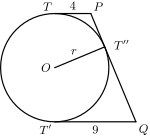
In the adjoining figure and are parallel tangents to a circle of radius with and the points of tangency. is a third tangent with as point of tangency. If and then is
un número distinto de o
a number other than or
no se puede determinar con la información dada
not determinable from the given information
Pista pequeña:
El centro está en cada bisectriz formada por dos tangentes desde el mismo punto exterior
The center lies on each angle bisector formed by two tangents from the same external point
Pista grande:
Demuestra que y usa en el teorema de la altura a la hipotenusa
Show that and use the altitude-to-hypotenuse theorem at
Solución:
Los radios a los puntos de tangencia forman triángulos rectángulos congruentes desde cada punto exterior, por lo que y bisecan los dos ángulos entre tangentes. Como las otras dos tangentes son paralelas, estos medios ángulos suman de ahí que
Así, es la altura a la hipotenusa La igualdad de los segmentos tangentes da y El teorema de la altura produce por lo que
Por lo tanto, la respuesta correcta es B.
The radii to the tangency points make congruent right triangles from each external point, so and bisect the two tangent angles. Because the other two tangents are parallel, these half-angles add to hence
Thus is the altitude to the hypotenuse Equal tangent segments give and The altitude theorem yields so
Therefore, the correct answer is B.
24.
Se lanza un dado equilibrado seis veces. La probabilidad de obtener cinco o seis en por lo menos cinco lanzamientos es
A fair die is rolled six times. The probability of rolling at least a five at least five times is
ninguna de estas
none of these
Pista pequeña:
Un lanzamiento es un éxito con probabilidad
A roll is a success with probability
Pista grande:
Suma los casos disjuntos de exactamente cinco éxitos y exactamente seis éxitos
Add the disjoint cases of exactly five successes and exactly six successes
Solución:
Sea un éxito obtener o de modo que su probabilidad sea La probabilidad buscada es
Por lo tanto, la respuesta correcta es A.
Let a success be a or so its probability is The desired probability is
Therefore, the correct answer is A.
25.
En el paralelogramo del diagrama adjunto, se traza la recta , que biseca en y corta a , prolongado, en Desde el vértice se traza la recta , que biseca el lado en y corta a , prolongado, en Las rectas y se cortan en Si el área del paralelogramo es entonces el área del triángulo es igual a
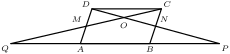
In parallelogram of the accompanying diagram, line is drawn bisecting at and meeting (extended) at From vertex line is drawn bisecting side at and meeting (extended) at Lines and meet at If the area of parallelogram is then the area of triangle is equal to
Pista pequeña:
Usa y
Use and
Pista grande:
Las rectas de los puntos medios cortan la base en y ; luego halla la altura de
The midpoint lines meet the baseline at and ; then find ’s height
Solución:
Elige las coordenadas y de modo que Los puntos medios son Al prolongar y hasta , se obtiene y
Al parametrizar y , se ve que su intersección es Así, y la altura desde es por lo que
Por lo tanto, la respuesta correcta es C.
Choose coordinates and so The midpoints are Extending and to gives and
Parameterizing and shows their intersection is Thus and the height from is so
Therefore, the correct answer is C.
26.
El número de divisores enteros positivos distintos de , excluyendo y , es
The number of distinct positive integral divisors of excluding and is
ninguna de estas
none of these
Pista pequeña:
Factoriza como producto de potencias de y
Factor into powers of and
Pista grande:
Elige independientemente cada exponente primo de a y luego elimina dos divisores
Choose each prime exponent independently from through then remove two divisors
Solución:
Como un divisor elige independientemente cada uno de los tres exponentes entre Hay divisores. Al excluir y , quedan
Por lo tanto, la respuesta correcta es C.
Because a divisor independently chooses each of three exponents from There are divisors. Excluding and leaves
Therefore, the correct answer is C.
27.
Si para todo número real entonces la afirmación:
« siempre que , y »
es verdadera cuando
If for all real then the statement:
“ whenever and and ”
is true when
La afirmación nunca es verdadera.
The statement is never true.
Pista pequeña:
Factoriza en términos de
Factor in terms of
Pista grande:
La condición se convierte en siempre que
The condition becomes whenever
Solución:
Tenemos Si y entonces como se requiere. Si se puede elegir estrictamente entre y de modo que la afirmación falla. Por tanto, la condición exacta es
Por lo tanto, la respuesta correcta es A.
We have If and then as required. If one can choose strictly between and so the statement fails. Thus the exact condition is
Therefore, the correct answer is A.
28.
¿Cuál de las siguientes afirmaciones se cumple para todos los números de la forma donde es o es o y es o ?
Which of the following is satisfied by all numbers of the form where is or is or is or
o
or
Pista pequeña:
Separa los casos y
Separate the cases and
Pista grande:
Acota los términos restantes mediante la cola geométrica infinita
Bound the remaining terms by the infinite geometric tail
Solución:
Si entonces Si entonces mientras que Por consiguiente, todo de esta forma se encuentra en uno de los dos tercios exteriores indicados.
Por lo tanto, la respuesta correcta es D.
If then If then while Hence every such lies in one of the two stated outer thirds.
Therefore, the correct answer is D.
29.
Para , sea la suma de los primeros términos de la progresión aritmética cuyo primer término es y cuya diferencia común es entonces es
For let be the sum of the first terms of the arithmetic progression whose first term is and whose common difference is then is
Pista pequeña:
Usa la fórmula de una serie aritmética de términos para un fijo
Use the -term arithmetic-series formula for a fixed
Pista grande:
Simplifica antes de sumar sobre
Simplify before summing over
Solución:
Para cada Como se tiene
Por lo tanto, la respuesta correcta es B.
For each Since therefore
Therefore, the correct answer is B.
30.
Un segmento se divide de modo que la parte menor es a la parte mayor como la parte mayor es al segmento completo. Si es la razón entre la parte menor y la mayor, entonces el valor de es
A line segment is divided so that the lesser part is to the greater part as the greater part is to the whole. If is the ratio of the lesser part to the greater part, then the value of is
Pista pequeña:
Traduce la condición de división como
Translate the division condition into
Pista grande:
A partir de deduce y simplifica desde el exponente más interior hacia afuera
From derive and simplify from the innermost exponent outward
Solución:
Escala la parte mayor a de modo que la menor sea La condición da por lo que En consecuencia, Al avanzar hacia afuera, el exponente del exterior se convierte en Por lo tanto, la expresión completa es
Por lo tanto, la respuesta correcta es A.
Scale the greater part to making the lesser part The condition gives so Consequently Working outward, the exponent of the outer becomes The whole expression is therefore
Therefore, the correct answer is A.