
Soluciones del 2026 AMC 10A
Desplázate hacia abajo para ver las soluciones preparadas profesionalmente de LIVE by Po-Shen Loh, imprime las soluciones en PDF, consulta la clave de respuestas, o haz el examen cronometrado completo.
Todos los problemas se usan con el permiso legal oficial de la Mathematical Association of America (MAA).
1.
La colección de discos de vinilo de Helena tiene discos LP y discos EP. Un disco LP dura tres veces lo que dura un disco EP. ¿Cuántos discos EP más debe comprar Helena para que la duración total de sus discos EP sea igual a la duración total de sus discos LP?
Helena’s vinyl record collection contains LP records and EP records. An LP record plays for three times as long as an EP record. How many more EP records must Helena buy so that the total playing time of her EP records equals the total playing time of her LP records?
Pista pequeña:
discos LP duran tanto como discos EP
LP records play as long as EP records
Pista grande:
Resta los discos EP que Helena ya tiene
Subtract the EP records Helena already has
Solución:
Cada disco LP dura lo mismo que tres discos EP, así que los discos LP juntos duran lo mismo que discos EP. Helena ya tiene discos EP, así que necesita más.
Por lo tanto, la respuesta correcta es B.
Each LP record plays as long as three EP records, so the LP records together play as long as EP records. Helena already has EP records, so she needs more.
Thus, the correct answer is B.
2.
Un letrero en un estacionamiento indica que el precio total incluye un impuesto del . Redondeando al número entero más cercano, ¿qué porcentaje de la cantidad que paga un cliente corresponde a este impuesto?
A sign in a parking lot states that the total price includes a tax. To the nearest whole number, what percentage of the amount a customer pays is this tax?
Pista pequeña:
Un precio de implica de impuesto y pagados
A price means tax and paid
Pista grande:
se acerca a
is close to
Solución:
Supón que el precio antes de impuestos es Entonces el impuesto es y el cliente paga en total. Así que el impuesto es de la cantidad pagada.
Esto se acerca a así que el impuesto ronda el Ahora, y y está más cerca de Así que, redondeando al número entero más cercano, el impuesto es el de la cantidad pagada.
Por lo tanto, la respuesta correcta es A.
Say the price before tax is Then the tax is and the customer pays in all. So the tax is of the amount paid.
This is close to so the tax is near Now and and is closer to So to the nearest whole number the tax is of the amount paid.
Thus, the correct answer is A.
3.
El cuadrado tiene lados de longitud Sea el punto medio de y sea la intersección de y
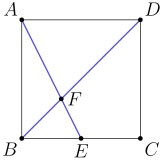
¿Cuál es el área de ?
Square has side length Let be the midpoint of and let be the intersection of and
What is the area of
Pista pequeña:
así que los triángulos y son semejantes
so triangles and are similar
Pista grande:
es la mitad de así que tiene la mitad de la altura de
is half of so is half as tall as
Solución:
Como los triángulos y son semejantes, y es la mitad de Así que la altura de es la mitad de la altura de Las dos alturas suman el lado así que está a un tercio del camino hacia arriba, a una altura de
Entonces tiene área
Otra forma de verlo: es una mediana de La diagonal pasa por el centro del cuadrado, que es el punto medio de así que contiene la mediana desde Así que es el baricentro de Las tres medianas dividen en seis triángulos de igual área, y es uno de ellos. Así que su área es de que es
Por lo tanto, la respuesta correcta es D.
Since triangles and are similar, and is half of So the height of is half the height of The two heights add up to the side so is one third of the way up, at height
Then has area
Alternatively, is a median of The diagonal passes through the center of the square, which is the midpoint of so it contains the median from So is the centroid of The three medians cut into six triangles of equal area, and is one of them. So its area is of which is
Thus, the correct answer is D.
4.
La mitad de los ángulos internos de un polígono miden cada uno, y la otra mitad de sus ángulos internos miden cada uno. ¿Cuántos lados tiene el polígono?
Half of the internal angles of a polygon measure each, and the other half of its internal angles measure each. How many sides does the polygon have?
Pista pequeña:
Los ángulos exteriores, cada uno igual a menos el ángulo interior, suman aunque algunos sean negativos
Exterior angles, each minus the interior angle, sum to even when some are negative
Pista grande:
Los ángulos interiores miden en promedio
The interior angles average
Solución:
El ángulo exterior en cada vértice es menos el ángulo interior: en los ángulos de y en los ángulos de , donde el borde gira en sentido contrario. Al dar una vuelta completa a cualquier polígono se gira en total, así que los ángulos exteriores suman
En promedio, los ángulos interiores miden así que los exteriores miden Con lados, así que
Por lo tanto, la respuesta correcta es A.
The exterior angle at each corner is minus the interior angle: at the angles and at the angles, where the boundary turns back the other way. Going once around any polygon turns through in all, so the exterior angles add up to
The interior angles average so the exterior angles average With sides, so
Thus, the correct answer is A.
5.
Sea una sucesión con y igual a la media aritmética de los términos anteriores para ¿Cuál es el valor de ?
Let be a sequence with and equal to the arithmetic mean of the previous terms for What is the value of
Pista pequeña:
es la media de y
is the mean of and
Pista grande:
Agregar la media actual no cambia la media
Appending the current mean leaves the mean unchanged
Solución:
Primero, Ahora los tres primeros términos tienen media porque es igual a la media de los dos términos anteriores. Así que
Cada vez que agregamos un término igual a la media actual, la media no cambia. En consecuencia, todos los términos desde en adelante son iguales a y
Por lo tanto, la respuesta correcta es C.
First, Now the first three terms have mean because equals the mean of the two terms before it. So
Each time we append a term equal to the current mean, the mean stays the same. Therefore every term from on equals and
Thus, the correct answer is C.
6.
Un triángulo con lados y está inscrito en un círculo y divide el interior del círculo en cuatro regiones. Sean y las áreas de las regiones que no son el triángulo, donde es la mayor. ¿Cuál es el valor de ?
A triangle with sides and is inscribed in a circle, dividing the interior of the circle into four regions. Let and be the areas of the non-triangular regions, with being the greatest. What is the value of
Pista pequeña:
Divide los lados entre dos:
Halve the sides:
Pista grande:
La hipotenusa de un triángulo rectángulo es un diámetro de su círculo circunscrito
A right triangle’s hypotenuse is a diameter of its circle
Solución:
Al dividir los lados entre dos se obtiene una terna pitagórica, así que el triángulo es rectángulo. Su hipotenusa es un diámetro, y el radio es
El diámetro corta el disco en dos mitades de área cada una. Una mitad no contiene ninguna parte del triángulo, así que es la región más grande, La otra mitad es el triángulo junto con las regiones y así que
Por lo tanto, la respuesta correcta es A.
Halving the sides gives a Pythagorean triple, so the triangle is right. Its hypotenuse is a diameter, and the radius is
The diameter cuts the disk into two halves of area each. One half contains no part of the triangle, so it is the largest region The other half is the triangle together with regions and so
Thus, the correct answer is A.
7.
¿Cuántas ternas ordenadas de enteros positivos satisfacen las dos ecuaciones siguientes?
How many ordered triples of positive integers satisfy both of the following equations?
Pista pequeña:
Resta la primera ecuación de la segunda
Subtract the first equation from the second
Pista grande:
Eso fija y Cuenta las formas de separar en dos enteros positivos.
That fixes and Count the ways to split into two positive integers.
Solución:
Al restar la primera ecuación de la segunda se obtiene así que y El par puede ser o así que hay ternas.
Por lo tanto, la respuesta correcta es A.
Subtracting the first equation from the second gives so and The pair can be or so there are triples.
Thus, the correct answer is A.
8.
Un conductor ve un letrero electrónico en la autopista que indica que la próxima salida está a millas y que tardará minutos en llegar a ella. Supón que ambos números se redondearon al entero más cercano. Entre las siguientes opciones, ¿cuál es el límite de velocidad más bajo (en millas por hora) que podría permitirle al conductor llegar a la salida legalmente dentro del tiempo indicado?
A driver sees an electronic highway sign stating that the next exit is miles away and it will take minutes to reach it. Assume both numbers have been rounded to the nearest integer. Among the following options, what is the lowest speed limit (in miles per hour) that would possibly allow the driver to legally reach the exit within the given time frame?
Pista pequeña:
La distancia es de por lo menos millas, y el tiempo es de menos de minutos
The distance is at least miles, and the time is under minutes
Pista grande:
Usa la distancia mínima y el tiempo máximo, en millas por hora
Use the shortest distance and the longest time, in miles per hour
Solución:
La salida está a por lo menos millas, y el viaje dura menos de minutos, ya que se redondearía hacia arriba a Así que la velocidad debe ser mayor que millas por hora, y la opción más baja que puede funcionar es (A millas por hora, millas toman minutos.)
Por lo tanto, la respuesta correcta es C.
The exit is at least miles away, and the trip takes less than minutes, since would round up to So the speed must be more than miles per hour, and the lowest choice that can work is (At mph, miles takes minutes.)
Thus, the correct answer is C.
9.
Dos triángulos escalenos semejantes pero no congruentes tienen cada uno un lado de longitud y un lado de longitud ¿Cuál es la longitud del lado más largo del triángulo más grande?
Two similar but not congruent scalene triangles each have a side with length and a side with length What is the length of the longest side of the larger triangle?
Pista pequeña:
Escalar por alarga todos los lados, así que el del triángulo menor debe convertirse en el del mayor
Scaling by lengthens every side, so the smaller triangle’s must become the larger triangle’s
Pista grande:
El del triángulo mayor debe provenir del tercer lado del triángulo menor
The larger triangle’s must come from the smaller triangle’s third side
Solución:
Supón que el triángulo menor tiene lados y y escálalo por El triángulo mayor tiene lados y dos de los cuales son y Como y la única posibilidad es y
Así que y el triángulo mayor tiene lados y Proviene del triángulo menor de lados y que es un triángulo de verdad, ya que La respuesta es
Por lo tanto, la respuesta correcta es D.
Let the smaller triangle have sides and and scale it by The larger triangle has sides and two of which are and Since and the only possibility is and
So and the larger triangle has sides and It comes from the smaller triangle with sides and which is a genuine triangle since The answer is
Thus, the correct answer is D.
10.
¿Para qué entero positivo impar la media de es exactamente un mayor que su mediana?
For what odd positive integer is the mean of exactly greater than its median?
Pista pequeña:
La media es y la mediana es
The mean is and the median is
Pista grande:
Su cociente es Iguálalo a
Their ratio is Set it to
Solución:
La media de los cuadrados es y como es impar, la mediana es el cuadrado del medio, El factor se cancela en su cociente:
Al igualar esto a se obtiene así que
Por lo tanto, la respuesta correcta es C.
The mean of the squares is and since is odd, the median is the middle square, The factor cancels in their ratio:
Setting this equal to gives so
Thus, the correct answer is C.
11.
Gary escribe seis enteros positivos distintos: y un número de tres dígitos Uno de esos seis números es el mínimo común múltiplo de los seis. ¿Cuál es la suma de todos los valores posibles de ?
Gary writes down six distinct positive integers: and a three-digit number One of those six numbers is the least common multiple of all six of them. What is the sum of all possible values of
Pista pequeña:
y dividen a
and all divide
Pista grande:
El mínimo común múltiplo de los seis es así que o es así que
The least common multiple of all six is so or it is so
Solución:
Cada uno de los números y divide a así que el mínimo común múltiplo de los seis números es múltiplo tanto de como de Es al menos y y son todos menores, así que debe ser o
Si es entonces es un divisor de tres dígitos de distinto del propio , así que Si es entonces es un múltiplo de tres dígitos de distinto de así que es o La suma es
Por lo tanto, la respuesta correcta es D.
Each of and divides so the least common multiple of all six numbers is a multiple of both and It is at least and and are all smaller, so it must be or
If it is then is a three-digit divisor of other than itself, so If it is then is a three-digit multiple of other than so is or The sum is
Thus, the correct answer is D.
12.
Un cajón tiene calcetines rojos y calcetines azules. Pippi saca calcetines al azar, uno a la vez y sin reemplazo, hasta que ha sacado todos los calcetines de un mismo color. ¿Cuál es la probabilidad de que queden exactamente calcetines en el cajón cuando eso ocurra?
A drawer has red socks and blue socks. Pippi randomly removes one sock at a time, without replacement, until all the socks of one color have been removed. What is the probability that there are exactly socks left in the drawer once that happens?
Pista pequeña:
Imagina que se sacan los calcetines. Los que quedan son la racha final de un mismo color.
Imagine all socks drawn. The socks left are the final run of one color.
Pista grande:
Quedan exactamente cuando los dos últimos coinciden y el antepenúltimo no
Exactly are left when the last two match and the third-to-last does not
Solución:
Imagina que los calcetines salen en un orden aleatorio. Pippi se detiene cuando se acaba un color, y los calcetines que siguen en el cajón son la racha final de un mismo color al final del orden. Así que quedan exactamente cuando los dos últimos calcetines coinciden y el antepenúltimo no.
Sea cual sea el color del último calcetín, el penúltimo coincide con él con probabilidad y entonces el antepenúltimo es del otro color con probabilidad La respuesta es
Por lo tanto, la respuesta correcta es D.
Picture all socks coming out in a random order. Pippi stops when one color runs out, and the socks still in the drawer are the final run of one color at the end of the order. So exactly are left when the last two socks match and the third-to-last does not.
Whatever the color of the last sock, the second-to-last matches it with probability and then the third-to-last has the other color with probability The answer is
Thus, the correct answer is D.
13.
Dos clubes de ciclismo, sin miembros en común, salen juntos de excursión. En la mañana de la excursión, los miembros se saludan con un apretón de manos. Cada persona le da la mano a cada una de las demás exactamente una vez. Hubo apretones de manos entre miembros del mismo club y apretones de manos entre miembros de clubes distintos. ¿Cuántas personas más vinieron del club más grande que del club más pequeño?
Two bicycle clubs, with disjoint memberships, go on a tour together. On the morning of the tour, members greet each other with a handshake. Everyone shakes hands with everyone else exactly once. There were handshakes between members of the same club and handshakes between members of different clubs. How many more people came from the larger club than from the smaller club?
Pista pequeña:
apretones de manos, y personas dan
handshakes, and people make
Pista grande:
Clubes de y personas dan apretones de manos entre clubes. Compara y
Clubs of and people make handshakes between clubs. Compare and
Solución:
Cada persona le dio la mano una vez a cada una de las demás, así que si vinieron personas, Entonces así que
Si los clubes tienen y personas, entonces y el número de apretones de manos entre los clubes es Así que y el club más grande tiene personas más.
Por lo tanto, la respuesta correcta es C.
Everyone shook hands once with everyone else, so if people came, Then so
If the clubs have and people, then and the handshakes between the clubs number So and the larger club has more people.
Thus, the correct answer is C.
14.
Considera un triángulo de área positiva cuyos lados tienen longitudes que dependen de y están dadas por y ¿Cuántos valores enteros distintos de son posibles?
Consider a triangle with positive area whose side lengths are functions of given by and How many different integer values of are possible?
infinitos
infinitely many
Pista pequeña:
Calcula y y factoriza cada expresión
Compute and and factor each
Pista grande:
Ambas tienen el factor que debe ser positivo
Both have the factor which must be positive
Solución:
Para que sea positivo necesitamos y entonces y también son positivos.
Las desigualdades triangulares se factorizan limpiamente. Primero, siempre es positivo. Luego, y Como necesitamos y
Así que lo que da valores.
Por lo tanto, la respuesta correcta es B.
For to be positive we need and then and are positive too.
The triangle inequalities factor neatly. First, is always positive. Next, and Since we need and
So which is values.
Thus, the correct answer is B.
15.
El diagrama de árbol de abajo tiene nodos etiquetados con números racionales. El nodo superior, en el nivel es De cada nodo salen dos nodos en el nivel de abajo, y Por ejemplo, el nivel tiene los nodos y
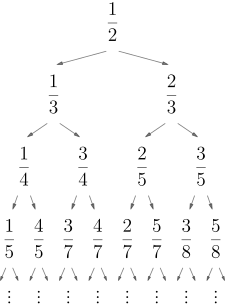
¿En qué nivel del diagrama aparece el nodo ?
The tree diagram below has nodes labeled with rational numbers. The top node, at level is Each node sprouts two nodes in the level below it, and For example, level has nodes and
At what level does the node appear in the diagram?
El nodo no aparece en el diagrama.
The node does not appear in the
diagram.
Pista pequeña:
Al subir un nivel, se convierte en una fracción formada por y
Going up a level, becomes a fraction made of and
Pista grande:
Empezando por y resta repetidamente el número menor del mayor hasta llegar a y
Starting from and keep subtracting the smaller number from the larger until you reach and
Solución:
Todo nodo es una fracción menor que en su mínima expresión. Si un nodo es su padre está formado por y en el orden que dé una fracción menor que Así que cada paso hacia arriba reemplaza el par de números por el menor de ellos y su diferencia, como en el algoritmo de Euclides.
Empezando por los pares son y Son pasos hasta así que está en el nivel
Por lo tanto, la respuesta correcta es B.
Every node is a fraction less than in lowest terms. If a node is its parent is made of and in whichever order gives a fraction less than So each step up replaces the pair of numbers by the smaller one and their difference, as in the Euclidean algorithm.
Starting from the pairs are and That is steps up to so is at level
Thus, the correct answer is B.
16.
Una urna contiene bolas rojas, bolas negras y bolas blancas. Supón que se sacan bolas al azar sin reemplazo y que se calcula una puntuación de la siguiente manera:
• Se da punto por cada bola roja, hasta un máximo de puntos.
• Se da punto por cada bola negra, hasta un máximo de puntos.
• Se da punto por cada bola blanca, hasta un máximo de puntos.
Por ejemplo, sacar bola roja, bolas negras y bolas blancas daría una puntuación de ¿Cuál es la probabilidad de obtener la puntuación más baja posible?
An urn contains red balls, black balls, and white balls. Suppose balls are drawn at random without replacement and a score is computed as follows:
• point is given for each red ball up to a maximum of points.
• point is given for each black ball up to a maximum of points.
• point is given for each white ball up to a maximum of points.
For example, drawing red ball, black balls, and white balls would earn a score of What is the probability of getting the lowest possible score?
Pista pequeña:
La puntuación es menos las bolas que exceden el tope de su color. Desperdicia tantas bolas como sea posible.
The score is minus the balls beyond their color’s cap. Waste as many balls as possible.
Pista grande:
Se pueden desperdiciar como máximo bolas: rojas y más, o de uno de los otros colores y del último
At most balls can be wasted: reds and other, or of one other color and of the last
Solución:
Diremos que una bola se desperdicia si excede el tope de su color. Entonces la puntuación es menos el número de bolas desperdiciadas, así que queremos desperdiciar tantas como sea posible.
Desperdiciar es imposible. Con rojas, se desperdician rojas y la bola restante no. Con rojas, se desperdician rojas y las bolas restantes no desperdician nada. Con rojas, se desperdicia roja y las bolas restantes desperdician como máximo Con rojas o menos, solo se pueden desperdiciar negras y blancas, y desperdiciar de cada color requeriría bolas. Así que se desperdician como máximo y la puntuación más baja es
Se desperdician exactamente con rojas y de las bolas restantes ( formas), con negras y blancas ( formas), o con negras y blancas ( formas). Eso da de las extracciones igualmente probables, para una probabilidad de
Por lo tanto, la respuesta correcta es D.
Call a ball wasted if it is beyond its color’s cap. Then the score is minus the number of wasted balls, so we want to waste as many as possible.
Wasting is impossible. With reds, reds are wasted and the other ball is not. With reds, reds are wasted and the other balls waste nothing. With reds, red is wasted and the other balls waste at most With at most reds, only black and white can be wasted, and wasting of each would take balls. So at most are wasted, and the lowest score is
Exactly are wasted with reds and of the other balls ( ways), with black and white ( ways), or with black and white ( ways). That is of the equally likely draws, for a probability of
Thus, the correct answer is D.
17.
Sobre cada lado de un hexágono regular de lado se construye un cuadrado dentro del hexágono que tiene ese lado como uno de sus lados. La región que está dentro de los seis cuadrados a la vez es el interior de un hexágono más pequeño, que se muestra sombreado en la figura de abajo.
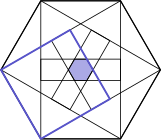
El área del hexágono más pequeño se puede expresar en la forma donde y son enteros positivos, y son primos relativos, y no es divisible entre el cuadrado de ningún primo. ¿Cuánto es ?
For each edge of a regular hexagon with side length a square is constructed inside the hexagon with that edge as one of its sides. The region interior to all six squares is the interior of a smaller hexagon, shown shaded in the figure below.
The area of the smaller hexagon can be expressed in the form where and are positive integers, and are relatively prime, and is not divisible by the square of any prime. What is
Pista pequeña:
El centro está a de cada lado, y cada cuadrado llega hacia adentro
The center is from each edge, and each square reaches inward
Pista grande:
El hexágono pequeño es regular con el mismo centro, y sus lados están a de este
The small hexagon is regular with the same center, and its sides are from it
Solución:
Sea el centro. Cada lado está a una distancia de y el cuadrado sobre ese lado llega a una distancia hacia adentro, así que su lado interior queda un poco más allá de a una distancia del otro lado. Junto con el cuadrado sobre el lado opuesto, recorta una franja de ancho centrada en
Las tres franjas se cortan en un hexágono regular con el mismo centro y la misma orientación que el grande, cuyos lados están a una distancia de (Sus vértices están a solo unos de así que los otros lados de los cuadrados, a de no lo cortan.) Es el hexágono grande escalado por
El hexágono grande tiene área así que el pequeño tiene área Así que
Por lo tanto, la respuesta correcta es C.
Let be the center. Each edge is from and the square on that edge reaches inward, so its inner side lies just past at distance on the far side. Together with the square on the opposite edge, it cuts out a strip of width centered on
The three strips meet in a regular hexagon with the same center and orientation as the big one, whose sides are from (Its corners are only about from so the squares’ other sides, from do not cut it.) It is the big hexagon scaled by
The big hexagon has area so the small one has area So
Thus, the correct answer is C.
18.
La sucesión estrictamente decreciente de enteros positivos está definida por la regla recursiva para Sea el menor valor posible de ¿Cuál es la suma de los dígitos de ?
The strictly decreasing sequence of positive integers is defined by the recursive rule for Let be the minimum possible value of What is the sum of the digits of
Pista pequeña:
Resta :
Subtract :
Pista grande:
Así que debe ser entero
So must be an integer
Solución:
Al restar de ambos lados de la regla se obtiene Así que la distancia a se reduce a la mitad en cada paso, y
Los términos son enteros exactamente cuando divide a La sucesión es estrictamente decreciente exactamente cuando y en ese caso todos los términos son mayores que así que son positivos. La menor opción es así que y la suma de sus dígitos es
Por lo tanto, la respuesta correcta es D.
Subtracting from both sides of the rule gives So the distance from halves at every step, and
All terms are integers exactly when divides The sequence is strictly decreasing exactly when and then every term is above so positive. The smallest choice is so and its digit sum is
Thus, the correct answer is D.
19.
Tres cubos de están sobre una mesa de modo que dos de los cubos comparten una cara, y una cara del tercer cubo está centrada a lo largo de una arista común de los otros dos cubos, como se muestra.
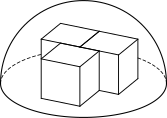
Se coloca una cubierta semiesférica sobre los cubos de modo que su borde circular descansa sobre la mesa y los cubos quedan debajo de la cubierta. ¿Cuál es el menor valor posible del radio de la cubierta?
Three cubes sit on a table so that two of the cubes share a face, and a face of the third cube is centered along a shared edge of the other two cubes, as shown.
A hemispherical cover is placed over the cubes so that its circumference rests on the table and the cubes are under the cover. What is the least possible value of the radius of the cover?
Pista pequeña:
Un punto a altura queda cubierto cuando su distancia horizontal al centro es como máximo
A point at height is covered when its horizontal distance from the center is at most
Pista grande:
Vistos desde arriba, los cubos forman un rectángulo de con un cuadrado de centrado en un lado largo. Halla el menor círculo que lo contiene.
From above, the cubes form a rectangle with a square centered on a long side. Find the smallest circle around it.
Solución:
El centro de la cubierta está sobre la mesa. Un punto a altura cuya distancia horizontal al centro es está debajo de la cubierta exactamente cuando Las esquinas superiores de los cubos son los puntos más difíciles de cubrir, así que necesitamos el círculo más pequeño sobre la mesa que contenga la sombra de los cubos. Si su radio es entonces
Coloca los dos cubos que están uno junto al otro sobre y el tercer cubo sobre El círculo debe alcanzar las esquinas y Por simetría, prueba con el centro y las cuatro esquinas a la misma distancia: lo que da y Las esquinas están dentro de este círculo. El centro está dentro del trapecio que tiene esas cuatro esquinas como vértices, así que ningún círculo más pequeño las contiene a todas.
Entonces y
Por lo tanto, la respuesta correcta es C.
The center of the cover lies on the table. A point at height whose horizontal distance from the center is is under the cover exactly when The top corners of the cubes are the hardest points to cover, so we need the smallest circle on the table that contains the cubes’ shadow. If its radius is then
Put the two side-by-side cubes over and the third cube over The circle must reach the corners and By symmetry, try the center with all four corners at the same distance: which gives and The corners are inside this circle. The center lies inside the trapezoid with those four corners, so no smaller circle holds them all.
Then and
Thus, the correct answer is C.
20.
Las cajas con dimensiones o tienen volumen ¿Cuántas cajas diferentes con lados de longitud entera de al menos incluidas estas dos, tienen volumen ? Dos cajas se consideran diferentes si tienen dimensiones diferentes.
Boxes with dimensions or have volume How many different boxes with integer side lengths at least including these two, have volume Boxes are considered different if they have different dimensions.
Pista pequeña:
Reparte estos primos en tres grupos no vacíos.
Split these primes into three nonempty groups.
Pista grande:
Cuenta los repartos ordenados: formas, menos las que dejan un lado igual a
Count ordered splits: ways, minus those that leave a side equal to
Solución:
Como elegir las tres longitudes de los lados en orden equivale a asignar cada uno de los siete primos a uno de los lados. Cada lado debe medir al menos así que cada lado debe recibir al menos un primo.
Hay formas de asignar los primos. Un lado determinado queda vacío de formas, y dos lados determinados quedan vacíos de forma. Así que el número de ternas ordenadas es
Los tres lados usan primos distintos, así que son tres números distintos, y cada caja se cuenta veces. Hay cajas.
Por lo tanto, la respuesta correcta es C.
Since choosing the three side lengths in order means sending each of the seven primes to one of the sides. Every side must be at least so every side must get at least one prime.
There are ways to send the primes. Leaving a particular side empty happens in ways, and leaving two particular sides empty happens in way. So the ordered triples number
The three sides use different primes, so they are three different numbers, and each box is counted times. There are boxes.
Thus, the correct answer is C.
21.
Gerry está jugando el Juego de los Tríos. Su tarea es dividir la cuadrícula de que se muestra arriba en tres secciones, cada una formada por tres casillas adyacentes. (Tres casillas son adyacentes si cada una comparte un lado con al menos una de las otras dos.) Se otorgará un punto por cada sección que contenga más X que O. Debajo se muestra un ejemplo de partición que obtendrá un punto en total. Una partición que obtenga dos o más puntos gana el juego. ¿Qué fracción de las particiones posibles de esta cuadrícula en particular darán la victoria a Gerry?
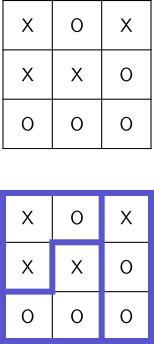
Gerry is playing the Triples Game. Her task is to partition the grid of squares shown at the top into three sections, each containing three adjoining squares. (Three squares are adjoining if each shares an edge with at least one of the other two.) One point will be awarded for each section containing more X’s than O’s. Shown below it is a sample partition that will earn one point in total. A partition that earns two or more points will win the game. What fraction of the possible partitions of this particular grid will result in a win for Gerry?
Pista pequeña:
Solo casillas tienen X. Para ganar se necesitan dos secciones con X cada una, así que la tercera sección es toda de O.
Only squares hold X’s. A win needs two sections with X’s each, so the third section is all O’s.
Pista grande:
Solo la fila de abajo y una pieza en L están formadas por tres O. Revisa las particiones que contienen a cada una.
Only the bottom row and one L-shape consist of three O’s. Check the partitions that contain each.
Solución:
Cada sección es una línea recta de tres casillas o una L. Una L cabe en un bloque de , así que cubre como máximo una esquina de la cuadrícula, y una fila o columna central no cubre ninguna. Las tres secciones cubren las cuatro esquinas, así que una de ellas es una fila o columna completa a lo largo del borde.
Queda un rectángulo de , que se divide de formas: en dos piezas rectas, o en dos piezas en L de formas. Los cuatro bordes dan pero las particiones en tres filas y en tres columnas se cuentan dos veces cada una, así que hay particiones.
La cuadrícula tiene solo X, y una sección gana un punto solo si tiene al menos de ellas. Así que una partición ganadora tiene dos secciones con X cada una y una tercera sección de tres O. Solo dos secciones están formadas por tres O: la fila de abajo, y la L formada por las casillas medio-derecha, abajo-centro y abajo-derecha.
Con la fila de abajo, las dos filas de arriba se dividen en dos filas (XOX y XXO) o en dos piezas en L (de nuevo XOX y XXO), ambas ganadoras, o en XXX y OXO, que da solo punto. Con la L, las otras seis casillas solo se dividen en la fila de arriba más una L (XOX y XXO) o en la columna izquierda más una L (XXO y OXX), ambas ganadoras.
Así que de las particiones ganan, una fracción de
Por lo tanto, la respuesta correcta es C.
Each section is a straight line of three squares or an L-shape. An L-shape fits in a block, so it covers at most one corner of the grid, and a middle row or column covers none. The three sections cover all four corners, so one of them is a full row or column along the edge.
That leaves a rectangle, which splits in ways: into two straight pieces, or into two L-shapes in ways. Four edges give but the three-rows and three-columns partitions are each counted twice, so there are partitions.
The grid has only X’s, and a section earns a point only with at least of them. So a winning partition has two sections with X’s each and a third section of three O’s. Only two sections consist of three O’s: the bottom row, and the L made of the middle-right, bottom-center, and bottom-right squares.
With the bottom row, the top two rows split as two rows (XOX and XXO) or as two L-shapes (XOX and XXO again), both wins, or as XXX and OXO, which earns only point. With the L, the other six squares split only as the top row plus an L (XOX and XXO) or as the left column plus an L (XXO and OXX), both wins.
So of the partitions win, a fraction of
Thus, the correct answer is C.
22.
Un ingeniero está diseñando un campo compacto de turbinas eólicas para producir electricidad. Cada turbina, cuyo centro está marcado con un punto etiquetado en la figura, ocupa una de regiones elípticas congruentes. Las turbinas de una misma fila tienen centros separados por unidades, y las turbinas de una misma columna tienen centros separados por unidades, como se muestra en la figura de abajo.
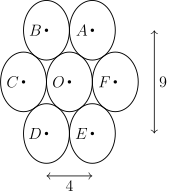
El eje mayor de cada elipse mide donde y son enteros positivos y no es divisible entre el cuadrado de ningún primo. ¿Cuánto es ?
An engineer is designing a closely packed field of wind turbines for electricity production. Each turbine, whose center is marked by a labeled dot in the figure, occupies one of congruent elliptical regions. Turbines in the same row have centers that are units apart, and turbines in the same column have centers that are units apart, as shown in the figure below.
The major axis of each ellipse is where and are positive integers and is not divisible by the square of any prime. What is
Pista pequeña:
Cada elipse mide de ancho. Comprime la figura verticalmente para volverlas círculos de radio
Each ellipse is wide. Squeeze vertically to make them circles of radius
Pista grande:
y están separados en horizontal y en vertical, y sus elipses se tocan
and are apart across and apart vertically, and their ellipses touch
Solución:
Las turbinas de una misma fila se tocan a medio camino entre sus centros, así que cada elipse tiene semieje horizontal Al semieje vertical lo llamamos
Comprime toda la figura verticalmente por el factor Cada elipse se convierte en un círculo de radio y las elipses que se tocaban se siguen tocando. Los centros y estaban separados en horizontal y en vertical, así que ahora están separados en horizontal y en vertical. Dos círculos de radio que se tocan tienen centros separados por , así que lo que da y
Como el eje mayor es vertical, con longitud Así que
Por lo tanto, la respuesta correcta es A.
Turbines in the same row touch halfway between their centers, so each ellipse has horizontal semi-axis Call the vertical semi-axis
Squeeze the whole picture vertically by the factor Every ellipse becomes a circle of radius and ellipses that touched still touch. The centers and were apart across and apart up and down, so now they are across and up and down. Touching circles of radius have centers apart, so which gives and
Since the major axis is vertical, with length So
Thus, the correct answer is A.
23.
En una lista de uno o más enteros consecutivos, hay múltiplos de y múltiplos de ¿Cuántos pares ordenados son posibles para esta lista si y están entre y inclusive?
In a list of one or more consecutive integers, there are multiples of and multiples of How many ordered pairs are possible for this list if and are between and inclusive?
Pista pequeña:
En enteros consecutivos, es redondeado hacia arriba o hacia abajo, y es redondeado hacia arriba o hacia abajo
In consecutive integers, is rounded up or down, and is rounded up or down
Pista grande:
Entonces y están ambos cerca de ¿Qué tan lejos pueden estar uno del otro?
Then and are both close to How far apart can they be?
Solución:
Toma una lista de enteros consecutivos. La cantidad de múltiplos de en ella es redondeado hacia arriba o hacia abajo, así que La cantidad de múltiplos de es redondeado hacia arriba o hacia abajo, así que Toda combinación de redondeos ocurre. Hacia dónde se redondea depende solo de si el primer número es par o impar, y hacia dónde se redondea depende solo de su residuo al dividirlo entre Seis puntos de inicio consecutivos cualesquiera cubren todas las combinaciones de ambos.
Así que es posible exactamente cuando algún entero positivo cumple a la vez y Tal existe exactamente cuando y distan a lo sumo unidades, es decir, cuando (En ese caso, el menor de y sirve como y es positivo.)
Ahora contemos según La condición dice que dista como máximo de Si divide a eso permite valores de y si no, Entre hay múltiplos de y números más. Al descartar en se obtiene (Todo obtenido es a lo sumo así que se cumple.)
Por lo tanto, la respuesta correcta es D.
Take a list of consecutive integers. The number of multiples of in it is rounded up or down, so The number of multiples of is rounded up or down, so Every combination of roundings occurs. Which way rounds depends only on whether the first number is even or odd, and which way rounds depends only on its remainder when divided by Any six consecutive starting points cover every combination of the two.
So is possible exactly when some positive satisfies both and Such an exists exactly when and are at most apart, that is, when (In that case the smaller of and works as and it is positive.)
Now count by The condition says is within of If divides that allows values of and otherwise Among there are multiples of and others. Dropping at gives (Every found is at most so holds.)
Thus, the correct answer is D.
24.
¿Cuántos polinomios de grado que satisfacen tienen coeficiente principal igual a y todos sus coeficientes enteros entre y inclusive?
How many polynomials of degree satisfying are there that have leading coefficient equal to and all of whose coefficients are integers between and inclusive?
Pista pequeña:
Sea de modo que las dos entradas son
Put so that the two inputs are
Pista grande:
Cambiar por solo cambia las potencias impares de
Replacing by changes only the odd powers of
Solución:
Escribe Las entradas son simétricas respecto a así que sea Al desarrollar y el coeficiente de es y el coeficiente de es
Cambiar por invierte el signo de las potencias impares de y deja igual las pares, así que En esto es que debe ser Así que
Para que necesitamos lo que da y todos dentro del rango. La constante puede ser cualquiera de los enteros de a Así que hay polinomios.
Por lo tanto, la respuesta correcta es D.
Write The inputs are symmetric about so put Expanding and the coefficient of is and the coefficient of is
Replacing by flips the signs of the odd powers of and leaves the even powers alone, so At this is which must be So
For we need giving and all in range. The constant can be any of the integers from to So there are polynomials.
Thus, the correct answer is D.
25.
La ardilla Chris tiene cámaras en su caverna para guardar comida. La primera cámara contiene nuez, la segunda cámara contiene nueces, la tercera cámara contiene nueces, y así sucesivamente, hasta la cámara número , que contiene nueces. A partir de hoy, Chris recogerá nueces adicionales cada día y las guardará, una por cámara, en cámaras distintas de su caverna. Su objetivo es que todas las cámaras contengan el mismo número de nueces cuando termine. ¿Cuál es el número mínimo de días necesarios para lograr este objetivo?
Chris the squirrel has rooms in his cavern for storing food. The first room contains nut, the second room contains nuts, the third room contains nuts, and so on, with the th room containing nuts. Starting from today, Chris will collect additional nuts each day and store them one per room in distinct rooms in his cavern. His goal is to have all the rooms contain the same number of nuts once he is finished. What is the minimum number of days required to accomplish this goal?
Pista pequeña:
La cámara gana como máximo una nuez por día, así que termina con a lo sumo
Room gains at most one nut a day, so it ends with at most
Pista grande:
Tras días, las nueces deben ser veces la cantidad final por cámara
After days the nuts must be times the final count per room
Solución:
Supón que después de días cada cámara tiene nueces. Al principio las cámaras tienen nueces, así que La cámara recibe como máximo una nuez al día, así que Entonces así que
Con obtenemos Cada día Chris se salta exactamente dos cámaras, y la cámara necesita nueces, así que Chris debe saltársela veces. Estos saltos suman como debe ser.
Para organizarlos, haz una lista de los saltos en orden: la cámara una vez, luego la cámara dos veces, y así sucesivamente hasta la cámara diecinueve veces. El día , Chris se salta las cámaras que ocupan las posiciones y de la lista. Ninguna cámara aparece veces, así que siempre son dos cámaras distintas. Así que el mínimo es de días.
Por lo tanto, la respuesta correcta es B.
Suppose that after days every room holds nuts. The rooms start with nuts, so Room gets at most one nut a day, so Then so
With we get Each day Chris skips exactly two rooms, and room needs nuts, so it must be skipped times. These skips add up to as they should.
To schedule them, list the skips in order: room once, then room twice, and so on up to room nineteen times. On day skip the rooms in positions and of the list. No room appears times, so these are always two different rooms. So days is the minimum.
Thus, the correct answer is B.