
Soluciones del 2015 AMC 10A
Desplázate hacia abajo para ver las soluciones preparadas profesionalmente de LIVE by Po-Shen Loh, imprime las soluciones en PDF, consulta la clave de respuestas, o haz el examen cronometrado completo.
Todos los problemas se usan con el permiso legal oficial de la Mathematical Association of America (MAA).
1.
¿Cuál es el valor de la siguiente expresión?
What is the value of the following expression?
Pista pequeña:
Primero evalúa lo que está dentro de los paréntesis.
Evaluate inside the parentheses first
Pista grande:
Después de simplificar los paréntesis, multiplica su recíproco por .
After simplifying the parentheses, multiply its reciprocal by
Solución:
Podemos evaluarlo de la siguiente manera.
Por lo tanto, C es la respuesta correcta.
We can evaluate it as follows.
Thus, C is the correct answer.
2.
Una caja contiene una colección de baldosas triangulares y cuadradas, en total baldosas. Estas baldosas tienen en conjunto aristas. ¿Cuántas baldosas cuadradas hay en la caja?
A box contains a collection of triangular and square tiles. There are tiles in the box, containing edges total. How many square tiles are there in the box?
Pista pequeña:
Compara el total con el caso en que todas las baldosas son triangulares.
Compare the total to the case where all tiles are triangular
Pista grande:
Cada baldosa cuadrada aporta una arista más que una triangular.
Each square contributes one more edge than a triangle
Solución:
Sea el número de baldosas triangulares y el número de baldosas cuadradas. Entonces y Multiplicando la primera ecuación por , obtenemos y, restándola de la otra ecuación, resulta
Por lo tanto, D es la respuesta correcta.
Let be the number of triangular tiles and be the number of square tiles. We then have that and Multiplying the first equation by gives us and subtracting this from the other equation gives us
Thus, D is the correct answer.
3.
Ann hizo una escalera de escalones usando palillos, como se muestra en la figura. ¿Cuántos palillos necesita agregar para completar una escalera de escalones?

Ann made a -step staircase using toothpicks as shown in the figure. How many toothpicks does she need to add to complete a -step staircase?
Pista pequeña:
Observa cuántos palillos nuevos agrega el siguiente escalón.
Look at how many new toothpicks the next stair step adds
Pista grande:
La cantidad de palillos nuevos aumenta en con cada escalón adicional.
The number of new toothpicks increases by with each added step
Solución:
Intentemos encontrar un patrón entre el número de escalones y la cantidad de palillos necesarios.
Para una escalera de escalón, solo necesitaríamos palillos, es decir, un cuadrado.
Para una escalera de escalones, según el diagrama necesitaríamos palillos.
De manera similar, necesitaríamos palillos para una escalera de escalones.
Una escalera de escalones necesita palillos más que una de escalón. Una escalera de escalones necesita palillos más que una de escalones.
Siguiendo este patrón, vemos que una escalera de escalones necesitará palillos, y una escalera de escalones necesitará palillos.
Esto significa que Ann necesitaría agregar palillos más.
Por lo tanto, D es la respuesta correcta.
Let us try to find a pattern between the number of toothpicks needed for the staircases.
For a -step staircase, we would only need toothpicks (just a square).
For a -step staircase, we would need toothpicks according to the diagram.
Similarly, we would need toothpicks for a -step staircase.
A -step staircase needs more toothpicks than a -step staircase. A -step staircase needs more toothpicks than a -step staircase.
Following this pattern, we can see that a -step staircase will need toothpicks, and a -step staircase will need toothpicks.
This means that Ann would need to add more toothpicks.
Thus, D is the correct answer.
4.
Pablo, Sofia y Mia recibieron algunos huevos de dulce en una fiesta. Pablo tenía el triple de huevos que Sofia, y Sofia tenía el doble de huevos que Mia. Pablo decide dar algunos de sus huevos a Sofia y Mia para que los tres tengan la misma cantidad de huevos. ¿Qué fracción de sus huevos debe dar Pablo a Sofia?
Pablo, Sofia, and Mia got some candy eggs at a party. Pablo had three times as many eggs as Sofia, and Sofia had twice as many eggs as Mia. Pablo decides to give some of his eggs to Sofia and Mia so that all three will have the same number of eggs. What fraction of his eggs should Pablo give to Sofia?
Pista pequeña:
Escribe a Mia, Sofia, Pablo como .
Write Mia, Sofia, Pablo as
Pista grande:
Repartir por igual significa que cada persona termina con huevos.
Equal sharing means each person ends with eggs
Solución:
Sea el número de huevos de dulce que tenía Mia. Entonces Sofia tenía huevos y Pablo tenía huevos.
El número total de huevos es Para que todos tengan la misma cantidad de huevos, cada uno debe tener huevos.
Sofia necesita huevos más. Esto significa que Pablo debe darle a Sofia de sus huevos.
Por lo tanto, B es la respuesta correcta.
Let be the number of candy eggs that Mia had. Then Sofia had eggs and Pablo had eggs.
The total number of eggs is then For all of them to have the same number of eggs, they each must have eggs.
Sofia needs more eggs. This means Pablo must give of his eggs to Sofia.
Thus, B is the correct answer.
5.
El Sr. Patrick enseña matemáticas a estudiantes. Al calificar los exámenes descubrió que, cuando había calificado el examen de todos excepto el de Payton, el promedio de la clase era Después de calificar el examen de Payton, el promedio pasó a ser ¿Cuál fue la calificación de Payton en el examen?
Mr. Patrick teaches math to students. He was grading tests and found that when he graded everyone’s test except Payton’s, the average grade for the class was After he graded Payton’s test, the class average became What was Payton’s score on the test?
Pista pequeña:
El puntaje total es igual al promedio multiplicado por el número de exámenes calificados.
Total score equals the average times the number of graded tests
Pista grande:
Resta del total de la clase el total de los primeros estudiantes.
Subtract the first students’ total from the full class total
Solución:
El total de los primeros exámenes calificados fue .
Después de incluir el examen de Payton, el total pasó a ser , así que la calificación de Payton fue .
Por lo tanto, E es la respuesta correcta.
The total for the first graded tests was .
After Payton’s test was included, the total became . Therefore Payton’s score was .
Thus, E is the correct answer.
6.
La suma de dos números positivos es veces su diferencia. ¿Cuál es la razón entre el número mayor y el número menor?
The sum of two positive numbers is times their difference. What is the ratio of the larger number to the smaller number?
Pista pequeña:
Sea el número mayor y el menor.
Let the larger number be and the smaller be
Pista grande:
Simplifica .
Simplify
Solución:
Sean y los dos números, y supongamos que Entonces Simplificando obtenemos
Dividiendo ambos lados, obtenemos
Por lo tanto, B es la respuesta correcta.
Let and be the two numbers. Then we have that Note that we are assuming This gives us
Dividing through yields
Thus, B is the correct answer.
7.
¿Cuántos términos hay en la sucesión aritmética ?
How many terms are in the arithmetic sequence
Pista pequeña:
Usa el primer término, el último término y la diferencia común.
Use the first term, last term, and common difference
Pista grande:
Cuenta los intervalos y luego suma un extremo.
Count intervals, then add one endpoint
Solución:
Recuerda que el -ésimo término de una sucesión aritmética es donde es el primer término y es la diferencia común.
En nuestro caso, y Sustituyendo, obtenemos Por lo tanto, B es la respuesta correcta.
Recall that the th term of an arithmetic sequence is where is the first term and is the common difference.
For us, and Plugging these in, we get that Thus, B is the correct answer.
8.
Hace dos años, Pete tenía el triple de la edad de su prima Claire. Dos años antes de eso, Pete tenía cuatro veces la edad de Claire. ¿En cuántos años la razón entre sus edades será ?
Two years ago Pete was three times as old as his cousin Claire. Two years before that, Pete was four times as old as Claire. In how many years will the ratio of their ages be
Pista pequeña:
Traduce los dos enunciados sobre las edades usando las edades actuales.
Translate the two age statements using current ages
Pista grande:
Halla las edades actuales antes de plantear la razón futura.
Solve for current ages before setting the future ratio
Solución:
Sean y las edades actuales de Pete y Claire respectivamente.
El enunciado nos da y Simplificando ambas ecuaciones obtenemos y Igualándolas, tenemos
Esto significa que
Ahora necesitamos hallar el número de años () hasta que lo que nos da Por lo tanto, B es la respuesta correcta.
Let and be Pete’s and Claire’s current ages respectively.
Then we have that and Simplifying both equations gives us and Setting them equal, we have
This means that
Now, we need to find the number of years () until which gives us Thus, B is the correct answer.
9.
Dos cilindros circulares rectos tienen el mismo volumen. El radio del segundo cilindro es mayor que el radio del primero. ¿Cuál es la relación entre las alturas de los dos cilindros?
Two right circular cylinders have the same volume. The radius of the second cylinder is more than the radius of the first. What is the relationship between the heights of the two cylinders?
La segunda altura es menor que la primera.
The second height is less than the first.
La primera altura es mayor que la segunda.
The first height is more than the second.
La segunda altura es menor que la primera.
The second height is less than the first.
La primera altura es mayor que la segunda.
The first height is more than the second.
La segunda altura es el de la primera.
The second height is of the first.
Pista pequeña:
Volúmenes iguales significan que la altura cambia según el inverso del cuadrado del cambio del radio.
Equal volumes mean height changes by the reciprocal square of the radius change
Pista grande:
Usa .
Use
Solución:
Sean y el radio y la altura del primer cilindro, y análogamente define y para el segundo cilindro.
Sabemos que y
Sustituyendo y simplificando obtenemos lo que nos dice que
Por lo tanto, D es la respuesta correcta.
Let and be the radius and height of the first cylinder and similarly define and for the second cylinder.
We know that and
Substituting and simplifying gives us which tells us that
Thus, D is the correct answer.
10.
¿Cuántos reordenamientos de hay en los que dos letras adyacentes no sean también letras adyacentes en el alfabeto? Por ejemplo, ninguno de esos reordenamientos podría incluir ni
How many rearrangements of are there in which no two adjacent letters are also adjacent letters in the alphabet? For example, no such rearrangements could include either or
Pista pequeña:
Prohíbe los pares de letras consecutivas del alfabeto en cualquier orden.
Forbid the adjacent alphabet pairs in either order
Pista grande:
Empezar con o es la única forma de terminar.
Starting with or is the only way to finish
Solución:
Los pares adyacentes prohibidos son
Si un ordenamiento empieza con su segunda letra debe ser o
Después de cualquier orden de las letras restantes contiene o Después de las letras restantes y deben quedar adyacentes. Por lo tanto, ningún ordenamiento válido empieza con
Por simetría, ningún ordenamiento válido empieza con
Si un ordenamiento empieza con debe continuar con luego luego dando
De manera similar, empezar con da únicamente Por lo tanto, hay reordenamientos válidos.
Por lo tanto, C es la respuesta correcta.
The forbidden adjacent pairs are
If an arrangement starts with its second letter must be or
After either remaining order contains or After the remaining and must be adjacent. Thus no valid arrangement starts with
By symmetry, no valid arrangement starts with
If an arrangement starts with it must continue with then then giving
Similarly, starting with gives only Therefore there are valid rearrangements.
Thus, C is the correct answer.
11.
La razón entre el largo y el ancho de un rectángulo es Si el rectángulo tiene una diagonal de longitud entonces el área se puede expresar como para cierta constante ¿Cuál es ?
The ratio of the length to the width of a rectangle is If the rectangle has diagonal of length then the area may be expressed as for some constant What is
Pista pequeña:
Un rectángulo -- tiene una diagonal de escala .
A -- rectangle has diagonal scale
Pista grande:
Expresa el área en términos de .
Express the area in terms of
Solución:
Sean las longitudes de los lados y Entonces la diagonal tiene longitud
El área del rectángulo es Entonces obtenemos
Por lo tanto, C es la respuesta correcta.
Let the side lengths be and Then the diagonal has length
The area of the rectangle is Then we get that
Thus, C is the correct answer.
12.
Los puntos y son puntos distintos de la gráfica de la ecuación ¿Cuál es el valor de ?
Points and are distinct points on the graph of What is
Pista pequeña:
Sustituye y completa un cuadrado en .
Substitute and complete a square in
Pista grande:
Los dos valores de son simétricos respecto a .
The two -values are symmetric around
Solución:
Sustituye . Entonces y , así que la ecuación se convierte en
Por lo tanto , lo que da los dos valores posibles y . Su distancia es .
Por lo tanto, C es la respuesta correcta.
Substitute . Then and , so the equation becomes
Hence , giving the two possible values and . Their distance is .
Thus, C is the correct answer.
13.
Claudia tiene monedas, cada una de centavos o de centavos. Con una o más de sus monedas se pueden obtener exactamente valores distintos. ¿Cuántas monedas de centavos tiene Claudia?
Claudia has coins, each of which is a -cent coin or a -cent coin. There are exactly different values that can be obtained as combinations of one or more of her coins. How many -cent coins does Claudia have?
Pista pequeña:
Cuenta los valores posibles en unidades de cinco centavos.
Count possible values in units of five cents
Pista grande:
Si hay monedas de cinco centavos, el mayor valor es centavos.
If there are nickels, the largest value is cents
Solución:
Sea el número de monedas de centavos. El número de monedas de centavos es
Si los únicos valores posibles son centavos, apenas valores. Por tanto, Al haber al menos una moneda de centavos, todo múltiplo de desde hasta el valor total se puede obtener.
Hay de estos múltiplos de por lo que debe ser para obtener valores distintos posibles.
El número de monedas de centavos es entonces
Así, C es la respuesta correcta.
Let the number of -cent coins be and the number of -cent coins be
If the only possible values are cents, giving just values. Hence Having at least one -cent coin then makes every multiple of from through the total value obtainable.
There are such multiples of which means that to get possible different values.
The number of -cent coins is therefore
Thus, C is the correct answer.
14.
El diagrama de abajo muestra la cara circular de un reloj con radio cm y un disco circular con radio cm tangente externamente a la cara del reloj en las en punto. El disco tiene una flecha pintada que inicialmente apunta verticalmente hacia arriba. Deja que el disco ruede en el sentido de las manecillas del reloj alrededor de la cara del reloj. ¿En qué punto de la cara del reloj será tangente el disco cuando la flecha vuelva a apuntar verticalmente hacia arriba?
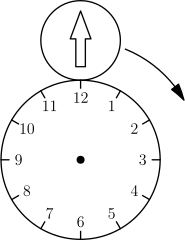
The diagram below shows the circular face of a clock with radius cm and a circular disk with radius cm externally tangent to the clock face at o’clock. The disk has an arrow painted on it, initially pointing in the upward vertical direction. Let the disk roll clockwise around the clock face. At what point on the clock face will the disk be tangent when the arrow is next pointing in the upward vertical direction?
las en punto
o’clock
las en punto
o’clock
las en punto
o’clock
las en punto
o’clock
las en punto
o’clock
Pista pequeña:
Un disco que rueda externamente gira veces el ángulo central.
A disk rolling externally rotates times the central angle
Pista grande:
Iguala el giro total del disco a una vuelta completa.
Set the disk’s total rotation equal to one full turn
Solución:
El disco de radio rueda externamente alrededor de la cara del reloj de radio . Si el punto de tangencia recorre un ángulo central alrededor del reloj, el disco gira respecto a su dirección original.
La flecha vuelve a apuntar hacia arriba cuando es un múltiplo positivo de . La primera vez que esto ocurre es , que es un tercio del camino alrededor del reloj desde las en punto, es decir, las en punto.
Por lo tanto, C es la respuesta correcta.
The disk of radius rolls externally around the clock face of radius . If the point of tangency moves through central angle around the clock, the disk rotates through relative to its original direction.
The arrow next points upward when is a positive multiple of . The first time this happens is , which is one-third of the way around the clock from o’clock, namely o’clock.
Thus, C is the correct answer.
15.
Considera el conjunto de todas las fracciones donde y son enteros positivos primos entre sí. ¿Cuántas de estas fracciones tienen la propiedad de que, si tanto el numerador como el denominador se aumentan en el valor de la fracción aumenta en ?
Consider the set of all fractions where and are relatively prime positive integers. How many of these fractions have the property that if both numerator and denominator are increased by the value of the fraction is increased by
Pista pequeña:
Convierte la condición sobre la fracción en una factorización.
Turn the fraction condition into a factorization
Pista grande:
Solo pueden funcionar los pares de factores negativos con .
Only negative factor pairs with can work
Solución:
La condición es Multiplicando en cruz obtenemos , es decir, .
Al factorizar por agrupación después de restar , obtenemos Como son positivos, los pares de factores negativos útiles son , y , que producen .
Solo tiene numerador y denominador primos entre sí, así que exactamente una fracción funciona.
Por lo tanto, B es la respuesta correcta.
The condition is Cross-multiplying gives , or .
Factoring by grouping after subtracting gives Since are positive, the useful negative factor pairs are , , and , producing .
Only has relatively prime numerator and denominator, so exactly one fraction works.
Thus, B is the correct answer.
16.
Si y ¿cuál es el valor de
If and what is the value of
Pista pequeña:
Suma y resta las dos ecuaciones por separado.
Add and subtract the two equations separately
Pista grande:
Como , divide la ecuación de la diferencia entre .
Since , divide the difference equation by
Solución:
Sumando las dos ecuaciones obtenemos Podemos reordenar esta ecuación para obtener Luego podemos restarlas para obtener Reordenando una vez más, encontramos Tenemos que , lo que significa que podemos dividir ambos lados entre . Esto nos da
Por lo tanto, B es la respuesta correcta.
Adding the two equations gives us We can rearrange this equation to get We can then subtract them to get Once again rearranging, we can find We have that which means that we can divide both sides by This gives us
Thus, B is the correct answer.
17.
Una recta que pasa por el origen corta tanto a la recta como a la recta Las tres rectas forman un triángulo equilátero. ¿Cuál es el perímetro del triángulo?
A line that passes through the origin intersects both the line and the line The three lines create an equilateral triangle. What is the perimeter of the triangle?
Pista pequeña:
La tercera recta debe formar un ángulo de con el lado vertical.
The third line must make a angle with the vertical side
Pista grande:
Evalúa las alturas de las dos intersecciones en .
Evaluate the two intersection heights at
Solución:
Como uno de los lados del triángulo equilátero es una recta vertical, el eje de simetría perpendicular a este lado debe ser horizontal.
Esto significa que la pendiente del tercer lado debe ser opuesta a la pendiente del segundo lado, que sería
Para hallar el perímetro, solo necesitamos hallar la longitud de uno de los lados del triángulo.
Podemos sustituir en las otras dos ecuaciones para obtener los dos vértices sobre la recta vertical.
Los dos valores de son y Su diferencia es por lo que el perímetro es Por lo tanto, D es la respuesta correcta.
Since one of the sides of the equilateral triangle is a vertical line, the line of symmetry perpendicular to this side must be horizontal.
This means that the slope of the third side must be opposite the slope of the second side, which would be
To find the perimeter, we only need to find the length of one of the sides of the triangle.
We can plug in into the two other equations to get the two vertices on the vertical line.
The two -values are and Their difference is which makes the perimeter Thus, D is the correct answer.
18.
Los números hexadecimales (base ) se escriben usando los dígitos a , así como las letras a para representar a Entre los primeros enteros positivos, hay cuya representación hexadecimal contiene solo dígitos numéricos. ¿Cuál es la suma de los dígitos de ?
Hexadecimal (base-) numbers are written using numeric digits through as well as the letters through to represent through Among the first positive integers, there are whose hexadecimal representation contains only numeric digits. What is the sum of the digits of
Pista pequeña:
Cuenta las cadenas hexadecimales válidas hasta .
Count valid hexadecimal strings up to
Pista grande:
Completa con ceros a la izquierda las representaciones hexadecimales más cortas antes de contar.
Pad shorter hexadecimal representations with leading zeros before counting digit choices
Solución:
En hexadecimal, Completamos cada representación más corta con ceros iniciales hasta tener tres dígitos. Cada cadena formada solo por dígitos desde hasta es como máximo y estas son todas las posibilidades.
El primer dígito tiene opciones y cada uno de los otros dos tiene opciones. Esto da cadenas, incluida Al excluir el cero, queda
La suma de los dígitos de es
Por lo tanto, E es la respuesta correcta.
In hexadecimal, Pad each shorter representation to three digits with leading zeros. Every numeric-only string from through is at most and these are all the possibilities.
The first digit has choices, and each of the other two digits has choices. This gives strings, including Excluding zero leaves
The sum of the digits in is
Thus, E is the correct answer.
19.
El triángulo rectángulo isósceles tiene el ángulo recto en y área Los rayos que trisecan cortan a en y ¿Cuál es el área de ?
The isosceles right triangle has right angle at and area The rays trisecting intersect at and What is the area of
Pista pequeña:
Usa el trisector de y resta dos triángulos congruentes de las esquinas.
Use the trisector and subtract two congruent corner triangles
Pista grande:
Si , halla la altura del .
If , find the height of
Solución:
Como es rectángulo isósceles con área , sus catetos tienen longitud . Los trisectores hacen y , por lo que y tienen áreas iguales.
Traza una perpendicular desde hacia con pie Como está sobre y es rectángulo isósceles. Sea Entonces y el ángulo de da Por lo tanto, , así que .
Por lo tanto, Restando del los dos triángulos congruentes de las esquinas,
Por lo tanto, D es la respuesta correcta.
Since is isosceles right with area , its legs have length . The trisectors make and , so and have equal area.
Drop a perpendicular from to with foot Since lies on and is isosceles right. Let Then and the angle gives Thus , so .
Therefore Subtracting the two congruent corner triangles from ,
Thus, D is the correct answer.
20.
Un rectángulo con longitudes de lados enteras positivas en tiene área y perímetro ¿Cuál de los siguientes números no puede ser igual a ?
A rectangle with positive integer side lengths in has area and perimeter Which of the following numbers cannot equal
Pista pequeña:
Factoriza como .
Factor as
Pista grande:
Prueba las opciones después de sumar .
Test the choices after adding
Solución:
Sean las longitudes de los lados enteros positivos y . Entonces Por lo tanto, debe factorizarse en dos enteros, ambos al menos .
Las opciones de respuesta más son . Todas excepto tienen una factorización con ambos factores al menos : Pero , así que no puede ser igual a .
Por lo tanto, B es la respuesta correcta.
Let the side lengths be positive integers and . Then Hence must factor into two integers both at least .
The answer choices plus are . All except have a factorization with both factors at least : But , so it cannot equal .
Thus, B is the correct answer.
21.
El tetraedro tiene y ¿Cuál es el volumen del tetraedro?
Tetrahedron has and What is the volume of the tetrahedron?
Pista pequeña:
Coloca los dos triángulos -- sobre una base común .
Put the two -- triangles on a common base
Pista grande:
hace que las dos alturas sean perpendiculares.
makes the two altitudes perpendicular
Solución:
Afirmamos que los planos de los triángulos y son perpendiculares entre sí.
Podemos demostrarlo trazando las perpendiculares desde y hacia .
Como y los pies de estas alturas coinciden en el punto
Entonces Además, lo que muestra que es un triángulo rectángulo isósceles y
Como y , el segmento es perpendicular al plano . Finalmente, el volumen del tetraedro es
Por lo tanto, C es la respuesta correcta.
We claim that the planes and are perpendicular to each other.
We can show this by dropping the perpendiculars from and to .
Since and we have that the feet of these altitudes will coincide at point
Then we have that We also have so is an isosceles right triangle and
Since and , the segment is perpendicular to the plane . Finally, the volume of the tetrahedron is
Thus, C is the correct answer.
22.
Ocho personas están sentadas alrededor de una mesa circular, cada una con una moneda justa. Las ocho personas lanzan sus monedas; quienes obtienen cara se ponen de pie, mientras que quienes obtienen cruz permanecen sentadas. ¿Cuál es la probabilidad de que no haya dos personas adyacentes de pie?
Eight people are sitting around a circular table, each holding a fair coin. All eight people flip their coins and those who flip heads stand while those who flip tails remain seated. What is the probability that no two adjacent people will stand?
Pista pequeña:
Cuenta los subconjuntos de un ciclo según el número de personas de pie.
Count subsets of a cycle by the number of standing people
Pista grande:
Separa el conteo en los casos de o caras.
Separate the count into cases with or heads
Solución:
Cuenta los posibles conjuntos de personas que se ponen de pie. Para y persona de pie, hay y posibilidades.
Para personas de pie, elige cualquier par y resta los pares adyacentes: .
Para personas de pie, primero elige una persona de pie. Entre los cinco asientos restantes que no son vecinos, hay pares posibles, pero de esos pares son adyacentes, dejando . Esto cuenta cada conjunto final tres veces, así que hay posibilidades.
Para personas de pie, las únicas posibilidades son los dos conjuntos alternados. Así, el número de resultados favorables de los lanzamientos es . Como los resultados son igualmente probables, la probabilidad es .
Por lo tanto, A es la respuesta correcta.
Count the possible sets of people who stand. For and people standing, there are and possibilities.
For people standing, choose any pair and subtract the adjacent pairs: .
For people standing, first choose one standing person. Among the remaining five non-neighbor seats, pairs are possible, but of those pairs are adjacent, leaving . This counts each final set three times, so there are possibilities.
For people standing, the only possibilities are the two alternating sets. Thus the number of favorable coin-flip outcomes is . Since all outcomes are equally likely, the probability is .
Thus, A is the correct answer.
23.
Los ceros de la función son enteros. ¿Cuál es la suma de los posibles valores de ?
The zeros of the function are integers. What is the sum of the possible values of
Pista pequeña:
Sean las raíces enteras y factoriza .
Let integer roots be and factor
Pista grande:
Los pares de factores de dan los posibles valores de .
The factor pairs of give the possible values of
Solución:
Sean los ceros y Usando las fórmulas de Vieta, tenemos que y
Entonces obtenemos que se reordena como
Los únicos pares posibles que funcionan son Para cualquiera de estos pares, tenemos Los valores distintos de son La suma de estos valores es
Por lo tanto, C es la respuesta correcta.
Let the zeros be and Using Vieta’s formulas, we have that and
Then we get that which rearranges to
The only possible pairs that work are For any of these pairs, we have that We want all the such unique values of We get that they are The sum of these values is
Thus, C is the correct answer.
24.
Para algunos enteros positivos existe un cuadrilátero con longitudes de lados enteras positivas, perímetro ángulos rectos en y y ¿Cuántos valores distintos de son posibles?
For some positive integers there is a quadrilateral with positive integer side lengths, perimeter right angles at and and How many different values of are possible?
Pista pequeña:
Toma a partir del triángulo rectángulo del diagrama.
Set from the right triangle in the diagram
Pista grande:
Usa .
Use
Solución:

Sea y . Bajando la altura desde hacia se obtiene un triángulo rectángulo con catetos y , e hipotenusa . Por lo tanto, así que .
Como es un entero, escribimos . Entonces , y el perímetro es
Necesitamos , es decir, . Esto se cumple para , mientras que es demasiado grande. Por lo tanto, hay perímetros posibles.
Por lo tanto, B es la respuesta correcta.
Let and . Dropping the altitude from to gives a right triangle with legs and , and hypotenuse . Therefore so .
Since is an integer, write . Then , and the perimeter is
We need , or . This holds for , while is too large. Thus there are possible perimeters.
Thus, B is the correct answer.
25.
Sea un cuadrado de lado Se eligen dos puntos de forma independiente y al azar sobre los lados de La probabilidad de que la distancia en línea recta entre los puntos sea al menos es donde y son enteros positivos con ¿Cuál es ?
Let be a square of side length Two points are chosen independently at random on the sides of The probability that the straight-line distance between the points is at least is where and are positive integers with What is
Pista pequeña:
Condiciona según si el segundo punto está en el mismo lado, en un lado adyacente o en el lado opuesto.
Condition on whether the second point is on the same, adjacent, or opposite side
Pista grande:
En el caso de lados adyacentes, la región de fracaso es un cuarto de círculo de radio .
The adjacent-side case removes a quarter circle of radius
Solución:
Fija uno de los dos puntos. El segundo punto está en el mismo lado con probabilidad , en un lado adyacente con probabilidad y en el lado opuesto con probabilidad .
En el mismo lado, dos coordenadas están a distancia al menos cuando . Esta región consiste en dos triángulos rectángulos con área total .
En lados adyacentes, la distancia tiene la forma . La región de fracaso es un cuarto de círculo de radio , así que la probabilidad de éxito es .
En lados opuestos, la distancia siempre es al menos , así que la probabilidad de éxito es . Por lo tanto, la probabilidad buscada es Por lo tanto, .
Por lo tanto, A es la respuesta correcta.
Fix one of the two points. The second point is on the same side with probability , on an adjacent side with probability , and on the opposite side with probability .
On the same side, two coordinates are at distance at least when . This region consists of two right triangles with total area .
On adjacent sides, the distance has the form . The failing region is a quarter circle of radius , so the success probability is .
On opposite sides, the distance is always at least , so the success probability is . Therefore the desired probability is Hence .
Thus, A is the correct answer.