
Soluciones del 2011 AMC 10B
Desplázate hacia abajo para ver las soluciones preparadas profesionalmente de LIVE by Po-Shen Loh, imprime las soluciones en PDF, consulta la clave de respuestas, o haz el examen cronometrado completo.
Todos los problemas se usan con el permiso legal oficial de la Mathematical Association of America (MAA).
1.
¿Cuál es el valor de la siguiente expresión?
What is the value of the following expression?
Pista pequeña:
Suma primero los números pares y los impares.
Add the even numbers and odd numbers first
Pista grande:
La expresión se convierte en .
The expression becomes
Solución:
Resolviendo directamente:
Por lo tanto, la respuesta correcta es C.
Simply solving directly:
Thus, the correct answer is C .
2.
Las notas de Josanna hasta ahora son y Su objetivo es subir su promedio de exámenes al menos puntos con su próximo examen. ¿Cuál es la nota mínima que necesitaría para lograr este objetivo?
Josanna’s test scores to date are and Her goal is to raise her test average at least points with her next test. What is the minimum test score she would need to accomplish this goal?
Pista pequeña:
Halla la suma actual de las notas y el promedio objetivo.
Find the current total score and target average
Pista grande:
La sexta nota debe llevar la suma total a .
The sixth score must bring the total to
Solución:
Su promedio actual es y la suma de sus notas es El promedio deseado es así que la suma requerida es Por lo tanto, la nota mínima es
Por lo tanto, la respuesta correcta es E.
Her current average is and the sum of her scores is The desired average is then so the sum of scores required is Therefore, the answer is
Thus, the correct answer is E .
3.
En una tienda, cuando una longitud se reporta como pulgadas significa que es de al menos pulgadas y a lo sumo pulgadas. Supón que las dimensiones de una baldosa rectangular se reportan como pulgadas por pulgadas. En pulgadas cuadradas, ¿cuál es el área mínima del rectángulo?
At a store, when a length is reported as inches that means it is at least inches and at most inches. Suppose the dimensions of a rectangular tile are reported as inches by inches. In square inches, what is the minimum area for the rectangle?
Pista pequeña:
Usa la longitud y el ancho más pequeños posibles.
Use the smallest possible length and width
Pista grande:
La baldosa reportada como por puede ser tan pequeña como por .
The reported by tile can be as small as by
Solución:
Las dimensiones más pequeñas posibles son así que el área es
Por lo tanto, la respuesta correcta es A.
The smallest possible dimensions are so the area is
Thus, the correct answer is A .
4.
LeRoy y Bernardo hicieron juntos un viaje de una semana y acordaron compartir los gastos por igual. Durante la semana, cada uno pagó varios gastos comunes como gasolina y alquiler del auto. Al final del viaje resultó que LeRoy había pagado dólares y Bernardo había pagado dólares, donde ¿Cuántos dólares debe darle LeRoy a Bernardo para que compartan los gastos por igual?
LeRoy and Bernardo went on a week-long trip together and agreed to share the costs equally. Over the week, each of them paid for various joint expenses such as gasoline and car rental. At the end of the trip it turned out that LeRoy had paid dollars and Bernardo had paid dollars, where How many dollars must LeRoy give to Bernardo so that they share the costs equally?
Pista pequeña:
Compara cuánto más pagó Bernardo que LeRoy.
Compare how much more Bernardo paid than LeRoy
Pista grande:
Solo hay que transferir la mitad de la diferencia.
Only half of the difference has to be transferred
Solución:
La cantidad que cada uno debería pagar es y LeRoy pagó Por lo tanto, todavía debe pagarle a Bernardo dólares.
Por lo tanto, la respuesta correcta es C.
The amount they each would have to pay is and LeRoy paid Thus, he has to pay more.
Thus, the correct answer is C .
5.
Al multiplicar dos enteros positivos y Ron invirtió los dígitos del número de dos cifras Su producto erróneo fue ¿Cuál es el valor correcto del producto de y ?
In multiplying two positive integers and Ron reversed the digits of the two-digit number His erroneous product was What is the correct value of the product of and
Pista pequeña:
Factoriza .
Factor
Pista grande:
El único factor de dos cifras te da el valor invertido de .
The only two-digit factor tells you the reversed value of
Solución:
El número es igual a No hay otros pares de números cuyo producto sea además de así que es el único factor de dos cifras. Por lo tanto, es el número invertido, de modo que él quería obtener , que es
Por lo tanto, la respuesta correcta es E.
The number is equal to There are no other pairs of numbers that multiply to besides so is the only two digit factor. Thus, is the number reversed, so he meant to get which is
Thus, the correct answer is E .
6.
En Halloween Casper se comió de sus dulces y luego le dio dulces a su hermano. Al día siguiente se comió de los dulces que le quedaban y luego le dio dulces a su hermana. Al tercer día se comió sus últimos dulces. ¿Cuántos dulces tenía Casper al principio?
On Halloween Casper ate of his candies and then gave candies to his brother. The next day he ate of his remaining candies and then gave candies to his sister. On the third day he ate his final candies. How many candies did Casper have at the beginning?
Pista pequeña:
Trabaja hacia atrás desde los últimos dulces.
Work backward from the final candies
Pista grande:
Antes de regalar , Casper tenía , que eran dos tercios de la cantidad anterior.
Before giving away , Casper had , which was two thirds of the previous amount
Solución:
Trabaja hacia atrás. Antes de darle dulces a su hermana, Casper tenía dulces, porque terminó el segundo día con .
Esos dulces eran de lo que tenía después del primer día, así que tras el primer día tenía dulces.
Antes de darle dulces a su hermano, tenía dulces. Esto era de su cantidad original, así que empezó con dulces.
Por lo tanto, la respuesta correcta es A.
Work backward. Before giving candies to his sister, Casper had candies, because he ended the second day with .
Those candies were of what he had after the first day, so after the first day he had candies.
Before giving candies to his brother, he had candies. This was of his original amount, so he began with candies.
Thus, A is the correct answer.
7.
La suma de dos ángulos de un triángulo es de un ángulo recto, y uno de estos dos ángulos es mayor que el otro. ¿Cuál es la medida en grados del mayor ángulo del triángulo?
The sum of two angles of a triangle is of a right angle, and one of these two angles is larger than the other. What is the degree measure of the largest angle in the triangle?
Pista pequeña:
Convierte de un ángulo recto a grados.
Convert of a right angle to degrees
Pista grande:
Compara el tercer ángulo con los dos ángulos cuya suma y diferencia se conocen.
Compare the third angle with the two angles whose sum and difference are known
Solución:
Los dos ángulos suman Esto hace que el otro ángulo sea Luego, si el mayor de los dos ángulos es , el menor es , de modo que su suma es lo que da
Esto significa que ningún ángulo es mayor que así que el mayor es igual a
Por lo tanto, la respuesta correcta es B.
The two angles add to This makes the other angle Then, if the larger of the two angles is then the smaller of them is so their sum is making
This means no angle is larger than making the largest equal to
Thus, the correct answer is B .
8.
En cierta playa, si hace al menos y está soleado, entonces la playa estará llena. El de junio la playa no estaba llena. ¿Qué se puede concluir sobre las condiciones climáticas del de junio?
At a certain beach if it is at least and sunny, then the beach will be crowded. On June the beach was not crowded. What can be concluded about the weather conditions on June
La temperatura era más fresca que F y no estaba soleado.
The temperature was cooler than F and it was not sunny.
La temperatura era más fresca que F o no estaba soleado.
The temperature was cooler than F or it was not sunny.
Si la temperatura era de al menos F, entonces estaba soleado.
If the temperature was at least F, then it was sunny.
Si la temperatura era más fresca que F, entonces estaba soleado.
If the temperature was cooler than F, then it was sunny.
Si la temperatura era más fresca que F, entonces no estaba soleado.
If the temperature was cooler than F, then it was not sunny.
Pista pequeña:
Usa el contrapositivo de “caluroso y soleado implica lleno”.
Use the contrapositive of “hot and sunny implies crowded”
Pista grande:
Que no esté llena significa que al menos una de las dos condiciones no se cumplió.
Not crowded means at least one of the two conditions failed
Solución:
El enunciado dice que si el clima era de al menos y soleado, entonces la playa estaba llena.
Como la playa no estaba llena, las dos condiciones no pudieron ser ambas verdaderas. Por lo tanto, la temperatura era más fresca que , o no estaba soleado, o ambas cosas.
Por lo tanto, la respuesta correcta es B.
The statement says that if the weather was at least and sunny, then the beach was crowded.
Because the beach was not crowded, the two conditions could not both have been true. Therefore the temperature was cooler than , or it was not sunny, or both.
Thus, B is the correct answer.
9.
El área de es un tercio del área del triángulo -- El segmento es perpendicular al segmento ¿Cuánto vale ?
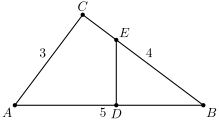
The area of is one third of the area of the -- triangle Segment is perpendicular to segment What is
Pista pequeña:
Usa la semejanza entre y .
Use similarity between and
Pista grande:
La razón de áreas da una razón de longitudes .
Area ratio gives side-length ratio
Solución:
Por semejanza ángulo-ángulo,
Luego, como la razón de las áreas es la razón de las longitudes de los lados es
Por lo tanto, de modo que
Por lo tanto, la respuesta correcta es D.
By angle angle similarity, we have
Then, since the ratio of the areas is the ratio of the sidelengths is
As such, making
Thus, the correct answer is D .
10.
Considera el conjunto de números ¿A qué entero se aproxima más la razón entre el mayor elemento del conjunto y la suma de los otros diez elementos del conjunto?
Consider the set of numbers The ratio of the largest element of the set to the sum of the other ten elements of the set is closest to which integer?
Pista pequeña:
El denominador es una suma geométrica.
The denominator is a geometric sum
Pista grande:
Nota que .
Solución:
El número mayor es Los otros diez números tienen suma Por lo tanto, la razón es que es apenas mayor que y, por tanto, está más cerca de
Así, la respuesta correcta es B.
The largest number is The other ten numbers have sum Therefore their ratio is which is just slightly greater than and hence closest to
Thus, the correct answer is B .
11.
Hay personas en una habitación. ¿Cuál es el mayor valor de tal que la afirmación “Al menos personas en esta habitación cumplen años en el mismo mes” es siempre verdadera?
There are people in a room. What is the largest value of such that the statement “At least people in this room have birthdays falling in the same month” is always true?
Pista pequeña:
Usa el principio del palomar con meses.
Use the pigeonhole principle with months
Pista grande:
Intenta distribuir cumpleaños lo más uniformemente posible.
Try distributing birthdays as evenly as possible
Solución:
No es necesariamente cierto para , pues podríamos tener personas nacidas en los primeros meses y personas nacidas en los meses restantes.
Sin embargo, algún mes debe ser mayor o igual que , ya que el promedio de personas nacidas en cada mes es , que es mayor que y algún mes debe estar por encima del promedio.
Por lo tanto, la respuesta correcta es D.
It isn’t necessarily true for as we could have people born in the first months and people born in the subsequent months.
However, one month must be greater than or equal to as the average of the number of people born in each month is which is greater than and some month must be above average.
Thus, the correct answer is D .
12.
Keiko camina una vuelta alrededor de una pista exactamente a la misma velocidad constante todos los días. Los lados de la pista son rectos y los extremos son semicírculos. La pista tiene un ancho de metros, y le toma segundos más caminar por el borde exterior de la pista que por el borde interior. ¿Cuál es la velocidad de Keiko en metros por segundo?
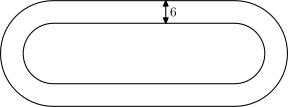
Keiko walks once around a track at exactly the same constant speed every day. The sides of the track are straight, and the ends are semicircles. The track has a width of meters, and it takes her seconds longer to walk around the outside edge of the track than around the inside edge. What is Keiko’s speed in meters per second?
Pista pequeña:
Las partes rectas se cancelan al comparar las trayectorias exterior e interior.
The straight portions cancel when comparing outside and inside paths
Pista grande:
Solo los dos extremos semicirculares añaden distancia adicional.
Only the two semicircular ends add extra distance
Solución:
Sea el radio del semicírculo interior. Las partes rectas de las trayectorias interior y exterior tienen la misma longitud total, así que solo los extremos semicirculares cambian la distancia.
Los dos semicírculos interiores tienen longitud total , mientras que los dos exteriores tienen longitud total . Por lo tanto, la trayectoria exterior es metros más larga.
Keiko tarda segundos más en caminar metros más, así que su velocidad es metros por segundo.
Por lo tanto, la respuesta correcta es A.
Let the inner semicircle radius be . The straight parts of the inside and outside paths have the same total length, so only the semicircular ends change the distance.
The two inner semicircles have total length , while the two outer semicircles have total length . The outside path is therefore meters longer.
Keiko takes more seconds to walk more meters, so her speed is meters per second.
Thus, A is the correct answer.
13.
Se seleccionan dos números reales de forma independiente y al azar del intervalo ¿Cuál es la probabilidad de que el producto de esos números sea mayor que cero?
Two real numbers are selected independently at random from the interval What is the probability that the product of those numbers is greater than zero?
Pista pequeña:
El producto es positivo cuando ambos números tienen el mismo signo.
The product is positive when both numbers have the same sign
Pista grande:
El intervalo tiene unidades negativas y unidades positivas.
The interval has negative units and positive units
Solución:
Un número elegido es negativo con probabilidad y positivo con probabilidad (Elegir exactamente tiene probabilidad ) El producto es positivo exactamente cuando ambos números tienen el mismo signo, así que la probabilidad es
Así, la respuesta correcta es D.
A selected number is negative with probability and positive with probability (Selecting exactly has probability ) The product is positive exactly when both numbers have the same sign, so the probability is
Thus, the correct answer is D .
14.
Un estacionamiento rectangular tiene una diagonal de metros y un área de metros cuadrados. En metros, ¿cuál es el perímetro del estacionamiento?
A rectangular parking lot has a diagonal of meters and an area of square meters. In meters, what is the perimeter of the parking lot?
Pista pequeña:
Sean y las longitudes de los lados.
Let the side lengths be and
Pista grande:
Usa .
Use
Solución:
Sean las longitudes de los lados. Queremos hallar Por el teorema de Pitágoras, También sabemos que
Por lo tanto, Esto da y así, el perímetro es
Por lo tanto, la respuesta correcta es C.
Let the side lengths be We wish to find From the Pythagorean Theorem, we get We also know
As such This makes and as such, our answer is
Thus, the correct answer is C .
15.
Sea la operación “promediar con”: ¿Cuáles de las siguientes leyes distributivas se cumplen para todos los números y ?
I.
II.
III.
Let denote the “averaged with” operation: Which of the following distributive laws hold for all numbers and
I.
II.
III.
Solo
only
Solo
only
Solo
only
Solo y
and only
Solo y
and only
Pista pequeña:
Desarrolla cada lado usando .
Expand each side using
Pista grande:
Comprueba cada una de I, II y III simbólicamente.
Test each of I, II, and III symbolically
Solución:
En I, el lado izquierdo es igual a y el lado derecho es igual a así que no son iguales.
En II, ambos lados son iguales a así que la igualdad se cumple.
En III, ambos lados son iguales a así que la igualdad también se cumple.
Por lo tanto, la respuesta correcta es E.
In statement I, the left-hand side equals and the right-hand side equals so they are not always equal.
In statement II, both sides equal so it holds.
In statement III, both sides equal so it also holds.
Thus, the correct answer is E .
16.
Un tablero de dardos es un octágono regular dividido en regiones como se muestra. Supón que un dardo lanzado al tablero tiene la misma probabilidad de caer en cualquier punto del tablero. ¿Cuál es la probabilidad de que el dardo caiga dentro del cuadrado central?
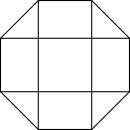
A dart board is a regular octagon divided into regions as shown. Suppose that a dart thrown at the board is equally likely to land anywhere on the board. What is the probability that the dart lands within the center square?
Pista pequeña:
Supón que la longitud de cada lado del cuadrado central es .
Let each side of the center square be
Pista grande:
Halla el área del octágono sumando el cuadrado central, cuatro rectángulos y cuatro triángulos en las esquinas.
Find the octagon area by adding the center square, four rectangles, and four corner triangles
Solución:
La longitud de cada lado del cuadrado central es Entonces, el área del centro es
Luego, debemos hallar el área del octágono. Se puede obtener como un cuadrado al que se le quitan triángulos rectángulos isósceles. La longitud del lado de este cuadrado es Por tanto, su área es
El cateto de cada triángulo rectángulo mide por lo que su área es Los cuatro tienen área total así que el área del octágono es
Por lo tanto, la razón es
Por lo tanto, la respuesta correcta es A.
Let the side length be Then, the area of the center is
Then, we must find the area of the octagon. It can be found as a square with isosceles right triangles taken out. The side length of this square is It has an area of
Then, the side length of the right triangles is making the area of one equal to This makes them have a total combined area of so the area of the octagon is
Thus, the ratio is
Thus, the correct answer is A .
17.
En el círculo dado, el diámetro es paralelo a y es paralelo a Los ángulos y están en la razón ¿Cuál es la medida en grados del ángulo ?
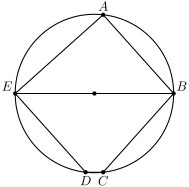
In the given circle, the diameter is parallel to and is parallel to The angles and are in the ratio What is the degree measure of angle
Pista pequeña:
Usa el hecho de que un ángulo que subtiende un diámetro es recto.
Use the fact that an angle subtending a diameter is right
Pista grande:
Las cuerdas paralelas crean ángulos de base iguales en un trapecio isósceles.
Parallel chords create equal base angles in an isosceles trapezoid
Solución:
Como es un diámetro, . La razón da entonces y .
Como , . Como , el cuadrilátero es un trapecio isósceles, así que .
Los ángulos y son suplementarios, así que . Por lo tanto, .
Por lo tanto, la respuesta correcta es C.
Since is a diameter, . The ratio then gives and .
Because , . Since , quadrilateral is an isosceles trapezoid, so .
Angles and are supplementary, so . Hence .
Thus, C is the correct answer.
18.
El rectángulo tiene y Se elige el punto sobre el lado de modo que ¿Cuál es la medida en grados de ?
Rectangle has and Point is chosen on side so that What is the degree measure of
Pista pequeña:
Usa para trasladar un ángulo a .
Use to transfer one angle to
Pista grande:
El triángulo se vuelve isósceles.
Triangle becomes isosceles
Solución:
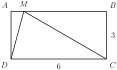
Los ángulos y son iguales porque
Por lo tanto, lo que hace que sea isósceles y
Como podemos ver, lo que da
Por lo tanto, Como es la mitad de eso,
Por lo tanto, la respuesta correcta es E.
The angles and are equal since
As such, making isosceles and
As we can see, making
Therefore, Since is half of that,
Thus, the correct answer is E .
19.
¿Cuál es el producto de todas las raíces de la siguiente ecuación?
What is the product of all the roots of the equation below?
Pista pequeña:
Eleva al cuadrado ambos lados después de verificar que los radicales estén definidos.
Square both sides after checking the radicals are defined
Pista grande:
Escribe la ecuación en términos de .
Write the equation in terms of
Solución:
Como al elevar la ecuación al cuadrado se obtiene Las posibilidades algebraicas para son y pero un valor absoluto no puede ser negativo. Por tanto, así que las raíces son y , cuyo producto es
Así, la respuesta correcta es A.
Because squaring the equation gives The algebraic possibilities for are and but an absolute value cannot be negative. Hence so the roots are and , with product
Thus, the correct answer is A .
20.
El rombo tiene lado y . La región consiste en todos los puntos dentro del rombo que están más cerca del vértice que de cualquiera de los otros tres vértices. ¿Cuál es el área de ?
Rhombus has side length and . Region consists of all points inside the rhombus that are closer to vertex than any of the other three vertices. What is the area of
Pista pequeña:
Usa mediatrices para localizar los puntos más cercanos a .
Use perpendicular bisectors to locate points closer to
Pista grande:
La región buscada es el pentágono central que resulta de recortar dos pequeños triángulos congruentes.
The desired region is the central pentagon cut out by two congruent small triangles
Solución:
Los puntos más cercanos a que a otro vértice están delimitados por las mediatrices de , y . La mediatriz de es la diagonal , así que la región buscada está en .
El triángulo tiene área . Las mediatrices de y recortan dos triángulos -- congruentes, cada uno con área .
Por lo tanto, el área buscada es .
Por lo tanto, la respuesta correcta es C.
The points closer to than to another vertex are bounded by the perpendicular bisectors of , , and . The bisector of is diagonal , so the desired region lies in .
Triangle has area . The perpendicular bisectors of and cut off two congruent -- triangles, each with area .
Therefore the desired area is .
Thus, C is the correct answer.
21.
Brian escribe cuatro enteros cuya suma es Las diferencias positivas por pares de estos números son y ¿Cuál es la suma de los posibles valores de ?
Brian writes down four integers whose sum is The pairwise positive differences of these numbers are and What is the sum of the possible values for
Pista pequeña:
La mayor diferencia debe ser .
The largest difference must be
Pista grande:
Las diferencias por pares restantes deben dividir como o .
The remaining paired differences must split as or
Solución:
La mayor diferencia es , así que . Para cualquiera de los números intermedios , las dos diferencias y deben sumar .
Los pares de diferencias disponibles que suman son y , y la diferencia restante entre los dos números intermedios es .
Un conjunto posible es , que da y . El otro es , que da y .
La suma de los posibles valores de es .
Por lo tanto, la respuesta correcta es B.
The largest difference is , so . For either middle number , the two differences and must add to .
The available pairs of differences that add to are and , and the remaining difference between the two middle numbers is .
One possible set is , giving and . The other is , giving and .
The sum of the possible values of is .
Thus, B is the correct answer.
22.
Una pirámide tiene una base cuadrada con lados de longitud y caras laterales que son triángulos equiláteros. Se coloca un cubo dentro de la pirámide de modo que una cara está sobre la base de la pirámide y su cara opuesta tiene todas sus aristas sobre las caras laterales de la pirámide. ¿Cuál es el volumen de este cubo?
A pyramid has a square base with sides of length and has lateral faces that are equilateral triangles. A cube is placed within the pyramid so that one face is on the base of the pyramid and its opposite face has all its edges on the lateral faces of the pyramid. What is the volume of this cube?
Pista pequeña:
Usa una sección transversal diagonal que atraviese la pirámide y el cubo.
Use a diagonal cross-section through the pyramid and cube
Pista grande:
El cubo aporta un rectángulo de altura y ancho .
The cube contributes a rectangle of height and width
Solución:
Sea la longitud del lado del cubo. Toma una sección transversal vertical diagonal de la pirámide que pasa por vértices opuestos de la base cuadrada.
Esta sección es un triángulo rectángulo isósceles con hipotenusa . El cubo aparece como un rectángulo de altura y ancho , dejando dos triángulos rectángulos isósceles congruentes de cateto .
Así, , de modo que . El volumen del cubo es .
Por lo tanto, la respuesta correcta es A.
Let the cube have side length . Take a vertical diagonal cross-section of the pyramid through opposite vertices of the square base.
This cross-section is an isosceles right triangle with hypotenuse . The cube appears as a rectangle of height and width , leaving two congruent right isosceles triangles of leg .
Thus , so . The cube volume is .
Thus, A is the correct answer.
23.
¿Cuál es la cifra de las centenas de ?
What is the hundreds digit of
Pista pequeña:
Trabaja módulo .
Work modulo
Pista grande:
En , los términos con o superior no afectan las últimas tres cifras.
In , terms with or higher do not affect the last three digits
Solución:
Como , basta con hallar módulo .
Todos los términos con o superior son divisibles por , así que solo importan los primeros tres términos:
Módulo , esto es .
Por lo tanto, la cifra de las centenas es .
Por lo tanto, la respuesta correcta es D.
Because , it is enough to find modulo .
All terms with or higher are divisible by , so only the first three terms matter:
Modulo , this is .
The hundreds digit is therefore .
Thus, D is the correct answer.
24.
Un punto reticular en un sistema de coordenadas es cualquier punto donde tanto como son enteros. La gráfica de no pasa por ningún punto reticular con para todo tal que ¿Cuál es el máximo valor posible de ?
A lattice point in an -coordinate system is any point where both and are integers. The graph of passes through no lattice point with for all such that What is the maximum possible value of
Pista pequeña:
Un punto reticular aparece cuando es entero, después de desplazar la gráfica unidades hacia abajo.
A lattice point occurs when is an integer after shifting down by
Pista grande:
Revisa el menor entero por encima de para cada .
Check the nearest integer above for each
Solución:
Desplaza la gráfica hacia abajo . El problema equivale a encontrar la menor pendiente para la cual pasa por un punto reticular con .
Para un entero fijo , el menor entero con es cuando es par, y cuando es impar.
Así, las pendientes candidatas son para par, minimizada en como , y para impar, minimizada en como .
La menor de estas es , así que todo con evita tales puntos reticulares, y este extremo superior es el mejor posible.
Por lo tanto, la respuesta correcta es B.
Shift the graph down by . The problem is equivalent to finding the smallest slope for which passes through a lattice point with .
For a fixed integer , the smallest integer with is when is even, and when is odd.
Thus the candidate slopes are for even , minimized at as , and for odd , minimized at as .
The smaller of these is , so every with avoids such lattice points, and this upper endpoint is best possible.
Thus, B is the correct answer.
25.
Sea un triángulo con lados y Para si y y son los puntos de tangencia de la circunferencia inscrita de con los lados y respectivamente, entonces es un triángulo con lados y si existe. ¿Cuál es el perímetro del último triángulo de la sucesión ?
Let be a triangle with side lengths and For if and and are the points of tangency of the incircle of to the sides and respectively, then is a triangle with side lengths and if it exists. What is the perimeter of the last triangle in the sequence
Pista pequeña:
Las longitudes de las tangentes desde un mismo vértice son iguales.
Tangent lengths from the same vertex are equal
Pista grande:
Para lados , el siguiente lado central es .
For side lengths , the next middle side is
Solución:
Para un triángulo con lados , y , las tangentes iguales desde un mismo vértice dan los siguientes lados
Si los lados actuales son , entonces los siguientes son . Así, se mantiene la misma forma mientras el lado central se reduce a la mitad cada vez.
Para , el lado central es . Un triángulo de la forma existe exactamente cuando .
El último triángulo válido cumple , pero el siguiente no. Esto da , con lado central .
El perímetro es .
Por lo tanto, la respuesta correcta es D.
For a triangle with side lengths , , and , equal tangents from the same vertex give the next side lengths
If the current side lengths are , then the next side lengths are . Thus the same form persists while the middle side halves each time.
For , the middle side is . A triangle of the form exists exactly when .
The last valid triangle has , but the next one does not. This gives , with middle side .
The perimeter is .
Thus, D is the correct answer.