
Soluciones del 1989 AIME
Desplázate hacia abajo para ver las soluciones preparadas profesionalmente de LIVE by Po-Shen Loh, imprime las soluciones en PDF, consulta la clave de respuestas, o haz el examen cronometrado completo.
Todos los problemas se usan con el permiso legal oficial de la Mathematical Association of America (MAA).
1.
Calcula
Compute
Pista pequeña:
Agrupa los factores exteriores y los factores interiores
Pair the outer factors and the inner factors
Pista grande:
Los dos productos agrupados son enteros pares consecutivos
The two paired products are consecutive even integers
Solución:
Tenemos y Estos productos son uno menos y uno más que así que su producto es Al sumar el final, el radicando es Su raíz cuadrada positiva es
We have and These products lie one below and one above so their product is After the final is added, the radicand is Its positive square root is
2.
Hay diez puntos marcados en una circunferencia. ¿Cuántos polígonos convexos distintos de tres o más lados pueden dibujarse usando algunos (o todos) de los diez puntos como vértices?
Ten points are marked on a circle. How many distinct convex polygons of three or more sides can be drawn using some (or all) of the ten points as vertices?
Pista pequeña:
Cada selección de al menos tres puntos marcados determina un polígono convexo
Each choice of at least three marked points determines one convex polygon
Pista grande:
Cuenta todos los subconjuntos y elimina los de tamaños y
Count all subsets and remove those of sizes and
Solución:
Cada subconjunto de al menos tres puntos determina exactamente un polígono convexo. Hay subconjuntos en total. De ellos, y tienen menos de tres puntos. Por lo tanto, el número pedido es
Every subset of at least three points determines exactly one convex polygon. There are subsets in all. Of these, and have fewer than three points. Therefore the required number is
3.
Supón que es un entero positivo y que es un solo dígito en base Halla si
Suppose is a positive integer and is a single digit in base Find if
Pista pequeña:
Convierte el bloque periódico de tres dígitos en una fracción con denominador
Convert the repeating three-digit block into a fraction with denominator
Pista grande:
Usa que es entero para determinar qué dígito hace que sea divisible por
Use the integrality of to determine which digit makes divisible by
Solución:
El decimal periódico es Por lo tanto, Como la única manera de que sea divisible por es que de modo que y
The repeating decimal is Thus Since the only way can be divisible by is so and
4.
Si son enteros positivos consecutivos tales que es un cuadrado perfecto y es un cubo perfecto, ¿cuál es el menor valor posible de ?
If are consecutive positive integers such that is a perfect square and is a perfect cube, what is the smallest possible value of
Pista pequeña:
Expresa ambas sumas en función del entero central
Express both sums in terms of the middle integer
Pista grande:
Compara los exponentes primos de y módulo y módulo
Compare the prime exponents in and modulo and modulo
Solución:
Las dos sumas son y Si que sea un cuadrado y sea un cubo impone condiciones sobre cada exponente. Para el menor exponente de que es impar y divisible por es Para el menor exponente que es par y congruente con es Todos los demás exponentes primos pueden ser Por lo tanto, el menor valor posible es
The two sums are and If then being a square and being a cube impose conditions on every exponent. For the smallest exponent in that is odd and divisible by is For the smallest exponent that is even and congruent to is Every other prime exponent can be Thus the least possible value is
5.
Al lanzar cinco veces cierta moneda sesgada, la probabilidad de obtener cara exactamente una vez no es y es igual a la de obtener cara exactamente dos veces. Sea en su mínima expresión, la probabilidad de que la moneda dé cara en exactamente de los lanzamientos. Halla
When a certain biased coin is flipped five times, the probability of getting heads exactly once is not equal to and is the same as that of getting heads exactly twice. Let in lowest terms, be the probability that the coin comes up heads in exactly out of flips. Find
Pista pequeña:
Sea la probabilidad de obtener cara e iguala las dos probabilidades binomiales
Let be the probability of heads and equate the two binomial probabilities
Pista grande:
Cancela los factores comunes no nulos antes de despejar
Cancel the nonzero common factors before solving for
Solución:
Sea la probabilidad de obtener cara. La condición da La condición de que la probabilidad no sea cero permite cancelar factores, lo que da y por tanto La probabilidad de obtener exactamente tres caras es Por lo tanto,
Let be the probability of heads. The condition gives The stated nonzero condition permits cancellation, yielding so The probability of exactly three heads is Therefore
6.
Dos patinadores, Allie y Billie, están en los puntos y respectivamente, sobre un lago llano y congelado. La distancia entre y es de metros. Allie parte de y patina a metros por segundo en una línea recta que forma un ángulo de con Al mismo tiempo que Allie parte de Billie parte de a metros por segundo y sigue la trayectoria recta que, dadas sus velocidades, permite que ambos se encuentren lo antes posible. ¿Cuántos metros patina Allie antes de encontrarse con Billie?
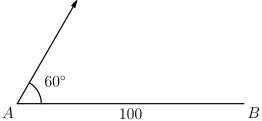
Two skaters, Allie and Billie, are at points and respectively, on a flat, frozen lake. The distance between and is meters. Allie leaves and skates at a speed of meters per second on a straight line that makes a angle with At the same time Allie leaves Billie leaves at a speed of meters per second and follows the straight path that produces the earliest possible meeting of the two skaters, given their speeds. How many meters does Allie skate before meeting Billie?
Pista pequeña:
Después de segundos, Allie está a metros de y Billie puede estar a metros de
After seconds, Allie is meters from and Billie can be meters from
Pista grande:
Aplica la ley de los cosenos al triángulo y elige el menor tiempo positivo
Apply the Law of Cosines to the triangle and select the smaller positive time
Solución:
Supón que los patinadores se encuentran después de segundos. Sus distancias desde y son y y el ángulo comprendido en es La ley de los cosenos da De aquí, cuyas raíces son y El encuentro más temprano ocurre cuando así que Allie patina metros.
Suppose the skaters meet after seconds. Their distances from and are and and the included angle at is The Law of Cosines gives Hence whose roots are and The earliest meeting occurs at so Allie skates meters.
7.
Si se suma el entero a cada uno de los números y se obtienen los cuadrados de tres términos consecutivos de una progresión aritmética. Halla
If the integer is added to each of the numbers and one obtains the squares of three consecutive terms of an arithmetic series. Find
Pista pequeña:
Escribe los tres términos de la progresión aritmética como y
Write the three arithmetic-sequence terms as and
Pista grande:
Resta ecuaciones de cuadrados adyacentes y después resta entre sí las dos ecuaciones resultantes
Subtract adjacent square equations, then subtract those two resulting equations
Solución:
Sean los tres términos y Al restar las ecuaciones de los cuadrados se obtiene y Su diferencia es así que Cambiar de signo los tres términos no altera sus cuadrados, por lo que podemos tomar Luego, de donde Por lo tanto,
Let the three terms be and Subtracting the square equations gives and Their difference is so Negating all three terms does not change their squares, so take Then giving Therefore
8.
Supón que son números reales tales que
Halla el valor de
Assume that are real numbers such that
Find the value of
Pista pequeña:
Sea
Let
Pista grande:
Como es cuadrática en sus segundas diferencias finitas son constantes
Because is quadratic in its second finite differences are constant
Solución:
Define Este es un polinomio cuadrático en y las ecuaciones dicen que y Sus dos primeras diferencias son y así que la segunda diferencia constante es Por lo tanto, la siguiente primera diferencia es lo que da
Define This is a quadratic polynomial in and the equations say and Its first two differences are and so the constant second difference is The next first difference is therefore giving
9.
Una de las conjeturas de Euler fue refutada en la década de por tres matemáticos estadounidenses cuando demostraron que existía un entero positivo tal que Halla el valor de
One of Euler’s conjectures was disproved in the s by three American mathematicians when they showed there was a positive integer such that Find the value of
Pista pequeña:
Estima la raíz quinta para reducir los posibles valores enteros de
Estimate the fifth root to narrow the possible integer values of
Pista grande:
Calcula las quintas potencias mediante cuadrados y multiplicaciones sucesivas, y compara su suma con el candidato cercano
Evaluate the fifth powers by repeated squaring and multiplication, then compare their sum with the nearby candidate
Solución:
La aritmética directa con enteros da Su suma es Las multiplicaciones sucesivas también dan así que el entero positivo es
Direct integer arithmetic gives Their sum is Repeated multiplication also gives so the positive integer is
10.
Sean los tres lados de un triángulo, y sean los ángulos opuestos a ellos. Si halla
Let be the three sides of a triangle, and let be the angles opposite them. If find
Pista pequeña:
Simplifica usando
Simplify using
Pista grande:
Usa la ley de los senos para los factores de seno resultantes y la ley de los cosenos para
Use the Law of Sines for the resulting sine factors and the Law of Cosines for
Solución:
Primero, Por consiguiente, la razón pedida es donde se usó la ley de los senos en la última igualdad. Por la ley de los cosenos, Por lo tanto, la razón es
First, Hence the desired ratio is where the Law of Sines was used in the final equality. By the Law of Cosines, Therefore the ratio is
11.
Se da una muestra de enteros, cada uno entre y , inclusive, con repeticiones permitidas. La muestra tiene una moda única (el valor más frecuente). Sea la diferencia entre la moda y la media aritmética de la muestra. ¿Cuál es el mayor valor posible de ? (Para un número real es el mayor entero menor o igual que )
A sample of integers is given, each between and inclusive, with repetitions allowed. The sample has a unique mode (most frequent value). Let be the difference between the mode and the arithmetic mean of the sample. What is the largest possible value of (For real is the greatest integer less than or equal to )
Pista pequeña:
Por simetría, coloca la moda en el extremo inferior y haz que las demás entradas sean tan grandes como permita la restricción de frecuencia
By symmetry, place the mode at the low endpoint and push every other entry as high as the frequency restriction allows
Pista grande:
Si la moda aparece veces, cada otro valor puede aparecer como máximo veces; optimiza por separado para cada
If the mode occurs times, every other value may occur at most times; optimize separately over
Solución:
Al transformar cada valor en basta maximizar la media menos la moda. Para una frecuencia modal fija la muestra extrema tiene copias de y luego se completa con los mayores enteros disponibles, con a lo sumo copias de cada uno.
Escribe donde Las entradas distintas de la moda son copias de cada uno de seguidas de copias de Para y esta fórmula da, respectivamente, las partes enteras y Si hay como máximo términos distintos de la moda, por lo que basta incluso la cota más débil . Así, el máximo ocurre cuando
La muestra extrema contiene cuatro copias de y tres copias de cada entero desde hasta Sea Como Por lo tanto, la mayor parte entera posible es
By reflecting every value to it suffices to maximize the mean minus the mode. For a fixed modal frequency the extremal sample has copies of then fills the largest available integers with at most copies each.
Put where The nonmodal entries are copies of each of followed by copies of For and this formula gives floors and respectively. If there are at most nonmodal terms, so even the weaker bound suffices. Thus the maximum occurs at
The extremal sample contains four ’s and three copies of every integer from through Put Since Therefore the largest possible floor is
12.
Sea un tetraedro con y como se muestra en la figura. Sea la distancia entre los puntos medios de las aristas y Halla
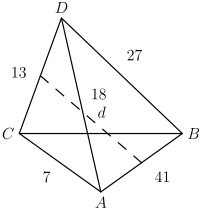
Let be a tetrahedron with and as shown in the figure. Let be the distance between the midpoints of edges and Find
Pista pequeña:
Representa los vértices con vectores y escribe el vector entre los dos puntos medios
Represent the vertices by vectors and write the vector between the two midpoints
Pista grande:
Desarrolla en función de las seis longitudes de las aristas
Expand in terms of the six edge lengths
Solución:
Hagamos que los nombres de los vértices también denoten sus vectores de posición. El vector entre los puntos medios es Al desarrollar los cuadrados de las longitudes se obtiene Por lo tanto, de modo que
Let the vertex names also denote their position vectors. The vector between the midpoints is Expanding squared lengths gives Therefore so
13.
Sea un subconjunto de tal que ningún par de elementos de difiera en ni en ¿Cuál es el mayor número de elementos que puede tener ?
Let be a subset of such that no two members of differ by or What is the largest number of elements can have?
Pista pequeña:
Entre cualesquiera once enteros consecutivos, el grafo de diferencias prohibidas es un ciclo de vértices
Within any eleven consecutive integers, the forbidden-difference graph is an -cycle
Pista grande:
Para una construcción que alcance la cota, busca cinco clases de residuos permitidas módulo
For a matching construction, look for five allowable residue classes modulo
Solución:
Entre cualesquiera once enteros consecutivos, une dos números cuando su diferencia sea o Como este grafo es un ciclo de vértices, cuyo mayor conjunto independiente tiene tamaño Del mismo modo, cualesquiera diez enteros consecutivos inducen un camino de diez vértices y aportan como máximo Como se obtiene
Esta cota se alcanza tomando todos los enteros cuyo residuo módulo es o Ningún par de residuos seleccionados difiere en ni en módulo y cada uno de estos cinco residuos aparece veces desde hasta Por tanto, el máximo es
On any eleven consecutive integers, join two numbers when their difference is or Because this graph is an -cycle, whose largest independent set has size Similarly, any ten consecutive integers induce a path on ten vertices and contribute at most Since this gives
This bound is attained by taking every integer whose residue modulo is or No two selected residues differ by or modulo and each of these five residues occurs times from through Thus the maximum is
14.
Dado un entero positivo se puede demostrar que todo número complejo de la forma donde y son enteros, puede expresarse de manera única en base usando los enteros como dígitos. Es decir, la ecuación
es verdadera para una elección única del entero no negativo y de los dígitos tomados del conjunto con Escribimos
para denotar la expansión en base de Solo hay una cantidad finita de enteros que tienen expansiones de cuatro dígitos
Halla la suma de todos esos
Given a positive integer it can be shown that every complex number of the form where and are integers, can be uniquely expressed in the base using the integers as digits. That is, the equation
is true for a unique choice of nonnegative integer and digits chosen from the set with We write
to denote the base expansion of There are only finitely many integers that have four-digit expansions
Find the sum of all such
Pista pequeña:
Calcula la segunda y la tercera potencia de e iguala a cero la parte imaginaria de la expansión
Compute the second and third powers of and set the imaginary part of the expansion equal to zero
Pista grande:
Los límites de los dígitos dejan solo dos ternas posibles ; luego deja que recorra todos los dígitos
The digit bounds leave only two possible triples ; then let range over all digits
Solución:
Sea Entonces y
La parte imaginaria de es Por lo tanto, Con y las únicas posibilidades son
Las partes reales correspondientes son y respectivamente. Cuando recorre los valores desde hasta la suma pedida es
Let Then and
The imaginary part of is Thus With and the only possibilities are
The corresponding real parts are and respectively. As ranges from through the required sum is
15.
El punto está dentro del triángulo Se trazan los segmentos y , con sobre sobre y sobre (véase la figura). Dado que y halla el área del triángulo
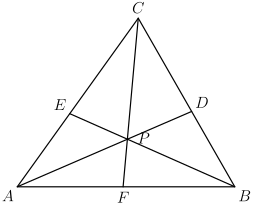
Point is inside triangle Line segments and are drawn with on on and on (see the figure). Given that and find the area of triangle
Pista pequeña:
Usa las dos razones conocidas de las cevianas para hallar los pesos baricéntricos de y en
Use the two known cevian ratios to find the barycentric weights of and at
Pista grande:
Coloca en el origen; la relación vectorial resultante determina el ángulo entre y
Place at the origin; the resulting vector relation determines the angle between and
Solución:
Como el peso baricéntrico de en es Como el peso de es así que el peso de también es A lo largo de esto significa que de donde y
Coloca en el origen y denota los vectores de posición y con las mismas letras. La relación baricéntrica es Por lo tanto, Usando y así que Por ello, Al desarrollar el producto vectorial se obtiene En consecuencia,
Since the barycentric weight of at is Since the weight of is so the weight of is also Along this means hence and
Place at the origin and denote the position vectors and by the same letters. The barycentric relation is Thus Using and so Therefore Expanding the cross product gives Consequently,