
2019 AMC 10B 详解
向下滚动即可查看来自 LIVE by Po-Shen Loh 的精心整理的解答,打印PDF 解答,查看答案,或参加完整限时模拟考试。
所有题目均经美国数学协会(MAA)官方合法授权使用。
1.
Alicia 有两个容器。第一个容器的水占其容量的 ,第二个是空的。她把第一个容器中的水全部倒入第二个容器,此时水占第二个容器容量的 。较小容器体积与较大容器体积的比是多少?
Alicia had two containers. The first was full of water and the second was empty. She poured all the water from the first container into the second container, at which point the second container was full of water. What is the ratio of the volume of the smaller container to the volume of the larger container?
小提示:
设两个容器的体积为变量。
Let the container volumes be variables
大提示:
倒水前后的水量相同,把两个表达式相等。
Equate the same water amount before and after pouring
解答:
设第一个和第二个容器的体积分别为 和 。水量既等于 ,也等于 ,所以 。
因此 。第一个容器较小,所以所求体积比为 。所以正确答案是 D。
Let the volumes of the first and second containers be and . The amount of water is both and , so .
Thus . Since the first container is smaller, the ratio of the smaller container to the larger container is . Thus, D is the correct answer.
2.
考虑命题:“如果 不是质数,那么 是质数。”下列哪个 的值是这个命题的反例?
Consider the statement, “If is not prime, then is prime.” Which of the following values of is a counterexample to this statement?
小提示:
反例必须使假设为真、结论为假。
A counterexample must make the hypothesis true and conclusion false
大提示:
只检查 不是质数的选项。
Check only choices where is not prime
解答:
反例必须满足 不是质数,所以 的候选值只有 。同时 也必须不是质数,只有 符合。
所以正确答案是 E。
We need to not be prime, so can only be Then, must be not prime, leaving just
Thus, the answer is E .
3.
一所高中有 名学生。 的高年级学生会演奏乐器,而 的非高年级学生不会演奏乐器。全校共有 的学生不会演奏乐器。有多少非高年级学生会演奏乐器?
In a high school with students, of the seniors play a musical instrument, while of the non-seniors do not play a musical instrument. In all, of the students do not play a musical instrument. How many non-seniors play a musical instrument?
小提示:
设高年级学生人数为 。
Let be the number of seniors
大提示:
使用不会演奏乐器的总百分比列方程。
Use the percent who do not play an instrument
解答:
设高年级学生人数为 。则非高年级学生有 人。高年级学生中 不会演奏乐器。因此,不会演奏乐器的人数可表示为 另一方面, 所以 非高年级学生有 人,其中 会演奏乐器,因此人数为
所以答案是 B。
Let the number of seniors be Then, people aren’t seniors. We know of seniors don’t play an instrument. Then, the number of students who don’t play an instrument can be represented as and Thus, This makes the number of non-seniors equal to Since of non-seniors play instruments, we have the total number as
Thus, the answer is B .
4.
所有方程为 且 ,, 构成等差数列的直线都经过同一个点。这个点的坐标是什么?
All lines with equation such that form an arithmetic progression pass through a common point. What are the coordinates of that point?
小提示:
写成 ,。
Write and
大提示:
方程必须对所有可能的 和 都成立。
The equation must hold for every possible and
解答:
令 。
于是 因此 分别比较 和 的部分,可得 以及 对所有 都成立。所以 从而 公共点为 。
所以答案是 A。
Let
Then, we have Thus, If we match the parts of and we get and for all Therefore, we have implying that This makes the pair
Thus, the answer is A .
5.
三角形 位于第一象限。点 、 和 关于直线 的对称点分别为 、 和 。假设三角形的顶点都不在直线 上。下列哪一项不一定总为真?
Triangle lies in the first quadrant. Points and are reflected across the line to points and respectively. Assume that none of the vertices of the triangle lie on the line Which of the following statements is not always true?
三角形 位于第一象限。
Triangle lies in the first quadrant.
三角形 与 面积相同。
Triangles and have the same area.
直线 的斜率为 。
The slope of line is
直线 与 的斜率相同。
The slopes of lines and are the same.
直线 与 互相垂直。
Lines and are perpendicular to each other.
小提示:
关于 的反射会保持第一象限和面积。
Reflections preserve area and the first quadrant across
大提示:
用一条斜率为 的简单线段测试关于 的说法。
Test the claim about with a simple segment of slope
解答:
关于 的反射把 映为 。因此它既保持第一象限,也保持面积,所以选项 A 和 B 必为真。
从 指向它的像 的方向向量是 ,由于 ,它的斜率为 。因此选项 C 和 D 也必为真。
对于选项 E,取 、 和 。这些点满足全部条件,但 和 的斜率都是 ,所以这两条直线平行而不是垂直。
所以正确答案是 E。
Reflection across sends to . It therefore preserves the first quadrant and preserves area, so A and B are always true.
The direction from to its image is , whose slope is because . Thus C and D are always true as well.
For E, take , , and . These points satisfy all the conditions, but and both have slope , so the two lines are parallel rather than perpendicular.
Thus, the answer is E .
6.
正整数 满足方程 求 的各位数字之和。
A positive integer satisfies the equation What is the sum of the digits of
7.
一家商店中每颗糖的价格都是整数美分。Casper 的钱恰好可以买 颗红糖、 颗绿糖、 颗蓝糖,或者 颗紫糖。一颗紫糖价格为 美分。 的最小可能值是多少?
Each piece of candy in a shop costs a whole number of cents. Casper has exactly enough money to buy either pieces of red candy, pieces of green candy, pieces of blue candy, or pieces of purple candy. A piece of purple candy costs cents. What is the least possible value of
小提示:
总钱数必须是 的公倍数。
The total money must be a common multiple of
大提示:
然后除以紫糖的价格。
Then divide by the purple candy price
解答:
设 Casper 有 美分。那么 是 和 的公倍数,所以它必为 的倍数。
令 ,其中 为整数。又有 ,所以 ,即 。因为 是正整数, 的最小值是 。
所以正确答案是 B。
Let the number of cents he has Then, is a multiple of and Thus, it must be a multiple of
Let for some Also, so making Since is a whole number, the minimum possible value of is
Thus, the answer is B .
8.
下图显示一个正方形和四个等边三角形。每个三角形都有一条边在正方形的一条边上,每个三角形边长为 ,且四个三角形的第三个顶点在正方形中心相交。正方形内但三角形外的区域被涂色。涂色区域的面积是多少?

The figure below shows a square and four equilateral triangles, with each triangle having a side lying on a side of the square, such that each triangle has side length and the third vertices of the triangles meet at the center of the square. The region inside the square but outside the triangles is shaded. What is the area of the shaded region?
小提示:
先求每个等边三角形的高。
Find the altitude of each equilateral triangle
大提示:
用正方形的面积减去四个三角形的面积。
Subtract the four triangle areas from the square’s area
解答:
每个等边三角形的边长为 ,所以它的高为 。这条高恰好从正方形的一条边伸到正方形中心,因此正方形的边长为 ,面积为 。
四个等边三角形的面积都是 。因此涂色区域的面积为
所以正确答案是 B。
Each equilateral triangle has side length , so its altitude is . Because that altitude runs from a side of the square to its center, the square has side length and area .
Each of the four equilateral triangles has area . Therefore the shaded area is
Thus, the answer is B .
9.
函数 对所有实数 定义为 其中 表示不超过实数 的最大整数。求 的值域。
The function is defined by for all real numbers where denotes the greatest integer less than or equal to the real number What is the range of
非正整数集合
The set of nonpositive integers
非负整数集合
The set of nonnegative integers
小提示:
分别检查正数、整数、负的非整数。
Check positive numbers, integers, and negative non-integers separately
大提示:
对负的非整数,比较先取绝对值再向下取整和先向下取整再取绝对值。
For negative non-integers, compare rounding before and after absolute value
解答:
若 ,则 ,所以 。
若 是负整数,则两项都等于 ,所以仍有 。
若 是负数且不是整数,可以写成 ,其中 是非负整数,且 。此时 ,而 ,所以 。
因此值域为 。
所以答案是 A。
If , then , so .
If is a negative integer, both terms equal , so again .
If is negative and not an integer, write , where is a nonnegative integer and . Then , while , so .
Therefore, the range is
Thus, the answer is A .
10.
在一个平面内,点 和 相距 个单位。平面内有多少个点 ,使得三角形 的周长为 个单位,三角形 的面积为 平方单位?
In a given plane, points and are units apart. How many points are there in the plane such that the perimeter of is units and the area of is square units?
小提示:
面积条件确定了从 出发的高。
The area condition fixes the altitude from
大提示:
再把这个高与周长条件所允许的边长进行比较。
Then compare that altitude to the side lengths forced by the perimeter
解答:
面积条件确定了 到直线 的距离。若该距离为 ,则 所以 。因此 必须位于与 平行且距离为 的直线上。
因为 到直线 的垂直距离为 ,所以 和 都至少为 。它们不能同时等于 ,否则从 向直线 作的垂线就必须同时落在不同的点 和 上。因此 ,与周长条件 矛盾。所以不存在符合条件的点 。
所以答案是 A。
The area condition fixes the distance from to line If that distance is then so Thus must lie on a line parallel to at distance
Since the perpendicular distance from to line is , both and are at least . They cannot both equal , because that would require the perpendicular from to meet line at both distinct points and . Hence , contradicting the perimeter requirement . Therefore no point works.
Thus, the answer is A .
11.
两个罐子中各有相同数量的弹珠,每颗弹珠不是蓝色就是绿色。罐子 中蓝珠与绿珠的比为 ,罐子 中蓝珠与绿珠的比为 。两个罐子中共有 颗绿珠。罐子 比罐子 多多少颗蓝珠?
Two jars each contain the same number of marbles, and every marble is either blue or green. In Jar the ratio of blue to green marbles is and the ratio of blue to green marbles in Jar is There are green marbles in all. How many more blue marbles are in Jar than in Jar
小提示:
设两个罐子中的绿珠数分别为 和 。
Let the green counts in the two jars be and
大提示:
使用两个罐子的总弹珠数相同,以及绿珠总数。
Use equal total jar sizes and total green marbles
解答:
设绿珠数分别为 和 ,对应罐子为 和 。那么两个罐子的弹珠总数分别为 和 。
两个罐子的弹珠总数相同,所以 。又有 。解得 ,。
罐子 有 颗蓝珠,罐子 有 颗蓝珠,相差 颗。所以正确答案是 A。
Let and be the numbers of green marbles in Jars and , respectively. Then the total numbers of marbles in the jars are and .
The jars contain the same number of marbles, so . Also . Solving gives and .
Jar has blue marbles, and Jar has blue marbles. The difference is . Thus, A is the correct answer.
12.
小于 的正整数中,其以七为底的表示的各位数字之和最大可能是多少?
What is the greatest possible sum of the digits in the base-seven representation of a positive integer less than
小提示:
把 写成 进制。
Write in base
大提示:
在不达到或超过这个上界的前提下尽量增大各位数字。
Maximize digits without reaching or exceeding that bound
解答:
首先,。任何首位不超过 的数,其数位和至多为 ,而 达到了这个数位和。
若首位为 ,则第二位不超过 时,数位和至多为 。若前两位是 ,与 比较可知,末两位的数位和至多为 ,得到更小的总和。因此最大的数位和是 。
所以答案是 C。
First, . Any number with leading digit at most has digit sum at most , and attains that sum.
If the leading digit is , then a second digit at most gives digit sum at most . If the first two digits are , comparison with forces the last two digits to contribute at most , giving an even smaller sum. Therefore, the largest digit sum is .
Thus, the answer is C .
13.
所有满足下列条件的实数 的和是多少:,,, 和 这五个数的中位数等于它们的平均数?
What is the sum of all real numbers for which the median of the numbers and is equal to the mean of those five numbers?
小提示:
按 、、 分类。
Case on whether , , or
大提示:
每种情况下,中位数都有简单表达式。
In each case the median has a simple expression
解答:
平均数为 。若 ,中位数为 ,所以 给出有效值 。
若 ,中位数为 ,但 给出 ,不在该区间内。若 ,中位数为 ,但 给出 ,仍不在所需范围内。
因此唯一可能的 是 ,其和为 。
所以答案是 A。
The mean is . If , the median is , so gives the valid value .
If , the median is , but gives , outside this interval. If , the median is , but gives , again outside the required range.
Therefore, the only possible is making the sum
Thus, the answer is A .
14.
的十进制表示为 ,,,,,,其中 、、 表示未给出的数字。求 。
The base-ten representation for is where and denote digits that are not given. What is
小提示:
使用被 、、 整除的性质。
Use divisibility by , , and
大提示:
未知数字会受到数字和检验与交错和检验的限制。
The unknown digits are constrained by the digit-sum and alternating-sum tests
解答:
因为 能被 整除,它的末三位都是零,所以 。
因为 能被 整除,它的数位和 也能被 整除。因此 ,所以 是 或 。
能被 整除说明交错数位和 能被 整除,所以 。检查这两个同余式下的数字可能性,得到 、。因此 。
所以答案是 C。
Because is divisible by , its last three digits are zero, so .
Since is divisible by , its digit sum is divisible by . Hence , so is either or .
Divisibility by says the alternating digit sum is divisible by , so . Checking the digit possibilities from these two congruences gives and . Therefore .
Thus, the answer is C .
15.
直角三角形 和 的面积分别为 和 。 的一条边与 的一条边全等,并且 的另一条边与 的另一条边全等。 和 各自剩下的(第三条)边的长度之积的平方是多少?
Right triangles and have areas and , respectively. A side of is congruent to a side of and a different side of is congruent to a different side of What is the square of the product of the lengths of the other (third) sides of and
小提示:
设两条共有边的长度为 。
Let the two shared side lengths be
大提示:
用两个面积方程求出 。
Use the two area equations to find
解答:
设两条共有边的长度为 。由于两个三角形的面积不同,这两条共有边在两个三角形中不可能扮演相同角色。因此面积为 的三角形以 和 为两条直角边,而面积为 的三角形有一条直角边 ,另一条直角边为 ,斜边为 。
两条不共有的第三边之积为 ,其平方为 。
利用面积,,且 。因此 ,且 ,所以 。于是 ,且 。所以正确答案是 A。
Let the two shared side lengths be . Because the triangles have different areas, the shared sides cannot play the same roles in both triangles. Thus the area- triangle has legs and , while the area- triangle has leg , other leg , and hypotenuse .
The product of the two non-shared third sides is , whose square is .
Using the areas, and . Hence and , so . Then , and . Thus, A is the correct answer.
16.
在直角三角形 中,直角在 ,点 位于线段 内部,点 位于线段 内部,满足 、,且 。求 。
In with a right angle at point lies in the interior of and point lies in the interior of so that and the ratio What is the ratio
小提示:
按比例放大或缩小,使 ,。
Scale so and
大提示:
利用等腰三角形角度证明 。
Use isosceles angles to show
解答:
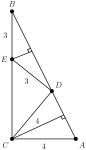
缩放图形,使 ,且 。设 、,所以 。
等腰三角形 和 给出 和 。因为 与 是反向射线,因此 ,所以 ,且 。
两个等腰三角形的底边长分别为 和 。所以
所以答案是 A。
Scale the figure so that and . Let and , so .
The isosceles triangles and give and . Because and are opposite rays, Therefore , so and .
The bases of the two isosceles triangles have lengths and . Hence
Thus, the answer is A .
17.
一个红球和一个绿球独立随机地被投入按正整数编号的箱子中。对每个球,投入第 号箱子的概率为 ,其中 、、、。红球被投入编号比绿球更大的箱子的概率是多少?
A red ball and a green ball are randomly and independently tossed into bins numbered with the positive integers so that for each ball, the probability that it is tossed into bin is for What is the probability that the red ball is tossed into a higher-numbered bin than the green ball?
小提示:
先求两个球落在同一个箱子的概率。
First compute the probability that both balls land in the same bin
大提示:
若它们落在不同箱子中,由对称性决定哪种颜色编号更大。
If they land in different bins, symmetry decides which color is higher
解答:
已知两个球落在不同箱子中时,较大编号箱子中的球为红球的概率为 。因此只需求出 这个值,这里用了补集计数。
两个球都落在第 号箱子的概率为
所以两个球落在同一个箱子的概率为 用等比数列求和公式,得到它等于
故所求概率为
所以答案是 C。
Given that the two balls were tossed into separate bins, the probability that the ball in the higher-numbered bin is red is Thus we must find by complementary counting.
The probability that both balls are in bin is
The probability that they are both in the same bin is therefore Using the geometric sequence formula, we get this to be
Therefore, our answer is
Thus, the answer is C .
18.
Henry 早上决定去锻炼,他先从家向健身房走了全程的 。健身房离 Henry 家 千米。到达该点后,他改变主意,朝家走回当前到家的距离的 。到达新点后,他再次改变主意,朝健身房走当前到健身房距离的 。如果 Henry 一直这样在每次改变主意后朝健身房或家走剩余距离的 ,他会越来越接近在离家 千米与离家 千米的两个点之间来回走。 是多少?
Henry decides one morning to do a workout, and he walks of the way from his home to his gym. The gym is kilometers away from Henry’s home. At that point, he changes his mind and walks of the way from where he is back toward home. When he reaches that point, he changes his mind again and walks of the distance from there back toward the gym. If Henry keeps changing his mind when he has walked of the distance toward either the gym or home from the point where he last changed his mind, he will get very close to walking back and forth between a point kilometers from home and a point kilometers from home. What is
小提示:
研究从一个转向点出发、两步后回到同一方向的映射。
Study the two-step map from one turnaround point back to the same direction
大提示:
在极限点处,应用这个两步映射后位置不变。
At the limiting point, applying that two-step map changes nothing
解答:
设某个向家转向的极限点离家 千米。当 Henry 朝健身房走完这一段后,他的位置为
接着向家走该距离的四分之三,新位置离家为
在极限点处,这个两步过程不改变位置,所以 由此得 。
另一个极限点就是朝健身房走完后到达的位置: 因此
所以正确答案是 C。
Suppose a limiting homeward turnaround point is kilometers from home. After Henry walks toward the gym, his position is
After he turns back toward home, one quarter of that distance remains, so his next homeward turnaround point is
At the limiting point this two-step map leaves the position unchanged, so which gives .
The other limiting point is the position reached after walking toward the gym: Therefore
Thus, the correct answer is C .
19.
设 为 的所有正整数因数组成的集合。有多少个数可以表示为 中两个不同元素的乘积?
Let be the set of all positive integer divisors of How many numbers are the product of two distinct elements of
小提示:
把因数写成 的形式。
Represent divisors as
大提示:
乘积对应指数相加,但要排除只能由两个相同因数得到的情况。
Products correspond to sums of exponents, except when only equal factors can create them
解答:
首先注意到 。
因此, 中任一元素都形如 ,其中 。
设 是两个不同的元素,且 于是 因此 这说明乘积的指数对至多有 种。不过其中有些只能在 时出现,也就是 的情形。
若 ,则必须有 。
若 ,则必须有 。
当 取其他值时,可以让 。
对 也有类似的结构。因此,若 则 从而 。
因此必须排除 种选择,剩下
所以答案是 C。
First, note that
Therefore, any element of must be of the form with
Suppose I have distinct with Then, Thus, This means that there are possible exponent pairs for a product. However, some products can arise only when , namely when .
If then must be true.
If then must be true.
With any other value of we can have
Similar structure holds for Thus, if then thus making
This means we have to eliminate choices, leaving
Thus, the answer is C .
20.
如图,线段 被点 和 三等分,使得 。三个半径为 的半圆 、 和 都以 上的线段为直径,位于直线 的同一侧,并与直线 分别在 、 和 处相切。另有一个半径为 的圆,其圆心为 。图中阴影区域在该圆内、三个半圆外,面积可写成 其中 ,, 和 是正整数,且 与 互质。 是多少?
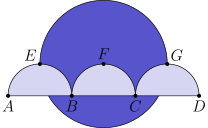
As shown in the figure, line segment is trisected by points and so that Three semicircles of radius and have their diameters on , lie in the same halfplane determined by line , and are tangent to line at and respectively. A circle of radius has its center at The area of the region inside the circle but outside the three semicircles, shaded in the figure, can be expressed in the form where and are positive integers and and are relatively prime. What is
小提示:
把阴影面积分解成圆扇形和简单的剩余部分。
Break the shaded area into circular sectors and simple leftover pieces
大提示:
计算由半径为 的圆切出的中央扇形。
Compute the central sector cut out by the radius- circle
解答:
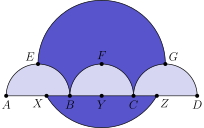
直线 经过半径为 的圆的圆心 ,所以阴影上半圆的面积为 。
弦 位于 上,且它到 的距离为一个单位。因此 下方的阴影弓形面积为
与 之间的部分由四个如下的全等区域组成。

每个区域都是一个单位正方形去掉一个单位圆的四分之一,所以四个区域的总面积为
因此阴影总面积为 所以 、、、,从而 。
所以答案是 E。
Line passes through the center of the radius- circle, so the shaded upper semicircle has area .
The chord lies on , one unit from . Thus The shaded circular segment below has area
The portion between and consists of four congruent pieces of the following form.
Each piece is a unit square with a quarter of a unit circle removed, so the four pieces have total area
The total shaded area is therefore Hence , , , and , giving .
Thus, the answer is E .
21.
Debra 反复抛一枚公平硬币,并记录到目前为止出现的正面数和反面数,直到出现连续两个正面或连续两个反面时停止。她出现连续两个正面,但在看到第二个正面之前先看到了第二个反面的概率是多少?
Debra flips a fair coin repeatedly, keeping track of how many heads and how many tails she has seen in total, until she gets either two heads in a row or two tails in a row, at which point she stops flipping. What is the probability that she gets two heads in a row but she sees a second tail before she sees a second head?
小提示:
最后出现相同的一对之前,序列必须一直交替。
The sequence must alternate until the final matching pair
大提示:
对可能的奇数长度求概率和。
Sum the probabilities of the possible odd lengths
解答:
在最后一次重复结果出现之前,序列必须交替。若以 开始,第二个正面必定早于第二个反面出现,所以成功序列必须以 开始。为了在以 结束之前看到第二个反面,开头必须是 。
因此成功序列为 :对每个不小于 的奇数长度,恰有一个序列。它们的总概率为
所以答案是 B。
Before the final repeated flip, the sequence must alternate. If it starts with , the second head necessarily occurs before the second tail, so a successful sequence must start with . To see a second tail before ending with , it must begin .
Thus the successful sequences are : exactly one sequence of each odd length at least . Their total probability is
Thus, the answer is B .
22.
Raashan、Sylvia 和 Ted 玩下面的游戏。每人起初有 。每 秒铃响一次,此时每个当前有钱的玩家都同时、独立且随机地选择另外两名玩家之一,并给那人 。铃响 次后,每个玩家都有 的概率是多少?
例如,Raashan 和 Ted 可以都决定给 Sylvia 一美元,而 Sylvia 决定把她的 给 Ted;这时 Raashan 有 ,Sylvia 有 ,Ted 有 ,第一轮结束。第二轮 Raashan 没钱可给,但 Sylvia 和 Ted 可能互相给对方 ,结果钱数保持不变。
Raashan, Sylvia, and Ted play the following game. Each starts with A bell rings every seconds, at which time each of the players who currently has money simultaneously chooses one of the other two players independently and at random and gives to that player. What is the probability that after the bell has rung times, each player will have
(For example, Raashan and Ted may each decide to give to Sylvia, and Sylvia may decide to give her dollar to Ted, at which point Raashan will have Sylvia will have and Ted will have and that is the end of the first round of play. In the second round Raashan has no money to give, but Sylvia and Ted might choose each other to give their to, and the holdings will be the same at the end of the second round.)
小提示:
不考虑玩家名字,钱数状态只有两种。
There are only two money configurations up to order
大提示:
从任一状态出发,计算下一轮变成 的概率。
From either configuration, compute the chance the next state is
解答:
不计顺序,唯一能达到的钱数状态是 和 。玩家不可能在一轮结束时拥有全部 美元:每个轮初有钱的人都必须给别人一美元,而且不能给自己。从 出发,下一状态仍为 ,当且仅当三个人沿同一个循环方向传钱,其概率为 。
从 出发,记三人的钱数为 。下一状态恰为 ,当且仅当 把钱给 ,且 把钱给 ,这是四个等可能选择组合中的一个。因此概率同样是 。
所以无论第 次铃响后的状态如何,下一次铃响后状态为 的概率都是 。所以正确答案是 B。
The only reachable money configurations up to order are and . A player cannot finish a round with all dollars: anyone who begins with money must give a dollar to someone else, and no one can give to themselves. From , the next state is again exactly when all three players pass dollars in the same cyclic direction, which has probability .
From , label the players’ holdings . The next state is exactly when gives to and gives to , one of the four equally likely pairs of choices. This also has probability .
Therefore, regardless of the state after rings, the probability that the state after the next ring is is . Thus, B is the correct answer.
23.
点 和 在平面中的圆 上。假设 在 和 处的切线相交于 轴上的一点。求 的面积。
Points and lie on a circle in the plane. Suppose that the tangent lines to at and intersect at a point on the -axis. What is the area of
小提示:
两条切线的交点在 的垂直平分线上。
The tangent intersection lies on the perpendicular bisector of
大提示:
到切点的半径垂直于切线。
The radius to a tangent point is perpendicular to the tangent line
解答:
设两条切线交于 。从同一点引出的两条切线长度相等,所以 ,因此 在 的垂直平分线上。
与 的中点为 , 的斜率为 ,所以垂直平分线为 。它与 轴交于 。
经过 和 的切线斜率为 ,所以通向 的半径斜率为 。联立 与 ,得到圆心 。
因此 ,所以圆面积为 。正确答案是 C。
Let be the intersection point of the two tangents. Since tangent lengths from the same point are equal, , so lies on the perpendicular bisector of .
The midpoint of and is , and the slope of is , so the perpendicular bisector is . Its intersection with the -axis is .
The tangent line through and has slope , so the radius to has slope . Intersecting with gives center .
Thus , so the area is . Thus, C is the correct answer.
24.
定义数列 ,且 对所有非负整数 都成立。设 为满足 的最小正整数。 落在哪个区间内?
Define a sequence recursively by and for all nonnegative integers Let be the least positive integer such that In which of the following intervals does lie?
小提示:
平移数列,令 。
Shift the sequence by writing
大提示:
把比值 夹在 和 之间。
Bound the ratio between and
解答:
令 ,则 。化简递推式可得 只要 ,就有
由归纳法,。当 时,,所以 ,从而 。
另一方面,,所以 ,从而 。于是 ,所以 位于 。正确答案是 C。
Let . Then , and simplifying the recurrence gives As long as , this implies
By induction, . For , , so , and therefore .
Also , so , which gives . Hence , so lies in . Thus, C is the correct answer.
25.
由 和 组成的长度为 的序列中,有多少个以 开头、以 结尾,且既不含两个连续的 ,也不含三个连续的 ?
How many sequences of s and s of length are there that begin with a end with a contain no two consecutive s, and contain no three consecutive s?
小提示:
初始的 之后,整个序列由 和 这两种块组成。
After the initial , the string is made of blocks and
大提示:
解 ,并数这些块的排列方式。
Solve and count block orderings
解答:
序列先以一个 开头,之后由若干个 块和 块依次组成,每个块都接在一个 后面。
设 块有 个, 块有 个。于是序列的项数为 即 可能的有序对为 于是排列这 个块的方法数为 因为只需选定 个位置中哪 个放 块。
因此总数为
所以正确答案是 C。
Our sequence starts with a then has sequences of and in some order, where they each come after a
Let the number of be and let the number of be Then the number of terms in the sequence is making The possible ordered pairs are Then, the number of ways to order the blocks is since we choose which of the positions hold a block.
Therefore, the total number of ways is
Thus, the answer is C .