
2015 AMC 10A 详解
向下滚动即可查看来自 LIVE by Po-Shen Loh 的精心整理的解答,打印PDF 解答,查看答案,或参加完整限时模拟考试。
所有题目均经美国数学协会(MAA)官方合法授权使用。
1.
2.
一个盒子里装有三角形瓷砖和正方形瓷砖,共 块。这些瓷砖一共有 条边。盒子里有多少块正方形瓷砖?
A box contains a collection of triangular and square tiles. There are tiles in the box, containing edges total. How many square tiles are there in the box?
小提示:
与全部都是三角形瓷砖的情况比较。
Compare the total to the case where all tiles are triangular
大提示:
每块正方形瓷砖比三角形瓷砖多贡献一条边。
Each square contributes one more edge than a triangle
解答:
设三角形瓷砖有 块,正方形瓷砖有 块,则 且 把第一个方程乘以 ,得到 两式相减得 。
所以正确答案是 D。
Let be the number of triangular tiles and be the number of square tiles. We then have that and Multiplying the first equation by gives us and subtracting this from the other equation gives us
Thus, D is the correct answer.
3.
Ann 如图用 根牙签搭了一个 级楼梯。她还需要再加多少根牙签才能完成一个 级楼梯?

Ann made a -step staircase using toothpicks as shown in the figure. How many toothpicks does she need to add to complete a -step staircase?
小提示:
观察下一阶楼梯会新增多少根牙签。
Look at how many new toothpicks the next stair step adds
大提示:
每增加一级,新添的牙签数比前一次多 根。
The number of new toothpicks increases by with each added step
解答:
我们试着找出楼梯级数与所需牙签数之间的规律。
对于 级楼梯,只需要 根牙签,也就是一个正方形。
对于 级楼梯,根据图形需要 根牙签。
同理, 级楼梯需要 根牙签。
级楼梯比 级楼梯多用 根牙签。 级楼梯比 级楼梯多用 根牙签。
按照这个规律, 级楼梯需要 根牙签, 级楼梯需要 根牙签。
这说明 Ann 还需要添加 根牙签。
所以正确答案是 D。
Let us try to find a pattern between the number of toothpicks needed for the staircases.
For a -step staircase, we would only need toothpicks (just a square).
For a -step staircase, we would need toothpicks according to the diagram.
Similarly, we would need toothpicks for a -step staircase.
A -step staircase needs more toothpicks than a -step staircase. A -step staircase needs more toothpicks than a -step staircase.
Following this pattern, we can see that a -step staircase will need toothpicks, and a -step staircase will need toothpicks.
This means that Ann would need to add more toothpicks.
Thus, D is the correct answer.
4.
Pablo、Sofia 和 Mia 在聚会上得到一些糖果蛋。Pablo 的糖果蛋数量是 Sofia 的三倍,Sofia 的数量是 Mia 的两倍。Pablo 决定把一些糖果蛋给 Sofia 和 Mia,使三人最后数量相同。Pablo 应该把自己糖果蛋的几分之几给 Sofia?
Pablo, Sofia, and Mia got some candy eggs at a party. Pablo had three times as many eggs as Sofia, and Sofia had twice as many eggs as Mia. Pablo decides to give some of his eggs to Sofia and Mia so that all three will have the same number of eggs. What fraction of his eggs should Pablo give to Sofia?
小提示:
把 Mia、Sofia、Pablo 的数量写成 。
Write Mia, Sofia, Pablo as
大提示:
平均分配意味着每人最后有 个糖果蛋。
Equal sharing means each person ends with eggs
解答:
设 Mia 有 个糖果蛋,则 Sofia 有 个,Pablo 有 个。
糖果蛋总数为 三人数量相同时,每人应有 个。
Sofia 还需要 个糖果蛋,因此 Pablo 应给她自己原有糖果蛋的 。
所以正确答案是 B。
Let be the number of candy eggs that Mia had. Then Sofia had eggs and Pablo had eggs.
The total number of eggs is then For all of them to have the same number of eggs, they each must have eggs.
Sofia needs more eggs. This means Pablo must give of his eggs to Sofia.
Thus, B is the correct answer.
5.
Patrick 先生教 名学生数学。他批改测验时发现,在批完除 Payton 以外所有人的试卷后,全班平均分为 。批完 Payton 的试卷后,测验平均分变为 。Payton 的测验分数是多少?
Mr. Patrick teaches math to students. He was grading tests and found that when he graded everyone’s test except Payton’s, the average grade for the class was After he graded Payton’s test, the class average became What was Payton’s score on the test?
小提示:
总分等于平均分乘以已批改的试卷数。
Total score equals the average times the number of graded tests
大提示:
用全班总分减去前 名学生的总分。
Subtract the first students’ total from the full class total
解答:
前 份已批改试卷的总分为 。
加入 Payton 的试卷后,总分为 ,所以 Payton 的分数为 。
所以正确答案是 E。
The total for the first graded tests was .
After Payton’s test was included, the total became . Therefore Payton’s score was .
Thus, E is the correct answer.
6.
两个正数的和是它们差的 倍。较大数与较小数的比是多少?
The sum of two positive numbers is times their difference. What is the ratio of the larger number to the smaller number?
7.
等差数列 、、、、、 中有多少项?
How many terms are in the arithmetic sequence
小提示:
使用首项、末项和公差。
Use the first term, last term, and common difference
大提示:
先数间隔数,再加上一个端点。
Count intervals, then add one endpoint
解答:
回忆等差数列的第 项为 ,其中 是首项, 是公差。
这里 ,。代入可得 所以正确答案是 B。
Recall that the th term of an arithmetic sequence is where is the first term and is the common difference.
For us, and Plugging these in, we get that Thus, B is the correct answer.
8.
两年前 Pete 的年龄是他的表妹 Claire 的三倍。再往前两年,Pete 的年龄是 Claire 的四倍。多少年后,他们年龄之比将为 ?
Two years ago Pete was three times as old as his cousin Claire. Two years before that, Pete was four times as old as Claire. In how many years will the ratio of their ages be
小提示:
用当前年龄翻译两个年龄关系。
Translate the two age statements using current ages
大提示:
先求出当前年龄,再列出未来的年龄比。
Solve for current ages before setting the future ratio
解答:
设 Pete 和 Claire 当前年龄分别为 和 。
题意给出 和 化简为 和 令两式相等,得到
因此
设还需 年,则 化简得 所以正确答案是 B。
Let and be Pete’s and Claire’s current ages respectively.
Then we have that and Simplifying both equations gives us and Setting them equal, we have
This means that
Now, we need to find the number of years () until which gives us Thus, B is the correct answer.
9.
两个直圆柱体体积相同。第二个圆柱体的半径比第一个多 。两个圆柱体的高之间有什么关系?
Two right circular cylinders have the same volume. The radius of the second cylinder is more than the radius of the first. What is the relationship between the heights of the two cylinders?
第二个高比第一个少 。
The second height is less than the first.
第一个高比第二个多 。
The first height is more than the second.
第二个高比第一个少 。
The second height is less than the first.
第一个高比第二个多 。
The first height is more than the second.
第二个高是第一个的 。
The second height is of the first.
小提示:
体积相等意味着高按半径变化平方的倒数变化。
Equal volumes mean height changes by the reciprocal square of the radius change
大提示:
使用 。
Use
解答:
设两个圆柱的半径和高分别为 、 与 、。
已知 且
代入并化简,得到 这告诉我们
所以正确答案是 D。
Let and be the radius and height of the first cylinder and similarly define and for the second cylinder.
We know that and
Substituting and simplifying gives us which tells us that
Thus, D is the correct answer.
10.
的重排中,有多少种排列使得任意两个相邻字母都不是字母表中相邻的字母?例如,这样的排列不能包含 或 。
How many rearrangements of are there in which no two adjacent letters are also adjacent letters in the alphabet? For example, no such rearrangements could include either or
小提示:
禁止相邻字母对以任意顺序出现。
Forbid the adjacent alphabet pairs in either order
大提示:
只有以 或 开头才有可能完成排列。
Starting with or is the only way to finish
解答:
禁用的相邻字母对为 。
若排列以 开头,第二个字母只能是 或 。
在 之后,无论怎样排列剩余字母,都会出现 或 。在 之后,剩余的 和 必须相邻。因此不存在以 开头的合格排列。
由对称性,也不存在以 开头的合格排列。
若以 开头,后面必须依次为 、、,得到 。
同理,以 开头时只能得到 。因此共有 种合格排列。
所以正确答案是 C。
The forbidden adjacent pairs are
If an arrangement starts with its second letter must be or
After either remaining order contains or After the remaining and must be adjacent. Thus no valid arrangement starts with
By symmetry, no valid arrangement starts with
If an arrangement starts with it must continue with then then giving
Similarly, starting with gives only Therefore there are valid rearrangements.
Thus, C is the correct answer.
11.
一个长方形的长与宽之比为 。如果长方形的对角线长为 ,那么面积可以表示为 ,其中 是常数。求 的值。
The ratio of the length to the width of a rectangle is If the rectangle has diagonal of length then the area may be expressed as for some constant What is
12.
点 和 是方程 图像上的两个不同点。求 的值。
Points and are distinct points on the graph of What is
小提示:
代入 ,并对 配方。
Substitute and complete a square in
大提示:
两个 值关于 对称。
The two -values are symmetric around
解答:
代入 。于是 ,,所以方程变为
因此 ,从而得到两个可能取值 和 。它们的距离为 。
所以正确答案是 C。
Substitute . Then and , so the equation becomes
Hence , giving the two possible values and . Their distance is .
Thus, C is the correct answer.
13.
Claudia 有 枚硬币,每枚是 美分或 美分。用其中一枚或多枚硬币组合,恰好可以得到 种不同金额。Claudia 有多少枚 美分硬币?
Claudia has coins, each of which is a -cent coin or a -cent coin. There are exactly different values that can be obtained as combinations of one or more of her coins. How many -cent coins does Claudia have?
小提示:
以五美分为单位数可能金额。
Count possible values in units of five cents
大提示:
若有 枚五美分硬币,最大金额为 美分。
If there are nickels, the largest value is cents
解答:
设 美分硬币有 枚,则 美分硬币有 枚。
若 ,则只能组成 美分,共 种金额。因此 。只要至少有一枚 美分硬币,就可以组成从 美分到总金额 之间的每个 的倍数。
这样的 的正倍数共有 种。题目给出这个数量为 ,所以 。
因此 美分硬币有 枚。
所以正确答案是 C。
Let the number of -cent coins be and the number of -cent coins be
If the only possible values are cents, giving just values. Hence Having at least one -cent coin then makes every multiple of from through the total value obtainable.
There are such multiples of which means that to get possible different values.
The number of -cent coins is therefore
Thus, C is the correct answer.
14.
下图显示一个半径为 厘米的圆形钟面,以及一个半径为 厘米的圆盘,它在 点处与钟面外切。圆盘上画有一个箭头,初始时竖直向上。令圆盘沿钟面顺时针滚动。当箭头下一次竖直向上时,圆盘与钟面在哪个位置相切?
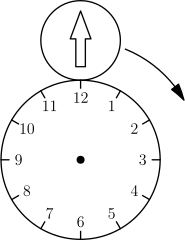
The diagram below shows the circular face of a clock with radius cm and a circular disk with radius cm externally tangent to the clock face at o’clock. The disk has an arrow painted on it, initially pointing in the upward vertical direction. Let the disk roll clockwise around the clock face. At what point on the clock face will the disk be tangent when the arrow is next pointing in the upward vertical direction?
点钟
o’clock
点钟
o’clock
点钟
o’clock
点钟
o’clock
点钟
o’clock
小提示:
外滚动圆盘的转角是接触点圆心角的 倍。
A disk rolling externally rotates times the central angle
大提示:
令圆盘的总转角等于一整圈。
Set the disk’s total rotation equal to one full turn
解答:
半径 的圆盘在半径 的钟面外侧滚动。若接触点绕钟面转过圆心角 ,圆盘相对于原方向转过 。
箭头再次竖直向上时, 等于 的正整数倍。第一次发生在 ,即从 点钟方向绕一圈的三分之一,对应 点钟方向。
所以正确答案是 C。
The disk of radius rolls externally around the clock face of radius . If the point of tangency moves through central angle around the clock, the disk rotates through relative to its original direction.
The arrow next points upward when is a positive multiple of . The first time this happens is , which is one-third of the way around the clock from o’clock, namely o’clock.
Thus, C is the correct answer.
15.
考虑所有分数 ,其中 和 是互质的正整数。有多少个这样的分数满足:若分子和分母都增加 ,分数值增加 ?
Consider the set of all fractions where and are relatively prime positive integers. How many of these fractions have the property that if both numerator and denominator are increased by the value of the fraction is increased by
小提示:
把分数条件转化为一个因式分解。
Turn the fraction condition into a factorization
大提示:
只有满足 的负因数对可能有效。
Only negative factor pairs with can work
解答:
条件为 交叉相乘得 ,即 。
从两边减去 并因式分解,得 因为 是正整数,可用的负因数对为 、 和 ,分别给出 。
其中只有 的分子分母互质,所以恰好有一个分数满足条件。
所以正确答案是 B。
The condition is Cross-multiplying gives , or .
Factoring by grouping after subtracting gives Since are positive, the useful negative factor pairs are , , and , producing .
Only has relatively prime numerator and denominator, so exactly one fraction works.
Thus, B is the correct answer.
16.
若 且 ,求下式的值:
If and what is the value of
小提示:
分别把两个方程相加和相减。
Add and subtract the two equations separately
大提示:
因为 ,可以把差方程除以 。
Since , divide the difference equation by
解答:
展开并相加两个方程,得到 整理得 两式相减,得到 再整理得 因为 ,两边可除以 ,得到
所以正确答案是 B。
Adding the two equations gives us We can rearrange this equation to get We can then subtract them to get Once again rearranging, we can find We have that which means that we can divide both sides by This gives us
Thus, B is the correct answer.
17.
一条经过原点的直线同时与直线 和直线 相交。这三条直线围成一个等边三角形。这个三角形的周长是多少?
A line that passes through the origin intersects both the line and the line The three lines create an equilateral triangle. What is the perimeter of the triangle?
小提示:
第三条直线必须与竖直边形成 角。
The third line must make a angle with the vertical side
大提示:
在 处求两个交点的高度。
Evaluate the two intersection heights at
解答:
因为等边三角形的一边是竖直线,所以其对称轴为水平线。
这说明第三条边的斜率必须是第二条边斜率的相反数,也就是 。
要求周长,只需求出这个三角形一条边的长度。
把 代入另外两个方程,就得到竖直边上的两个顶点。
两个 值分别为 和 。它们的差为 ,所以周长为 因此正确答案是 D。
Since one of the sides of the equilateral triangle is a vertical line, the line of symmetry perpendicular to this side must be horizontal.
This means that the slope of the third side must be opposite the slope of the second side, which would be
To find the perimeter, we only need to find the length of one of the sides of the triangle.
We can plug in into the two other equations to get the two vertices on the vertical line.
The two -values are and Their difference is which makes the perimeter Thus, D is the correct answer.
18.
十六进制(以 为底)数使用数字 到 ,以及字母 到 表示 到 。前 个正整数中,有 个数的这种表示只含数字字符。求 的各位数字之和。
Hexadecimal (base-) numbers are written using numeric digits through as well as the letters through to represent through Among the first positive integers, there are whose hexadecimal representation contains only numeric digits. What is the sum of the digits of
小提示:
统计到 为止的有效十六进制字符串。
Count valid hexadecimal strings up to
大提示:
计数前,先在较短的十六进制表示前补零。
Pad shorter hexadecimal representations with leading zeros before counting digit choices
解答:
在十六进制中,。把较短的表示在前面补零,补成三位数。从 到 的每个纯数字字符串都不超过 ,而且这些就是全部可能。
第一位有 种选择,另外两位各有 种选择。因此共有 个字符串,其中包括 。去掉零后得到 。
的数位和为 。
所以正确答案是 E。
In hexadecimal, Pad each shorter representation to three digits with leading zeros. Every numeric-only string from through is at most and these are all the possibilities.
The first digit has choices, and each of the other two digits has choices. This gives strings, including Excluding zero leaves
The sum of the digits in is
Thus, E is the correct answer.
19.
等腰直角三角形 在 处为直角,面积为 。三等分 的两条射线与 相交于 和 。求 的面积。
The isosceles right triangle has right angle at and area The rays trisecting intersect at and What is the area of
小提示:
使用 的三等分线,并减去两个全等的角上三角形。
Use the trisector and subtract two congruent corner triangles
大提示:
若 ,求 的高。
If , find the height of
解答:
因为 是面积为 的等腰直角三角形,所以两条直角边长为 ;三等分线给出 和 ,并且 与 的面积相等。
从 向 作垂线,垂足为 。因为 在 上且 ,所以 是等腰直角三角形。设 ,则 。由 直角三角形关系, 因此 ,所以 。
因此 从 的面积中减去两个全等的角上三角形,得到
所以正确答案是 D。
Since is isosceles right with area , its legs have length . The trisectors make and , so and have equal area.
Drop a perpendicular from to with foot Since lies on and is isosceles right. Let Then and the angle gives Thus , so .
Therefore Subtracting the two congruent corner triangles from ,
Thus, D is the correct answer.
20.
一个边长以 计且为正整数的长方形,面积为 ,周长为 。下列哪个数不可能等于 ?
A rectangle with positive integer side lengths in has area and perimeter Which of the following numbers cannot equal
小提示:
把 因式分解为 。
Factor as
大提示:
加 之后逐一检验各个选项。
Test the choices after adding
解答:
设长方形的正整数边长为 和 ,则 因此 必须分解成两个都至少为 的整数之积。
各选项加 后得到 。除 外,其余数都有两个不小于 的因数: 但 ,不能等于 。
所以正确答案是 B。
Let the side lengths be positive integers and . Then Hence must factor into two integers both at least .
The answer choices plus are . All except have a factorization with both factors at least : But , so it cannot equal .
Thus, B is the correct answer.
21.
四面体 满足 ,,,,,且 。求该四面体的体积。
Tetrahedron has and What is the volume of the tetrahedron?
小提示:
把两个 -- 三角形放在共同底边 上。
Put the two -- triangles on a common base
大提示:
使两条高互相垂直。
makes the two altitudes perpendicular
解答:
我们断言三角形 和 所在平面互相垂直。
分别从 和 向 作垂线,即可证明这一点。
因为 且 ,这两条高的垂足重合于点 。
于是 又有 ,所以 是等腰直角三角形,且 。
因为 且 ,所以线段 垂直于平面 。因此四面体的体积为
所以正确答案是 C。
We claim that the planes and are perpendicular to each other.
We can show this by dropping the perpendiculars from and to .
Since and we have that the feet of these altitudes will coincide at point
Then we have that We also have so is an isosceles right triangle and
Since and , the segment is perpendicular to the plane . Finally, the volume of the tetrahedron is
Thus, C is the correct answer.
22.
八个人围坐在一张圆桌旁,每人手中有一枚公平硬币。所有人同时抛硬币,正面朝上的人站起来,反面朝上的人仍坐着。没有两个相邻的人都站起来的概率是多少?
Eight people are sitting around a circular table, each holding a fair coin. All eight people flip their coins and those who flip heads stand while those who flip tails remain seated. What is the probability that no two adjacent people will stand?
小提示:
按站起来的人数统计圆环上的子集。
Count subsets of a cycle by the number of standing people
大提示:
分别讨论正面数为 或 的情形。
Separate the count into cases with or heads
解答:
统计站起来的人构成的集合。站起 人和 人时,分别有 种和 种。
站起 人时,从任意两人的组合中减去 对相邻者,共有 种。
站起 人时,先选一人;其余五个非相邻座位有 对,其中 对相邻,剩下 对。每个最终集合被计数三次,所以共有 种。
站起 人时,只有两种交替站立的情况。因此有利结果共有 种。全部 种结果等可能,所以概率为 。
所以正确答案是 A。
Count the possible sets of people who stand. For and people standing, there are and possibilities.
For people standing, choose any pair and subtract the adjacent pairs: .
For people standing, first choose one standing person. Among the remaining five non-neighbor seats, pairs are possible, but of those pairs are adjacent, leaving . This counts each final set three times, so there are possibilities.
For people standing, the only possibilities are the two alternating sets. Thus the number of favorable coin-flip outcomes is . Since all outcomes are equally likely, the probability is .
Thus, A is the correct answer.
23.
函数 的零点都是整数。所有可能的 值之和是多少?
The zeros of the function are integers. What is the sum of the possible values of
小提示:
设整数根为 ,并因式分解 。
Let integer roots be and factor
大提示:
的因数对给出可能的 值。
The factor pairs of give the possible values of
解答:
设整数零点为 和 。由韦达定理,,且 。
因此 整理并配方得到
可行的 只有 对每一对,都有 所有不同的 值为 它们的和为 。
所以正确答案是 C。
Let the zeros be and Using Vieta’s formulas, we have that and
Then we get that which rearranges to
The only possible pairs that work are For any of these pairs, we have that We want all the such unique values of We get that they are The sum of these values is
Thus, C is the correct answer.
24.
对某些正整数 ,存在一个四边形 ,其边长均为正整数,周长为 ,在 和 处为直角,且 、。满足 的周长可以有多少个不同的值?
For some positive integers there is a quadrilateral with positive integer side lengths, perimeter right angles at and and How many different values of are possible?
小提示:
根据图中的直角三角形令 。
Set from the right triangle in the diagram
大提示:
使用 。
Use
解答:

设 ,且 。从 向 作高,得到一个直角三角形,其直角边为 和 ,斜边为 。因此 所以 。
因为 是整数,写作 。于是 ,周长为
需要 ,也就是 。这对 成立,而 过大,所以共有 个可能的周长。
所以正确答案是 B。
Let and . Dropping the altitude from to gives a right triangle with legs and , and hypotenuse . Therefore so .
Since is an integer, write . Then , and the perimeter is
We need , or . This holds for , while is too large. Thus there are possible perimeters.
Thus, B is the correct answer.
25.
设 是边长为 的正方形。独立随机地在 的边上选取两个点。两点间直线距离至少为 的概率为 ,其中 、、 是正整数且 。求 的值。
Let be a square of side length Two points are chosen independently at random on the sides of The probability that the straight-line distance between the points is at least is where and are positive integers with What is
小提示:
按第二个点位于同一边、相邻边或对边来分类。
Condition on whether the second point is on the same, adjacent, or opposite side
大提示:
相邻边情形中,失败区域是半径 的四分之一圆。
The adjacent-side case removes a quarter circle of radius
解答:
先固定第一个点所在的边。第二个点在同一边、相邻边、对边上的概率分别为 、、。
同一边上时,两个坐标 的距离至少为 ,等价于 。这个区域由两个直角三角形组成,总面积为 。
相邻边上时,距离形如 。失败区域是半径为 的四分之一圆,所以成功概率为 。
对边上时,距离总是至少为 ,所以成功概率为 。因此所求概率为 所以 。
所以正确答案是 A。
Fix one of the two points. The second point is on the same side with probability , on an adjacent side with probability , and on the opposite side with probability .
On the same side, two coordinates are at distance at least when . This region consists of two right triangles with total area .
On adjacent sides, the distance has the form . The failing region is a quarter circle of radius , so the success probability is .
On opposite sides, the distance is always at least , so the success probability is . Therefore the desired probability is Hence .
Thus, A is the correct answer.