
2005 AMC 8 Problems
Scroll down and press Start to try the exam! Or, go to the printable PDF, answer key, or professional solutions curated by LIVE by Po-Shen Loh.
All problems are used with official legal permission of the Mathematical Association of America (MAA).
Or jump straight to a single problem with its solution: 1 · 2 · 3 · 4 · 5 · 6 · 7 · 8 · 9 · 10 · 11 · 12 · 13 · 14 · 15 · 16 · 17 · 18 · 19 · 20 · 21 · 22 · 23 · 24 · 25
Want to learn professionally through interactive video classes?
Timed
40:00
1.
Connie multiplies a number by and gets as her answer. However, she should have divided the number by to get the correct answer. What is the correct answer?
Answer: B
Small Hint:
Undo Connie’s mistaken multiplication to find the original number.
Big Hint:
Then divide that original number by .
Solution:
Since Connie multiplied by her original number was To get the correct answer, she must divide by to get
Thus, B is the correct answer.
2.
Karl bought five folders from Pay-A-Lot at a cost of each. Pay-A-Lot had a -off sale the following day. How much could Karl have saved on the purchase by waiting a day?
Answer: C
Small Hint:
Find the total price of the five folders.
Big Hint:
The savings would be of that total.
Solution:
Karl paid for the folders.
A discount on would save dollars.
Thus, C is the correct answer.
3.
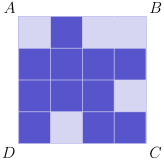
What is the minimum number of small squares that must be shaded so that a line of symmetry lies on the diagonal of square ?
Answer: D
Small Hint:
Reflect the shaded squares across diagonal .
Big Hint:
Only shaded squares without a matching reflected square need to be paired.
Solution:
For diagonal to be a line of symmetry, every shaded square off the diagonal must have a matching reflected shaded square on the other side of the diagonal.
There are shaded squares whose reflected partners are not shaded, so additional small squares must be shaded.
Thus, D is the correct answer.
4.
A square and a triangle have equal perimeters. The lengths of the three sides of the triangle are cm, cm and cm. What is the area of the square in square centimeters?
Answer: C
Small Hint:
First find the triangle’s perimeter.
Big Hint:
That perimeter is also the square’s perimeter.
Solution:
The perimeter of the triangle is This means that the side length of the square is Therefore, the area of the square is
Thus, C is the correct answer.
5.
Soda is sold in packs of and cans. What is the minimum number of packs needed to buy exactly cans of soda?
Answer: B
Small Hint:
Use as many -packs as possible without going over .
Big Hint:
After three -packs, finish the remaining cans with the fewest packs.
Solution:
Four packs cannot be enough. Four -packs would contain cans, and replacing any -pack by a smaller pack decreases the total by either or cans. There is no way to decrease by exactly cans to reach .
Five packs do work: three -packs, one -pack, and one -pack contain cans. Therefore, the minimum number is .
Thus, B is the correct answer.
6.
Suppose is a digit. For how many values of is
Answer: C
Small Hint:
Compare the thousandths digit of with that of .
Big Hint:
The digit must be at least .
Solution:
The numbers and first differ in the thousandths place: is compared with .
Thus exactly when . The possible digits are , for values.
Thus, C is the correct answer.
7.
Bill walks mile south, then mile east, and finally mile south. How many miles is he, in a direct line, from his starting point?
Answer: B
Small Hint:
Combine the two southward parts into one vertical displacement.
Big Hint:
Use the Pythagorean theorem with legs and .
Solution:
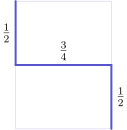
Note that what we want is the length of the diagonal. We can use the Pythagorean theorem to find this.
Thus, B is the correct answer.
8.
Suppose and are positive odd integers. Which of the following must also be an odd integer?
Answer: E
Small Hint:
Test the choices using parity rules for odd numbers.
Big Hint:
The product of odd integers is odd.
Solution:
Recall the four following rules:
• odd plus odd and even plus even is even
• even plus odd is odd
• even times anything is even
• odd times odd is odd
These rules can be easily verified by representing arbitrary odd numbers as and arbitrary even numbers as respectively, for integers
With this in mind, let’s examine each answer choice individually:
A:
Note that is odd. Modulo , this gives us From our above rules, we know that this is even.
B: Once again, this is even.
C: This is also even.
D: Unfortunately, this is also even.
E: This is odd.
Therefore, E is the only answer choice that is an odd integer.
Thus, E is the correct answer.
9.
In quadrilateral sides and both have length sides and both have length and the measure of angle is What is the length of diagonal

Answer: D
Small Hint:
Look only at .
Big Hint:
It is isosceles and has a angle.
Solution:
Note that is isosceles. This means that
We get that
This shows that is equilateral. This gives us that
Thus, D is the correct answer.
10.
Joe had walked half way from home to school when he realized he was late. He ran the rest of the way to school. He ran times as fast as he walked. Joe took minutes to walk half way to school. How many minutes did it take Joe to get from home to school?
Answer: D
Small Hint:
Joe runs the same half-distance he previously walked.
Big Hint:
Running three times as fast takes one third as much time.
Solution:
Joe took minutes to walk the first half of the distance.
He ran the second half, the same distance, at times his walking speed, so that half took minutes.
His total time was minutes.
Thus, D is the correct answer.
11.
The sales tax rate in Bergville is . During a sale at the Bergville Coat Closet, the price of a coat is discounted from its price. Two clerks, Jack and Jill, calculate the bill independently. Jack rings up and adds sales tax, then subtracts from this total. Jill rings up , subtracts of the price, then adds of the discounted price for sales tax. What is Jack’s total minus Jill’s total?
Answer: C
Small Hint:
Adding tax and taking the discount are both multiplications.
Big Hint:
Multiplication gives the same result in either order.
Solution:
Jack’s total is dollars.
Jill’s total is dollars.
These products are equal because multiplication is commutative, so Jack’s total minus Jill’s total is .
Thus, C is the correct answer.
12.
Big Al, the ape, ate bananas from May through May Each day he ate six more bananas than on the previous day. How many bananas did Big Al eat on May
Answer: D
Small Hint:
The five daily amounts form an arithmetic sequence.
Big Hint:
The middle day equals the average of the five days.
Solution:
Let be the number of bananas Big Al ate on May Then Big Al ate the following amounts starting from May
The sum of this is which equals This gives us that Then on May Big Al ate bananas.
Thus, D is the correct answer.
13.
The area of polygon is with and What is

Answer: C
Small Hint:
Complete the figure to a rectangle.
Big Hint:
Subtract the polygon area from the rectangle area to get the missing rectangle.
Solution:
Complete the shape to rectangle , which has area .

The missing rectangle has area . Its height is .
Therefore , so .
Thus, C is the correct answer.
14.
The Little Twelve Basketball Conference has two divisions, with six teams in each division. Each team plays each of the other teams in its own division twice and every team in the other division once. How many conference games are scheduled?
Answer: B
Small Hint:
Count each team’s games, then correct for double-counting.
Big Hint:
Each game is counted once for each of its two teams.
Solution:
Let us focus on one team. This team plays against other teams twice in its own division, for a total of games.
This team also plays games with teams from the other division. Therefore, they play a total of games.
There are teams total, so there are games conducted. Each game, however, involves teams, so we have to divide by
This gives us the actual total number of games to be
Thus, B is the correct answer.
15.
How many different isosceles triangles have integer side lengths and perimeter
Answer: C
Small Hint:
Let the equal side length be and the base be .
Big Hint:
Use and the triangle inequality.
Solution:
Let the equal side length be and the base be . Then , so must be odd.
The triangle inequality requires . Since , this gives , so . Thus .
Also , so and . The possible values and all work, giving triangles.
Thus, C is the correct answer.
16.
A five-legged Martian has a drawer full of socks, each of which is red, white or blue, and there are at least five socks of each color. The Martian pulls out one sock at a time without looking. How many socks must the Martian remove from the drawer to be certain there will be socks of the same color?
Answer: D
Small Hint:
In the worst case, the Martian gets only socks of each color first.
Big Hint:
The next sock must make five of some color.
Solution:
Note that the Martian can pull out socks of each color without drawing of the same color. The th sock, however, must be the th sock of some color.
Thus, D is the correct answer.
17.
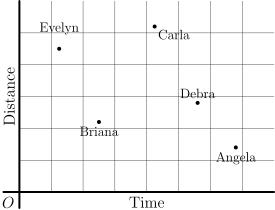
The results of a cross-country team’s training run are graphed below. Which student has the greatest average speed?
Answer: E
Small Hint:
Average speed is distance divided by time.
Big Hint:
On the graph, compare slopes from the origin.
Solution:
Average speed is distance over time, which is given by the slope of the line through the point and the origin.
Evelyn has the steepest slope, telling us that she had the greatest average speed.
Thus, E is the correct answer.
18.
How many three-digit numbers are divisible by
Answer: C
Small Hint:
A three-digit multiple of has form .
Big Hint:
Find the smallest and largest possible values of .
Solution:
We want to find how many exist such that is a three-digit number.
The smallest possible such that is
The largest possible such that is
This tells us that can range from to which gives us values for
Thus, C is the correct answer.
19.
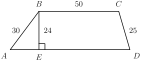
What is the perimeter of trapezoid
Answer: A
Small Hint:
Drop perpendiculars to split the trapezoid into right triangles and a rectangle.
Big Hint:
Use the and right triangles.
Solution:
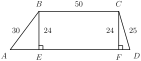
Drop the altitude from to meet at . The existing altitude from meets at .
By the Pythagorean theorem, and . Also .
Thus , and the trapezoid perimeter is .
Thus, A is the correct answer.
20.
Alice and Bob play a game involving a circle whose circumference is divided by equally-spaced points. The points are numbered clockwise, from to Both start on point Alice moves clockwise and Bob, counterclockwise. In a turn of the game, Alice moves points clockwise and Bob moves points counterclockwise. The game ends when they stop on the same point. How many turns will this take?
Answer: A
Small Hint:
Track the relative motion of Alice and Bob around the circle.
Big Hint:
Together they close the gap by points each turn, modulo .
Solution:
After one turn, Alice has moved points clockwise and Bob has moved points counterclockwise. Their relative movement is points per turn.
They meet when is a multiple of , where is the number of turns.
Since , the smallest positive making a multiple of is .
Thus, A is the correct answer.
21.
How many distinct triangles can be drawn using three of the dots below as vertices?

Answer: C
Small Hint:
There are dots total.
Big Hint:
Subtract the choices of three collinear dots from all -dot choices.
Solution:
Notice that choosing any of these dots forms a triangle, except for the triples that form a straight line.
There are ways to choose the points, and then we subtract to get
Thus, C is the correct answer.
22.
A company sells detergent in three different sized boxes: small (S), medium (M) and large (L). The medium size costs more than the small size and contains less detergent than the large size. The large size contains twice as much detergent as the small size and costs more than the medium size. Rank the three sizes from best to worst buy.
Answer: E
Small Hint:
Choose convenient numbers for the small and large sizes.
Big Hint:
Compare price per ounce for each size.
Solution:
Choose convenient values: let the small box cost and contain ounces. Then the large box contains ounces.
The medium box costs and contains less than the large box, or ounces. The large box costs more than the medium, or .
The costs per ounce are , , and .
From best to worst buy, the order is .
Thus, E is the correct answer.
23.
Isosceles right triangle encloses a semicircle of area The circle has its center on hypotenuse and is tangent to sides and What is the area of triangle

Answer: B
Small Hint:
Reflect the triangle and semicircle across the hypotenuse.
Big Hint:
This makes a circle inscribed in a square.
Solution:

Reflect the triangle and semicircle across hypotenuse . This forms a full circle inscribed in a square.
The semicircle has area , so the full circle has area and radius . The square side length is therefore .
The square area is , so the original triangle has half that area, .
Thus, B is the correct answer.
24.
A certain calculator has only two keys [] and []. When you press one of the keys, the calculator automatically displays the result. For instance, if the calculator originally displayed “” and you pressed [], it would display “” If you then pressed [], it would display “” Starting with the display “” what is the fewest number of keystrokes you would need to reach “”?
Answer: B
Small Hint:
Work backward from to .
Big Hint:
For a lower bound, note what eight keystrokes can and cannot reach near .
Solution:
Work backward from . When the number is even, undo by dividing by ; when it is odd, undo by subtracting .
uses reverse steps, so keystrokes are enough.
Eight keystrokes are not enough: the largest value below reachable in keystrokes is obtained by followed by six doublings, giving . The next larger possibilities overshoot to at least , so cannot be reached in keystrokes.
Thus, B is the correct answer.
25.
A square with side length and a circle share the same center. The total area of the regions that are inside the circle and outside the square is equal to the total area of the regions that are outside the circle and inside the square. What is the radius of the circle?

Answer: A
Small Hint:
The two outside-area totals are equal.
Big Hint:
That makes the square and circle have equal total area.
Solution:
Let be the common area inside both the square and circle. The problem says the circle-only area equals the square-only area.
Adding to both equal areas shows that the total area of the circle equals the total area of the square.
The square area is , so . Hence .
Thus, A is the correct answer.