
1991 AMC 8 Solutions
Scroll down to view professionally curated solutions from LIVE by Po-Shen Loh, print PDF solutions, view answer key, or take the full timed exam.
All problems are used with official legal permission of the Mathematical Association of America (MAA).
1.
What is the value of
Small Hint:
Think of the amount you must add to to reach
Big Hint:
Work from the right: the units digits must add to with a carry, and every other column then adds to with that carry
Solution:
Lining up the subtraction gives
Equivalently, to climb from up to you add in the units place and in each of the other eleven places.
Thus, the correct answer is B .
2.
What is the value of
Small Hint:
The fraction bar groups the whole numerator over the whole denominator
Big Hint:
Simplify and separately before dividing
Solution:
Thus, the correct answer is C .
3.
Two hundred thousand times two hundred thousand equals
four hundred thousand
four million
forty thousand
four hundred million
forty billion
Small Hint:
Write two hundred thousand as
Big Hint:
Multiply the leading digits, then count the zeros: each factor has five zeros
Solution:
which is forty billion.
Thus, the correct answer is E .
4.
If then
Small Hint:
Each of the five numbers is just a little less than
Big Hint:
Write each as the sum becomes
Solution:
Since we get
Thus, the correct answer is E .
5.
A “domino” is made up of two small squares:

. Which of the “checkerboards” illustrated below CANNOT be covered exactly and completely by a whole number of non-overlapping dominoes?


Small Hint:
Each domino covers exactly two small squares, so focus on how many small squares each board has.
Big Hint:
A board can be fully covered only if its total number of squares is even; find the number of squares in each board by multiplying its two dimensions.
Solution:
Every domino covers exactly squares, so any board that is completely covered by non-overlapping dominoes must contain an even number of small squares.
Counting squares: and Only is odd, so that board cannot be covered. (Each of the even boards has a side of even length and is easily tiled with dominoes.)
Thus, the correct answer is B .
6.
Which number in the array below is both the largest in its column and the smallest in its row? (Columns go up and down, rows go right and left.)
Small Hint:
First find the largest number in each of the five columns
Big Hint:
Then check which of those column-maxima is also the smallest number in its own row
Solution:
The largest entry in each column is (column ), (column ), (column ), (column ), and (column ).
Of these, only is the smallest number in its own row (row is ).
Thus, the correct answer is C .
7.
The value of is closest to
Small Hint:
The numerator shares a common factor of
Big Hint:
Round each number to a single leading digit before dividing, for example and
Solution:
Factor the numerator:
Rounding to leading digits, this is about The denominator is about
So the value is roughly
Thus, the correct answer is D .
8.
What is the largest quotient that can be formed using two numbers chosen from the set
Small Hint:
A quotient is largest when it is positive and large in size
Big Hint:
A negative divided by a negative is positive; try the largest-magnitude negative over the smallest-magnitude negative
Solution:
For a large quotient it should be positive, so use two positive numbers or two negative numbers.
Best positive pair: Best negative pair: The larger is
Thus, the correct answer is D .
9.
How many whole numbers from through are divisible by either or or both?
Small Hint:
Count the multiples of and the multiples of separately
Big Hint:
Numbers divisible by both and are multiples of and get counted twice, so subtract them once
Solution:
There are multiples of and multiples of up to The multiples of (namely ) were counted twice.
By inclusion-exclusion, the count is
Thus, the correct answer is B .
10.
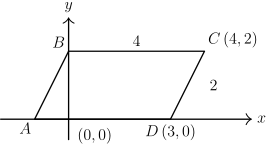
The area in square units of the region enclosed by parallelogram is
Small Hint:
Take as the base; it is horizontal from to
Big Hint:
The area is base times height, where the height is the vertical distance between the two horizontal sides
Solution:
Side runs from to so the base is The opposite side lies on the -axis, so the height is
The area is
Thus, the correct answer is B .
11.
There are several sets of three different numbers whose sum is which can be chosen from How many of these sets contain a
Small Hint:
If is one of the three numbers, the other two must add to
Big Hint:
List the pairs of different numbers from that sum to
Solution:
With chosen, the other two different numbers must sum to The pairs are giving sets.
Thus, the correct answer is B .
12.
If then
Small Hint:
Simplify the left side first
Big Hint:
The sum of three consecutive integers divided by the middle one equals
Solution:
The left side is The right side is and setting it equal to gives
Equivalently, so dividing by leaves the middle term. Here the middle term is
Thus, the correct answer is D .
13.
How many zeros are at the end of the product
Small Hint:
A trailing zero comes from a factor of
Big Hint:
Count the total factors of and of the number of trailing zeros is the smaller count
Solution:
Since the seven ’s give Since the three ’s give
The number of trailing zeros is
Thus, the correct answer is C .
14.
Several students are competing in a series of three races. A student earns points for winning a race, points for finishing second, and point for finishing third. There are no ties. What is the smallest number of points that a student must earn in the three races to be guaranteed of earning more points than any other student?
Small Hint:
To be guaranteed the lead, plan for the worst case where another student does as well as possible
Big Hint:
Check the attainable three-race totals in increasing order; for each one, see whether the remaining places allow a rival to tie or exceed it
Solution:
A total of (for example ) does not guarantee first place, since another student could also reach
But if one student scores the remaining places give every other student at most So points guarantees the lead.
Thus, the correct answer is D .
15.
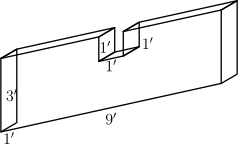
All six sides of a rectangular solid were rectangles. A one-foot cube was cut out of the rectangular solid as shown. The total number of square feet in the surface of the new solid is how many more or less than that of the original solid?
less
less
the same
more
more
Small Hint:
Cutting the cube removes some faces that were on the surface but uncovers new ones; compare the two amounts
Big Hint:
The cube’s top, front, and back faces were on the surface ( square feet removed); the notch’s floor and its two side walls become new surface ( square feet added)
Solution:
The removed cube had three faces on the surface of the solid (top, front, and back), so square feet of surface are removed.
Cutting it out exposes three new faces (the floor of the notch and its two side walls), adding square feet. The surface area is unchanged.
Thus, the correct answer is C .
16.
The squares on a piece of paper are numbered as shown in the diagram. While lying on a table, the paper is folded in half four times in the following sequence:
fold the top half over the bottom half;
fold the bottom half over the top half;
fold the right half over the left half;
fold the left half over the right half.
Which numbered square is on top after step
Small Hint:
After each fold, track which squares end up on the bottom (or top) of the stack
Big Hint:
Folds and leave the middle rows; folds and leave the middle columns, and the final left-over-right fold flips square to the top
Solution:
Fold (top over bottom) leaves squares on the bottom. Fold (bottom over top) leaves on the bottom. Fold (right over left) leaves and on the bottom.
Fold (left over right) puts on the bottom and brings to the top.
Thus, the correct answer is B .
17.
An auditorium with rows of seats has seats in the first row. Each successive row has one more seat than the previous row. If students taking an exam are permitted to sit in any row, but not next to another student in that row, then the maximum number of students that can be seated for an exam is
Small Hint:
In a row of seats, the most students with no two adjacent is
Big Hint:
Row has seats; add over the rows
Solution:
Row has seats, so it holds students. For rows through (seats through ) the maxima are
These sum to
Thus, the correct answer is C .
18.
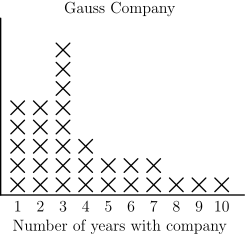
The vertical axis indicates the number of employees, but the scale was accidentally omitted from this graph. What percent of the employees at the Gauss Company have worked there for years or more?
Small Hint:
Since the vertical scale is unknown, work with the number of X’s rather than any value
Big Hint:
Divide the X’s over years through by the total number of X’s
Solution:
No matter the missing scale, each X represents the same number of employees. There are X’s over years through and X’s in all.
So the fraction is
Thus, the correct answer is C .
19.
The average (arithmetic mean) of different positive whole numbers is The largest possible value of any of these numbers is
Small Hint:
The ten numbers must sum to
Big Hint:
To make one number as large as possible, make the other nine as small as possible:
Solution:
The ten numbers sum to To maximize one of them, the other nine (all different positive whole numbers) should be as small as possible:
The largest number is then
Thus, the correct answer is C .
20.
In the addition problem shown, each digit has been replaced by a letter. If different letters represent different digits, then
Small Hint:
Write the sum in terms of
Big Hint:
Solution:
The three numbers add to Since is too small and is too large,
Then which forces and So
Thus, the correct answer is A .
21.
For every rise in temperature, the volume of a certain gas expands by cubic centimeters. If the volume of the gas is cubic centimeters when the temperature is what was the volume of the gas in cubic centimeters when the temperature was
Small Hint:
The temperature dropped from to a change of
Big Hint:
Each drop shrinks the volume by cubic centimeters
Solution:
From to is a decrease, which is steps of
The volume decreases by cubic centimeters, from down to
Thus, the correct answer is A .
22.
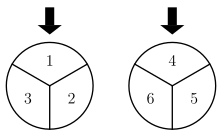
Each spinner is divided into equal parts. The results obtained from spinning the two spinners are multiplied. What is the probability that this product is an even number?
Small Hint:
A product is even unless both spun numbers are odd
Big Hint:
Find the probability of an odd product (odd times odd), then subtract from
Solution:
The product is odd only when both numbers are odd. The first spinner is odd ( or ) with probability and the second is odd () with probability
So the product is odd with probability and even with probability
Thus, the correct answer is D .
23.
The Pythagoras High School band has female and male members. The Pythagoras High School orchestra has female and male members. There are females who are members in both band and orchestra. Altogether, there are students who are in either band or orchestra or both. The number of males in the band who are NOT in the orchestra is
Small Hint:
First find how many females are in at least one group, using
Big Hint:
Subtract the females from the total to get the males in at least one group, then use inclusion–exclusion to find how many males are in both groups
Solution:
Females in band or orchestra: So males in at least one group:
With males in band and in orchestra, the males in both are Hence males in band but not orchestra:
Thus, the correct answer is A .
24.
A cube of edge cm is cut into smaller cubes, not all the same size. If the edge of each of the smaller cubes is a whole number of centimeters, then
Small Hint:
The smaller cubes must have whole-number edges, so each is edge or edge
Big Hint:
Only one edge- cube fits; the rest are unit cubes filling the remaining volume
Solution:
The cube has volume Since the cubes are smaller and have whole-number edge lengths, their edges are or . Two edge- cubes cannot be disjoint inside the original cube: separating them would require a total span of at least in some direction. Thus at most one edge- cube fits.
The remaining of volume is filled by unit cubes. That is cubes.
Thus, the correct answer is E .
25.
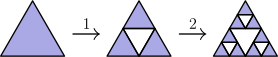
An equilateral triangle is originally painted black. Each time the triangle is changed, the middle fourth of each black triangle turns white. After five changes, what fractional part of the original area of the black triangle remains black?
Small Hint:
After one change the middle fourth turns white, so of the black area remains
Big Hint:
Each change multiplies the black area by so after five changes multiply by
Solution:
Each change leaves of the current black area black. After five changes the black fraction is
Thus, the correct answer is C .