
1990 AMC 8 Solutions
Scroll down to view professionally curated solutions from LIVE by Po-Shen Loh, print PDF solutions, view answer key, or take the full timed exam.
All problems are used with official legal permission of the Mathematical Association of America (MAA).
1.
What is the smallest sum of two -digit numbers that can be obtained by placing each of the six digits into one of the six boxes of a sum of two -digit numbers?
Small Hint:
A digit in the hundreds place counts times, so put the smallest digits there
Big Hint:
Hundreds digits should be and , tens digits and , units digits and
Solution:
To make the sum small, the two smallest digits go in the hundreds places, the next two in the tens places, and the two largest in the units places.
One such arrangement is , and every arrangement of this type gives the same sum.
Thus, the correct answer is C .
2.
Which digit of when changed to gives the largest number?
Small Hint:
Changing a digit in a higher place value raises the number by more
Big Hint:
The leftmost digit sits in the tenths place, the largest place value shown
Solution:
Changing a digit in the tenths place changes the number more than changing any digit farther to the right. The digit in the tenths place is .
Changing it gives , which is the largest possible result.
Thus, the correct answer is A .
3.
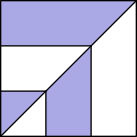
What fraction of the square is shaded?
Small Hint:
Reflect the figure across the main diagonal that runs corner to corner
Big Hint:
Each shaded piece on one side of the diagonal matches an unshaded piece of equal area on the other side
Solution:
The diagonal from one corner to the opposite corner splits the square into two equal halves. Every shaded piece on one side of the diagonal is the mirror image of an equal unshaded piece on the other side.
So the shaded and unshaded areas are equal, and exactly of the square is shaded.
Thus, the correct answer is E .
4.
Which of the following could not be the units digit [one’s digit] of the square of a whole number?
Small Hint:
The units digit of a square depends only on the units digit of the number being squared
Big Hint:
Square each of the digits through and record only the units digit of each result
Solution:
The units digit of a square is determined by the units digit of the number squared. Squaring through gives units digits .
So a square can only end in or ; it can never end in or . Among the choices, only is impossible.
Thus, the correct answer is E .
5.
Which of the following is closest to the product
Small Hint:
is very close to
Big Hint:
Estimate the product as
Solution:
Since is close to , the product is close to
The choice closest to is .
Thus, the correct answer is B .
6.
Which of these five numbers is the largest?
Small Hint:
Dividing by is the same as multiplying by
Big Hint:
All the other choices stay near , but one of them becomes thousands of times larger
Solution:
Choices A, B, and E are all very close to , and choice C multiplies by a tiny number, making it much smaller.
Choice D divides by , which is the same as multiplying by . This makes it thousands of times larger than , so it is the largest.
Thus, the correct answer is D .
7.
When three different numbers from the set are multiplied, the largest possible product is
Small Hint:
A product of three numbers is positive only when none or two of them are negative
Big Hint:
There are only two positive numbers, so use two negatives and the largest positive
Solution:
For the product of three numbers to be positive, either all three are positive or exactly two are negative. There are only two positive numbers, so we must use two negatives and one positive.
To maximize, take the two most negative numbers and the largest positive: .
Thus, the correct answer is C .
8.
A dress originally priced at was put on sale at off. If tax was added to the sale price, then the total selling price of the dress was
Small Hint:
A discount leaves of the price
Big Hint:
Adding tax multiplies the sale price by
Solution:
The sale price is
The tax is of which is so the total is
Thus, the correct answer is D .
9.
The grading scale shown is used at Jones Junior High. The fifteen scores in Mr. Freeman’s class were:
A B C D F
In Mr. Freeman’s class, what percent of the students received a grade of C?
Small Hint:
Count how many scores fall in the range
Big Hint:
Divide that count by the students to get the fraction, then convert to a percent
Solution:
A grade of C corresponds to scores from to . The qualifying scores are , which is students.
So the percent is
Thus, the correct answer is D .
10.
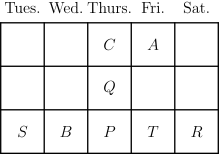
On this monthly calendar, the date behind one of the letters is added to the date behind . If this sum equals the sum of the dates behind and , then the letter is
Small Hint:
On a calendar, moving one column right adds to the date and moving one row down adds
Big Hint:
The date behind is one less than the date behind , so the missing date must be one more than the date behind
Solution:
Moving one column right adds to the date, and moving one row down adds . Let have date . Then , one column to the right, is . The letter sits two rows directly below , so , and , one column left of in the bottom row, is .
We need a letter whose date satisfies , so . That date is behind .
Thus, the correct answer is A .
11.
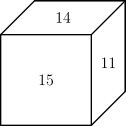
The numbers on the faces of this cube are consecutive whole numbers. The sums of the two numbers on each of the three pairs of opposite faces are equal. The sum of the six numbers on this cube is
Small Hint:
Five of the faces must be ; the sixth is either or
Big Hint:
The three faces meet at one corner, so no two of them are opposite; this rules out one of the two possibilities
Solution:
The six consecutive numbers include , so five of the faces are and the sixth is or .
If the sixth were , equal opposite sums would force the pairs , making and opposite. But the figure shows meeting at one corner, so no two of them are opposite. Hence the sixth number is , with pairs , each summing to .
The total is .
Thus, the correct answer is E .
12.
There are twenty-four -digit whole numbers that use each of the four digits and exactly once. Listed in numerical order from smallest to largest, the number in the th position in the list is
Small Hint:
The numbers split into four blocks of by their leading digit
Big Hint:
Positions – start with , – start with , – start with ; find the th number starting with
Solution:
Each leading digit accounts for of the numbers. Positions – begin with , positions – begin with , and positions – begin with .
So the th number is the th one beginning with : . The fifth is .
Thus, the correct answer is B .
13.
One proposal for new postage rates for a letter was ¢ for the first ounce and ¢ for each additional ounce (or fraction of an ounce). The postage for a letter weighing ounces was
¢
Small Hint:
The first ounce costs ¢; the remaining ounces are billed as full additional ounces
Big Hint:
A fraction of an ounce counts as a whole additional ounce, so ounces beyond the first counts as
Solution:
The first ounce costs ¢. The remaining ounces are charged as additional ounces, since any fraction rounds up to a full ounce.
That is ¢ ¢, so the total is ¢ ¢ ¢
Thus, the correct answer is C .
14.
A bag contains only blue balls and green balls. There are blue balls. If the probability of drawing a blue ball at random from this bag is then the number of green balls in the bag is
Small Hint:
If the probability of blue is then blue balls are a quarter of the total
Big Hint:
Use blue balls to find the total, then subtract to get the green balls
Solution:
Since blue balls make up of the bag and there are of them, the total is balls.
So the number of green balls is .
Thus, the correct answer is B .
15.
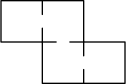
The area of this figure is Its perimeter is
(The figure consists of four identical squares.)
Small Hint:
Each of the four squares has area
Big Hint:
Find the side length of one square, then count how many side lengths make up the outline
Solution:
Each of the four squares has area , so each side is
The outline of this staircase shape is made up of such sides, so the perimeter is
Thus, the correct answer is E .
16.
What is the value of the following expression?
Small Hint:
Group the terms in pairs:
Big Hint:
Each pair equals ; count the pairs and remember the leftover at the end
Solution:
Group the terms as Each parenthesized pair equals .
The first elements number , so there are pairs, giving , plus the leftover at the end for a total of .
Thus, the correct answer is D .
17.
A straight concrete sidewalk is to be feet wide, feet long, and inches thick. How many cubic yards of concrete must a contractor order for the sidewalk if concrete must be ordered in a whole number of cubic yards?
more than
Small Hint:
First convert inches to feet:
Big Hint:
Find the volume in cubic feet, then divide by since cubic yard cubic feet
Solution:
The thickness is inches foot, so the volume is cubic feet.
Since cubic yard cubic feet, this is cubic yards. Rounding up to a whole number, the contractor must order cubic yards.
Thus, the correct answer is A .
18.
Every corner of a rectangular prism is cut off by a straight slice through the three edges meeting at that corner, removing a small triangular piece at each of the eight corners. How many edges does the new figure have?
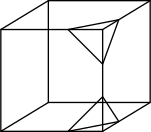
Small Hint:
The original rectangular prism has edges, and none of them disappear
Big Hint:
Each corner cut creates a new triangular face, adding new edges
Solution:
A rectangular prism starts with edges, and cutting corners only shortens them without removing any.
Each of the corner cuts creates a small triangular face with new edges, adding edges. The total is .
Thus, the correct answer is C .
19.
There are seats in a row. What is the fewest number of seats that must be occupied so the next person to be seated must sit next to someone?
Small Hint:
To force the next person to sit adjacent to someone, no empty seat may have both neighbors empty
Big Hint:
Seat people so there is exactly one empty seat between occupied ones: occupy every third seat
Solution:
To force the next person next to someone, every empty seat must be adjacent to an occupied one. Each occupied seat can account for at most itself and its two neighboring seats, so at least seats must be occupied.
This bound is attainable: use a repeating pattern of empty-occupied-empty, filling the middle seat of every group of three. This uses exactly occupied seats.
Thus, the correct answer is B .
20.
The annual incomes of families range from to In error, the largest income was entered on the computer as The difference between the mean of the incorrect data and the mean of the actual data is
Small Hint:
Only one value changed, so only the total sum changes; the count stays at
Big Hint:
Find how much the one wrong entry inflated the total, then divide that by
Solution:
Only one entry changed. The incorrect total exceeds the actual total by
Since this extra amount is spread over families, the means differ by
Thus, the correct answer is A .
21.
A list of numbers is formed by beginning with two given numbers. Each new number in the list is the product of the two previous numbers. Find the first number if the last three are :
Small Hint:
If a term is the product of the two before it, then dividing a term by the one just before it recovers the term two positions back
Big Hint:
Work backwards from the end, filling one earlier term at a time by dividing
Solution:
Since each term is the product of the two before it, dividing any term by the term just before it recovers the term two positions earlier. Working backwards from the last three terms :
These fill in the earlier terms, giving the full list . The first number is .
Thus, the correct answer is B .
22.
Several students are seated at a large circular table. They pass around a bag containing pieces of candy. Each person receives the bag, takes one piece of candy, and then passes the bag to the next person. If Chris takes the first and the last piece of candy, then the number of students at the table could be
Small Hint:
Chris takes piece and piece , so after Chris’s first piece, the remaining pieces bring the bag exactly back to Chris
Big Hint:
The number of students must divide evenly
Solution:
Chris takes the first piece, and then the bag goes around until Chris takes the last (th) piece. So the pieces after Chris’s first must be exactly a whole number of trips around the table back to Chris.
This means the number of students divides . Among the choices, only divides .
Thus, the correct answer is B .
23.
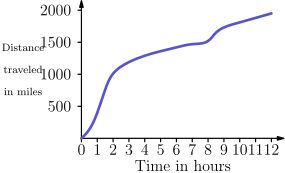
The graph relates the distance traveled (in miles) to the time elapsed (in hours) on a trip taken by an experimental airplane. During which hour was the average speed of this airplane the largest?
first
second
third
ninth
last
Small Hint:
The average speed during an hour equals the distance covered in that hour, which is how far the curve climbs from the start of the hour to its end
Big Hint:
Find the one-hour interval over which the graph rises the most steeply
Solution:
The average speed during any single hour equals the distance the airplane covers in that hour, which on the graph is the vertical rise of the curve over that one-hour interval. So the largest average speed happens during the hour where the curve is steepest.
From to the curve climbs from about miles to about miles, a rise of roughly miles, giving an average speed near mph. During every other hour the curve rises by less than miles, so those average speeds are all smaller. The steepest climb, and hence the largest average speed, is during the second hour.
Thus, the correct answer is B .
24.
Three triangles and a diamond balance nine dots. Also, one triangle balances a diamond and a dot. How many dots will balance two diamonds?
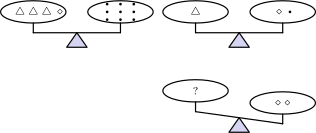
Small Hint:
Let a triangle weigh , a diamond , and a dot ; write the two balance conditions as equations
Big Hint:
From and , substitute to solve for , then double it
Solution:
Let a triangle, diamond, and dot weigh , , and . The conditions give and .
Substituting, , so and . Then two diamonds weigh dots.
Thus, the correct answer is C .
25.
How many different patterns can be made by shading exactly two of the nine unit squares in a grid? Patterns that can be matched by flips and/or turns are not considered different.
Small Hint:
The nine squares come in three types: corners, edge-middles, and center; describe each pattern by which types its two shaded squares use and how far apart they are
Big Hint:
Split into cases by whether a corner is shaded, being careful that flips and turns merge many placements into one pattern
Solution:
Classify the two shaded squares up to rotations and reflections. Patterns that include a corner: two adjacent corners (same edge), two diagonally opposite corners, corner with the center, corner with an adjacent edge-middle, and corner with a far edge-middle. That is patterns.
Patterns with no corner: two adjacent edge-middles, two opposite edge-middles, and an edge-middle with the center. That is more.
In total there are distinct patterns.
Thus, the correct answer is C .