
2026 AMC 12A Solutions
Scroll down to view professionally curated solutions from LIVE by Po-Shen Loh, print PDF solutions, view answer key, or take the full timed exam.
All problems are used with official legal permission of the Mathematical Association of America (MAA).
1.
A sign in a parking lot states that the total price includes a tax. To the nearest whole number, what percentage of the amount a customer pays is this tax?
Small hint:
A price means tax and paid
Big hint:
is close to
Solution:
Say the price before tax is Then the tax is and the customer pays in all. So the tax is of the amount paid.
This is close to so the tax is near Now and and is closer to So to the nearest whole number the tax is of the amount paid.
Thus, the correct answer is A.
2.
Square has side length Let be the midpoint of and let be the intersection of and
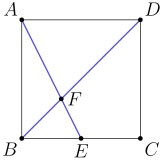
What is the area of
Small hint:
so triangles and are similar
Big hint:
is half of so is half as tall as
Solution:
Since triangles and are similar, and is half of So the height of is half the height of The two heights add up to the side so is one third of the way up, at height
Then has area
Alternatively, is a median of The diagonal passes through the center of the square, which is the midpoint of so it contains the median from So is the centroid of The three medians cut into six triangles of equal area, and is one of them. So its area is of which is
Thus, the correct answer is D.
3.
Half of the internal angles of a polygon measure each, and the other half of its internal angles measure each. How many sides does the polygon have?
Small hint:
Exterior angles, each minus the interior angle, sum to even when some are negative
Big hint:
The interior angles average
Solution:
The exterior angle at each corner is minus the interior angle: at the angles and at the angles, where the boundary turns back the other way. Going once around any polygon turns through in all, so the exterior angles add up to
The interior angles average so the exterior angles average With sides, so
Thus, the correct answer is A.
4.
Let be a sequence with and equal to the arithmetic mean of the previous terms for What is the value of
Small hint:
is the mean of and
Big hint:
Appending the current mean leaves the mean unchanged
Solution:
First, Now the first three terms have mean because equals the mean of the two terms before it. So
Each time we append a term equal to the current mean, the mean stays the same. Therefore every term from on equals and
Thus, the correct answer is C.
5.
How many ordered triples of positive integers satisfy both of the following equations?
Small hint:
Subtract the first equation from the second
Big hint:
That fixes and Count the ways to split into two positive integers.
Solution:
Subtracting the first equation from the second gives so and The pair can be or so there are triples.
Thus, the correct answer is A.
6.
For what odd positive integer is the mean of exactly greater than its median?
Small hint:
The mean is and the median is
Big hint:
Their ratio is Set it to
Solution:
The mean of the squares is and since is odd, the median is the middle square, The factor cancels in their ratio:
Setting this equal to gives so
Thus, the correct answer is C.
7.
What is the value of where
Small hint:
and
Big hint:
Square again to get then take the th power
Solution:
Since squaring again gives Likewise and So each term is and the sum is
Thus, the correct answer is A.
8.
At Euclid High School, students registered to take the AMC and students registered to take the AMC (No student registered to take both.) However, not all students showed up on test day. To compute the percentage of those students who actually took one of the exams, Euclid High School performed the following incorrect two-step process:
Step : The school computed both the percentage of AMC registrants who actually took that exam and the percentage of AMC registrants who actually took that exam.
Step : The school took the average of the previous two numbers to obtain a final percentage.
Suppose that Euclid High School’s process yielded an answer of What is the minimum number of students who might have actually taken one of the exams?
Small hint:
With AMC and AMC takers,
Big hint:
So Minimize
Solution:
Say of the AMC registrants and of the AMC registrants took the exams. The school’s process gives Multiplying by gives
Then which is smallest when is as large as possible. Since take and So the minimum is
Thus, the correct answer is C.
9.
How many ordered pairs of real numbers satisfy the following system of equations?
Small hint:
Multiply the second equation by :
Big hint:
So or Substitute each into the first equation.
Solution:
Here Multiplying the second equation by gives or So or
If the first equation says so That gives pairs.
If the first equation says so or That gives values of for each of the values of or pairs. None of them has so the two cases do not overlap, and there are pairs.
Thus, the correct answer is E.
10.
The tree diagram below has nodes labeled with rational numbers. The top node, at level is Each node sprouts two nodes in the level below it, and For example, level has nodes and
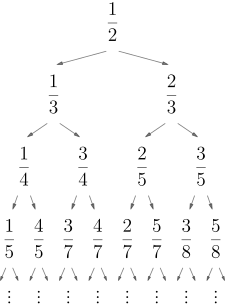
At what level does the node appear in the diagram?
The node does not appear in the
diagram.
Small hint:
Going up a level, becomes a fraction made of and
Big hint:
Starting from and keep subtracting the smaller number from the larger until you reach and
Solution:
Every node is a fraction less than in lowest terms. If a node is its parent is made of and in whichever order gives a fraction less than So each step up replaces the pair of numbers by the smaller one and their difference, as in the Euclidean algorithm.
Starting from the pairs are and That is steps up to so is at level
Thus, the correct answer is B.
11.
An urn contains red balls, black balls, and white balls. Suppose balls are drawn at random without replacement and a score is computed as follows:
• point is given for each red ball up to a maximum of points.
• point is given for each black ball up to a maximum of points.
• point is given for each white ball up to a maximum of points.
For example, drawing red ball, black balls, and white balls would earn a score of What is the probability of getting the lowest possible score?
Small hint:
The score is minus the balls beyond their color’s cap. Waste as many balls as possible.
Big hint:
At most balls can be wasted: reds and other, or of one other color and of the last
Solution:
Call a ball wasted if it is beyond its color’s cap. Then the score is minus the number of wasted balls, so we want to waste as many as possible.
Wasting is impossible. With reds, reds are wasted and the other ball is not. With reds, reds are wasted and the other balls waste nothing. With reds, red is wasted and the other balls waste at most With at most reds, only black and white can be wasted, and wasting of each would take balls. So at most are wasted, and the lowest score is
Exactly are wasted with reds and of the other balls ( ways), with black and white ( ways), or with black and white ( ways). That is of the equally likely draws, for a probability of
Thus, the correct answer is D.
12.
Ethan writes down five congruences: How many positive integers less than or equal to satisfy at least one of these five congruences?
Small hint:
Every modulus divides so only the remainder of mod matters
Big hint:
Evens and multiples of are covered. Check the remainders and
Solution:
Each modulus divides so whether satisfies a congruence depends only on the remainder of when divided by The first congruence covers the remainders and The second adds and The third adds and the fourth adds and the fifth adds
All twelve remainders are covered, so every positive integer satisfies at least one congruence. The answer is
Thus, the correct answer is E.
13.
A board has spaces in a row, which can be filled with numbers. The sides of a fair, -sided die are numbered through David rolls the die times. After each roll, he randomly chooses an empty spot to write the number shown on the die. What is the probability that the numbers on the board form a strictly increasing sequence when read from left to right?
Small hint:
The rolls must be distinct, and then one placement is increasing
Big hint:
The placement is one of equally likely orders, whatever was rolled
Solution:
David’s choices of spots put the four rolls on the board in one of orders, each equally likely and unrelated to the numbers rolled.
A strictly increasing board needs four different numbers. That happens with probability Then exactly one of the orders is increasing. The probability is
Thus, the correct answer is C.
14.
Three identical boxes, each with one open face, are made from -inch-thick wood. The outer dimensions of each box are and inches, where and each open face appears on a face with outer dimensions
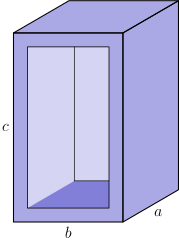
It happens that if the open faces of two of the boxes are held together, then the space inside can exactly contain the (rotated) third box, with no room to spare. What is
Small hint:
One box’s inside is
Big hint:
Two boxes make Match this to and in some order.
Solution:
Each box has walls inch thick on every face except the open face, so its inside measures Holding two boxes open face to open face makes a space of
This must be and in some order. Since and are both less than the number must be Then and are and in some order, and so and
So and which gives and Then
Thus, the correct answer is C.
15.
Suppose that and with What is the greatest integer less than
Small hint:
Big hint:
The product is See which powers of it lies between.
Solution:
By the product-to-sum identity and the double-angle identity
This is Since its base- logarithm is between and The greatest integer less than it is
Thus, the correct answer is A.
16.
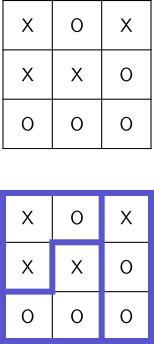
Gerry is playing the Triples Game. Her task is to partition the grid of squares shown at the top into three sections, each containing three adjoining squares. (Three squares are adjoining if each shares an edge with at least one of the other two.) One point will be awarded for each section containing more X’s than O’s. Shown below it is a sample partition that will earn one point in total. A partition that earns two or more points will win the game. What fraction of the possible partitions of this particular grid will result in a win for Gerry?
Small hint:
Only squares hold X’s. A win needs two sections with X’s each, so the third section is all O’s.
Big hint:
Only the bottom row and one L-shape consist of three O’s. Check the partitions that contain each.
Solution:
Each section is a straight line of three squares or an L-shape. An L-shape fits in a block, so it covers at most one corner of the grid, and a middle row or column covers none. The three sections cover all four corners, so one of them is a full row or column along the edge.
That leaves a rectangle, which splits in ways: into two straight pieces, or into two L-shapes in ways. Four edges give but the three-rows and three-columns partitions are each counted twice, so there are partitions.
The grid has only X’s, and a section earns a point only with at least of them. So a winning partition has two sections with X’s each and a third section of three O’s. Only two sections consist of three O’s: the bottom row, and the L made of the middle-right, bottom-center, and bottom-right squares.
With the bottom row, the top two rows split as two rows (XOX and XXO) or as two L-shapes (XOX and XXO again), both wins, or as XXX and OXO, which earns only point. With the L, the other six squares split only as the top row plus an L (XOX and XXO) or as the left column plus an L (XXO and OXX), both wins.
So of the partitions win, a fraction of
Thus, the correct answer is C.
17.
An engineer is designing a closely packed field of wind turbines for electricity production. Each turbine, whose center is marked by a labeled dot in the figure, occupies one of congruent elliptical regions. Turbines in the same row have centers that are units apart, and turbines in the same column have centers that are units apart, as shown in the figure below.
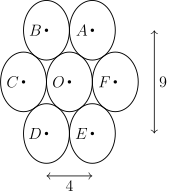
The major axis of each ellipse is where and are positive integers and is not divisible by the square of any prime. What is
Small hint:
Each ellipse is wide. Squeeze vertically to make them circles of radius
Big hint:
and are apart across and apart vertically, and their ellipses touch
Solution:
Turbines in the same row touch halfway between their centers, so each ellipse has horizontal semi-axis Call the vertical semi-axis
Squeeze the whole picture vertically by the factor Every ellipse becomes a circle of radius and ellipses that touched still touch. The centers and were apart across and apart up and down, so now they are across and up and down. Touching circles of radius have centers apart, so which gives and
Since the major axis is vertical, with length So
Thus, the correct answer is A.
18.
A sphere with center and radius cuts three mutually perpendicular planes that meet at point forming three circular cross-sections on these planes, which have radii and What is
Small hint:
A plane at distance from cuts a circle of radius
Big hint:
With at the origin and the planes as coordinate planes, these distances are the coordinates of
Solution:
A plane at distance from meets the sphere in a circle of radius So the squared distances from to the three planes are and
Put at the origin with the planes as the coordinate planes. Then these distances are the coordinates of (up to sign), so and
Thus, the correct answer is D.
19.
How many values of between and inclusive, satisfy the equation
Small hint:
and
Big hint:
Both sides then share the factor
Solution:
Since the left side is Since the right side is So the equation becomes and since
In gives and gives and and gives and These values are all different.
Thus, the correct answer is D.
20.
How many polynomials of degree satisfying are there that have leading coefficient equal to and all of whose coefficients are integers between and inclusive?
Small hint:
Put so that the two inputs are
Big hint:
Replacing by changes only the odd powers of
Solution:
Write The inputs are symmetric about so put Expanding and the coefficient of is and the coefficient of is
Replacing by flips the signs of the odd powers of and leaves the even powers alone, so At this is which must be So
For we need giving and all in range. The constant can be any of the integers from to So there are polynomials.
Thus, the correct answer is D.
21.
Six dogs find a large cookie in the shape of a regular hexagon To divide the cookie, the dogs agree to choose a point uniformly at random in the interior of the hexagon. The dogs will then cut out the segments and dividing the cookie into six triangles, one for each dog. A dog will be happy if and only if its piece has at least of the total area of the hexagon. What is the probability that all six dogs will be happy?
Small hint:
With side and center-to-side distance the area is If is from a side, that side’s triangle has area
Big hint:
Each dog needs at least from its side. That region is a smaller hexagon with the same center.
Solution:
Let the hexagon have side and let be the distance from its center to each side. The hexagon splits into six triangles from the center, so its area is The triangle on a side whose distance from is has area
That dog is happy when or So all six dogs are happy when is at least from every side, which means lies in a regular hexagon with the same center whose sides are from the center.
That hexagon is the original scaled by so the probability is
Thus, the correct answer is D.
22.
A flock of birds is flying in formation, led by a single leader bird, which has exactly followers immediately behind. Each non-leader bird follows exactly one bird, and has or followers immediately behind. Two possible formations are shown in the figure below. (When a bird has two followers, swapping its left and right subflocks can produce a different formation, as shown in the figure.)
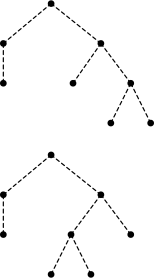
What is the total number of possible formations?
Small hint:
Let count subflocks of birds. With followers, the other birds split into an ordered left and right pair.
Big hint:
The leader’s subflocks have and birds. Compute
Solution:
Let be the number of ways to arrange a subflock of birds, each with or followers. A single follower has no left or right, while two followers form an ordered left and right pair. So and
This gives and
The leader has exactly two followers, with subflocks of and birds. The number of formations is
Thus, the correct answer is C.
23.
There is a unique real number between and such that For that there exist unique integers and such that the infinite product equals What is
Small hint:
Multiply by The factors collapse, starting with
Big hint:
So the product is Use and
Solution:
Multiplying the first factors by collapses them one at a time: Since the right side tends to so the infinite product equals
To turn into a quadratic, use twice. First, and so Second, so Therefore using in the last step.
So and and
Thus, the correct answer is D.
24.
Trapezoid has and Circles and lie inside the trapezoid as follows: is tangent to and is tangent to and and and are externally tangent to each other. The distance between the centers of and is where and are positive integers such that is not divisible by the square of any prime. What is
Small hint:
The perpendicular from to cuts off a -- triangle. Find the tangent lengths from and
Big hint:
On both and the two touch points are apart
Solution:
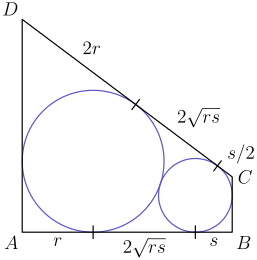
Since and are right angles, Say is the longer base. The perpendicular from to has length so it cuts off a right triangle with legs and and hypotenuse Its incircle has radius and touches the two sides through at points from that vertex. So and since the angles at and add up to we get
A circle of radius inside an angle touches both sides at distance from the vertex. So if and have radii and the tangent length from to is and from to it is The tangent lengths from and are and
Both and are common external tangents of the two touching circles. On each of them the touch points are apart, since Adding up the pieces of each side, as in the figure,
Subtracting the first equation from the second gives so The first equation says so
Then Squaring gives or so Thus and
The distance between the centers is so
Thus, the correct answer is D.
25.
Let be a positive integer such that there are at least positive integers less than for which is a multiple of What is the sum of the digits of the least possible value of
Small hint:
Mod an odd prime power, has solutions. Mod and with it has and
Big hint:
By the Chinese Remainder Theorem the counts multiply, so the count must reach
Solution:
We are counting the solutions of among For this is every solution modulo because is never one.
Modulo an odd prime power we need to divide The prime cannot divide both factors, since they differ by so : there are solutions. Modulo there is solution, modulo there are and modulo with there are There is odd, and of the even numbers and one is not a multiple of so the other is a multiple of That gives which is and modulo
By the Chinese Remainder Theorem, the number of solutions modulo is the product over the prime powers in So it is a power of and to be at least it must be at least
With a factor for we need at least odd primes, and the smallest choice is With exactly dividing we need odd primes, so With at most one factor of we need odd primes, so
The least is and its digit sum is
Thus, the correct answer is B.