
2025 AMC 12B Solutions
Scroll down to view professionally curated solutions from LIVE by Po-Shen Loh, print PDF solutions, view answer key, or take the full timed exam.
All problems are used with official legal permission of the Mathematical Association of America (MAA).
1.
The instructions on a -gram bag of coffee beans say that proper brewing of a large mug of pour-over coffee requires grams of coffee beans. What is the greatest number of properly brewed large mugs of coffee that can be made from the coffee beans in that bag?
Small Hint:
Divide the total grams by the grams needed per mug
Big Hint:
Only whole mugs count, so round down
Solution:
Each mug uses grams, and Only complete mugs can be brewed, so the greatest number is
Thus, the correct answer is B.
2.
Jerry wrote down the ones digit of each of the first positive squares: What is the sum of all the numbers Jerry wrote down?
Small Hint:
The ones digit of depends only on the ones digit of so the list repeats every terms
Big Hint:
Sum one full block of multiply by the number of blocks, then add the leftover terms
Solution:
The ones digits of are which sum to The terms contain full blocks ( terms) plus more with digits summing to The total is
Thus, the correct answer is D.
3.
What is the value of where
Small Hint:
Multiply in pairs: and
Big Hint:
Use to reduce each product before multiplying the two results
Solution:
and Then
Thus, the correct answer is D.
4.
The value of the two-digit number in base seven equals the value of the two-digit number in base nine. What is
Small Hint:
Write each number in terms of its base: is and is
Big Hint:
Set and simplify to a ratio between and
Solution:
Setting gives so Thus and Because both are base-seven digits and only works. Hence and indeed Therefore
Thus, the correct answer is A.
5.
Positive integers and satisfy the equation What is the least possible value of
Small Hint:
Reduce modulo to pin down
Big Hint:
Since is positive and only a few values of are possible
Solution:
Modulo the equation gives so With the only option is which gives so Then
Thus, the correct answer is E.
6.
Emmy says to Max, “I ordered math club sweatshirts today.” Max asks, “How much did each shirt cost?” Emmy responds, “I’ll give you a hint. The total cost was where and are digits and ” After a pause, Max says, “That was a good price.” What is
Small Hint:
In cents the total is and it must be divisible by
Big Hint:
Reduce modulo to get then test digits with
Solution:
The total in cents is which must be a multiple of Since and the condition is i.e. Reducing once more modulo gives so the only possible nonzero digit is Then is divisible by only for the digit Indeed so
Thus, the correct answer is C.
7.
What is the value of
Small Hint:
Write
Big Hint:
With each term becomes
Solution:
Let The numerator equals so each term is Telescoping from to leaves
Thus, the correct answer is C.
8.
There are integers and such that the polynomial has as a root. What is
Small Hint:
Integer coefficients force the conjugate to be a root as well
Big Hint:
The three roots sum to so find the third root, then expand to read off and
Solution:
The conjugate is also a root, and these two are the roots of The third root satisfies so Then giving and so
Thus, the correct answer is C.
9.
What is the tens digit of
Small Hint:
The tens digit is determined by
Big Hint:
For cycles with period reduce the exponent modulo
Solution:
Here For the last two digits of cycle with period through Since ends in so the tens digit is
Thus, the correct answer is C.
10.
The altitude to the hypotenuse of a right triangle is divided into two segments of lengths by the median to the shortest side of the triangle. What is the ratio
Small Hint:
Place the right angle at the origin with the legs along the axes and coordinatize every point
Big Hint:
Find where the median to the shortest side crosses the altitude to the hypotenuse, then split the altitude at that point
Solution:
Take so is the hypotenuse and is the shortest side. The altitude from meets at The median from to crosses the altitude at This splits the altitude into and so and
Thus, the correct answer is A.
11.
Nine athletes, no two of whom are the same height, try out for the basketball team. One at a time, they draw a wristband at random, without replacement, from a bag containing blue bands, red bands, and green bands. They are divided into a blue group, a red group, and a green group. The tallest member of each group is named the group captain. What is the probability that the group captains are the three tallest athletes?
Small Hint:
The captains are the three tallest exactly when the three tallest land in three different groups
Big Hint:
Place the tallest three one at a time; each must avoid the groups already used, whose slots shrink the pool
Solution:
Each group has slots. The three tallest athletes are the captains precisely when they fall into three different groups. Placing them one at a time into the slots, the second must avoid the first’s group ( of the remaining slots) and the third must avoid both used groups ( of the remaining slots). The probability is
Thus, the correct answer is C.
12.
The windshield wiper on the driver’s side of a large bus is depicted below.
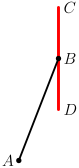
Arm pivots back and forth around point sweeping out an arc of symmetric about the vertical line through The wiper blade is attached to at its midpoint and stays vertical as the arm moves. The arm is feet long, and the wiper blade is feet tall. What is the area of the windshield cleaned by the wiper, in square feet, to the nearest hundredth? (Assume that the windshield is a flat vertical surface.)
Small Hint:
As the arm turns, traces an arc of radius the blade is always a vertical segment of height centered at
Big Hint:
Each vertical line meets the cleaned region in a segment of constant height so the area is that height times the horizontal width swept
Solution:
Put at the origin. Then for so the horizontal coordinate of ranges over a width of At each horizontal position exactly one vertical blade of height passes through, so by Cavalieri’s principle the cleaned area is square feet.
Thus, the correct answer is C.
13.
A circle has been divided into sectors of different sizes. Then of the sectors are painted red, painted green, and painted blue so that no two neighboring sectors are painted the same color. One such coloring is shown below.
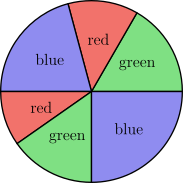
How many different colorings are possible?
Small Hint:
Because same-colored sectors cannot touch, the two sectors of each color form a non-adjacent pair
Big Hint:
Count the ways to split the sectors into three non-adjacent pairs, then assign the three colors to the pairs
Solution:
The two sectors of each color must be a non-adjacent pair, so a coloring is a way to split the cyclic sectors into three non-adjacent pairs together with an assignment of the three colors. The non-adjacent pairs are the edges of the complement of the -cycle, the triangular prism, which has perfect matchings. Assigning the three colors in ways gives colorings.
Thus, the correct answer is D.
14.
Consider a decreasing sequence of positive integers that satisfies the following two conditions:
• The average (arithmetic mean) of the first terms in the sequence is
• For all the average of the first terms in the sequence is less than the average of the first terms in the sequence.
What is the greatest possible value of
Small Hint:
Let be the average of the first terms; the second condition gives for
Big Hint:
From recover for then require every term to stay positive
Solution:
The average of the first terms is for so the partial sum is For which is positive exactly when A valid start such as keeps the whole sequence strictly decreasing, so the greatest possible is
Thus, the correct answer is B.
15.
A container has a square bottom, a open square top, and four congruent trapezoidal sides, as shown. Starting when the container is empty, a hose that runs water at a constant rate takes minutes to fill the container up to the midline of the trapezoids.
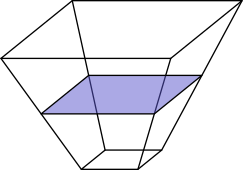
How many more minutes will it take to fill the remainder of the container?
Small Hint:
At height fraction the cross-section is a square of side so its area is
Big Hint:
Compare the volume up to the midline () with the total volume; fill time is proportional to volume
Solution:
At height fraction the square cross-section has side so the volume filled up to height is Up to the midline this is and the full volume is The remaining volume is which is times the first part. So the remainder takes more minutes.
Thus, the correct answer is D.
16.
An analog clock starts at midnight and runs for minutes before stopping. What is the tangent of the acute angle between the hour hand and the minute hand when the clock stops?
Small Hint:
Reduce minutes modulo hours to find where the hands point
Big Hint:
Find each hand’s angle, take the acute difference, then evaluate
Solution:
minutes is hours minutes, which modulo hours reads The minute hand points at and the hour hand at so the acute angle between them is Using the half-angle value,
Thus, the correct answer is B.
17.
Each of the squares in a grid is to be colored red, blue, or yellow in such a way that each red square shares an edge with at least one blue square, each blue square shares an edge with at least one yellow square, and each yellow square shares an edge with at least one red square. Colorings that can be obtained from one another by rotations and/or reflections are to be considered the same. How many different colorings are possible?
Small Hint:
Every color must appear, and the cyclic conditions red blue yellow red tightly constrain the layout
Big Hint:
Count all valid colorings of the fixed (labeled) grid, then reduce by the rotations and reflections using Burnside’s lemma
Solution:
First count colorings of the grid with its positions labeled. Checking the possible rows in succession and rejecting a row as soon as a square whose neighbors are now known lacks its required next color gives the following complete count by the numbers of red, blue, and yellow squares: Thus the identity symmetry fixes colorings.
For the other symmetries, the fixed-coloring counts are for each nontrivial rotation, for each reflection across a horizontal or vertical axis, and for each diagonal reflection. (For an axis reflection, a direct check of the three palindromic rows gives the possibilities.) Therefore Burnside’s lemma gives
Thus, the correct answer is C.
18.
Awnik repeatedly plays a game that has a probability of winning of The outcomes of the games are independent. What is the expected value of the number of games he will play until he has both won and lost at least once?
Small Hint:
After the first game you already have one outcome; you then wait only for the opposite outcome
Big Hint:
The expected number of games to get an outcome of probability is condition on whether the first game is a win or a loss
Solution:
The first game produces one outcome. If it was a win (probability ), the expected wait for a loss is if it was a loss (probability ), the expected wait for a win is So the expected total is
Thus, the correct answer is D.
19.
A rectangular grid of squares has rows and columns. Each square has room for two numbers. Horace and Vera each fill in the grid by putting the numbers from through into the squares. Horace fills the grid horizontally: he puts through in order from left to right into row puts through into row in order from left to right, and continues similarly through row Vera fills the grid vertically: she puts through in order from top to bottom into column then through into column in order from top to bottom, and continues similarly through column How many squares get two copies of the same number?
Small Hint:
Write the Horace-number and the Vera-number of the square in row column as formulas in and
Big Hint:
Setting them equal gives find which make an integer in range
Solution:
In row column Horace writes and Vera writes Setting these equal gives i.e. This requires so — that is values, and each yields a valid between and So squares match.
Thus, the correct answer is C.
20.
A frog hops along the number line according to the following rules.
• It starts at
• If it is at then it moves to with probability and it disappears with probability
• For or if it is at then it moves to with probability it moves to with probability and it disappears with probability
What is the probability that the frog reaches
Small Hint:
Let be the probability of eventually reaching starting from write a first-step equation at each state
Big Hint:
Solve the linear system with and value whenever the frog disappears
Solution:
Let be the probability of reaching from Then and for with Solving upward gives and then yields so
Thus, the correct answer is E.
21.
Two non-congruent triangles have the same area. Each triangle has sides of length and and the third side of each triangle has integer length. What is the sum of the lengths of the third sides?
Small Hint:
With sides and and included angle the area is so equal areas come from and
Big Hint:
By the law of cosines the third sides satisfy so
Solution:
The area with included angle is so two triangles of equal area use angles and with cosines By the law of cosines the third sides satisfy hence Since both integer sides must be odd. Checking the odd squares in the triangle-inequality range leaves only Therefore the sum is
Thus, the correct answer is C.
22.
What is the greatest possible area of the triangle in the complex plane with vertices and where is a complex number satisfying
Small Hint:
The vertices are times the fixed points so the triangle is that fixed triangle scaled by
Big Hint:
Its area is times a fixed area; the condition is a circle, so maximize on it
Solution:
The vertices are and so the triangle is the fixed triangle with vertices — which has area — scaled by giving area The condition is the circle on which is at most So the greatest area is
Thus, the correct answer is C.
23.
Let be the set of all integers such that for all pairs of nonnegative integers with the remainder when is divided by is less than the remainder when is divided by What is the sum of the elements of
Small Hint:
The condition says the map is strictly increasing on
Big Hint:
An increasing rearrangement of starting at must be the identity, forcing
Solution:
The condition requires to be strictly increasing on A strictly increasing list of distinct values in must be so i.e. is divisible by Since the sum of all its divisors is Excluding leaves
Thus, the correct answer is E.
24.
How many real numbers satisfy the equation
Small Hint:
A solution needs so lies in
Big Hint:
On each monotonic half-wave of the slowly rising log crosses once; count the branches carefully at both ends
Solution:
Since every solution lies in For the logarithm is negative, so only the negative sine lobes in can contribute. Each has one crossing on each side of its minimum; on the last lobe, the second crossing is the endpoint Hence this part contributes solutions.
For only positive lobes contribute. There are of them: one in each interval from to for Every one after the first has one crossing on each side of its maximum. The first has only one new crossing because its left endpoint is the already-counted solution Thus contributes more solutions.
For completeness, the claimed uniqueness on each half-lobe follows by differentiating the difference of the two sides. On a falling positive half-lobe it is strictly decreasing. On a rising positive half-lobe its derivative increases and then decreases once, so the difference crosses from negative to positive only once. Applying the same argument to handles a negative lobe. The total is
Thus, the correct answer is D.
25.
Three concentric circles have radii An equilateral triangle with side length has one vertex on each circle. What is
Small Hint:
For a point at distances from the vertices of an equilateral triangle of side there is a symmetric relation among
Big Hint:
Use with
Solution:
For the common center at distances from the vertices of an equilateral triangle of side the identity holds. This simplifies to i.e. so
Thus, the correct answer is E.