
2025 AMC 12A Problems
Scroll down and press Start to try the exam! Or, go to the printable PDF, answer key, or professional solutions curated by LIVE by Po-Shen Loh.
All problems are used with official legal permission of the Mathematical Association of America (MAA).
Or jump straight to a single problem with its solution: 1 · 2 · 3 · 4 · 5 · 6 · 7 · 8 · 9 · 10 · 11 · 12 · 13 · 14 · 15 · 16 · 17 · 18 · 19 · 20 · 21 · 22 · 23 · 24 · 25
Want to learn professionally through interactive video classes?
Timed
1:15:00
1.
Andy and Betsy both live in Mathville. Andy leaves Mathville on his bicycle at traveling due north at a steady miles per hour. Betsy leaves on her bicycle from the same point at traveling due east at a steady miles per hour. At what time will they be exactly the same distance from their common starting point?
Answer: E
Small Hint:
Measure time from ; Betsy has been riding one hour less than Andy
Big Hint:
If Andy has ridden hours, set
Solution:
Let be the number of hours since Andy has traveled miles north, and Betsy, who started an hour later, has traveled miles east.
Setting the distances equal, so and
Three hours after is
Thus, the correct answer is E.
2.
A box contains pounds of a nut mix that is percent peanuts, percent cashews, and percent almonds. A second nut mix containing percent peanuts, percent cashews, and percent almonds is added to the box resulting in a new nut mix that is percent peanuts. How many pounds of cashews are now in the box?
Answer: B
Small Hint:
The first box holds lb peanuts, lb cashews, and lb almonds
Big Hint:
If pounds of the second mix are added, solve
Solution:
The first box has lb peanuts, lb cashews, and lb almonds. Adding pounds of the second mix contributes lb peanuts and lb cashews.
The new peanut fraction is so This gives so
The cashews now total pounds.
Thus, the correct answer is B.
3.
A team of students is going to compete against a team of teachers in a trivia contest. The total number of students and teachers is Ash, a cousin of one of the students, wants to join the contest. If Ash plays with the students, the average age on that team will increase from to If Ash plays with the teachers, the average age on that team will decrease from to How old is Ash?
Answer: A
Small Hint:
Let be the number of students; their ages total
Big Hint:
Adding Ash gives and
Solution:
Let be the number of students and be Ash’s age. The students’ ages total and adding Ash gives
There are teachers with ages totaling and adding Ash gives
Setting gives so
Thus, the correct answer is A.
4.
Agnes writes the following four statements on a blank piece of paper.
• At least one of these statements is true.
• At least two of these statements are true.
• At least two of these statements are false.
• At least one of these statements is false.
Each statement is either true or false. How many false statements did Agnes write on the paper?
Answer: B
Small Hint:
Let be the number of true statements; the four claims say
Big Hint:
Find the value of for which exactly of the four conditions hold
Solution:
Let be the number of true statements. The statements assert and respectively.
Testing : the conditions hold (statements one, two, four) and fails (statement three). Exactly statements are true, matching
For the respective numbers of true conditions are so no other value is self-consistent. Therefore exactly one statement is false.
Thus, the correct answer is B.
5.
In the figure below, the outside square contains infinitely many squares, each of them with the same center and sides parallel to the outside square. The ratio of the side length of a square to the side length of the next inner square is where The spaces between squares are alternately shaded, as shown in the figure (which is not necessarily drawn to scale).

The area of the shaded portion of the figure is of the area of the original square. What is
Answer: D
Small Hint:
Take the outer square to have area ; the squares have areas
Big Hint:
The shaded rings form a geometric series that sums to
Solution:
Let the outer square have area The nested squares have areas so the ring between the th and th squares has area
The shaded rings are the alternate ones with total area
Setting gives so and
Thus, the correct answer is D.
6.
Six chairs are arranged around a round table. Two students and two teachers randomly select four of the chairs to sit in. What is the probability that the two students will sit in two adjacent chairs and the two teachers will also sit in two adjacent chairs?
Answer: B
Small Hint:
Count the ways to give the students one pair of chairs and the teachers another pair
Big Hint:
There are adjacent pairs; after fixing the students’ pair, count the adjacent pairs left for the teachers
Solution:
Choosing chairs for the students and for the teachers gives equally likely outcomes.
A round table has adjacent pairs of chairs. Give the students any adjacent pair; among the remaining chairs there are exactly adjacent pairs for the teachers. That is favorable outcomes.
The probability is
Thus, the correct answer is B.
7.
In a certain alien world, the maximum running speed of an organism is dependent on its number of toes and number of eyes The relationship can be expressed as centimeters per hour, where and are integer constants. In a population where all organisms have toes, and in a population where all organisms have eyes, where the logarithms are base What is
Answer: C
Small Hint:
Take logs:
Big Hint:
Setting gives and ; setting gives
Solution:
Taking logarithms,
With this reads matching so and
With it reads matching so and
Then so Hence
Thus, the correct answer is C.
8.
Pentagon is inscribed in a circle, and Let and intersect at point and suppose that and What is
Answer: E
Small Hint:
and both subtend arcs, so bisects
Big Hint:
Find with the Law of Cosines in then use the Angle Bisector Theorem
Solution:
The inscribed angle subtends arc so which also subtends arc equals Likewise
Thus bisects In so
Since (along ) bisects the Angle Bisector Theorem gives Hence
Thus, the correct answer is E.
9.
Let be the complex number where What real number has the property that and are three collinear points in the complex plane?
Answer: E
Small Hint:
Compute and treat and as points in the plane
Big Hint:
Find where the line through and meets the real axis
Solution:
Compute so the points are and
The line through them has slope giving Setting yields
So
Thus, the correct answer is E.
10.
In the figure shown below, major arc and minor arc have the same center, Also, lies between and and lies between and Major arc minor arc and each of the two segments and have length
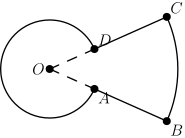
What is the distance from to
Small Hint:
Let and ; the arcs give and
Big Hint:
The segments give ; eliminating the radii yields
Solution:
Let and and let (the rays coincide). The minor arc has length and the major arc is the reflex arc, so
Each segment
From the first two equations, and Substituting into and dividing by gives which simplifies to
The larger root is greater than so it cannot be an angle of this minor arc. Thus Then after rationalizing (the denominator times equals ).
Thus, the correct answer is B.
11.
The orthocenter of a triangle is the concurrent intersection of the three (possibly extended) altitudes. What is the sum of the coordinates of the orthocenter of the triangle whose vertices are and
Answer: A
Small Hint:
and share so the altitude from is the vertical line
Big Hint:
The altitude from is perpendicular to ; intersect it with
Solution:
Since and both have side is horizontal and the altitude from is the vertical line
Side has slope so the altitude from has slope :
At The orthocenter is with coordinate sum
Thus, the correct answer is A.
12.
The harmonic mean of a collection of numbers is the reciprocal of the arithmetic mean of the reciprocals of the numbers in the collection. For example, the harmonic mean of and is What is the harmonic mean of all the real roots of the th degree polynomial
Answer: B
Small Hint:
The harmonic mean is where is the number of roots
Big Hint:
For the two roots have reciprocal-sum the same for every
Solution:
Each factor has discriminant so it has two real roots; there are roots in all.
For the roots of the sum of reciprocals is independent of
Summing over all factors, The harmonic mean is
Thus, the correct answer is B.
13.
Let Let be the greatest integer such that there exists a subset of with elements that does not contain five consecutive integers. Suppose integers are chosen at random from without replacement. What is the probability that the chosen elements do not include five consecutive integers?
Answer: D
Small Hint:
Removing two well-placed elements breaks every run of five, so
Big Hint:
Choosing means removing ; count removals whose two elements hit every block of five consecutive integers
Solution:
To avoid five consecutive integers, it suffices to remove two elements (for example and ), and no single removal can hit both disjoint blocks and Thus
Choosing of elements is the same as removing which can be done in ways. The chosen set avoids five consecutive integers exactly when the two removed elements together intersect every window for
This forces one removed element in the other in and the two within of each other. The valid removals are and giving of them.
The probability is
Thus, the correct answer is D.
14.
Points and are collinear with between and The ellipse with foci at and is internally tangent to the ellipse with foci at and as shown below.
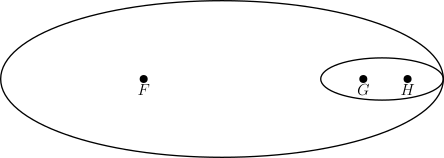
The two ellipses have the same eccentricity and the ratio of their areas is (Recall that the eccentricity of an ellipse is where is the distance from the center to a focus, and is the length of the major axis.) What is
Answer: D
Small Hint:
Equal eccentricity makes area proportional to so
Big Hint:
The ellipses share focus ; equate their right vertices to get
Solution:
With the same eccentricity, so the area The area ratio gives where are the semi-major axes.
Both ellipses share focus On the large ellipse is the right focus, so its right vertex lies to the right of On the small ellipse is the left focus, so its right vertex lies to the right of Internal tangency makes these coincide:
Using so giving and
Thus, the correct answer is D.
15.
A set of numbers is called sum-free if whenever and are (not necessarily distinct) elements of the set, is not an element of the set. For example, and the empty set are sum-free, but is not. What is the greatest possible number of elements in a sum-free subset of
Answer: C
Small Hint:
The set is sum-free
Big Hint:
If are in the differences are not in forcing
Solution:
The set has elements and is sum-free, since any two elements sum to at least
For the upper bound, let be a sum-free subset. Each difference for cannot lie in because would violate sum-freeness.
These differences are distinct, lie in and are disjoint from the elements of So giving
Thus, the correct answer is C.
16.
Triangle has side lengths and The bisector of and the altitude to side intersect at point What is
Answer: D
Small Hint:
Big Hint:
The altitude’s foot is from along and
Solution:
By the Law of Cosines,
The altitude to is drawn from and its foot is at distance from along
Along the bisector from the component parallel to is which must reach the altitude’s foot:
Since we get
Thus, the correct answer is D.
17.
The polynomial has three roots in the complex plane, where What is the area of the triangle formed by these roots?
Answer: A
Small Hint:
Shift by the centroid: let to center the roots at the origin
Big Hint:
The polynomial becomes
Solution:
The sum of the roots is so the centroid is Substituting
Since is a root, giving roots and
These are the points The base between and has length at horizontal distance from so the area is Translation does not change the area.
Thus, the correct answer is A.
18.
How many ordered triples of distinct nonnegative integers less than or equal to satisfy and
Answer: C
Small Hint:
None of can be since then some product equals and cannot exceed a nonnegative value
Big Hint:
For distinct the only binding condition is ; count such -subsets, then multiply by
Solution:
If any variable is say then is impossible. So are distinct positive integers.
The conditions are symmetric. For distinct values we have and automatically, so the only real constraint is When it holds, all orderings work.
For each possible smallest value the numbers of pairs satisfying are For fixed this count comes from choosing between and Thus there are unordered triples, and all orderings of each work. The answer is
Thus, the correct answer is C.
19.
Let and be the roots of the polynomial What is the sum
Answer: E
Small Hint:
By Vieta, and
Big Hint:
Group as and replace
Solution:
By Vieta’s formulas, and
Group the sum as Since we have
So the sum equals
Thus, the correct answer is E.
20.
The base of the pentahedron shown below is a rectangle, and its lateral faces are two isosceles triangles with base of length and congruent sides of length and two isosceles trapezoids with bases of lengths and and nonparallel sides of length
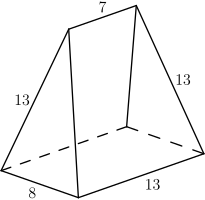
What is the volume of the pentahedron?
Answer: C
Small Hint:
Place the ridge of length at height ; a slant edge gives so
Big Hint:
The cross-section at height is a rectangle
Solution:
The top is a ridge of length centered above the base at some height Its endpoints sit above and of the base. A slant edge to a base corner has length so
At height the horizontal cross-section is a rectangle measuring by At its area is ; at it is ; at the ridge has area
By the prismatoid formula,
Thus, the correct answer is C.
21.
There is a unique ordered triple of nonnegative integers such that
What is
Answer: A
Small Hint:
Sum both geometric series and use
Big Hint:
The remaining fraction is odd over odd, so comparing powers of with forces
Solution:
If or the original ratio is just which cannot equal Hence
Summing the geometric series, the numerator is and the denominator is Using the ratio simplifies to
The fraction on the left is odd over odd, so its power of is Since we must have and Reducing this equation modulo shows that is divisible by so For the required powers of would be none of which is a power of For however, so and This also proves uniqueness.
Then
Thus, the correct answer is A.
22.
Three real numbers are chosen independently and uniformly at random between and What is the probability that the greatest of these three numbers is greater than times each of the other two numbers? (In other words, if the chosen numbers are then )
Answer: E
Small Hint:
With order statistics the joint density is on the region
Big Hint:
Integrate over and
Solution:
Order the values as ; the joint density of the order statistics is on this region. The event is
Integrating from to contributes a factor of Then
This equals
Thus, the correct answer is E.
23.
Call a positive integer fair if no digit is used more than once, it has no s, and no digit is adjacent to two greater digits. For example, and are fair, but and are not fair. How many fair positive integers are there?
Answer: C
Small Hint:
A fair number has no interior digit smaller than both of its neighbors
Big Hint:
Build a valid arrangement of a chosen digit set by placing digits largest-to-smallest, each at either end: ways for digits
Solution:
The digits are distinct and drawn from and “no digit adjacent to two greater digits” means no interior digit is smaller than both neighbors.
For a fixed set of digits, build the arrangement by inserting digits from largest to smallest; each new (smaller) digit must go to one of the two ends, giving valid arrangements.
Summing over all nonempty digit subsets,
Thus, the correct answer is C.
24.
A circle of radius is surrounded by circles of radius externally tangent to the central circle and sequentially tangent to each other, as shown. Then can be written as where and are integers. What is
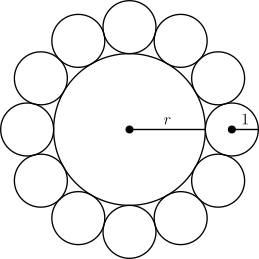
Answer: C
Small Hint:
The outer centers form a regular -gon of circumradius with adjacent centers apart
Big Hint:
So and
Solution:
The centers of the outer circles lie on a circle of radius forming a regular -gon. Adjacent centers are apart (both circles have radius ), and the central angle between them is
Thus so Since
Then so
Thus, the correct answer is C.
25.
Polynomials and each have degree and leading coefficient and their roots are all elements of The function has the property that there exist real numbers such that the set of all real numbers such that consists of the closed interval together with the open interval How many functions are possible?
Answer: E
Small Hint:
The closed endpoints must be zeros of and the open endpoints must be zeros of
Big Hint:
After those four endpoint factors are fixed, the remaining numerator and denominator factors must cancel; count distinct functions, not polynomial pairs
Solution:
This problem was voided: as written, its answer is not among the choices. Here is the count.
For the endpoints of the closed interval must be zeros of at which while must be poles. The required sign pattern is therefore that of The unused third factor of must match the unused third factor of otherwise there would be an extra zero, pole, or sign change.
If the common factor is the fifth value not among it cannot make a hole inside either interval. In the ordered list of five values it may therefore occur before between and or after giving functions.
Alternatively, the common factor can equal or For each of the choices of these two polynomial pairs simplify to the same formula and have the same domain (both omit ), so they define only one function. This gives more functions, for a literal total of
Counting the two polynomial pairs separately in each of the last five cases gives the provisional answer (E), but that does not answer the stated question about functions. Thus none of the printed choices is correct.