2024 AMC 12B Problems

Scroll down and press Start to try the exam! Or, go to the printable PDF, answer key, or professional solutions curated by LIVE by Po-Shen Loh.

All problems are used with official legal permission of the Mathematical Association of America (MAA).

Or jump straight to a single problem with its solution: 1 · 2 · 3 · 4 · 5 · 6 · 7 · 8 · 9 · 10 · 11 · 12 · 13 · 14 · 15 · 16 · 17 · 18 · 19 · 20 · 21 · 22 · 23 · 24 · 25

Want to learn professionally through interactive video classes?

Learn LIVE

Timed

1:15:00

1.

In a long line of people arranged left to right, the 10131013th person from the left is also the 10101010th person from the right. How many people are in the line?

20212021

20222022

20232023

20242024

20252025

Answer: B
Concepts:counting integers in a rangebasic counting
Difficulty rating: 890
Small Hint:

The people to the left of the target person and the people to the right, plus the person themself, make up the whole line

Big Hint:

There are 10121012 people to the left and 10091009 to the right; add these to the target person

Solution:

The target person has 1013−1=10121013 - 1 = 1012 people to the left and 1010−1=10091010 - 1 = 1009 people to the right. Including the person themself, the line has 1012+1009+1=20221012 + 1009 + 1 = 2022 people.

Thus, the correct answer is B.

2.

What is 10!−7!⋅6!?10! - 7! \cdot 6!?

−120-120

00

120120

600600

720720

Answer: B
Concepts:factorial
Difficulty rating: 1020
Small Hint:

Write 7!⋅6!7! \cdot 6! and see whether it can be rebuilt into 10!10!

Big Hint:

Since 6!=720=8⋅9⋅10,6! = 720 = 8 \cdot 9 \cdot 10, we get 7!⋅6!=7!⋅8⋅9⋅10=10!7! \cdot 6! = 7! \cdot 8 \cdot 9 \cdot 10 = 10!

Solution:

Note that 6!=720=8⋅9⋅10.6! = 720 = 8 \cdot 9 \cdot 10. Therefore 7!⋅6!=7!⋅(8⋅9⋅10)=10!.7! \cdot 6! = 7! \cdot (8 \cdot 9 \cdot 10) = 10!. So 10!−7!⋅6!=10!−10!=0.10! - 7! \cdot 6! = 10! - 10! = 0.

Thus, the correct answer is B.

3.

For how many integer values of xx is ∣2x∣≤7π?|2x| \le 7\pi?

1616

1717

1919

2020

2121

Answer: E
Difficulty rating: 1130
Small Hint:

Rewrite as ∣x∣≤7π2|x| \le \dfrac{7\pi}{2} and estimate 7π2\dfrac{7\pi}{2} as a decimal

Big Hint:

Since 7π2≈10.99,\dfrac{7\pi}{2} \approx 10.99, count the integers from −10-10 to 1010

Solution:

The inequality ∣2x∣≤7π|2x| \le 7\pi is equivalent to ∣x∣≤7π2≈10.99.|x| \le \dfrac{7\pi}{2} \approx 10.99. The integers satisfying this run from −10-10 to 10,10, which is 10+10+1=2110 + 10 + 1 = 21 values.

Thus, the correct answer is E.

4.

Balls numbered 1,1, 2,2, 3,3, …\ldots are deposited in 55 bins, labeled A,A, B,B, C,C, D,D, and E,E, using the following procedure. Ball 11 is deposited in bin A,A, and balls 22 and 33 are deposited in B.B. The next three balls are deposited in bin C,C, the next 44 in bin D,D, and so on, cycling back to bin AA after balls are deposited in bin E.E. (For example, 22,22, 23,23, …,\ldots, 2828 are deposited in bin BB at step 77 of this process.) In which bin is ball 20242024 deposited?

AA

BB

CC

DD

EE

Answer: D
Difficulty rating: 1270
Small Hint:

At step k,k, exactly kk balls are deposited, so after kk steps a total of k(k+1)2\dfrac{k(k+1)}{2} balls have been placed

Big Hint:

Find the step containing ball 2024,2024, then note that step kk uses the bin at position (k−1) mod 5(k-1)\bmod 5 in the cycle A,B,C,D,EA, B, C, D, E

Solution:

Step kk deposits kk balls, so after step kk a total of k(k+1)2\dfrac{k(k+1)}{2} balls have been placed. Since 63⋅642=2016\dfrac{63 \cdot 64}{2} = 2016 and 64⋅652=2080,\dfrac{64 \cdot 65}{2} = 2080, ball 20242024 falls in step 64.64.

The steps cycle through the bins A,B,C,D,E,A, B, C, D, E, so step kk uses position (k−1) mod 5.(k-1) \bmod 5. Here (64−1) mod 5=63 mod 5=3,(64 - 1) \bmod 5 = 63 \bmod 5 = 3, which is the fourth bin, D.D.

Thus, the correct answer is D.

5.

In the following expression, Melanie changed some of the plus signs to minus signs:

1+3+5+7+⋯+97+991 + 3 + 5 + 7 + \cdots + 97 + 99

When the new expression was evaluated, it was negative. What is the least number of plus signs that Melanie could have changed to minus signs?

1414

1515

1616

1717

1818

Answer: B
Difficulty rating: 1340
Small Hint:

The original sum is 1+3+⋯+99=502=2500;1 + 3 + \cdots + 99 = 50^2 = 2500; flipping a term of value vv lowers the total by 2v2v

Big Hint:

To go negative the flipped terms must total more than 1250;1250; flip the largest odd numbers first, where the largest kk of them sum to k(100−k)k(100-k)

Solution:

The original expression sums the first 5050 odd numbers, giving 502=2500.50^2 = 2500. Changing a term of value vv from ++ to −- decreases the total by 2v,2v, so to make the result negative the flipped terms must total more than 25002=1250.\dfrac{2500}{2} = 1250.

To use as few terms as possible, flip the largest odd numbers 99,97,95,…99, 97, 95, \ldots The largest kk of them sum to k(100−k).k(100 - k). With k=14k = 14 this is 14⋅86=1204≤1250,14 \cdot 86 = 1204 \le 1250, but with k=15k = 15 it is 15⋅85=1275>1250.15 \cdot 85 = 1275 \gt 1250. So 1515 sign changes suffice and 1414 do not.

Thus, the correct answer is B.

6.

The national debt of the United States is on track to reach 5⋅10135 \cdot 10^{13} dollars by 2033.2033. How many digits does this number of dollars have when written as a numeral in base 5?5? (The approximation of log⁡105\log_{10} 5 as 0.70.7 is sufficient for this problem.)

1818

2020

2222

2424

2626

Answer: B
Difficulty rating: 1370
Small Hint:

The number of base-55 digits of NN is ⌊log⁡5N⌋+1\lfloor \log_5 N \rfloor + 1

Big Hint:

Use log⁡5N=log⁡10Nlog⁡105\log_5 N = \dfrac{\log_{10} N}{\log_{10} 5} with log⁡105=0.7\log_{10} 5 = 0.7 and log⁡10(5⋅1013)=13+log⁡105\log_{10}(5\cdot 10^{13}) = 13 + \log_{10} 5

Solution:

The number of digits of NN in base 55 is ⌊log⁡5N⌋+1.\lfloor \log_5 N \rfloor + 1. With N=5⋅1013,N = 5 \cdot 10^{13}, log⁡10N=13+log⁡105=13.7.\log_{10} N = 13 + \log_{10} 5 = 13.7. Converting bases, log⁡5N\log_5 N =13.7log⁡105= \dfrac{13.7}{\log_{10} 5} =13.70.7= \dfrac{13.7}{0.7} =19.57…= 19.57\ldots

Thus the number of digits is ⌊19.57⌋+1=19+1=20.\lfloor 19.57 \rfloor + 1 = 19 + 1 = 20.

Thus, the correct answer is B.

7.

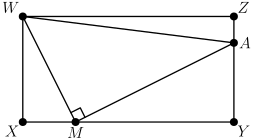
In the figure below WXYZWXYZ is a rectangle with WX=4WX = 4 and WZ=8.WZ = 8. Point MM lies on XY‾,\overline{XY}, point AA lies on YZ‾,\overline{YZ}, and ∠WMA\angle WMA is a right angle. The areas of △WXM\triangle WXM and △WAZ\triangle WAZ are equal. What is the area of △WMA?\triangle WMA?

1313

1414

1515

1616

1717

Answer: C
Difficulty rating: 1420
Small Hint:

Place X=(0,0),X = (0,0), W=(0,4),W = (0,4), Y=(8,0),Y = (8,0), Z=(8,4),Z = (8,4), with M=(m,0)M = (m, 0) and A=(8,a)A = (8, a)

Big Hint:

The right angle gives MW→⋅MA→=0,\overrightarrow{MW} \cdot \overrightarrow{MA} = 0, and the equal-area condition gives a second equation; solve for mm and aa

Solution:

Set X=(0,0),X = (0,0), W=(0,4),W = (0,4), Y=(8,0),Y = (8,0), Z=(8,4),Z = (8,4), with M=(m,0)M = (m, 0) on XY‾\overline{XY} and A=(8,a)A = (8, a) on YZ‾.\overline{YZ}.

Since ∠WMA=90∘,\angle WMA = 90^\circ, MW→⋅MA→\overrightarrow{MW} \cdot \overrightarrow{MA} =(−m)(8−m)= (-m)(8-m) +4a=0,+ 4a = 0, so 4a=m(8−m).4a = m(8-m). The areas give [△WXM]=12⋅4⋅m=2m[\triangle WXM] = \tfrac12 \cdot 4 \cdot m = 2m and [△WAZ][\triangle WAZ] =12⋅8⋅(4−a)= \tfrac12 \cdot 8 \cdot (4 - a) =4(4−a).= 4(4 - a). Setting these equal yields m=8−2a.m = 8 - 2a.

Substituting a=8−m2a = \tfrac{8-m}{2} into 4a=m(8−m)4a = m(8-m) gives 2(8−m)=m(8−m),2(8-m) = m(8-m), so m=2m = 2 and a=3.a = 3. The other algebraic root, m=8,m=8, gives M=A=YM=A=Y and no defined angle ∠WMA,\angle WMA, so it is invalid. Then with W=(0,4),W = (0,4), M=(2,0),M = (2,0), A=(8,3),A = (8,3), [△WMA]=12 ∣2(3−4)+8(4−0)∣=12(30)=15. \begin{aligned} [\triangle WMA] &= \tfrac12\,\bigl|2(3 - 4) + 8(4 - 0)\bigr| \\ &= \tfrac12 (30) = 15. \end{aligned}

Thus, the correct answer is C.

8.

What value of xx satisfies

log⁡2x⋅log⁡3xlog⁡2x+log⁡3x=2?\frac{\log_2 x \cdot \log_3 x}{\log_2 x + \log_3 x} = 2?

2525

3232

3636

4242

4848

Answer: C
Concepts:logarithm
Difficulty rating: 1460
Small Hint:

Divide numerator and denominator by log⁡2x⋅log⁡3x\log_2 x \cdot \log_3 x to turn the left side into 11log⁡2x+1log⁡3x\dfrac{1}{\frac{1}{\log_2 x} + \frac{1}{\log_3 x}}

Big Hint:

Since 1log⁡2x=log⁡x2\dfrac{1}{\log_2 x} = \log_x 2 and 1log⁡3x=log⁡x3,\dfrac{1}{\log_3 x} = \log_x 3, the equation becomes log⁡x6=12\log_x 6 = \dfrac12

Solution:

Dividing top and bottom by log⁡2x⋅log⁡3x,\log_2 x \cdot \log_3 x, the left side becomes 11log⁡2x+1log⁡3x=1log⁡x2+log⁡x3=1log⁡x6. \begin{gathered} \frac{1}{\dfrac{1}{\log_2 x} + \dfrac{1}{\log_3 x}} \\ = \frac{1}{\log_x 2 + \log_x 3} \\ = \frac{1}{\log_x 6}. \end{gathered} So 1log⁡x6=2,\dfrac{1}{\log_x 6} = 2, meaning log⁡x6=12,\log_x 6 = \dfrac12, i.e. x12=6.x^{\frac{1}{2}} = 6.

Therefore x=36.x = 36.

Thus, the correct answer is C.

9.

A dartboard is the region BB in the coordinate plane consisting of points (x,y)(x, y) such that ∣x∣+∣y∣≤8.|x| + |y| \le 8. A target TT is the region where (x2+y2−25)2≤49.(x^2 + y^2 - 25)^2 \le 49. A dart is thrown and lands at a random point in B.B. The probability that the dart lands in TT can be expressed as mn⋅π,\dfrac{m}{n} \cdot \pi, where mm and nn are relatively prime positive integers. What is m+n?m + n?

3939

7171

7373

7575

135135

Answer: B
Difficulty rating: 1540
Small Hint:

The region BB is a square with diagonals of length 16,16, and (x2+y2−25)2≤49(x^2+y^2-25)^2 \le 49 means 18≤x2+y2≤3218 \le x^2 + y^2 \le 32

Big Hint:

The annulus TT has area π(32−18);\pi(32 - 18); check that its outer radius 32\sqrt{32} exactly reaches the sides of B,B, so TT lies entirely inside BB

Solution:

The dartboard ∣x∣+∣y∣≤8|x| + |y| \le 8 is a square with diagonals 16,16, so its area is 12⋅16⋅16=128.\tfrac12 \cdot 16 \cdot 16 = 128. The target condition (x2+y2−25)2≤49(x^2 + y^2 - 25)^2 \le 49 means −7≤x2+y2−25≤7,-7 \le x^2 + y^2 - 25 \le 7, i.e. 18≤x2+y2≤32,18 \le x^2 + y^2 \le 32, an annulus of area π(32−18)=14π.\pi(32 - 18) = 14\pi.

The distance from the origin to a side of the square (for instance x+y=8x + y = 8) is 82=32,\dfrac{8}{\sqrt2} = \sqrt{32}, exactly the annulus’s outer radius. So the annulus is tangent to the square and lies entirely within B.B. The probability is 14π128=764π,\dfrac{14\pi}{128} = \dfrac{7}{64}\pi, giving m+n=7+64=71.m + n = 7 + 64 = 71.

Thus, the correct answer is B.

10.

A list of 99 real numbers consists of 1,1, 2.2,2.2, 3.2,3.2, 5.2,5.2, 6.2,6.2, and 7,7, as well as x,x, y,y, zz with x≤y≤z.x \le y \le z. The range of the list is 7,7, and the mean and median are both positive integers. How many ordered triples (x,y,z)(x, y, z) are possible?

11

22

33

44

infinitely many

Answer: C
Difficulty rating: 1600
Small Hint:

The six fixed numbers sum to 24.8,24.8, so the mean is an integer only when x+y+zx + y + z ends in 0.20.2

Big Hint:

The range condition gives three cases: (min⁡,max⁡)=(0,7), (1,8),(\min,\max)=(0,7),\ (1,8), or (t,t+7)(t,t+7) with 0<t<10\lt t\lt1

Solution:

The six fixed numbers sum to 24.824.8 and span [1,7].[1,7]. There are three possible arrangements of the overall extremes.

If the extremes are 00 and 7,7, then x=0x=0 and z≤7.z\le7. The only possible integer means are 33 and 4,4, requiring y+z=2.2y+z=2.2 or 11.2.11.2. The first makes the median 2.2.2.2. In the second, an integer median forces y=5,y=5, hence z=6.2.z=6.2. This gives (0,5,6.2).(0,5,6.2).

If the extremes are 11 and 8,8, then z=8z=8 and the integer mean forces x+y=3.2x+y=3.2 or 12.2.12.2. The first makes the median 3.2;3.2; the second has an integer median only for x=6, y=6.2.x=6,\ y=6.2. This gives (6,6.2,8).(6,6.2,8).

Finally, if both extremes are new, write x=t, z=t+7x=t,\ z=t+7 with 0<t<1.0\lt t\lt1. The mean must be 4,4, so y=4.2−2t.y=4.2-2t. The median is the fourth number among 1,2.2,3.2,5.2,6.2,7,y;1,2.2,3.2,5.2,6.2,7,y; it is an integer only when y=4,y=4, giving t=0.1.t=0.1. Thus the third triple is (0.1,4,7.1),(0.1,4,7.1), and there are exactly 33 in all.

Thus, the correct answer is C.

11.

Let xn=sin⁡2(n∘).x_n = \sin^2(n^\circ). What is the mean of x1,x_1, x2,x_2, x3,x_3, …,\ldots, x90?x_{90}?

1145\dfrac{11}{45}

2245\dfrac{22}{45}

89180\dfrac{89}{180}

12\dfrac{1}{2}

91180\dfrac{91}{180}

Answer: E
Difficulty rating: 1610
Small Hint:

Use sin⁡2θ=1−cos⁡2θ2\sin^2\theta = \dfrac{1 - \cos 2\theta}{2} to rewrite the sum

Big Hint:

The cosine terms cos⁡2∘,cos⁡4∘,…,cos⁡180∘\cos 2^\circ, \cos 4^\circ, \ldots, \cos 180^\circ cancel in pairs via cos⁡(180∘−θ)=−cos⁡θ,\cos(180^\circ - \theta) = -\cos\theta, leaving only cos⁡180∘=−1\cos 180^\circ = -1

Solution:

Using sin⁡2θ=1−cos⁡2θ2,\sin^2\theta = \dfrac{1 - \cos 2\theta}{2}, ∑n=190sin⁡2(n∘)=902−12∑n=190cos⁡(2n∘). \begin{aligned} \sum_{n=1}^{90} \sin^2(n^\circ) &= \frac{90}{2} \\ &\quad {}- \frac12 \sum_{n=1}^{90}\cos(2n^\circ). \end{aligned} In the cosine sum, the terms for nn and 90−n90 - n satisfy cos⁡(2n∘)+cos⁡(180∘−2n∘)=0,\cos(2n^\circ) + \cos(180^\circ - 2n^\circ) = 0, and cos⁡90∘=0,\cos 90^\circ = 0, so everything cancels except cos⁡180∘=−1.\cos 180^\circ = -1.

Hence the sum is 45−12(−1)=45.5,45 - \tfrac12(-1) = 45.5, and the mean is 45.590=91180.\dfrac{45.5}{90} = \dfrac{91}{180}.

Thus, the correct answer is E.

12.

Suppose zz is a complex number with positive imaginary part, with real part greater than 1,1, and with ∣z∣=2.|z| = 2. In the complex plane, the four points 0,0, z,z, z2,z^2, and z3z^3 are the vertices of a quadrilateral with area 15.15. What is the imaginary part of z?z?

34\dfrac{3}{4}

11

43\dfrac{4}{3}

32\dfrac{3}{2}

53\dfrac{5}{3}

Answer: D
Difficulty rating: 1670
Small Hint:

The signed area of the quadrilateral 0→z→z2→z30 \to z \to z^2 \to z^3 is 12 ∣Im⁡(zˉz2+z2‾ z3)∣\tfrac12\,\bigl|\operatorname{Im}(\bar z z^2 + \overline{z^2}\, z^3)\bigr|

Big Hint:

Since zˉz2=∣z∣2z\bar z z^2 = |z|^2 z and z2‾z3=∣z∣4z,\overline{z^2} z^3 = |z|^4 z, the area is 12(∣z∣2+∣z∣4)Im⁡(z);\tfrac12(|z|^2 + |z|^4)\operatorname{Im}(z); plug in ∣z∣=2|z| = 2

Solution:

For vertices 0,z,z2,z30, z, z^2, z^3 the shoelace formula gives area 12 ∣Im⁡(zˉz2+z2‾ z3)∣=12 ∣Im⁡((∣z∣2+∣z∣4)z)∣=12(∣z∣2+∣z∣4)Im⁡(z). \begin{aligned} &\tfrac12\,\bigl|\operatorname{Im}(\bar z z^2 + \overline{z^2}\,z^3)\bigr| \\ &= \tfrac12\,\bigl|\operatorname{Im}\bigl((|z|^2 + |z|^4)z\bigr)\bigr| \\ &= \tfrac12(|z|^2 + |z|^4)\operatorname{Im}(z). \end{aligned}

With ∣z∣=2,|z| = 2, this is 12(4+16)Im⁡(z)=10Im⁡(z).\tfrac12(4 + 16)\operatorname{Im}(z) = 10\operatorname{Im}(z). Setting 10Im⁡(z)=1510\operatorname{Im}(z) = 15 gives Im⁡(z)=32.\operatorname{Im}(z) = \dfrac32. (Then Re⁡(z)=4−94=72>1,\operatorname{Re}(z) = \sqrt{4 - \tfrac94} = \tfrac{\sqrt7}{2} \gt 1, as required.)

Thus, the correct answer is D.

13.

There are real numbers x,x, y,y, h,h, and kk that satisfy the system of equations

x2+y2−6x−8y=hx^2 + y^2 - 6x - 8y = h

x2+y2−10x+4y=k.x^2 + y^2 - 10x + 4y = k.

What is the minimum possible value of h+k?h + k?

−54-54

−46-46

−34-34

−16-16

1616

Answer: C
Difficulty rating: 1640
Small Hint:

Add the two equations to get h+kh + k as a single expression in xx and yy

Big Hint:

Complete the square: h+k=2(x−4)2h + k = 2(x-4)^2 +2(y−1)2−34,+ 2(y-1)^2 - 34, which is smallest when both squares vanish

Solution:

Adding the equations, h+k=2x2+2y2−16x−4y=2(x−4)2+2(y−1)2−34. \begin{aligned} h + k &= 2x^2 + 2y^2 - 16x - 4y \\ &= 2(x - 4)^2 \\ &\quad {}+ 2(y - 1)^2 - 34. \end{aligned} Both squared terms are nonnegative, so the minimum occurs at x=4,x = 4, y=1,y = 1, giving h+k=−34.h + k = -34.

Thus, the correct answer is C.

14.

How many different remainders can result when the 100100th power of an integer is divided by 125?125?

11

22

55

2525

125125

Answer: B
Difficulty rating: 1760
Small Hint:

Split into integers coprime to 55 and integers divisible by 55

Big Hint:

Since φ(125)=100,\varphi(125) = 100, Euler’s theorem gives n100≡1(mod125)n^{100} \equiv 1 \pmod{125} when gcd⁡(n,5)=1;\gcd(n,5)=1; a multiple of 55 has n100n^{100} divisible by 125125

Solution:

If nn is coprime to 5,5, then since φ(125)=100,\varphi(125) = 100, Euler’s theorem gives n100≡1(mod125).n^{100} \equiv 1 \pmod{125}. If nn is a multiple of 5,5, then n100n^{100} is divisible by 5100,5^{100}, hence by 125,125, leaving remainder 0.0.

So the only possible remainders are 00 and 1,1, which is 22 distinct values.

Thus, the correct answer is B.

15.

A triangle in the coordinate plane has vertices A(log⁡21,log⁡22),A(\log_2 1, \log_2 2), B(log⁡23,log⁡24),B(\log_2 3, \log_2 4), and C(log⁡27,log⁡28).C(\log_2 7, \log_2 8). What is the area of △ABC?\triangle ABC?

log⁡237\log_2 \dfrac{\sqrt3}{7}

log⁡237\log_2 \dfrac{3}{\sqrt7}

log⁡273\log_2 \dfrac{7}{\sqrt3}

log⁡2117\log_2 \dfrac{11}{\sqrt7}

log⁡2113\log_2 \dfrac{11}{\sqrt3}

Answer: B
Difficulty rating: 1800
Small Hint:

The vertices are (0,1),(0, 1), (log⁡23,2),(\log_2 3, 2), and (log⁡27,3)(\log_2 7, 3)

Big Hint:

Apply the shoelace formula and simplify with 2log⁡23−log⁡27=log⁡297,2\log_2 3 - \log_2 7 = \log_2 \dfrac{9}{7}, then halve the logarithm

Solution:

The vertices are A=(0,1),A = (0, 1), B=(log⁡23,2),B = (\log_2 3, 2), C=(log⁡27,3).C = (\log_2 7, 3). By the shoelace formula, [△ABC]=12 ∣2log⁡23−log⁡27∣. \begin{gathered} [\triangle ABC]\\ {}=\tfrac12\,\bigl|2\log_2 3-\log_2 7\bigr|. \end{gathered}

This equals 12log⁡297=log⁡297=log⁡237.\tfrac12\log_2 \dfrac{9}{7} = \log_2 \sqrt{\tfrac{9}{7}} = \log_2 \dfrac{3}{\sqrt7}.

Thus, the correct answer is B.

16.

A group of 1616 people will be partitioned into 44 indistinguishable 44-person committees. Each committee will have one chairperson and one secretary. The number of different ways to make these assignments can be written as 3rM,3^r M, where rr and MM are positive integers and MM is not divisible by 3.3. What is r?r?

55

66

77

88

99

Answer: A
Difficulty rating: 1860
Small Hint:

The number of assignments is 16!(4!)4 4!⋅124,\dfrac{16!}{(4!)^4\, 4!} \cdot 12^4, where each committee contributes 4⋅3=124 \cdot 3 = 12 chair-and-secretary choices

Big Hint:

Track only powers of 3:3: 16!16! gives 36,3^6, the denominator (4!)4 4!(4!)^4\,4! gives 35,3^5, and 12412^4 gives 343^4

Solution:

The number of ways to split 1616 people into 44 indistinguishable groups of 44 is 16!(4!)4 4!.\dfrac{16!}{(4!)^4\, 4!}. Each committee then chooses a chairperson and a secretary in 4⋅3=124 \cdot 3 = 12 ways, contributing 124.12^4. So the total is 16!(4!)4 4!⋅124.\dfrac{16!}{(4!)^4\,4!}\cdot 12^4.

Counting factors of 3:3: 16!16! contributes ⌊163⌋+⌊169⌋=6.\lfloor \frac{16}{3}\rfloor + \lfloor \frac{16}{9}\rfloor = 6. The denominator (4!)4 4!(4!)^4\,4! contributes 4+1=5.4 + 1 = 5. And 124=(22⋅3)412^4 = (2^2\cdot 3)^4 contributes 4.4. Thus r=6−5+4=5.r = 6 - 5 + 4 = 5.

Thus, the correct answer is A.

17.

Integers aa and bb are randomly chosen without replacement from the set of integers with absolute value not exceeding 10.10. What is the probability that the polynomial x3+ax2+bx+6x^3 + ax^2 + bx + 6 has 33 distinct integer roots?

1240\dfrac{1}{240}

1221\dfrac{1}{221}

1105\dfrac{1}{105}

184\dfrac{1}{84}

163\dfrac{1}{63}

Answer: C
Difficulty rating: 1910
Small Hint:

If the roots are distinct integers p,q,r,p, q, r, then pqr=−6,pqr = -6, a=−(p+q+r),a = -(p+q+r), and b=pq+qr+rpb = pq + qr + rp

Big Hint:

List the ways to write −6-6 as a product of three distinct integers, discard any giving ∣a∣>10|a|\gt 10 or ∣b∣>10,|b| \gt 10, and divide by 21⋅2021 \cdot 20 ordered choices

Solution:

The set has 2121 integers, so there are 21⋅20=42021 \cdot 20 = 420 ordered choices of (a,b).(a, b). If the polynomial has distinct integer roots p,q,r,p, q, r, then pqr=−6,pqr = -6, a=−(p+q+r),a = -(p + q + r), and b=pq+qr+rp.b = pq + qr + rp.

The triples of distinct integers with product −6-6 are {1,2,−3},\{1, 2, -3\}, {1,−2,3},\{1, -2, 3\}, {−1,2,3},\{-1, 2, 3\}, {−1,−2,−3},\{-1, -2, -3\}, and {1,−1,6}.\{1, -1, 6\}. These give (a,b)=(0,−7),(a, b) = (0, -7), (−2,−5),(-2, -5), (−4,1),(-4, 1), (6,11),(6, 11), and (−6,−1).(-6, -1). The fourth has b=11>10,b = 11 \gt 10, so it is invalid; the other four are valid and distinct.

The probability is 4420=1105.\dfrac{4}{420} = \dfrac{1}{105}.

Thus, the correct answer is C.

18.

The Fibonacci numbers are defined by F1=1,F_1 = 1, F2=1,F_2 = 1, and Fn=Fn−1+Fn−2F_n = F_{n-1} + F_{n-2} for n≥3.n \ge 3. What is

F2F1+F4F2+F6F3+⋯+F20F10?\frac{F_2}{F_1} + \frac{F_4}{F_2} + \frac{F_6}{F_3} + \cdots + \frac{F_{20}}{F_{10}}?

318318

319319

320320

321321

322322

Answer: B
Difficulty rating: 1930
Small Hint:

Each term simplifies: F2kFk\dfrac{F_{2k}}{F_k} is an integer; compute the first few, such as F2F1=1,\dfrac{F_2}{F_1} = 1, F4F2=3,\dfrac{F_4}{F_2} = 3, F6F3=4\dfrac{F_6}{F_3} = 4

Big Hint:

These values are the Lucas numbers Lk=1,3,4,7,11,…;L_k = 1, 3, 4, 7, 11, \ldots; sum L1L_1 through L10L_{10}

Solution:

Since F2k=FkLkF_{2k} = F_k L_k where LkL_k is the kkth Lucas number, each term F2kFk=Lk.\dfrac{F_{2k}}{F_k} = L_k. The sum is L1+L2+⋯+L10=1+3+4+7+11+18+29+47+76+123=319. \begin{gathered} L_1 + L_2 + \cdots + L_{10} \\ = 1 + 3 + 4 + 7 + 11 + 18 \\ {}+ 29 + 47 + 76 + 123 \\ = 319. \end{gathered} (Equivalently, L1+⋯+L10L_1 + \cdots + L_{10} =L12−3= L_{12} - 3 =322−3=319.= 322 - 3 = 319.)

Thus, the correct answer is B.

19.

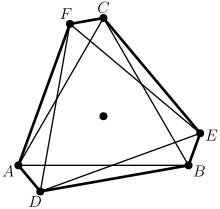
Equilateral △ABC\triangle ABC with side length 1414 is rotated about its center by angle θ,\theta, where 0<θ<60∘,0 \lt \theta \lt 60^\circ, to form △DEF.\triangle DEF. See the figure. The area of hexagon ADBECFADBECF is 913.91\sqrt3. What is tan⁡θ?\tan\theta?

34\dfrac{3}{4}

5311\dfrac{5\sqrt3}{11}

45\dfrac{4}{5}

1113\dfrac{11}{13}

7313\dfrac{7\sqrt3}{13}

Answer: B
Difficulty rating: 2040
Small Hint:

All six vertices lie on the circle of radius R=143;R = \dfrac{14}{\sqrt3}; the hexagon’s central angles alternate θ\theta and 120∘−θ120^\circ - \theta

Big Hint:

The area is 12R2(3sin⁡θ+3sin⁡(120∘−θ))\tfrac12 R^2\bigl(3\sin\theta + 3\sin(120^\circ - \theta)\bigr) =98(sin⁡θ+sin⁡(120∘−θ));= 98\bigl(\sin\theta + \sin(120^\circ - \theta)\bigr); simplify with sum-to-product to solve for θ\theta

Solution:

The six vertices lie on the circumcircle of radius R=143,R = \dfrac{14}{\sqrt3}, so R2=1963.R^2 = \dfrac{196}{3}. Going around, the central angles alternate between θ\theta (three times) and 120∘−θ120^\circ - \theta (three times). The cyclic-hexagon area is 12R2(3sin⁡θ+3sin⁡(120∘−θ))=98(sin⁡θ+sin⁡(120∘−θ)). \begin{aligned} &\tfrac12 R^2\bigl(3\sin\theta + 3\sin(120^\circ - \theta)\bigr) \\ &= 98\bigl(\sin\theta + \sin(120^\circ - \theta)\bigr). \end{aligned}

By sum-to-product, sin⁡θ+sin⁡(120∘−θ)\sin\theta + \sin(120^\circ - \theta) =2sin⁡60∘cos⁡(θ−60∘)= 2\sin 60^\circ\cos(\theta - 60^\circ) =3cos⁡(60∘−θ).= \sqrt3\cos(60^\circ - \theta). Setting the area to 91391\sqrt3 gives 3cos⁡(60∘−θ)\sqrt3\cos(60^\circ - \theta) =91398=13314,= \dfrac{91\sqrt3}{98} = \dfrac{13\sqrt3}{14}, so cos⁡(60∘−θ)=1314\cos(60^\circ - \theta) = \dfrac{13}{14} and sin⁡(60∘−θ)=3314.\sin(60^\circ - \theta) = \dfrac{3\sqrt3}{14}.

Then tan⁡(60∘−θ)=3313,\tan(60^\circ - \theta) = \dfrac{3\sqrt3}{13}, and tan⁡θ=tan⁡(60∘−(60∘−θ))=3−33131+3⋅3313=103132213=5311. \begin{aligned} &\tan\theta = \tan\bigl(60^\circ - (60^\circ - \theta)\bigr) \\ &= \frac{\sqrt3 - \frac{3\sqrt3}{13}}{1 + \sqrt3\cdot\frac{3\sqrt3}{13}} \\ &= \frac{\frac{10\sqrt3}{13}}{\frac{22}{13}} \\ &= \frac{5\sqrt3}{11}. \end{aligned}

Thus, the correct answer is B.

20.

Suppose A,A, B,B, and CC are points in the plane with AB=40AB = 40 and AC=42,AC = 42, and let xx be the length of the line segment from AA to the midpoint of BC‾.\overline{BC}. Define a function ff by letting f(x)f(x) be the area of △ABC.\triangle ABC. Then the domain of ff is an open interval (p,q),(p, q), and the maximum value rr of f(x)f(x) occurs at x=s.x = s. What is p+q+r+s?p + q + r + s?

909909

910910

911911

912912

913913

Answer: C
Difficulty rating: 2110
Small Hint:

The median satisfies x2=2⋅402+2⋅422−a24,x^2 = \dfrac{2\cdot 40^2 + 2\cdot 42^2 - a^2}{4}, where a=BC;a = BC; the triangle inequality 2<a<822 \lt a \lt 82 determines the domain

Big Hint:

The area is largest when ∠A=90∘;\angle A = 90^\circ; find that maximum area and the corresponding xx

Solution:

Let a=BC.a = BC. The median length gives x2x^2 =2⋅1600+2⋅1764−a24= \dfrac{2\cdot 1600 + 2\cdot 1764 - a^2}{4} =6728−a24.= \dfrac{6728 - a^2}{4}. The triangle inequality requires 2<a<82,2 \lt a \lt 82, i.e. 4<a2<6724,4 \lt a^2 \lt 6724, which translates to 1<x<41.1 \lt x \lt 41. So (p,q)=(1,41).(p, q) = (1, 41).

With AB=40AB = 40 and AC=42AC = 42 fixed, the area 12⋅40⋅42sin⁡A\tfrac12\cdot 40\cdot 42\sin A is largest when ∠A=90∘,\angle A = 90^\circ, giving r=840.r = 840. Then a2=402+422=3364,a^2 = 40^2 + 42^2 = 3364, so x2=6728−33644=841,x^2 = \dfrac{6728 - 3364}{4} = 841, i.e. s=29.s = 29.

Thus p+q+r+sp + q + r + s =1+41+840+29= 1 + 41 + 840 + 29 =911.= 911.

Thus, the correct answer is C.

21.

The measures of the smallest angles of three different right triangles sum to 90∘.90^\circ. All three triangles have side lengths that are primitive Pythagorean triples. Two of them are 33-44-55 and 55-1212-13.13. What is the perimeter of the third triangle?

4040

126126

154154

176176

208208

Answer: C
Difficulty rating: 2130
Small Hint:

The smallest angles have tangents 34\tfrac34 and 512;\tfrac{5}{12}; the third must satisfy α+β+γ=90∘,\alpha + \beta + \gamma = 90^\circ, so tan⁡γ=cot⁡(α+β)\tan\gamma = \cot(\alpha + \beta)

Big Hint:

Compute tan⁡(α+β)=5633,\tan(\alpha + \beta) = \dfrac{56}{33}, so tan⁡γ=3356;\tan\gamma = \dfrac{33}{56}; find the primitive triple with legs 3333 and 5656

Solution:

The smallest angles α,β\alpha, \beta of the 33-44-55 and 55-1212-1313 triangles have tan⁡α=34\tan\alpha = \tfrac34 and tan⁡β=512.\tan\beta = \tfrac{5}{12}. By the tangent addition formula, tan⁡(α+β)=34+5121−34⋅512=14123348=5633. \begin{aligned} &\tan(\alpha + \beta) = \frac{\tfrac34 + \tfrac{5}{12}}{1 - \tfrac34\cdot\tfrac{5}{12}} \\ &= \frac{\tfrac{14}{12}}{\tfrac{33}{48}} \\ &= \frac{56}{33}. \end{aligned}

The third smallest angle γ\gamma satisfies γ=90∘−(α+β),\gamma = 90^\circ - (\alpha + \beta), so tan⁡γ=3356.\tan\gamma = \dfrac{33}{56}. The right triangle with legs 3333 and 5656 has hypotenuse 332+562=4225=65,\sqrt{33^2 + 56^2} = \sqrt{4225} = 65, a primitive triple. Its perimeter is 33+56+65=154.33 + 56 + 65 = 154.

Thus, the correct answer is C.

22.

Let △ABC\triangle ABC be a triangle with integer side lengths and the property that ∠B=2∠A.\angle B = 2\angle A. What is the least possible perimeter of such a triangle?

1313

1414

1515

1616

1717

Answer: C
Difficulty rating: 2230
Small Hint:

With a=BC,a = BC, b=CA,b = CA, c=AB,c = AB, the condition ∠B=2∠A\angle B = 2\angle A is equivalent to b2=a(a+c)b^2 = a(a + c)

Big Hint:

Since the perimeter is b+b2a>2b,b+\dfrac{b^2}{a}\gt2b, a perimeter below 1515 would require b≤6b\le6; check the divisors a<ba\lt b of b2b^2

Solution:

When ∠B=2∠A,\angle B = 2\angle A, the side lengths satisfy b2=a(a+c),b^2 = a(a + c), where a=BC,a = BC, b=CA,b = CA, c=AB.c = AB. So c=b2−a2ac = \dfrac{b^2 - a^2}{a} must be a positive integer, and the sides must form a valid triangle.

Also b>a,b\gt a, because ∠B=2∠A>∠A.\angle B=2\angle A\gt\angle A. The perimeter is a+b+c=b+b2a>2b.a+b+c=b+\dfrac{b^2}{a}\gt2b. Therefore a perimeter below 1515 would require b≤6.b\le6. For b=2,3,4,5,6,b=2,3,4,5,6, the divisors a<ba\lt b of b2b^2 give the possible pairs (b,a)=(2,1),(3,1),(4,1),(4,2),(5,1),(6,1),(6,2),(6,3),(6,4). \begin{gathered} (b,a)=(2,1),(3,1),\\ (4,1),(4,2),(5,1),\\ (6,1),(6,2),(6,3),(6,4). \end{gathered} Substitution gives a degenerate or invalid triangle in every case except (a,b)=(4,6),(a,b)=(4,6), which gives c=5.c=5. Thus (4,5,6)(4,5,6) is the first valid triangle, and its perimeter is 15.15.

Thus, the correct answer is C.

23.

A right pyramid has regular octagon ABCDEFGHABCDEFGH with side length 11 as its base and apex V.V. Segments AV‾\overline{AV} and DV‾\overline{DV} are perpendicular. What is the square of the height of the pyramid?

11

1+22\dfrac{1 + \sqrt2}{2}

2\sqrt2

32\dfrac{3}{2}

2+23\dfrac{2 + \sqrt2}{3}

Answer: B
Difficulty rating: 2300
Small Hint:

Each lateral edge has length LL with L2=h2+R2,L^2 = h^2 + R^2, where RR is the octagon’s circumradius; the right angle at VV gives AD2=2L2AD^2 = 2L^2

Big Hint:

AA and DD are three vertices apart, so the central angle is 135∘135^\circ and AD2=R2(2+2);AD^2 = R^2(2 + \sqrt2); also R2=2+22.R^2 = \dfrac{2 + \sqrt2}{2}. Solve for h2h^2

Solution:

Let RR be the circumradius of the octagon and LL the length of each lateral edge, so L2=h2+R2.L^2 = h^2 + R^2. Since ∠AVD=90∘,\angle AVD = 90^\circ, AD2=2L2.AD^2 = 2L^2.

Vertices AA and DD are three steps apart, a central angle of 135∘,135^\circ, so AD2AD^2 =2R2(1−cos⁡135∘)= 2R^2(1 - \cos 135^\circ) =R2(2+2).= R^2(2 + \sqrt2). Setting R2(2+2)=2(h2+R2)R^2(2 + \sqrt2) = 2(h^2 + R^2) gives 2h2=R22.2h^2 = R^2\sqrt2.

For a regular octagon of side 1,1, R2=12sin⁡2(22.5∘)=2+22.R^2 = \dfrac{1}{2\sin^2(22.5^\circ)} = \dfrac{2 + \sqrt2}{2}. Therefore h2h^2 =R222= \dfrac{R^2\sqrt2}{2} =(2+2)24= \dfrac{(2 + \sqrt2)\sqrt2}{4} =22+24= \dfrac{2\sqrt2 + 2}{4} =1+22.= \dfrac{1 + \sqrt2}{2}.

Thus, the correct answer is B.

24.

What is the number of ordered triples (a,b,c)(a, b, c) of positive integers, with a≤b≤c≤9,a \le b \le c \le 9, such that there exists a (non-degenerate) triangle △ABC\triangle ABC with an integer inradius for which a,a, b,b, and cc are the lengths of the altitudes from AA to BC‾,\overline{BC}, BB to AC‾,\overline{AC}, and CC to AB‾,\overline{AB}, respectively? (Recall that the inradius of a triangle is the radius of the largest possible circle that can be inscribed in the triangle.)

22

33

44

55

66

Answer: B
Difficulty rating: 2410
Small Hint:

Since each side equals 2[△]altitude,\dfrac{2[\triangle]}{\text{altitude}}, the inradius satisfies 1r=1a+1b+1c\dfrac1r = \dfrac1a + \dfrac1b + \dfrac1c

Big Hint:

The sides are proportional to 1a,1b,1c,\tfrac1a, \tfrac1b, \tfrac1c, so non-degeneracy needs 1a<1b+1c;\tfrac1a \lt \tfrac1b + \tfrac1c; seek triples with 1a+1b+1c\tfrac1a + \tfrac1b + \tfrac1c a unit fraction

Solution:

Writing each side as 2[△]h,\dfrac{2[\triangle]}{h}, the semiperimeter is [△](1a+1b+1c),[\triangle]\bigl(\tfrac1a + \tfrac1b + \tfrac1c\bigr), so the inradius r=[△]sr = \dfrac{[\triangle]}{s} satisfies 1r=1a+1b+1c.\dfrac1r = \dfrac1a + \dfrac1b + \dfrac1c. We need this to be 1r\dfrac1r for a positive integer r,r, with the sides (proportional to 1a,1b,1c\tfrac1a, \tfrac1b, \tfrac1c) forming a non-degenerate triangle, requiring 1a<1b+1c.\tfrac1a \lt \tfrac1b + \tfrac1c.

Because a≤b≤c≤9,a\le b\le c\le9, the reciprocal sum is at least 3c≥13,\frac{3}{c}\ge\frac{1}{3}, so the integer rr is one of 1,2,3.1,2,3. Also 1a<1r≤3a,\frac{1}{a}\lt\frac{1}{r}\le\frac{3}{a}, so r<a≤3r.r\lt a\le3r. For each of these few values of r,a,r,a, substitute b=a,a+1,…,9b=a,a+1,\ldots,9 into c=abrab−ar−br. c=\frac{abr}{ab-ar-br}. Keeping only integral cc with b≤c≤9b\le c\le9 gives the complete list r(a,b,c)1(2,3,6),(2,4,4),(3,3,3)2(4,8,8),(6,6,6)3(9,9,9). \begin{array}{c|l} r& (a,b,c)\\ \hline 1&(2,3,6),(2,4,4),(3,3,3)\\ 2&(4,8,8),(6,6,6)\\ 3&(9,9,9). \end{array} The triples (2,3,6),(2,4,4),(2,3,6),(2,4,4), and (4,8,8)(4,8,8) have 1a=1b+1c\tfrac1a=\tfrac1b+\tfrac1c and therefore give degenerate triangles. The remaining triples are (3,3,3),(6,6,6),(3,3,3),(6,6,6), and (9,9,9),(9,9,9), so the answer is 3.3.

Thus, the correct answer is B.

25.

Pablo will decorate each of 66 identical white balls with either a striped or a dotted pattern, using either red or blue paint. He will decide on the color and pattern for each ball by flipping a fair coin for each of the 1212 decisions he must make. After the paint dries, he will place the 66 balls in an urn. Frida will randomly select one ball from the urn and note its color and pattern. The events “the ball Frida selects is red” and “the ball Frida selects is striped” may or may not be independent, depending on the outcome of Pablo’s coin flips. The probability that these two events are independent can be written as mn,\dfrac{m}{n}, where mm and nn are relatively prime positive integers. What is m?m? (Recall that two events AA and BB are independent if P(A and B)=P(A)⋅P(B).P(A \text{ and } B) = P(A)\cdot P(B).)

243243

245245

247247

249249

251251

Answer: A
Difficulty rating: 2510
Small Hint:

Let the six balls include kk that are red-and-striped, with RR red and SS striped total. Independence for Frida’s uniform pick means k6=R6⋅S6\dfrac{k}{6} = \dfrac{R}{6}\cdot\dfrac{S}{6}

Big Hint:

So the condition is 6k=RS.6k = RS. Count assignments of 66 balls to the 44 equally likely types satisfying this, over 464^6 total, using multinomial coefficients

Solution:

Each ball is independently one of four equally likely types: red-striped, red-dotted, blue-striped, blue-dotted. Suppose among the 66 balls there are kk red-striped, with RR red and SS striped in total. For Frida’s uniform pick, P(red)=R6,P(\text{red}) = \tfrac{R}{6}, P(striped)=S6,P(\text{striped}) = \tfrac{S}{6}, and P(red and striped)=k6.P(\text{red and striped}) = \tfrac{k}{6}. Independence means k6=R6⋅S6,\dfrac{k}{6} = \dfrac{R}{6}\cdot\dfrac{S}{6}, i.e. 6k=RS.6k = RS.

First count assignments with R∈{0,6}R\in\{0,6\} or S∈{0,6}.S\in\{0,6\}. Each of these four conditions leaves 26=642^6=64 choices for the other attribute, and the four assignments at their pairwise intersections have been counted twice. Their union therefore contributes 4⋅64−4=252.4\cdot64-4=252.

For 1≤R,S≤5,1\le R,S\le5, the condition that RSRS be divisible by 66 leaves only (R,S)=(2,3),(3,2)(R,S)=(2,3),(3,2) or (3,4),(4,3).(3,4),(4,3). In each case k=RS6,k=\frac{RS}{6}, and the four type counts are a permutation of (1,1,2,2).(1,1,2,2). Thus each pair contributes 6!1!1!2!2!=180\dfrac{6!}{1!1!2!2!}=180 assignments. The favorable count is therefore 252+4⋅180=972.252+4\cdot180=972. Out of 46=40964^6=4096 equally likely assignments, the probability is 9724096=2431024,\dfrac{972}{4096}=\dfrac{243}{1024}, so m=243.m=243.

Thus, the correct answer is A.