
2021 AMC 12B Fall Problems
Scroll down and press Start to try the exam! Or, go to the printable PDF, answer key, or professional solutions curated by LIVE by Po-Shen Loh.
All problems are used with official legal permission of the Mathematical Association of America (MAA).
Or jump straight to a single problem with its solution: 1 · 2 · 3 · 4 · 5 · 6 · 7 · 8 · 9 · 10 · 11 · 12 · 13 · 14 · 15 · 16 · 17 · 18 · 19 · 20 · 21 · 22 · 23 · 24 · 25
Want to learn professionally through interactive video classes?
Timed
1:15:00
1.
What is the value of
Answer: E
Small Hint:
Each of the digits appears once in every place value
Big Hint:
Every column adds to
Solution:
Each of the digits appears exactly once in the thousands, hundreds, tens, and units columns. So each column sums to
The total is therefore
Thus, the correct answer is E.
2.
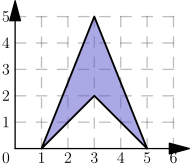
What is the area of the shaded figure shown below?
Answer: B
Small Hint:
The shaded region is a large triangle with a triangular notch removed from its base
Big Hint:
Both triangles have base along the -axis
Solution:
The outer triangle has vertices and giving base and height so its area is
Removed from it is the triangle with vertices and which has base and height so area
The shaded area is
Thus, the correct answer is B.
3.
At noon on a certain day, Minneapolis is degrees warmer than St. Louis. At the temperature in Minneapolis has fallen by degrees while the temperature in St. Louis has risen by degrees, at which time the temperatures in the two cities differ by degrees. What is the product of all possible values of
Answer: C
Small Hint:
At noon the difference is ; track how each change affects the gap
Big Hint:
The new difference is
Solution:
At noon the gap is Minneapolis then loses degrees and St. Louis gains so the gap changes by The new absolute difference is
This gives or whose product is
Thus, the correct answer is C.
4.
Let Which of the following is equal to
Answer: E
Small Hint:
Rewrite everything as a power of
Big Hint:
Solution:
Write Then
Since this matches the last option.
Thus, the correct answer is E.
5.
Call a fraction not necessarily in the simplest form, special if and are positive integers whose sum is How many distinct integers can be written as the sum of two, not necessarily different, special fractions?
Small Hint:
List the special fractions and note which are integers, half-integers, or quarter-integers
Big Hint:
Two specials sum to an integer only when their fractional parts cancel
Solution:
Listing for the integers are the fractions with fractional part are and have complementary fractional parts
The remaining fractional parts are and none of their complements occurs. Thus only the integer, half-integer, and quarter cases can give integer sums.
Integer pairs give Half-integer pairs give The quarter pair gives
The distinct integers are a total of
Thus, the correct answer is C.
6.
The greatest prime number that is a divisor of is because What is the sum of the digits of the greatest prime number that is a divisor of
Answer: C
Small Hint:
Big Hint:
Factor as
Solution:
We have Then so
The greatest prime factor is whose digit sum is
Thus, the correct answer is C.
7.
Which of the following conditions is sufficient to guarantee that integers and satisfy the equation
and
and
and
and
Answer: D
Small Hint:
Multiply by : the left side equals
Big Hint:
For integers, that sum equals only when two differences are and one is
Solution:
The expression satisfies So the equation holds exactly when this sum of squares equals
Since the three differences sum to this requires two of them to be and one to be
Option D gives and so the squares are This works for all such integers.
Thus, the correct answer is D.
8.
The product of the lengths of the two congruent sides of an obtuse isosceles triangle is equal to the product of the base and twice the triangle’s height to the base. What is the measure, in degrees, of the vertex angle of this triangle?
Answer: D
Small Hint:
Write the area two ways using the legs and the vertex angle
Big Hint:
The area is both and
Solution:
Let the congruent sides have length the base be and the height to the base be The given condition is
The area equals and also where is the vertex angle. So
Substituting gives so Since the triangle is obtuse,
Thus, the correct answer is D.
9.
Triangle is equilateral with side length Suppose that is the center of the inscribed circle of this triangle. What is the area of the circle passing through and
Answer: B
Small Hint:
In an equilateral triangle the incenter coincides with the circumcenter
Big Hint:
In triangle angle and ; apply the law of sines
Solution:
For an equilateral triangle, is also the circumcenter, so The central angle
In triangle side is opposite the angle, so the circumradius of this triangle satisfies giving
The area of the circle is
Thus, the correct answer is B.
10.
What is the sum of all possible values of between and such that the triangle in the coordinate plane whose vertices are and is isosceles?
Answer: E
Small Hint:
All three points lie on the unit circle, so equal sides mean equal chords, i.e. equal arc separations
Big Hint:
Consider the three cases where the third point matches distance to to or lies on their perpendicular bisector
Solution:
The three points lie on the unit circle at angles and A chord’s length depends only on the angular separation of its endpoints.
If the third point is equidistant from the other two, it lies on the perpendicular bisector: or
If its distance to equals the fixed chord (separation ), then (since is degenerate). If its distance to matches, then (since is degenerate).
The valid values are summing to
Thus, the correct answer is E.
11.
Una rolls standard -sided dice simultaneously and calculates the product of the numbers obtained. What is the probability that the product is divisible by
Answer: C
Small Hint:
Use complementary counting: the product has fewer than two factors of
Big Hint:
Track whether each die contributes zero, one, or two factors of
Solution:
The product fails to be divisible by when it has at most one factor of Each die is odd with probability contributes exactly one factor of (a or ) with probability and two factors (a ) with probability
All six odd: Exactly one die a or and the rest odd:
The complement is so the answer is
Thus, the correct answer is C.
12.
For a positive integer, let be the quotient obtained when the sum of all positive divisors of is divided by For example, What is
Answer: B
Small Hint:
Factor and then use of a prime power
Big Hint:
Put both over a common denominator of
Solution:
Since its divisor sum is so
Since its divisor sum is so
The difference is
Thus, the correct answer is B.
13.
Let What is the value of
Answer: E
Small Hint:
Each angle is a multiple of ; reduce the numerator angles modulo
Big Hint:
Use to relate leftover numerator factors to denominator factors
Solution:
Write each angle as Reducing modulo and
So the numerator is Cancelling the common factors leaves
Now and so the ratio equals
Thus, the correct answer is E.
14.
Suppose that and are polynomials with real coefficients, having degrees and respectively, and constant terms and respectively. Let be the number of distinct complex numbers that satisfy the equation What is the minimum possible value of
Answer: B
Small Hint:
Consider ; what is its degree and constant term?
Big Hint:
A degree- polynomial can have a single root of multiplicity
Solution:
Let Since has degree and has degree the degree of is Its constant term is
Because is otherwise unconstrained, can be made equal to any real degree- polynomial with constant term for instance
Such a polynomial has a single distinct root, so the minimum is
Thus, the correct answer is B.
15.
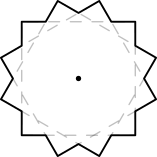
Three identical square sheets of paper each with side length are stacked on top of each other. The middle sheet is rotated clockwise about its center and the top sheet is rotated clockwise about its center, resulting in the -sided polygon shown in the figure below. The area of this polygon can be expressed in the form where and are positive integers, and is not divisible by the square of any prime. What is
Answer: E
Small Hint:
By symmetry the polygon’s vertices alternate between outer square-corners and inner edge-crossings, every
Big Hint:
The outer vertices are at distance from the center and the inner ones at distance
Solution:
Because the three squares are rotated by and the figure has -fold symmetry. Its vertices alternate every : outer vertices are the square corners at distance from the center, and inner vertices are edge crossings at distance
Connecting the center to all vertices splits the polygon into triangles, each with sides and and included angle The total area is
This simplifies to so
Thus, the correct answer is E.
16.
Suppose are positive integers such that and What is the sum of all possible distinct values of
Answer: B
Small Hint:
By symmetry assume then and
Big Hint:
Use and check the short range
Solution:
The condition is symmetric, so assume Then and for each fixed we have and The gcd sum can be evaluated as
Checking these short ranges, the possible gcd sums for are, respectively, and The value occurs only at and
The triple has sum and The triple has sum and
The sum of the distinct values is
Thus, the correct answer is B.
17.
A bug starts at a vertex of a grid made of equilateral triangles of side length At each step the bug moves in one of the possible directions along the grid lines randomly and independently with equal probability. What is the probability that after moves the bug never will have been more than unit away from the starting position?
Answer: A
Small Hint:
The bug must always be at the start or one of its neighbors
Big Hint:
From a neighbor, only of the moves stay within distance : back to start or to the two adjacent neighbors
Solution:
Staying within distance means the bug is always at the origin or one of its neighbors. From the origin, all moves are allowed. From a neighbor, only moves keep it in range: back to the origin, or to either of the two adjacent neighbors.
Let and count valid -step paths ending at the origin and at a neighbor. Then and starting from
Iterating gives then The total number of valid paths is
The probability is
Thus, the correct answer is A.
18.
Set and for let be determined by the recurrence This sequence tends to a limit; call it What is the least value of such that
Answer: A
Small Hint:
The limit is ; substitute
Big Hint:
The substitution gives so squares repeatedly
Solution:
The limit satisfies giving Let Then
Since we get so
We need i.e. The least such is since
Thus, the correct answer is A.
19.
Regular polygons with and sides are inscribed in the same circle. No two of the polygons share a vertex, and no three of their sides intersect at a common point. At how many points inside the circle do two of their sides intersect?
Answer: E
Small Hint:
Consider each pair of polygons separately
Big Hint:
Two inscribed polygons with and sides in general position cross at points
Solution:
For two convex polygons inscribed in the same circle with no shared vertices, each side of the smaller polygon crosses the larger polygon’s boundary exactly twice, so they meet at points.
Summing over all pairs: give each; give each; gives
The total is
Thus, the correct answer is E.
20.
A cube is constructed from white unit cubes and blue unit cubes. How many different ways are there to construct the cube using these smaller cubes? (Two constructions are considered the same if one can be rotated to match the other.)
Answer: A
Small Hint:
Use Burnside’s lemma over the rotations of the cube acting on the corner positions
Big Hint:
For each rotation type, count the colorings with exactly blue cubes that it fixes
Solution:
By Burnside’s lemma, the count is the average number of -blue colorings fixed by each of the rotations acting on the cubies.
The identity fixes The face quarter-turns fix each The face half-turns fix each The vertex rotations fix each The edge half-turns fix each
The total is and
Thus, the correct answer is A.
21.
For real numbers let where For how many values of with does
Answer: A
Small Hint:
Write and require both the real and imaginary parts to vanish
Big Hint:
The imaginary part factors as
Solution:
Group by Euler’s formula: The imaginary part is
This vanishes when (so ) or (so ).
Checking the real part at each of these values gives or never So no makes
Thus, the correct answer is A.
22.
Right triangle has side lengths and A circle centered at is tangent to line at and passes through A circle centered at is tangent to line at and passes through What is
Answer: C
Small Hint:
Place at the origin with legs along the axes
Big Hint:
A tangent point’s radius is perpendicular to the tangent line, so lies directly above and directly across from
Solution:
Place and so the right angle is at
Circle is tangent to line (the -axis) at so Setting gives so and
Circle is tangent to line (the -axis) at so Setting gives so and
Then
Thus, the correct answer is C.
23.
What is the average number of pairs of consecutive integers in a randomly selected subset of distinct integers chosen from the set (For example the set has pairs of consecutive integers.)
Answer: A
Small Hint:
Use linearity of expectation over the possible consecutive pairs
Big Hint:
The probability that both and are chosen is
Solution:
For each of the adjacent pairs let an indicator be if both are in the subset. The probability of this is
By linearity of expectation, the expected number of consecutive pairs is
Thus, the correct answer is A.
24.
Triangle has side lengths and The bisector of intersects in point and intersects the circumcircle of in point The circumcircle of intersects the line in points and What is
Answer: C
Small Hint:
Apply power of the point to the circle through :
Big Hint:
Because we get so
Solution:
Points are collinear on the bisector, and are collinear on line The power of with respect to the circle through gives
Since and (subtending ), triangles and are similar, so Therefore
Place From point Point lies on ray with so
Then so
Thus, the correct answer is C.
25.
For a positive integer, let be the sum of the remainders when is divided by and For example, How many two-digit positive integers satisfy
Answer: C
Small Hint:
When increases by each remainder rises by unless is divisible by where it drops to
Big Hint:
so you need the divisors of among to sum to
Solution:
Going from to each remainder increases by unless is divisible by in which case it drops from to So
Distinct integers from through can sum to only as or Divisibility closure eliminates every case except for example, a multiple of also has divisor and a multiple of also has divisors and Thus must be a multiple of with no other divisor in
Testing the multiples in the required range leaves only and Hence or giving values.
Thus, the correct answer is C.