
2021 AMC 12A Fall Problems
Scroll down and press Start to try the exam! Or, go to the printable PDF, answer key, or professional solutions curated by LIVE by Po-Shen Loh.
All problems are used with official legal permission of the Mathematical Association of America (MAA).
Or jump straight to a single problem with its solution: 1 · 2 · 3 · 4 · 5 · 6 · 7 · 8 · 9 · 10 · 11 · 12 · 13 · 14 · 15 · 16 · 17 · 18 · 19 · 20 · 21 · 22 · 23 · 24 · 25
Want to learn professionally through interactive video classes?
Timed
1:15:00
1.
What is the value of
Answer: C
Small Hint:
Big Hint:
and
Solution:
Since and the fraction is
Thus, the correct answer is C.
2.
Menkara has a index card. If she shortens the length of one side of this card by inch, the card would have area square inches. What would the area of the card be in square inches if instead she shortens the length of the other side by inch?
Small Hint:
Shortening a side by to get area means so the -inch side was the one reduced
Big Hint:
Instead reduce the -inch side by giving
Solution:
The original card is Shortening a side by inch gives area which requires so the reduced side was the -inch side.
Shortening the other side by inch instead gives square inches.
Thus, the correct answer is E.
3.
Mr. Lopez has a choice of two routes to get to work. Route A is miles long, and his average speed along this route is miles per hour. Route B is miles long, and his average speed along this route is miles per hour, except for a -mile stretch in a school zone where his average speed is miles per hour. By how many minutes is Route B quicker than Route A?
Answer: B
Small Hint:
Route A takes hour; convert to minutes
Big Hint:
Route B splits into miles at mph and mile at mph
Solution:
Route A takes hour minutes.
Route B has miles at mph and mile at mph, taking hour minutes.
The difference is minutes.
Thus, the correct answer is B.
4.
The six-digit number is prime for only one digit What is
Answer: E
Small Hint:
The number is even makes it even, and makes it a multiple of
Big Hint:
For and the digit sum is a multiple of and
Solution:
The number is Any even makes it even, and makes it divisible by so must be odd and not
For the digit sum is (divisible by ); for the digit sum is (divisible by ); and Only survives all tests, and it is prime.
Thus, the correct answer is E.
5.
Elmer the emu takes equal strides to walk between consecutive telephone poles on a rural road. Oscar the ostrich can cover the same distance in equal leaps. The telephone poles are evenly spaced, and the st pole along this road is exactly one mile ( feet) from the first pole. How much longer, in feet, is Oscar’s leap than Elmer’s stride?
Answer: B
Small Hint:
From the first pole to the st pole there are gaps, so each gap is feet
Big Hint:
Elmer’s stride is one gap divided by Oscar’s leap is one gap divided by
Solution:
There are gaps between the first and st poles, so each gap is feet.
Elmer’s stride is feet and Oscar’s leap is feet, a difference of feet.
Thus, the correct answer is B.
6.
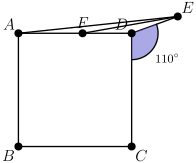
As shown in the figure below, point lies on the opposite half-plane determined by line from point so that Point lies on so that and is a square. What is the degree measure of
Answer: D
Small Hint:
Around point the triangle’s angle is minus
Big Hint:
Triangle is isosceles with so its two base angles are equal
Solution:
Because is a square, Since and lie on opposite sides of line ray is swung past so the angle of triangle at (with on ) is
Since triangle is isosceles with base angles
As are collinear,
Thus, the correct answer is D.
7.
A school has students and teachers. In the first period, each student is taking one class, and each teacher is teaching one class. The enrollments in the classes are and Let be the average value obtained if a teacher is picked at random and the number of students in their class is noted. Let be the average value obtained if a student was picked at random and the number of students in their class, including the student, is noted. What is
Answer: B
Small Hint:
is a plain average over the classes:
Big Hint:
For each class of size is counted times:
Solution:
The teacher average is
The student average weights each class size by how many students are in it:
So
Thus, the correct answer is B.
8.
Let be the least common multiple of all the integers through inclusive. Let be the least common multiple of and What is the value of
Answer: D
Small Hint:
already contains and all primes up to check what – add
Big Hint:
raises the power of and is a new prime; nothing else is new
Solution:
contains (from ), (from ), (from ), and every prime up to
Among the only new contributions are which raises the power of from to and the new prime Everything else factors into primes and powers already in
Therefore
Thus, the correct answer is D.
9.
A right rectangular prism whose surface area and volume are numerically equal has edge lengths and What is
Answer: E
Small Hint:
With edges the equation divides to
Big Hint:
Solution:
Let Surface area equals volume gives Dividing by
Since etc., the sum is Thus so meaning and
Thus, the correct answer is E.
10.
The base-nine representation of the number is What is the remainder when is divided by
Answer: D
Small Hint:
so
Big Hint:
Take the alternating sum of the base-nine digits (from the right)
Solution:
Since each power so is congruent to the alternating sum of its base-nine digits.
The nonzero digits, with their positions from the right, are (position ), (position ), (position ), (position ), and (position ). The alternating sum is
Thus, the correct answer is D.
11.
Consider two concentric circles of radius and The larger circle has a chord, half of which lies inside the smaller circle. What is the length of the chord in the larger circle?
Answer: E
Small Hint:
Let the chord be at distance from the center. Its half-length is and the part inside the small circle has half-length
Big Hint:
“Half lies inside” means the inside portion equals half the whole chord:
Solution:
Let the chord lie at distance from the common center. Its total length is and the portion inside the smaller circle has length
Since half the chord lies inside, Squaring gives so and
The chord length is
Thus, the correct answer is E.
12.
What is the number of terms with rational coefficients among the terms in the expansion of
Answer: C
Small Hint:
The term for index carries rationality needs to be a multiple of and to be a multiple of
Big Hint:
These force and even, i.e.
Solution:
The general term is whose coefficient contains and This is rational exactly when is a multiple of and is even.
Since we need and even, which combine to The valid values number
Thus, the correct answer is C.
13.
The angle bisector of the acute angle formed at the origin by the graphs of the lines and has equation What is
Answer: A
Small Hint:
A bisector direction is the sum of unit vectors along the two lines:
Big Hint:
is the ratio (second component)/(first component); rationalize the result
Solution:
The bisector points along the sum of the unit vectors of the two lines: Its slope is
Multiplying numerator and denominator by gives
Thus, the correct answer is A.
14.
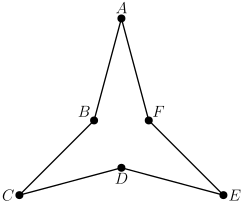
In the figure, equilateral hexagon has three nonadjacent acute interior angles that each measure The enclosed area of the hexagon is What is the perimeter of the hexagon?
Answer: E
Small Hint:
Let the side be The three tips are isosceles triangles with legs they sit on the sides of the inner triangle formed by the three reflex vertices
Big Hint:
Each tip has area and the inner equilateral triangle has side
Solution:
Let the common side length be The three acute vertices are the tips of isosceles triangles with two sides and apex each has area
The three reflex vertices form an inner equilateral triangle with side whose area is Using the total area is
Setting gives so and the perimeter is
Thus, the correct answer is E.
15.
Recall that the conjugate of the complex number where and are real numbers and is the complex number For any complex number let The polynomial has four complex roots: and Let be the polynomial whose roots are and where the coefficients and are complex numbers. What is
Answer: D
Small Hint:
The elementary symmetric functions of are the conjugates of those of all of ’s coefficients are real, so those symmetric sums are real
Big Hint:
and
Solution:
By Vieta on and both real, so their conjugates are also and
The roots of are Then is the sum of products of pairs: And
So
Thus, the correct answer is D.
16.
An organization has employees, of whom have a brand A computer while the other have a brand B computer. For security, the computers can only be connected to each other and only by cables. The cables can only connect a brand A computer to a brand B computer. Employees can communicate with each other if their computers are directly connected by a cable or by relaying messages through a series of connected computers. Initially, no computer is connected to any other. A technician arbitrarily selects one computer of each brand and installs a cable between them, provided there is not already a cable between that pair. The technician stops once every employee can communicate with each other. What is the maximum possible number of cables used?
Answer: B
Small Hint:
To delay connectivity, keep the graph disconnected as long as possible, then one final cable joins everything
Big Hint:
The most edges while still disconnected is a complete bipartite graph on brand A and brand B, leaving one brand A computer isolated
Solution:
The technician keeps adding cables until the graph becomes connected. To maximize the count, keep the network disconnected for as long as possible: leave a single brand A computer isolated and fully connect the remaining brand A computers to all brand B computers.
That uses cables while still disconnected. The next cable connects the last brand A computer, joining everyone, for a total of
Thus, the correct answer is B.
17.
For how many ordered pairs of positive integers does neither nor have two distinct real solutions?
Answer: B
Small Hint:
“No two distinct real solutions” means each discriminant is and
Big Hint:
Multiplying gives so test small positive integers
Solution:
Neither quadratic has two distinct real roots exactly when both discriminants are nonpositive: and
Combining with gives so Checking: gives gives gives and gives
That is — ordered pairs.
Thus, the correct answer is B.
18.
Each of balls is tossed independently and at random into one of bins. Let be the probability that some bin ends up with balls, another with balls, and the other three with balls each. Let be the probability that every bin ends up with balls. What is
Answer: E
Small Hint:
Both probabilities share the same denominator, so is a ratio of counts
Big Hint:
uses uses choices of the special bins times
Solution:
Both probabilities divide by so is a ratio of arrangement counts.
For all bins have For choose which bin has and which has in ways, times Therefore
Thus, the correct answer is E.
19.
Let be the least real number greater than such that where the arguments are in degrees. What is rounded up to the closest integer?
Answer: B
Small Hint:
requires or for an integer
Big Hint:
The smallest comes from (with )
Solution:
Equal sines require or for some integer
The family first exceeds at giving The family with gives so which is smaller.
Rounded up,
Thus, the correct answer is B.
20.
For each positive integer let be twice the number of positive integer divisors of and for let For how many values of is
Answer: D
Small Hint:
so is a fixed point; is another
Big Hint:
After enough steps every lands on or count those whose orbit reaches
Solution:
Both and are fixed. For the first value is at most Checking the even values through shows that an orbit reaches exactly when its first value is or Thus we need or
The numbers at most with divisors are the only one with divisors is and the only one with divisors is These values all reach the fixed point
Thus, the correct answer is D.
21.
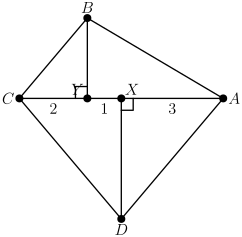
Let be an isosceles trapezoid with and Points and lie on diagonal with between and as shown in the figure. Suppose and What is the area of
Answer: C
Small Hint:
Place on a horizontal line with Then is vertically below and vertically above
Big Hint:
Use and to relate the heights of and then apply the shoelace formula
Solution:
Put The right angles give and on opposite sides of
Parallelism forces and gives so Substituting yields
The shoelace formula gives area
Thus, the correct answer is C.
22.
Azar and Carl play a game of tic-tac-toe. Azar places an in one of the boxes in a -by- array of boxes, then Carl places an in one of the remaining boxes. After that, Azar places an in one of the remaining boxes, and so on until all boxes are filled or one of the players has of their symbols in a row — horizontal, vertical, or diagonal — whichever comes first, in which case that player wins the game. Suppose the players make their moves at random, rather than trying to follow a rational strategy, and that Carl wins the game when he places his third How many ways can the board look after the game is over?
Answer: D
Small Hint:
The final board has three s forming a line and three s that must not themselves form a line
Big Hint:
Split into cases by whether ’s line is a row/column or a diagonal, since that changes how many placements accidentally make a row
Solution:
Carl wins on his third so the board has three s forming one of the lines and three s in the other six cells. The s must not form a line (else Azar would have won first).
If the line is a row or column ( choices), the remaining six cells contain two full lines, so valid placements number If the line is a diagonal ( choices), the remaining six cells contain no full line, giving
The total is
Thus, the correct answer is D.
23.
A quadratic polynomial with real coefficients and leading coefficient is called disrespectful if the equation is satisfied by exactly three real numbers. Among all the disrespectful quadratic polynomials, there is a unique such polynomial for which the sum of the roots is maximized. What is
Answer: A
Small Hint:
If has roots then means or exactly three roots requires one of these to have a double root
Big Hint:
With and letting maximize
Solution:
Let have roots and Then splits into and with discriminants and Exactly three real roots means one discriminant is and the other positive.
Take and set Then and the other discriminant is so Also maximized at giving and
So and
Thus, the correct answer is A.
24.
Convex quadrilateral has and In some order, the lengths of the four sides form an arithmetic progression, and side is a side of maximum length. The length of another side is What is the sum of all possible values of
Answer: E
Small Hint:
With the maximum, the four sides are place and at angle
Big Hint:
For each assignment of the three smaller lengths to impose that is horizontal and solve for also include common difference
Solution:
Since is the largest, the four sides are Placing and with let and Then so
Write for Substituting the permutations of for gives the nonzero candidates respectively. Positivity of requires leaving only and The case also gives a valid rhombus.
Thus the side sets are and
The possible values of a non- side length are whose sum is
Thus, the correct answer is E.
25.
Let be an odd integer, and let denote the number of quadruples of distinct integers with for all such that divides There is a polynomial such that for all odd integers What is
Answer: E
Small Hint:
First count all ordered residue quadruples summing to then use inclusion-exclusion on equal coordinates
Big Hint:
Group collision patterns as one pair, two pairs, a triple, or all four equal; odd makes multiplication by and invertible
Solution:
Regard as all residues modulo Without the distinctness condition, the first three entries are arbitrary and the fourth is determined, giving ordered quadruples.
Inclusion-exclusion over equal-coordinate partitions gives the remaining terms. There are choices of one equal pair, each leaving solutions, for The two-pair partitions contribute The triple-and-single partitions have inclusion-exclusion coefficient and contribute Finally, the all-equal partition has coefficient and one solution. (Here odd makes and invertible modulo ) Therefore Hence
Thus, the correct answer is E.